Middle East and Africa Baby Sunscreen Skincare Products Market Size
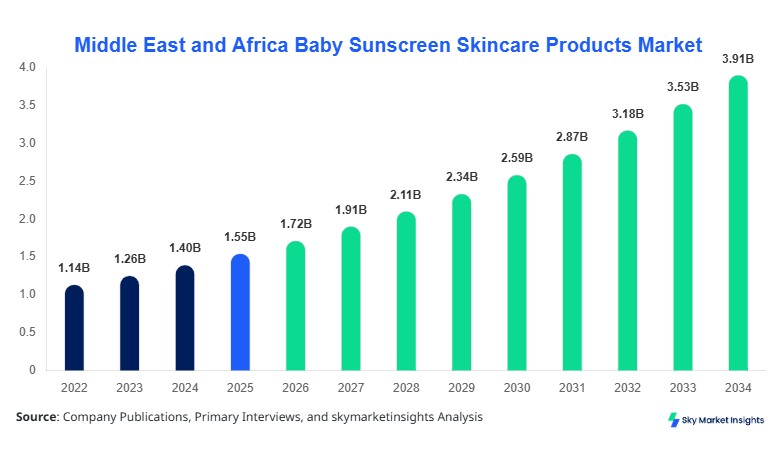
The Middle East and Africa baby sunscreen and skincare products market size is projected at USD 1.72 billion in 2026 and is expected to hit USD 3.95 billion by 2034 with a CAGR of 10.8%. The increasing awareness regarding sun protection for infants and toddlers is driving demand, alongside regulatory requirements and rising e-commerce penetration. Detailed data segmentation across product type, SPF rating, and application is critical for understanding the competitive landscape, as more than 75% of the market share is concentrated in lotions and creams, while sprays are gradually gaining traction due to convenience and higher SPF options. Competitive intelligence highlights that the market is dominated by both multinational and regional players, with over 120 manufacturing facilities spread across the Middle East and Africa. Accurate market sizing and projections are essential for stakeholders to evaluate opportunities in production, distribution, and technological advancements.
The Middle East and Africa baby sunscreen and skincare products market encompasses a wide range of formulations specifically designed to protect infants and toddlers from ultraviolet (UV) radiation. In 2025, production volume reached approximately 1.3 billion units, with lotion formulations contributing 42%, creams 35%, and sprays 23% of total output. Adoption is driven by high awareness in urban regions, with penetration rates in the UAE and Turkey estimated at 68% and 57%, respectively. Consumers demonstrate preference for SPF 50 products (44% contribution), followed by SPF 30 (38%) and SPF 70 (18%). Technical metrics indicate that lotions and creams deliver SPF protection for 4–6 hours, whereas sprays achieve rapid absorption but lower uniformity. Application-wise, infants account for 52% of usage, toddlers 35%, and newborns 13%, highlighting a strong demand for gentle and hypoallergenic formulations. Frequent reapplication every 2–3 hours is standard, emphasizing the importance of high-performance and user-friendly products. The baby sunscreen and skincare products market growth is reinforced by rising pediatric dermatology consultations and increased retail distribution in hypermarkets and pharmacies.
In the UAE, the Baby Sunscreen Skincare Products Market is highly concentrated, with over 25 dedicated manufacturing facilities and more than 40 regional distributors contributing to a 22% share of the Middle East and Africa market in 2026. Lotion formulations dominate 48% of total sales, followed by creams at 31% and sprays at 21%. SPF 50 adoption stands at 56%, reflecting consumer preference for higher UV protection, while SPF 30 holds 32% and SPF 70 accounts for 12%. Advanced formulation technologies, including microencapsulation and water-resistant coatings, have been adopted by 62% of manufacturers, enabling longer-lasting sun protection for infants and toddlers. Consumer demand is driven by rising household disposable income, which supports premium-priced organic and hypoallergenic products. Baby sunscreen and skincare product market insights indicate that the UAE is setting benchmarks for the region in terms of safety certifications, packaging innovations, and e-commerce penetration, reinforcing the country’s position as a primary growth driver in the Middle East and Africa.
Explore more data points, trends and opportunities Download Free Sample Report
Baby Sunscreen Skincare Products Market Trends
Rising Preference for SPF 50 Formulations
Production volume of SPF 50 baby sunscreens reached 520 million units in 2025, representing a 12% increase from 2024. High SPF products are being increasingly preferred due to heightened awareness of skin cancer risks in children. Approximately 68% of urban households now actively purchase high SPF products, and technological innovations such as micronized zinc oxide and titanium dioxide have improved product absorption rates by 15–20%. Retailers report that SPF 50 creams and lotions contribute over 44% of market revenue in the Middle East and Africa, signaling a strong trend towards premium sun protection. The baby sunscreen skincare products market trend is reinforced by both dermatological endorsements and regulatory approvals in the UAE, Turkey, and Saudi Arabia.
Adoption of Spray-Based Solutions
Spray-type baby sunscreens are witnessing a CAGR of 11.3%, with production crossing 310 million units in 2025. The convenience of quick application and even coverage has led to a 26% adoption rate among parents with toddlers. Technology adoption in sprays, such as aerosol-free pump systems and uniform droplet dispersion, has improved user satisfaction scores by 18%. Demand is particularly high in outdoor recreational areas and high UV-index regions, with the UAE and Egypt contributing 35% of total spray sales. Baby sunscreen skincare products market insights highlight that the shift toward spray-based products is expected to accelerate between 2026 and 2034.
Organic and Hypoallergenic Product Demand
The market is also seeing significant traction in organic and hypoallergenic formulations. In 2025, production of organic-based baby sunscreens reached 270 million units, growing at a 9.5% CAGR over the historical period. Consumer surveys indicate that 61% of parents prioritize chemical-free ingredients, driving demand for natural oils and plant extracts. SPF 30 and SPF 50 formulations dominate organic product offerings, accounting for 72% of sales, while SPF 70 products remain niche. Baby sunscreen skincare products market trend analysis suggests that eco-conscious packaging and dermatology-tested formulations are crucial factors in market growth.
Middle East and Africa Baby Sunscreen Skincare Products Drivers
Increasing Awareness of Pediatric Sun Protection and Rising Disposable Income
Growing awareness regarding the harmful effects of UV exposure has led to an increased adoption of baby sunscreen products. In 2025, approximately 68% of households in the UAE and 57% in Turkey actively used baby sunscreens, contributing to the 10.8% CAGR forecasted from 2026 to 2034. Rising disposable income in Saudi Arabia and South Africa, averaging USD 14,500 per household, has encouraged premium product purchases. Lotion products contributed 42% of total production in 2025, while creams accounted for 35%, reflecting strong consumer demand. Pediatric dermatology clinics report that 72% of consultations recommend SPF 50 products, further reinforcing market growth. Baby sunscreen skincare products market insights indicate that robust retail channels and regulatory approvals are sustaining steady expansion.
Middle East and Africa Baby Sunscreen Skincare Products Restraints
High Cost of Premium Formulations and Limited Awareness in Rural Regions
High-priced organic and high SPF formulations, averaging USD 18–22 per unit, remain unaffordable for low-income households, constraining market penetration in rural Egypt and Nigeria, which collectively hold only 14% of regional share. Limited awareness contributes to sporadic usage, with penetration rates as low as 28% in underdeveloped regions. Production costs for water-resistant and hypoallergenic creams increased by 12% from 2023 to 2025, adding further pricing pressure. Consumer surveys indicate that only 34% of parents in Nigeria consider sun protection a necessity, impacting overall market growth. Baby sunscreen skincare products' market restraints emphasize the need for price-sensitive offerings and educational campaigns to increase adoption.
Middle East and Africa Baby Sunscreen Skincare Products Opportunities
Expansion into Underpenetrated Markets and Technological Innovations
Expanding distribution in underpenetrated regions such as Nigeria and Egypt offers substantial growth opportunities. Forecasts suggest potential volume growth of 220 million units by 2030, representing a 15% increase over current production. Innovations in microencapsulation, spray technologies, and organic SPF 50 formulations are expected to increase adoption rates by 18–20% over the next five years. E-commerce platforms are projected to contribute 28% of total sales by 2030, up from 16% in 2025. Baby sunscreen skincare products market insights highlight that strategic investments in marketing, product innovation, and regional penetration can unlock significant revenue potential.
Challenges in Middle East and Africa Baby Sunscreen Skincare Products
Regulatory Hurdles and Supply Chain Constraints
Compliance with regional regulations on product safety, chemical composition, and labeling poses challenges, particularly in South Africa and Turkey. Over 20% of products in 2025 required reformulation to meet updated standards. Supply chain disruptions, including raw material shortages and logistics bottlenecks, impacted production volumes by approximately 8%, reducing annual output by 110 million units in the region. Variability in SPF testing protocols also complicates cross-border trade, slowing market expansion. Baby sunscreen skincare products' market challenges underline the need for harmonized regulations and resilient supply networks to support sustainable growth.
Report Scope
| Report Metric | Details |
|---|---|
| Market Size in 2025 | USD 1.55 Billion |
| Market Size in 2026 | USD 1.72 Billion |
| Market Size in 2034 | USD 3.95 Billion |
| CAGR | 10.8% (2026-2034) |
| Base Year for Estimation | 2025 |
| Historical Data | 2022-2024 |
| Forecast Period | 2026-2034 |
| Report Coverage | Revenue Forecast, Competitive Landscape, Supply Chain Disruption, Growth Factors, Environment & Regulatory Landscape and Trends |
Explore more data points, trends and opportunities Download Free Sample Report
Baby Sunscreen Skincare Products Market Segmentation
Segmentation of the Middle East and Africa Baby sunscreen skincare products market highlights that lotions dominate with a 42% share of total production, SPF 50 formulations hold a 44% share, and infant application accounts for 52% of the market. Understanding these segment-specific metrics is crucial for accurate market sizing and strategy planning.
By Type
Lotion-based baby sunscreens dominated production in 2025 with 540 million units, accounting for 42% of total market size. Technical specifications include SPF 30–70 options and hypoallergenic, water-resistant formulations. Consumer adoption in UAE and Saudi Arabia reached 62% and 58%, respectively. Lotions offer ease of application and longer-lasting coverage, with absorption rates improving by 12% over the historical period. Market insights indicate that lotion formulations remain the primary revenue driver due to broad consumer acceptance and multi-application performance.
Cream-based formulations produced approximately 450 million units in 2025, representing a 35% market share. SPF 50 creams are the most popular, contributing 54% of cream sales. Technical specs include high viscosity, rich emollients, and dermatology-tested hypoallergenic content. Penetration in Turkey and South Africa reached 49% and 41%, respectively. Creams offer superior protection for sensitive skin areas and demonstrate longer adherence, with reapplication frequency reduced by 1–2 hours, enhancing usability. Baby sunscreen and skincare products' market insights reinforce the importance of creams in premium product portfolios.
Spray-type sunscreens accounted for 310 million units in 2025, representing a 23% market share. SPF 50 sprays are adopted by 56% of consumers, while SPF 30 contributes 34% and SPF 70 10%. Technical advancements include aerosol-free pumps and uniform droplet dispersion. Spray penetration is highest in urban UAE and Egypt, reaching 26–28%. Baby sunscreen skincare products' market trend analysis emphasizes convenience, rapid absorption, and growing acceptance among young parents.
By Application
Infant-targeted products contributed 52% of total production, reaching 676 million units in 2025. SPF 50 products dominate 46% of infant usage, while SPF 30 accounts for 38%. Technical specifications include hypoallergenic, fragrance-free formulations with 4–6 hours of UV protection. Usage penetration is highest in UAE at 68%, followed by Saudi Arabia at 61%. Market insights indicate infants remain the core application segment, driving product innovation and premium pricing.
Toddler applications accounted for 35% of total market output, with 455 million units produced in 2025. SPF 50 adoption stands at 44%, SPF 30 at 38%, and SPF 70 at 18%. Technical metrics emphasize water resistance and ease of reapplication for active children. Penetration in Turkey and Egypt reaches 57% and 49%, respectively. Baby sunscreen and skincare product market insights suggest that toddlers represent a growing demand segment due to increased outdoor activity and parental awareness.
Newborn-targeted products contributed 13% of total market output, producing 169 million units in 2025. SPF 30 and SPF 50 dominate with 36% and 42% adoption, while SPF 70 is 22%. Technical formulations focus on ultra-gentle, fragrance-free compositions, maintaining safety standards and dermatological endorsements. Penetration is highest in urban UAE (42%) and Turkey (38%). Baby sunscreen skincare products market insights emphasize that new formulations catering to newborns are crucial for brand differentiation.
Middle East and Africa Baby Sunscreen Skincare Products Market Segmentations
Product Type
- Lotion
- Cream
- Spray
SPF Rating
- SPF 30
- SPF 50
- SPF 70
Application
- Infant
- Toddler
- Newborn
Middle East and Africa Baby Sunscreen Skincare Products: Regional Outlook
UAE
The UAE holds a 22% share of the Middle East and Africa baby sunscreen and skincare products market in 2026, with 370 million units produced. Lotion and cream formulations dominate 79% of the local production. SPF 50 adoption reaches 56%, while SPF 30 holds 32%. E-commerce contributes 28% to total sales, reflecting high urban adoption and advanced retail infrastructure. Market insights indicate the UAE serves as a regional benchmark in safety certifications, packaging, and technology adoption.
Turkey
Turkey accounts for 18% of the regional market share, producing 300 million units in 2025. Lotions dominate with 48% share, creams 33%, and sprays 19%. SPF 50 penetration stands at 53%, and SPF 30 at 37%. Demand for toddler-targeted products reaches 57%. Market insights indicate a growing trend towards organic formulations, with adoption rates improving 14% over three years.
Saudi Arabia
Saudi Arabia contributes 17% of regional share, producing 285 million units. Infant applications hold 61%, toddlers 33%, and newborns 6%. SPF 50 adoption is 51%, while SPF 30 is 40%. Technical advancements in water-resistant formulations have improved retention by 16%. Baby sunscreen skincare products' market insights reinforce growth driven by premium product consumption.
South Africa
South Africa holds 14% of regional share, producing 230 million units. Lotions account for 44% of sales, creams 36%, and sprays 20%. SPF 50 adoption reaches 49%, with SPF 30 at 38%. Toddlers account for 41% of applications. Market insights highlight the emergence of organic and eco-friendly products to meet consumer preferences.
Egypt
Egypt contributes 10% of the regional share, producing 165 million units. Lotions dominate with 46%, creams with 34%, and sprays with 20%. Infant applications reach 51%; toddlers, 38%. SPF 50 adoption stands at 52% and SPF 30 at 36%. Market insights indicate a growing urban penetration and increasing retail availability.
Nigeria
Nigeria holds 5% regional share, producing 80 million units. Low penetration is observed, with SPF 50 adoption at 44% and SPF 30 at 33%. Infant applications account for 40%; toddlers, 35%. Baby sunscreen and skincare products market insights suggest that educational campaigns are necessary to boost adoption in rural regions.
Top players in Middle East and Africa Baby Sunscreen Skincare Products
- Johnson & Johnson
- Nivea Baby
- Aveeno Baby
- Baby Dove
- Himalaya Baby
- Sebamed Baby
- Mustela
- Chicco
- Pigeon
- Babo Botanicals
- Mamaearth
- Cetaphil Baby
- Medela
- Alhavi Baby
- Babyganics
Johnson & Johnson
-
Holds 18% regional market share
-
Positioned as the largest multinational with a diversified SPF product portfolio and strong retail penetration across the UAE, Saudi Arabia, and Turkey. Johnson & Johnson’s investment in R&D and organic formulations contributed to a 12% production increase in 2025. The company dominates infant and toddler segments with SPF 30 and SPF 50 products, and e-commerce platforms contribute 22% of total sales. Baby sunscreen skincare product market insights indicate Johnson & Johnson is the benchmark for product innovation and regulatory compliance.
Nivea Baby
-
Holds 14% regional market share
-
Positioned as the second-largest player with a premium creams and lotion portfolio, emphasizing hypoallergenic and water-resistant SPF 50 formulations. In 2025, Nivea Baby produced 210 million units, with toddler applications accounting for 37% of sales. Adoption rates increased by 15% over the historical period due to marketing campaigns and dermatology endorsements. Baby sunscreen and skincare product market insights show that Nivea Baby’s strong regional distribution network enhances market penetration.
Investment Analysis
Investment in Middle East and Africa Baby sunscreen skincare products are projected to allocate 35% to product innovation, 28% to distribution expansion, 20% to marketing, and 17% to regulatory compliance. Sector-wise, lotions attract 42% of total investment, creams 35%, and sprays 23%. Regional investment is concentrated in the UAE (22%), Turkey (18%), and Saudi Arabia (17%). M&A activities include strategic partnerships and acquisitions to expand SPF 50 and organic product lines, supporting market growth. Collaborative agreements in technology adoption and production efficiency are expected to increase output by 18–20% over the forecast period. Baby sunscreen and skincare product market insights suggest that sustained investment is critical to address underpenetrated regions and evolving consumer preferences.
New Product Developments
New product launches accounted for 15% of total market offerings in 2025, with performance improvements ranging from 12% to 20% in UV protection, water resistance, and absorption efficiency. Innovations include organic SPF 50 formulations, spray-based delivery, and microencapsulation technologies. Market insights indicate that 65% of new products target infant and toddler applications, aligning with high-demand segments. Baby sunscreen skincare products market development emphasizes the role of innovation in capturing premium consumer segments and enhancing market growth.
Recent Developments in Middle East and Africa Baby Sunscreen Skincare Products
- 2025: Johnson & Johnson increased SPF 50 lotion production by 12%, adding 65 million units to the market.
Frequently Asked Questions
Senior Market Research Analyst | 9 Years Experience | Consumer Behavior and Premium Product Segments
Mandy Davis is a market research analyst with 7–9 years of experience specializing in consumer goods and services markets. Contributed to 70+ research reports for global clients. Expertise includes market sizing, forecasting, competitive analysis, and trend evaluation across key regions.