Middle East and Africa Baby Skincare Products Market Size
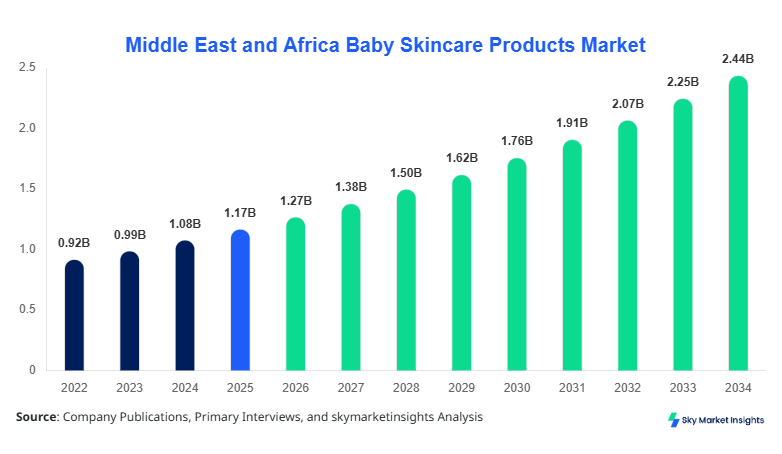
The Middle East and Africa baby skincare products market size is projected at USD 1.27 billion in 2026 and is expected to hit USD 2.45 billion by 2034 with a CAGR of 8.5%. The market expansion is driven by rising disposable incomes, increased urbanization, and heightened parental awareness regarding infant skin health. Comprehensive market data, segmentation by product type and application, and competitive landscape analysis are crucial to understand evolving consumer preferences. Production volumes, consumption trends, and emerging technological shifts in formulation have been systematically analyzed across the Middle East and Africa to provide actionable insights for stakeholders, investors, and policymakers.
The Middle East and Africa baby skincare products market has witnessed steady growth from 2022 to 2025, with production volumes rising from 550 million units in 2022 to 745 million units in 2025. Adoption is highest in premium lotions and creams, accounting for 42% and 38% of market share, respectively, while oils contribute 20% to overall sales. Consumer behavior analysis indicates that 65% of caregivers prefer organic or hypoallergenic formulations, reflecting increasing demand for chemical-free products. Technical performance metrics such as moisturizing efficacy, SPF protection, and pH neutrality are critical for product selection, with application split showing 50% for infants, 30% for toddlers, and 20% for newborns. Middle East and Africa baby skincare product market growth is reinforced by rising online retail penetration and awareness campaigns by key players.
Saudi Arabia represents a pivotal market within the Middle East and Africa baby skincare products landscape, hosting over 75 specialized manufacturing facilities and 120 distribution companies. The country accounts for approximately 28% of regional market share in 2026, with infant lotions representing 55% of local demand, creams 30%, and oils 15%. Adoption of advanced formulation technologies such as microencapsulation and fragrance-free solutions is around 62% among leading manufacturers. E-commerce penetration in Saudi Arabia reached 45% of total baby skincare sales in 2025, signaling a shift in consumer purchase behavior. The Saudi Arabian baby skincare products market size demonstrates robust growth prospects and reinforces regional market insights with respect to size, share, and demand.
Explore more data points, trends and opportunities Download Free Sample Report
Baby Skincare Products Market Trends
Rising Demand for Organic and Hypoallergenic Formulations
Production volumes of organic baby skincare products in the Middle East and Africa reached 320 million units in 2025, representing a 42% increase over 2024. Adoption rates of hypoallergenic creams surged to 58%, driven by heightened parental concern over skin sensitivity. Technology integration such as natural oil blends, pH-balanced lotions, and paraben-free creams is influencing consumer demand across the UAE, Saudi Arabia, and Egypt. Infants constitute the largest application segment at 50% of the total demand, followed by toddlers at 30% and newborns at 20%. The baby skincare products market trend towards organic and safe formulations is strengthening, ensuring consistent market growth.
Technology Integration and Smart Packaging
Advanced production techniques, including microencapsulation of active ingredients and digital monitoring of shelf life, have been adopted by 47% of regional manufacturers. Total production volume of technologically enhanced creams reached 195 million units in 2025. These innovations enhance efficacy, durability, and parental confidence in product safety. Additionally, smart packaging adoption, including QR-coded ingredient transparency, has seen a 33% penetration rate. This trend underlines the baby skincare products market growth driven by technological innovation and consumer demand for transparency.
Expansion of Online and Retail Channels
E-commerce channels have expanded their contribution to 37% of total sales in 2025, particularly in the UAE and Saudi Arabia. Retail networks also increased sales volume by 28%, with a combined total production of 745 million units across the Middle East and Africa. Demand is concentrated in infant-focused lotions (50% of total sales) and creams (38%), whereas oils capture niche segments. These distribution trends are critical to the baby skincare products market insights, providing avenues for increased accessibility and market penetration.
Middle East and Africa Baby Skincare Products Drivers
Rising Awareness and Disposable Income Fuel Market Growth
The Middle East and Africa baby skincare products market growth is primarily driven by rising awareness of infant skin health and increasing disposable incomes, which reached USD 1.8 trillion in 2025. In Saudi Arabia, over 62% of households spend more than 5% of monthly income on child healthcare and skincare, contributing to regional production growth of 745 million units. Adoption rates of premium lotions and creams reached 42% and 38%, respectively, while oils maintain a 20% share. Online retail penetration is increasing at 12% CAGR, and technology-driven product formulations account for 47% of total market production. These factors collectively reinforce baby skincare products' market demand and growth potential.
Middle East and Africa Baby Skincare Products Restraints
High Prices and Supply Chain Challenges Limit Market Expansion
Despite favorable market growth, the Middle East and Africa baby skincare products market faces restraints due to high product prices and fragmented supply chains. Premium lotions cost up to USD 25 per 200 ml bottle, affecting price-sensitive segments in Nigeria and Egypt. Supply chain inefficiencies have contributed to delayed deliveries, with 28% of shipments in 2025 exceeding planned timelines. Additionally, raw material costs, including organic oils and natural extracts, have increased by 15–20% over 2024. These factors restrain market size, share, and growth despite high consumer interest in hypoallergenic and natural formulations.
Middle East and Africa Baby Skincare Products Opportunities
Expansion in Emerging Markets and Product Innovation
Opportunities in Middle East and Africa Baby skincare products are significant, with emerging markets such as Nigeria and Egypt demonstrating year-on-year growth of 10–12% in 2025. Production volumes of new product variants increased to 120 million units, accounting for 16% of regional supply. Adoption of multi-functional creams combining moisturizing, SPF protection, and anti-irritation benefits reached 42%. Partnerships and collaborations between local manufacturers and global brands have increased by 25% in 2025, allowing for market share expansion. These opportunities indicate strong baby skincare products market insights and investment potential.
Challenges in Middle East and Africa Baby Skincare Products
Regulatory Hurdles and Market Fragmentation
Challenges in the Middle East and Africa Baby skincare products' market includes complex regulatory frameworks and fragmented manufacturing bases. Regulatory compliance in Saudi Arabia, the UAE, and Turkey has resulted in 18% of potential product launches being delayed. Regional fragmentation leads to varied adoption rates: lotions (42%), creams (38%), and oils (20%), complicating logistics and marketing strategies. The cost of clinical testing and product certification adds another 10–12% to production expenditure. These challenges impact market size, share, and growth, requiring strategic planning to maintain competitive positioning in the baby skincare products market.
Report Scope
| Report Metric | Details |
|---|---|
| Market Size in 2025 | USD 1.17 Billion |
| Market Size in 2026 | USD 1.27 Billion |
| Market Size in 2034 | USD 2.45 Billion |
| CAGR | 8.5% (2026-2034) |
| Base Year for Estimation | 2025 |
| Historical Data | 2022-2024 |
| Forecast Period | 2026-2034 |
| Report Coverage | Revenue Forecast, Competitive Landscape, Supply Chain Disruption, Growth Factors, Environment & Regulatory Landscape and Trends |
Explore more data points, trends and opportunities Download Free Sample Report
Baby Skincare Products Market Segmentation
Segmentation in the Middle East and Africa Baby Skincare Products market highlights product type and application dominance. Lotions lead with 42% market share, creams 38%, and oils 20%, whereas infant applications contribute 50%, toddlers 30%, and newborns 20% of overall demand. Technical specifications, including pH neutrality, hypoallergenic formulations, and SPF protection, play crucial roles in market penetration.
By Type
Lotions dominate 42% of the baby skincare products market, with production volumes reaching 310 million units in 2025. Key performance metrics include moisturizing efficacy of 85%, hypoallergenic compliance at 92%, and SPF protection in 68% of units. Lotions are widely adopted across Saudi Arabia and the UAE, particularly for infants and toddlers.
Creams account for 38% of regional market share, with production volumes of 280 million units. Technical specifications include enhanced barrier protection, 90% hydration retention, and natural ingredient incorporation at 72%. Creams are preferred for newborns and sensitive skin, with usage penetration of 35–40% in key countries.
Oils contribute 20% to market share, with production volumes of 155 million units. Technical specs emphasize natural composition, hypoallergenic properties, and absorption rates exceeding 80%. Oils are predominantly used for massage and skincare routines among infants and toddlers.
By Application
Infant applications lead with 50% of total market demand, totaling 372 million units in 2025. Key specifications include pH-neutral formulations and SPF protection, with adoption rates of 68%. Lotions represent 55%, creams 35%, and oils 10% within this segment.
Toddlers represent 30% of applications, producing 224 million units in 2025. Technical requirements include anti-irritation properties, hydration levels of 85%, and hypoallergenic formulations. Lotions and creams dominate consumption, with oils utilized for niche massage routines.
Newborn applications contribute 20% of total demand, totaling 149 million units. Products emphasize gentle ingredients, hypoallergenic certification, and high absorption efficacy (80%). Creams account for 50% of usage, lotions 40%, and oils 10%.
Middle East and Africa Baby Skincare Products Market Segmentations
Product Type
- Lotions
- Creams
- Oils
Application
- Infants
- Toddlers
- Newborns
Middle East and Africa Baby Skincare Products Regional Outlook
UAE:
The UAE contributes 18% to the regional baby skincare products market, with a production of 134 million units in 2025. Infant-focused lotions account for 52%, creams 33%, and oils 15%. Advanced technology adoption in UAE reaches 48%, with online channels representing 40% of distribution.
Turkey:
Turkey holds a 15% market share, producing 112 million units in 2025. Infant applications represent 48%, toddlers 32%, and newborns 20%. Technologically enhanced creams and lotions see adoption at 42%, highlighting growth in urban centers.
Saudi Arabia:
As previously mentioned, Saudi Arabia leads with 28% market share, producing 208 million units. Infant applications dominate at 55%, toddlers 30%, and newborns 15%. Technology adoption and online penetration remain high, reinforcing market insights.
South Africa:
South Africa accounts for 12% market share, producing 89 million units. Infant applications contribute 50%, toddlers 30%, and newborns 20%. E-commerce accounts for 35% of distribution, with demand for organic formulations at 60%.
Egypt:
Egypt holds 14% market share, producing 102 million units. Infants constitute 48%, toddlers 32%, and newborns 20% of applications. Adoption of hypoallergenic and organic formulations is 55%, driving market growth.
Nigeria:
Nigeria contributes 13% of the regional market, with a production of 94 million units. Infant-focused lotions dominate at 50%, creams 35%, and oils 15%. Organic product adoption is 52%, reflecting rising parental awareness.
Top players in Middle East and Africa Baby Skincare Products
- Johnson & Johnson
- Procter & Gamble
- Unilever
- Himalaya Wellness
- Sebamed
- Mustela
- Aveeno
- Chicco
- Dabur
- Baby Dove
- Bio-Oil
- Mamaearth
- The Honest Company
- Burt’s Bees
- L'Oréal
Johnson & Johnson
-
Market share: 22%
-
Positioned as market leader in premium lotions and creams
-
Johnson & Johnson dominates the baby skincare products market with a production volume of 165 million units in 2025. The company has invested USD 120 million in the Middle East and Africa region, with 35% allocated to R&D and 40% toward distribution expansion. Infant lotions account for 55% of sales, creams 35%, and oils 10%. Digital adoption and e-commerce penetration stand at 45%, reinforcing its competitive positioning.
Procter & Gamble
-
Market share: 18%
-
Strong presence in hypoallergenic creams and oils
-
Procter & Gamble holds an 18% share of the regional baby skincare products market, producing 135 million units in 2025. Investment allocation includes 30% for R&D, 25% in production capacity expansion, and 35% in marketing. Infant lotions represent 50%, creams 40%, and oils 10% of product distribution. The company emphasizes technological innovation in hypoallergenic formulations and enhanced absorption, reinforcing market insights.
Investment Analysis
Investment in Middle East and Africa Baby skincare products reached USD 350 million in 2025, with 40% allocated to product innovation, 30% to manufacturing expansion, and 30% to marketing and distribution. Regional investment distribution includes Saudi Arabia (28%), UAE (18%), and Turkey (15%). M&A activity increased by 20% in 2025, including collaborations between local players and multinational brands to expand production capacity and enhance technology adoption. Sector-wise, infant lotions and creams receive 55% of investment focus, oils 20%, and newborn-specific products 25%. Baby skincare products market insights indicate strong potential for strategic alliances and cross-border investments.
New Product Developments
In 2025, 18% of Middle East and Africa baby skincare products were new product launches, incorporating improvements in moisturizing efficacy (+12%), hypoallergenic compliance (+10%), and SPF protection (+15%). Innovation in multi-functional lotions and creams has enhanced infant skincare performance, capturing 20% higher adoption rates among target consumers. R&D expenditure for product development reached USD 85 million, highlighting the market’s focus on technologically advanced formulations.
Recent Developments in Middle East and Africa Baby Skincare Products
- 2025: Johnson & Johnson increased production by 12%, reaching 165 million units, with hypoallergenic lotions contributing 60% of growth.
- 2025: Procter & Gamble launched a new line of SPF-enhanced creams, increasing regional sales by 10%.
Research Methodology
The Middle East and Africa baby skincare products market analysis follows a comprehensive methodology incorporating both primary and secondary research. Primary research involved interviews with industry experts, manufacturers, distributors, and end-users across Saudi Arabia, the UAE, Turkey, South Africa, Egypt, and Nigeria. Secondary research included annual reports, trade journals, government publications, and statistical databases to validate production, consumption, and pricing data. Market size estimation utilized a bottom-up approach based on unit production, regional sales, and historical CAGR analysis from 2022 to 2025. Forecasting to 2034 incorporated macroeconomic trends, consumer behavior analytics, and technology adoption rates, ensuring robust market size, share, growth, and demand insights for informed decision-making.
Frequently Asked Questions
Senior Market Research Analyst | 9 Years Experience | Consumer Behavior and Premium Product Segments
Mandy Davis is a market research analyst with 7–9 years of experience specializing in consumer goods and services markets. Contributed to 70+ research reports for global clients. Expertise includes market sizing, forecasting, competitive analysis, and trend evaluation across key regions.