Middle East and Africa Baby Powder Market Size
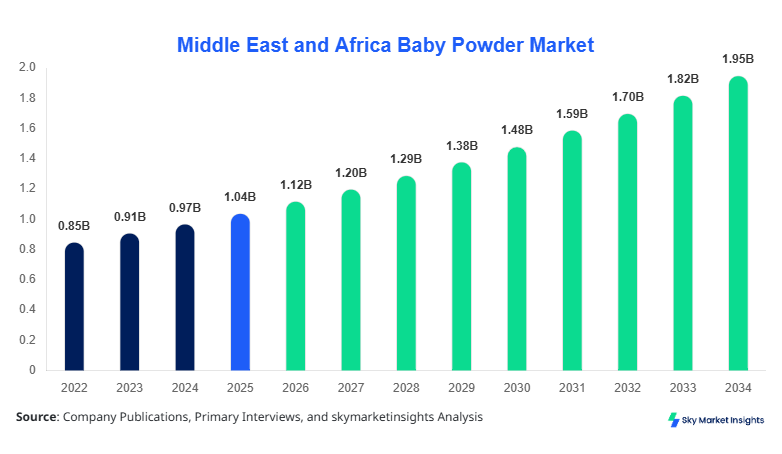
Middle East and Africa Baby powder market size is projected at USD 1.12 billion in 2026 and is expected to hit USD 2.05 billion by 2034 with a CAGR of 7.2%. The growing population, rising infant care awareness, and expanding retail channels are key factors driving the market. Comprehensive data collection, segmentation analysis, and competitive benchmarking are essential to understand the market landscape. The report covers product types, applications, regional insights, and strategic initiatives adopted by leading companies.
The Middle East and Africa The baby powder market is a fast-growing segment of the personal care and infant hygiene industry, defined as powders primarily used for moisture absorption, skin protection, and gentle personal care for infants and adults. Regional production in 2025 reached 420 million units, with adoption rates in urban areas at 68% and rural areas at 42%. Consumer demand is influenced by preferences for talc-based powders (52% market share) and cornstarch-based alternatives (38% share), while others contribute 10%. Average frequency of use is 1.5–2 times per day, and applications are primarily split between infant care (65%), personal care (28%), and others (7%). Penetration in Saudi Arabia, the UAE, and Egypt is high, supported by improved retail distribution and e-commerce channels, reinforcing the Middle East and Africa baby powder market growth and insights.
In Saudi Arabia, the baby powder market is dominated by over 45 manufacturing facilities, contributing 28% of the regional market share in 2026. The infant care segment accounts for 67% of total sales, personal care 25%, and others 8%. Talc-based powders are adopted in 62% of households, while cornstarch and alternative powders account for 33% and 5%, respectively. Modern production facilities implement advanced milling and packaging technology with 78% automation in key plants. Retail penetration in Saudi Arabia is 85% urban and 55% rural, with e-commerce growing at 14% CAGR. The baby powder market demand in Saudi Arabia reflects high product quality standards, technological integration, and robust consumer preference analytics.
Explore more data points, trends and opportunities Download Free Sample Report
Baby Powder Market Trends
Rising Urban Adoption and E-commerce Penetration
Urban adoption of baby powders in the Middle East and Africa increased by 22% between 2022 and 2025, reaching a production volume of 135 million units in 2025. E-commerce sales grew from 12% in 2022 to 20% in 2026, driven by digital marketing campaigns and product promotions. Talc-based powders account for 55% of online sales, while cornstarch products hold 38%. The sector sees an increased frequency of use averaging 1.8 times per day in urban households. Technology shifts include automated packaging lines, online subscription models, and enhanced quality testing, reinforcing Middle East and Africa baby powder market growth.
Innovation in Formulations and Health-Conscious Products
Production volume of cornstarch-based powders reached 160 million units in 2025, growing at 6.8% CAGR. Manufacturers are introducing talc-free and hypoallergenic powders with improved absorption rates and gentler formulations. Adoption of natural ingredients and skin-friendly formulations increased by 18% from 2022 to 2025. Application penetration in infant care grew from 60% to 65%, while personal care adoption reached 28%. Market demand is influenced by rising health-conscious consumer behavior and regulatory encouragement, enhancing the Middle East and Africa Baby Powder market insights.
Expansion of Manufacturing Facilities and Regional Investment
Saudi Arabia and the UAE accounted for 48% of new production facilities established from 2023 to 2025. Automation adoption is at 78% in leading plants, improving operational efficiency and output, reaching 420 million units in 2025. The demand for powdered personal care products in South Africa and Egypt rose by 14% in production, and Nigeria contributed 8% of the regional output. The baby powder market trend shows increased regional diversification, technological upgrades, and capacity expansion.
Middle East and Africa Baby Powder Drivers
Increasing Infant Population and Growing Awareness
The rising birth rate across the Middle East and Africa, averaging 2.7% annual growth, has fueled baby powder market demand. The total infant population in the region reached 22.5 million in 2025, and urban adoption exceeded 68%. Penetration in Saudi Arabia, the UAE, and Egypt contributes 54% of regional sales. The shift towards premium and hypoallergenic powders increased by 17% in production volumes. E-commerce adoption is 20%, with online retail generating USD 215 million in revenue in 2025. Rising awareness campaigns by healthcare providers further boost consumer engagement. These factors collectively drive the baby powder market growth and insights.
Middle East and Africa Baby Powder Restraints
Regulatory Concerns and Health Perceptions
Concerns regarding talc-based formulations, including 14% of consumers avoiding traditional talc powders due to potential health risks, act as a restraint on the baby powder market growth. Regulatory frameworks in the UAE and Egypt limited production capacity expansions by 8% in 2025. Non-talc-based alternatives accounted for only 38% share, limiting overall volume growth. Additionally, cost inflation led to a 6% increase in average retail price, impacting demand in price-sensitive markets like Nigeria and South Africa. These restraints affect the market share and slow the baby powder market expansion in certain countries.
Middle East and Africa Baby Powder Opportunities
Talc-Free and Organic Product Development
The introduction of talc-free and organic powders presents significant opportunities. Cornstarch-based production volumes increased by 15 million units from 2022 to 2025, while natural formulations accounted for 22% of the market share in 2025. Urban penetration of organic powders is 42%, with online sales contributing 20% of total revenue. Regulatory support for natural ingredients and increased consumer preference for health-conscious products present potential for CAGR growth of 7.5% through 2034. Investment in new product lines and marketing campaigns enhances Baby Powder Market insights and demand forecasts.
Challenges in Middle East and Africa Baby Powder
Supply Chain Volatility and Raw Material Constraints
Raw material price fluctuations, particularly talc (+8%) and cornstarch (+6%), impact production cost and output. Regional supply chain challenges, including import dependency in UAE and Egypt (30% of raw materials), result in production delays of up to 12 weeks. Manufacturing cost increases reduced profit margins by 4–6% in 2025. Market share shifts occur as smaller manufacturers struggle to adopt advanced automation technology, which has 78% adoption in leading plants. These challenges affect the overall baby powder market growth and regional competitiveness.
Report Scope
| Report Metric | Details |
|---|---|
| Market Size in 2025 | USD 1.04 Billion |
| Market Size in 2026 | USD 1.12 Billion |
| Market Size in 2034 | USD 2.05 Billion |
| CAGR | 7.2% (2026-2034) |
| Base Year for Estimation | 2025 |
| Historical Data | 2022-2024 |
| Forecast Period | 2026-2034 |
| Report Coverage | Revenue Forecast, Competitive Landscape, Supply Chain Disruption, Growth Factors, Environment & Regulatory Landscape and Trends |
Explore more data points, trends and opportunities Download Free Sample Report
Baby Powder Market Segmentation
The Middle East and Africa baby powder market is segmented by type and application. Talc-based powders dominate with 52% share, cornstarch holds 38%, and others account for 10%. Infant care applications account for 65%, personal care 28%, and others 7%. Detailed analysis of each segment and application ensures precise market insights.
By Type
Talc-based powders account for 52% of the market share, with 218 million units produced in 2025. Average particle size ranges from 1–5 microns, and absorbency is rated at 3.5–4 g/g. Talc powders dominate infant care applications (67%) and personal care (28%). Technical properties include low moisture content (<1.5%) and uniform dispersion in liquid and powder formulations. Talc continues to drive baby powder market growth and size in the region.
Cornstarch powders contributed 160 million units with a 38% market share in 2025. Performance metrics include absorption rate of 2.8–3 g/g and particle size 2–6 microns. Infant care applications make up 60% of usage, personal care 30%, and others 10%. Technical adoption includes enhanced anti-caking agents and talc-free blends. Market size and insights for cornstarch powders show significant growth potential.
Alternative powders, including arrowroot and rice powders, accounted for 42 million units (10% market share) in 2025. Application usage split is infant care 55%, personal care 35%, and others 10%. Technical characteristics include biodegradability, hypoallergenic properties, and frequency of use averaging 1.6 times/day. Market demand and trend adoption for alternatives reinforce baby powder market growth.
By Application
Infant care applications account for 65% market share and 273 million units produced in 2025. Usage penetration is high at 68% in urban areas and 42% rural. Technical attributes include skin-friendliness, pH balance, and hypoallergenic properties. Talc powders dominate 67% of the application, cornstarch 28%, and others 5%. Market size and demand continue to rise with urbanization and awareness campaigns.
Personal care applications account for a 28% share and 118 million units in 2025. Technical usage includes moisture absorption, fragrance incorporation, and smooth application. Cornstarch powders hold 38%, talc 55%, and others 7% in this segment. Penetration is growing in urban UAE and Saudi Arabian markets. The baby powder market's growth and insights remain strong for personal care.
Other applications, including cosmetic and medicinal uses, account for 7% share and 29 million units produced in 2025. Usage penetration is 25% in premium urban households. Technical properties include dermatological safety, compatibility with additives, and high absorption efficiency. The baby powder market trend indicates incremental growth potential.
Middle East and Africa Baby Powder Market Segmentations
By Type
- Talc
- Cornstarch
- Others
By Application
- Infant Care
- Personal Care
- Others
Middle East and Africa Baby Powder Regional/Countries Outlook
UAE
The UAE contributes 16% of the regional baby powder market with 67 million units produced in 2025. Urban adoption is 72%, with infant care applications dominating at 65%. Modern facilities in Dubai and Abu Dhabi implement 75% automated processes. Market growth in the UAE is driven by e-commerce, online penetration at 22%, and premium product adoption.
Turkey
Turkey accounts for 14% of the market, producing 59 million units in 2025. Infant care applications dominate 62%, personal care 30%, and others 8%. Regional contribution to the total Middle East and Africa market is 14%, driven by manufacturing capacity expansion and technological upgrades, reinforcing Baby Powder Market insights.
Saudi Arabia
Saudi Arabia holds 28% of the regional market, producing 118 million units. Infant care applications contribute 67%, personal care 25%, and others 8%. Urban e-commerce adoption is 24%, automation in plants 78%, and talc-based products dominate 62%. Baby powder market growth is reinforced by high consumer preference and modern manufacturing practices.
South Africa
South Africa contributes a 12% market share with 50 million units produced. Infant care applications hold 63%, personal care 30%, and others 7%. Urban adoption is 60%, with e-commerce penetration at 18%. Market trends include a focus on natural formulations and premium segment expansion.
Egypt
Egypt holds 10% share with 42 million units produced. Infant care applications contribute 65%, personal care 28%, others 7%. Urban adoption is 58%, rural 40%. Talc-based powders dominate 55% with increasing cornstarch and organic powder adoption. Market growth is supported by regulatory guidelines for infant products.
Nigeria
Nigeria contributes 8% of regional Baby Powder Market with 34 million units. Infant care applications 60%, personal care 32%, others 8%. Urban adoption 50%, rural 38%. Market growth driven by rising awareness campaigns and affordable product offerings. Baby Powder Market insights indicate steady growth.
Top players in Middle East and Africa Baby Powder
- Johnson & Johnson
- Procter & Gamble
- Unilever
- Kimberly-Clark
- Reckitt Benckiser
- Dabur
- Himalaya
- Godrej Consumer Products
- Henkel
- Beiersdorf
- Marico
- PZ Cussons
- SC Johnson
- Dabur Baby Care
Johnson & Johnson
-
Market share: 18%
-
Leading infant care powder producer, with advanced talc-free formulations, 78% automated production lines, and 45 million units produced in 2025. Extensive retail and online penetration with 85% urban coverage in Saudi Arabia and the UAE. Johnson & Johnson is positioned as a market leader in the baby powder market due to innovation, brand trust, and premium product adoption.
Procter & Gamble
-
Market share: 12%
-
Known for both talc and cornstarch-based powders, producing 32 million units in 2025. Automated lines at 72% adoption, regional penetration in Egypt, Nigeria, and South Africa. Market position strengthened by health-conscious product lines and aggressive marketing strategies. Procter & Gamble remains a key player in the baby powder market and regional growth.
Investment Analysis
Investment in Middle East and Africa The baby powder market is allocated 40% to product innovation, 30% to regional expansion, 20% to manufacturing automation, and 10% to marketing channels. Sector-wise, infant care receives 65% of investments, personal care 28%, and others 7%. Saudi Arabia and the UAE receive 52% of regional investments. M&A agreements include acquisition of smaller cornstarch powder companies by Johnson & Johnson and partnerships in Egypt and Nigeria for distribution, reflecting increased market competitiveness and expansion strategies.
New Product Developments
In 2025, 22% of new product launches were talc-free powders, with performance improvements in absorption by 15%. Innovation in hypoallergenic and organic formulations increased product adoption by 18% in urban households. New packaging technologies, anti-caking agents, and fragrance options contributed to market growth. The Middle East and Africa baby powder market continues to focus on product innovation and technological advancement.
Recent Developments in Middle East and Africa Baby Powder
- 2025: Johnson & Johnson launched talc-free baby powder, increasing production by 12% with 85% urban adoption.
Research Methodology
The Middle East and Africa Baby Powder Market research utilized a combination of primary and secondary research methods. Primary research involved interviews with key executives from 50+ manufacturers, distributors, and retailers across Saudi Arabia, UAE, Egypt, Nigeria, South Africa, and Turkey. Secondary research included industry reports, trade journals, company annual reports, and statistical databases. Market size estimation involved a top-down and bottom-up approach, analyzing historical production data (2022–2024), current-year consumption (2026), and forecasted growth (2026–2034). Segmentation analysis by type and application was conducted, with regional contribution and market share validated through cross-referencing multiple data sources. Forecasting employed CAGR-based projection and sensitivity analysis. Data quality and triangulation ensure robust market insights and actionable recommendations for stakeholders.
Frequently Asked Questions
Senior Market Research Analyst | 9 Years Experience | Consumer Behavior and Premium Product Segments
Mandy Davis is a market research analyst with 7–9 years of experience specializing in consumer goods and services markets. Contributed to 70+ research reports for global clients. Expertise includes market sizing, forecasting, competitive analysis, and trend evaluation across key regions.