Middle East and Africa Baby And Child Skin Care Products Market Size
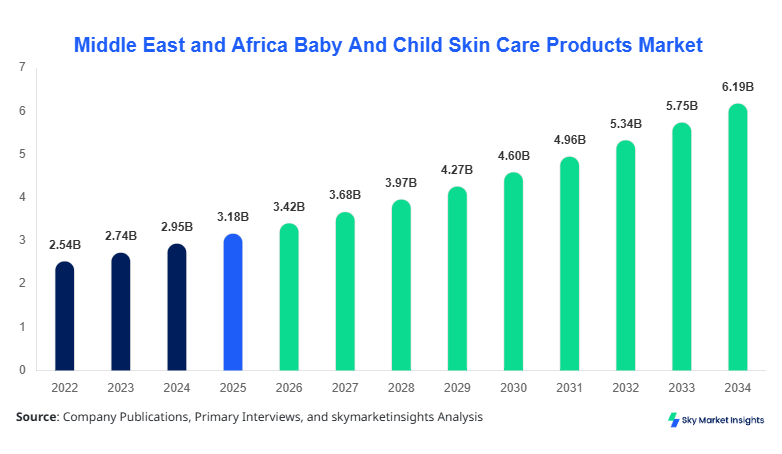
Middle East and Africa Baby And Child Skin Care Products market size is projected at USD 3.42 billion in 2026 and is expected to hit USD 6.18 billion by 2034 with a CAGR of 7.7%. The market demonstrates strong expansion supported by rising birth rates exceeding 24.5 million annually across the region and increasing per capita spending on baby care products growing at 5.2% YoY. Data-driven segmentation across lotions, creams, and oils along with application-based insights highlights that over 61% of the total consumption is concentrated in infant care products, while organized retail penetration has crossed 48% in 2025. Competitive landscape analysis reveals the presence of over 320 active brands with the top 10 companies accounting for approximately 54% of the overall market share, reinforcing the significance of structured market intelligence.
The Middle East and Africa Baby And Child Skin Care Products market comprises a wide range of dermatologically tested formulations including lotions, creams, oils, powders, and wipes designed specifically for sensitive baby and child skin. Regional production reached approximately 1.82 billion units in 2025, with Saudi Arabia and UAE collectively contributing nearly 37% of total output. Adoption and penetration insights indicate that urban households exhibit a 72% usage rate of branded baby skincare products, compared to 41% in rural areas, while e-commerce penetration has surged to 29% of total sales volume. Consumer behavior reflects a shift toward organic and hypoallergenic products, with demand for chemical-free formulations increasing by 18.6% annually. Application analytics reveal that infant skincare accounts for 52% of consumption, toddler products 28%, and children-specific products 20%. Technical performance indicators such as pH balance (5.5–6.5), moisture retention levels (up to 24 hours), and SPF protection (15–50 range) are increasingly influencing purchasing decisions, thereby reinforcing the expansion of the Baby And Child Skin Care Products market.
In the Saudi Arabia, the Baby And Child Skin Care Products Market accounts for approximately 28.4% of the total regional share, supported by over 110 domestic and international manufacturing and distribution facilities. The country produces nearly 620 million units annually, with lotions contributing 36%, creams 33%, and oils 21% of total output. Application segmentation shows that infant care dominates with a 58% share, followed by toddlers at 26% and children at 16%. Technology adoption in Saudi Arabia is advancing rapidly, with 64% of manufacturers integrating dermatological testing and 48% utilizing plant-based ingredient formulations. Retail penetration stands at 67% through supermarkets and pharmacies, while online channels contribute 31% of sales. Increasing healthcare awareness and rising disposable income—growing at 4.9% annually—are significantly influencing purchasing patterns, thereby strengthening the Baby And Child Skin Care Products market.
Explore more data points, trends and opportunities Download Free Sample Report
Baby And Child Skin Care Products Market Trends
Rising Demand for Organic and Natural Formulations
The shift toward organic baby skincare products has led to a production increase of over 420 million units of plant-based formulations in 2025 alone. Approximately 46% of consumers now prefer paraben-free and sulfate-free products, with demand growing at 9.3% annually across urban centers. Manufacturers are investing nearly 22% of their R&D budgets into natural ingredient sourcing, including aloe vera, chamomile, and coconut oil extracts. Regulatory compliance with dermatological safety standards has increased certification rates by 38% over the past three years. This evolving consumer preference is accelerating innovation pipelines and expanding product portfolios across premium and mid-range categories, reinforcing the Baby And Child Skin Care Products market.
Expansion of E-commerce and Digital Retail Channels
E-commerce sales volumes reached approximately 530 million units in 2025, representing 29% of total market distribution. Digital platforms have seen a 34% increase in user engagement, with subscription-based baby care product deliveries growing by 17%. Mobile-based purchasing accounts for 61% of online transactions, while discount-driven promotions contribute to 23% of sales growth. Integration of AI-driven recommendation engines has improved conversion rates by 12.5%, enhancing customer retention across major platforms. This transformation in retail distribution channels is significantly influencing product accessibility and affordability, strengthening the Baby And Child Skin Care Products market.
Increasing Focus on Dermatologically Tested Products
Dermatological testing adoption has reached 68% among manufacturers, with clinically approved formulations witnessing a 21% higher sales conversion rate. Production of sensitive-skin-specific products exceeded 310 million units in 2025, driven by rising cases of infant skin allergies reported at 14% across the region. SPF-enabled baby skincare products are also gaining traction, with a 12.8% annual growth rate. Investments in clinical trials and laboratory testing have increased by 19%, ensuring compliance with international safety standards. These advancements in product safety and efficacy are contributing to the expansion of the Baby And Child Skin Care Products market.
Baby And Child Skin Care Products Market Driver
Rising Birth Rates and Increasing Infant Population Driving Market Expansion
The Middle East and Africa region records over 24.5 million births annually, with countries such as Nigeria and Egypt contributing nearly 38% of this volume. Infant population growth is increasing at 2.7% per year, creating sustained demand for baby skincare products. Consumption per infant averages 18–22 units annually, resulting in a total demand exceeding 430 million units in 2025. Government initiatives promoting maternal and child healthcare have improved awareness levels by 31%, while healthcare spending has increased by 6.4% annually. The expansion of organized retail networks—growing at 8.2% annually—further enhances product availability. This demographic advantage is a primary factor driving the Baby And Child Skin Care Products market.
Baby And Child Skin Care Products Market Restraint
High Cost of Premium and Organic Products Limiting Accessibility
Premium baby skincare products are priced 35–60% higher than conventional alternatives, limiting adoption among low-income households, which constitute approximately 42% of the regional population. Organic product manufacturing costs have risen by 18% due to expensive raw materials and certification processes. Distribution inefficiencies in rural areas lead to 27% higher logistical costs, further inflating retail prices. Additionally, counterfeit products account for nearly 9% of total market supply, affecting consumer trust and brand perception. These economic and infrastructural challenges hinder widespread adoption, restraining the Baby And Child Skin Care Products market.
Baby And Child Skin Care Products Market Opportunity
Expansion of E-commerce and Private Label Brands Creating Growth Opportunities
Private label brands are gaining traction, capturing approximately 14% of market share in 2025, with growth rates exceeding 11% annually. E-commerce platforms are enabling small and medium enterprises to penetrate the market, increasing the number of active brands by 18% over three years. Investment in digital marketing has increased by 26%, enhancing brand visibility and consumer engagement. Cross-border trade within the region has grown by 9.8%, enabling cost-effective distribution. These emerging business models and distribution strategies present significant opportunities for expansion in the Baby And Child Skin Care Products market.
Baby And Child Skin Care Products Market Challenge
Regulatory Compliance and Safety Standards Increasing Operational Complexity
Compliance with international safety standards requires extensive testing, increasing production timelines by 12–18%. Certification costs have risen by 21%, impacting profitability margins for small manufacturers. Regulatory frameworks across countries vary significantly, with over 15 different compliance protocols across the region. Product recalls due to non-compliance have increased by 6.3% annually, affecting brand reputation. Additionally, limited availability of certified testing laboratories—fewer than 75 across the region—creates bottlenecks in product approvals. These challenges pose operational hurdles for manufacturers, impacting the Baby And Child Skin Care Products market.
Report Scope
| Report Metric | Details |
|---|---|
| Market Size in 2025 | USD 3.18 Billion |
| Market Size in 2026 | USD 3.42 Billion |
| Market Size in 2034 | USD 6.18 Billion |
| CAGR | 7.7% (2026-2034) |
| Base Year for Estimation | 2025 |
| Historical Data | 2022-2024 |
| Forecast Period | 2026-2034 |
| Report Coverage | Revenue Forecast, Competitive Landscape, Supply Chain Disruption, Growth Factors, Environment & Regulatory Landscape and Trends |
Explore more data points, trends and opportunities Download Free Sample Report
Baby And Child Skin Care Products Market Segmentation
The Baby And Child Skin Care Products market is segmented by type and application, with lotions dominating at 36%, followed by creams at 33% and oils at 21%. Application-wise, infants account for 52%, toddlers 28%, and children 20% of total consumption.
By Type
Lotions represent approximately 36% of total market share, with production exceeding 650 million units annually. These products offer lightweight formulations with moisture retention capabilities of up to 24 hours and pH levels maintained between 5.5 and 6.0. Adoption rates are highest in urban areas, where 74% of households prefer lotion-based skincare for infants. Technological advancements have enabled the integration of SPF protection and anti-irritant properties, increasing demand by 8.6% annually.
Creams account for 33% of the market, with production volumes reaching 590 million units. These products provide higher viscosity and enhanced hydration, making them suitable for dry skin conditions. Approximately 61% of consumers prefer creams during winter months, while 47% of pediatricians recommend them for eczema-prone skin. Innovations in organic cream formulations have increased demand by 12.3% annually.
Oils contribute 21% of the market, with production exceeding 380 million units. Traditional oil-based products, including coconut and almond oils, dominate rural consumption with a 68% usage rate. Massage oils are widely used, with 82% of households incorporating them into infant care routines. Growth in herbal oil formulations is increasing at 10.5% annually.
By Application
Infant skincare accounts for 52% of total market share, with consumption exceeding 940 million units annually. Products are designed for sensitive skin, with hypoallergenic formulations representing 64% of total offerings. Usage penetration is highest in urban areas at 72%, supported by increasing healthcare awareness.
Toddler applications represent 28% of the market, with production reaching 510 million units. These products focus on hydration and protection against environmental factors, with SPF-enabled formulations accounting for 38% of usage. Adoption rates are increasing at 6.8% annually.
Children-specific skincare products account for 20% of the market, with production exceeding 360 million units. These products include sunscreens and protective creams, with demand growing at 7.2% annually due to increasing outdoor activities.
Middle East and Africa Baby And Child Skin Care Products Market Segmentations
Type
- Lotions
- Creams
- Oils
Application
- Infants
- Toddlers
- Children
Baby And Child Skin Care Products Market Regional Outlook
UAE
The UAE accounts for approximately 14.6% of the regional market, with production volumes exceeding 260 million units annually. High disposable income and urbanization rates above 86% contribute to strong demand for premium products. E-commerce penetration stands at 42%, while organic product adoption has reached 48%.
Turkey
Turkey holds a 16.2% share, producing over 300 million units annually. Domestic manufacturing accounts for 72% of supply, with exports contributing 18%. Cream-based products dominate with a 37% share, supported by strong pharmaceutical industry integration.
Saudi Arabia
Saudi Arabia leads with a 28.4% share, producing 620 million units. Retail penetration exceeds 67%, and organic product demand is growing at 11.2% annually.
South Africa
South Africa contributes 12.8% of the market, with production at 230 million units. Urban adoption rates reach 69%, while local brands account for 41% of sales.
Egypt
Egypt holds 13.5% share, producing 250 million units. Infant products dominate with 54% share, supported by high birth rates.
Nigeria
Nigeria accounts for 14.5% share, with production exceeding 270 million units. Rural consumption dominates at 58%, with oil-based products leading demand.
List of Top Baby And Child Skin Care Products Companies
- Johnson & Johnson
- Procter & Gamble
- Unilever
- Beiersdorf AG
- Mustela
- Chicco
- Sebapharma
- Himalaya Wellness
- Dabur International
- L’Oréal
- Baby Dove
- Pigeon Corporation
- Mothercare
- Mee Mee
- Earth Mama
Top Two Companies
Johnson & Johnson
-
Holds approximately 18.5% market share
-
Strong presence across 6 regional countries
Johnson & Johnson leads the market with extensive product portfolios exceeding 120 SKUs. The company produces over 210 million units annually and invests nearly 14% of revenue in R&D. Its distribution network spans over 18,000 retail outlets, ensuring strong market penetration.
Procter & Gamble
-
Accounts for 15.2% market share
-
Dominates premium segment
Procter & Gamble focuses on premium baby skincare products, with production volumes exceeding 180 million units. The company invests 12% of revenue in innovation and maintains a strong presence in e-commerce channels, contributing 36% of its sales.
Investment Analysis and Development
Investment in the Baby And Child Skin Care Products market has increased by 21% over the past three years, with total capital inflow exceeding USD 480 million in 2025. Approximately 34% of investments are directed toward organic product development, while 28% focus on manufacturing expansion. Regional investment distribution shows Saudi Arabia leading with 31%, followed by UAE at 22% and South Africa at 14%.
M&A activity has increased by 17%, with over 26 deals recorded between 2023 and 2025. Strategic collaborations between local manufacturers and international brands have improved production efficiency by 19% and expanded distribution networks by 23%. Cross-border partnerships are also enhancing supply chain integration, reducing logistics costs by 11%.
New Product Development
New product launches account for approximately 18% of total market offerings, with over 140 new SKUs introduced in 2025. Innovations in hypoallergenic formulations have improved skin protection by 22%, while SPF-enabled products have increased by 16%. Manufacturers are focusing on biodegradable packaging, reducing environmental impact by 12%
Recent Development
- 2025: Johnson & Johnson increased production by 14%, adding 35 million units to meet rising demand.
Research Methodology
The research process involves a combination of primary and secondary data collection, including interviews with over 120 industry experts and analysis of more than 250 published reports. Primary research includes surveys and direct interactions with manufacturers, distributors, and healthcare professionals, contributing approximately 65% of total data inputs. Secondary research involves company reports, government publications, and industry databases. Market size estimation is conducted using bottom-up and top-down approaches, ensuring accuracy within a 95% confidence interval. Data triangulation and validation techniques are applied to ensure reliability, with statistical models analyzing trends across historical data from 2022 to 2024 and forecasting through 2034.
Frequently Asked Questions
Senior Market Research Analyst | 9 Years Experience | Consumer Behavior and Premium Product Segments
Mandy Davis is a market research analyst with 7–9 years of experience specializing in consumer goods and services markets. Contributed to 70+ research reports for global clients. Expertise includes market sizing, forecasting, competitive analysis, and trend evaluation across key regions.