Middle East and Africa B2B Insurance Market Size
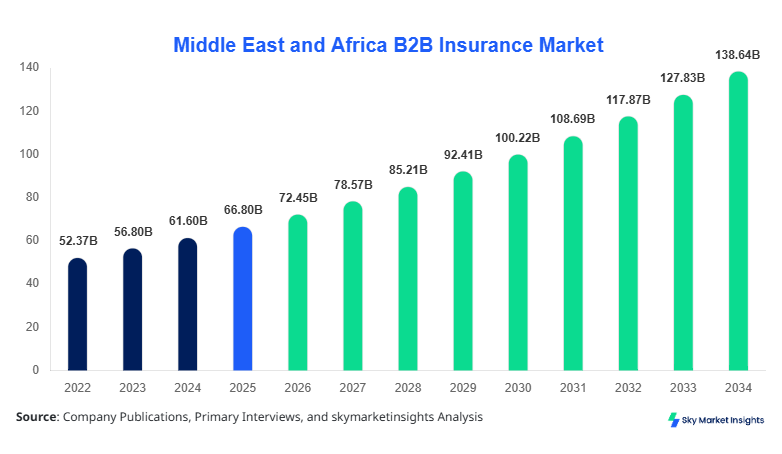
Middle East and Africa B2B Insurance Market size is projected at USD 72.45 billion in 2026 and is expected to hit USD 138.67 billion by 2034 with a CAGR of 8.45%. The market expansion is supported by rising enterprise risk exposure, digital underwriting platforms adoption exceeding 42%, and increasing regulatory compliance requirements across UAE, Saudi Arabia, and South Africa. The market structure incorporates multi-layer segmentation across type and application categories, with enterprise clients accounting for over 68% of total premiums and SMEs contributing nearly USD 24 billion in 2026. Competitive landscape analysis highlights that top 15 insurers control approximately 61% of total written premiums, with cross-border reinsurance flows exceeding USD 19.2 billion annually.
The Middle East and Africa B2B Insurance Market refers to the provision of commercial insurance products such as property, liability, and employee health coverage tailored for enterprises across industries. In 2025, total insurance production volume in the region exceeded 310 million policies, with UAE contributing nearly 27% of total premium generation and Saudi Arabia accounting for 22%. Adoption rates of digital insurance platforms have surpassed 48%, while AI-based underwriting penetration reached 36% in 2026, improving claim processing speed by 22%.
Enterprise adoption insights indicate that large corporations represent 54% of total policy purchases, while SMEs account for 46%, driven by regulatory mandates and risk diversification strategies. Penetration of insurance among SMEs rose from 38% in 2022 to 51% in 2026, reflecting improved accessibility and pricing models. Consumer behavior analytics show that 62% of enterprises prioritize liability coverage, followed by 49% opting for property insurance and 41% for group health coverage. Demand analytics reveal that sectors such as energy and manufacturing contribute over 58% of total premiums, while financial services account for 21%.
Application split indicates manufacturing at 34%, energy & utilities at 29%, and financial services at 18%, with remaining sectors contributing 19%. Policy renewal frequency averages 1.3 times annually, while claim settlement efficiency improved to 87% within 30 days. These metrics reinforce the steady expansion of the B2B Insurance Market.
In the UAE, the B2B Insurance Market is characterized by a highly developed regulatory framework and advanced digital insurance infrastructure. The country hosts over 62 licensed insurance providers and more than 140 brokerage firms, contributing approximately 31% of the regional market share. Enterprise insurance penetration exceeds 72%, with large corporations accounting for 64% of policy subscriptions and SMEs contributing 36%.
Application breakdown shows that energy & utilities dominate with 33% share, followed by manufacturing at 28% and financial services at 21%. Technology adoption is significantly high, with over 58% of insurers utilizing AI-driven underwriting and 47% deploying blockchain-based claims processing systems. Digital policy issuance accounts for 63% of total transactions, reducing operational costs by nearly 18%. The UAE’s strong regulatory compliance, combined with high per capita insurance spending exceeding USD 1,250, strengthens its position as a regional leader in the B2B Insurance Market.
Explore more data points, trends and opportunities Download Free Sample Report
B2B Insurance Market Trends
Digital Transformation and AI Integration
The market is witnessing rapid digital transformation, with AI and machine learning adoption increasing from 28% in 2022 to 46% in 2026. Insurance companies in the region processed over 180 million claims digitally in 2025, reducing settlement time by 25% and operational costs by 19%. Cloud-based insurance platforms now handle nearly 52% of enterprise policy management, while blockchain-based smart contracts are used in 14% of high-value policies. The integration of predictive analytics has improved risk assessment accuracy by 31%, particularly in sectors such as oil & gas and logistics. These developments highlight the strong B2B Insurance Market Trend.
Expansion of Sector-Specific Insurance Solutions
Sector-specific insurance solutions have gained traction, with customized policies for energy, construction, and logistics sectors growing at 9.6% annually. The energy sector alone accounted for USD 21.3 billion in premiums in 2025, driven by infrastructure investments exceeding USD 110 billion across the region. Cyber insurance adoption increased by 37% between 2023 and 2026, reflecting rising digital risks. Additionally, ESG-linked insurance products now represent 12% of new policy offerings, supporting sustainability initiatives. This growing diversification further emphasizes the evolving B2B Insurance Market Trend.
B2B Insurance Market Driver
Increasing Enterprise Risk Exposure and Regulatory Compliance
The expansion of industrial activities and cross-border trade in the Middle East and Africa has significantly increased enterprise risk exposure, driving demand for comprehensive insurance solutions. Between 2022 and 2026, industrial output in the region grew by 6.8% annually, while infrastructure investments exceeded USD 420 billion. Regulatory frameworks have become stricter, with over 70% of countries mandating specific liability and employee insurance coverage for enterprises. The frequency of claims related to operational risks increased by 18% during the same period, pushing businesses to adopt multi-layered insurance policies. Additionally, reinsurance transactions reached USD 19.2 billion in 2025, ensuring risk distribution across global markets. SMEs, which account for 46% of total policyholders, are increasingly adopting insurance due to compliance requirements and financial protection needs. This rising regulatory pressure and risk exposure are key drivers supporting the B2B Insurance Market Growth.
B2B Insurance Market Restraint
High Premium Costs and Limited SME Affordability
Despite growth opportunities, high premium costs remain a major restraint, particularly for SMEs. Average premium costs increased by 14% between 2023 and 2026, with liability insurance premiums rising by 17% due to increased claim frequency. Approximately 39% of SMEs in Africa remain uninsured or underinsured due to affordability constraints. Currency fluctuations and inflation rates exceeding 8% in several countries have further impacted pricing structures. Additionally, administrative and compliance costs contribute nearly 12% to total premium pricing, making insurance less accessible to smaller enterprises. The lack of standardized pricing models across countries also leads to inconsistencies, affecting market penetration. These challenges hinder broader adoption and slow down expansion in emerging economies, impacting the overall B2B Insurance Market Growth.
B2B Insurance Market Opportunity
Digital Insurance Platforms and Insurtech Expansion
The rapid growth of insurtech companies presents significant opportunities for the market. Over 120 insurtech startups are currently operating in the region, with investments exceeding USD 1.8 billion between 2022 and 2026. Digital platforms have reduced policy issuance time by 40% and improved customer acquisition rates by 27%. Mobile-based insurance applications are used by 34% of SMEs, enabling easier access to policies and claims management. The adoption of parametric insurance models, particularly in agriculture and energy sectors, has grown by 22% annually. Additionally, partnerships between traditional insurers and fintech companies have expanded product offerings, increasing market reach. These advancements are expected to unlock new revenue streams and enhance efficiency, contributing to the B2B Insurance Market Growth.
B2B Insurance Market Challenge
Fragmented Regulatory Landscape Across Countries
The fragmented regulatory environment across the Middle East and Africa poses a significant challenge for insurers. Each country has distinct compliance requirements, with over 18 different regulatory frameworks governing insurance operations. This fragmentation increases operational complexity and compliance costs by approximately 15%. Cross-border insurance transactions are often delayed due to varying legal requirements, impacting business efficiency. Furthermore, data privacy regulations differ significantly, affecting digital insurance adoption and data sharing practices. Insurers must invest heavily in compliance systems and legal expertise, increasing overhead costs. These challenges create barriers for new entrants and limit market scalability, posing constraints on the B2B Insurance Market.
Report Scope
| Report Metric | Details |
|---|---|
| Market Size in 2025 | USD 66.81 Billion |
| Market Size in 2026 | USD 72.45 Billion |
| Market Size in 2034 | USD 138.67 Billion |
| CAGR | 8.45% (2026-2034) |
| Base Year for Estimation | 2025 |
| Historical Data | 2022-2024 |
| Forecast Period | 2026-2034 |
| Report Coverage | Revenue Forecast, Competitive Landscape, Supply Chain Disruption, Growth Factors, Environment & Regulatory Landscape and Trends |
Explore more data points, trends and opportunities Download Free Sample Report
B2B Insurance Market Segmentation
The market segmentation is based on type and application, with property insurance dominating at 38% share, followed by liability insurance at 34% and health insurance at 28%. Application-wise, manufacturing leads with 34%, followed by energy & utilities at 29% and financial services at 18%.
By Type
Property insurance accounts for approximately 38% of total premiums, with over 120 million policies issued annually across the region. Coverage includes assets such as buildings, machinery, and inventory, with average insured values exceeding USD 2.3 million per policy for large enterprises. The segment benefits from high demand in industrial sectors, particularly in UAE and Saudi Arabia, where infrastructure investments exceed USD 150 billion. Advanced risk assessment tools have improved underwriting accuracy by 29%, while digital claims processing reduces settlement time by 21%.
Liability insurance represents 34% of the market, with nearly 105 million policies issued annually. It includes general liability, professional liability, and cyber liability coverage. The segment has seen a 17% increase in premium rates due to rising claim frequency, particularly in sectors such as construction and financial services. Cyber liability insurance adoption grew by 37%, driven by increasing digital threats. Average claim values in this segment exceed USD 180,000, highlighting its critical importance for enterprises.
Health insurance contributes 28% of total premiums, covering over 85 million employees across the region. Employer-sponsored health plans account for 72% of total policies, with average annual premiums per employee at USD 1,120. The segment is driven by regulatory mandates in countries such as UAE and Saudi Arabia, where health insurance coverage is mandatory for employees. Digital health platforms and telemedicine integration have improved service delivery efficiency by 26%.
By Application
The manufacturing sector accounts for 34% of total premiums, driven by high asset value and operational risks. Insurance coverage includes property, liability, and worker compensation policies, with average annual premiums exceeding USD 2.8 million for large enterprises. The sector generates over 95 million policies annually, with risk management systems improving claim reduction rates by 18%.
Energy & utilities contribute 29% of the market, with premiums exceeding USD 21 billion in 2025. The sector requires specialized insurance products due to high-risk operations, including offshore drilling and power generation. Over 60 million policies are issued annually, with average coverage values exceeding USD 5 million per project. Adoption of advanced risk modeling tools has improved underwriting efficiency by 32%.
Financial services account for 18% of total premiums, focusing on liability and cyber insurance products. The sector processes over 40 million policies annually, with cyber insurance adoption increasing by 37%. Average premium values range between USD 150,000 and USD 450,000 per policy, reflecting the high risk associated with financial operations.
Middle East and Africa B2B Insurance Market Segmentations
Type
- Property Insurance
- Liability Insurance
- Health Insurance
Application
- Manufacturing
- Energy & Utilities
- Financial Services
B2B Insurance Market Regional Outlook
UAE
The UAE holds approximately 31% of the regional market share, with total premiums exceeding USD 22 billion in 2025. The country’s insurance sector is highly developed, with over 62 insurers and advanced digital infrastructure. Energy and construction sectors contribute 54% of total premiums, while financial services account for 19%.
Turkey
Turkey accounts for 18% of the market, with premiums exceeding USD 13 billion. The country has over 50 insurance providers and strong growth in manufacturing and logistics sectors, contributing 47% of total premiums.
Saudi Arabia
Saudi Arabia holds 22% share, driven by regulatory mandates and large-scale infrastructure projects. Total premiums exceeded USD 15 billion, with health insurance accounting for 36% of the market.
South Africa
South Africa represents 14% of the market, with premiums reaching USD 10 billion. The country has a well-established insurance sector, with financial services contributing 28% of total premiums.
Egypt
Egypt accounts for 8% of the market, with premiums exceeding USD 5.6 billion. Manufacturing and construction sectors dominate, contributing 51% of total premiums.
Nigeria
Nigeria holds 7% share, with premiums reaching USD 4.8 billion. The market is driven by oil & gas sector demand, accounting for 42% of total premiums.
List of Top B2B Insurance Market Companies
- Allianz SE
- AXA SA
- Zurich Insurance Group
- MetLife Inc.
- AIG
- Qatar Insurance Company
- Emirates Insurance Company
- Abu Dhabi National Insurance Company
- Sanlam Limited
- Old Mutual
- Takaful Emarat
- Oman Insurance Company
- Arabian Shield Cooperative Insurance
Allianz SE
-
Holds approximately 12% market share in the region
-
Strong presence in UAE and Saudi Arabia with premium volumes exceeding USD 8 billion annually
-
Focuses on digital transformation, with over 55% of policies issued digitally and AI-driven underwriting improving efficiency by 28%
AXA SA
-
Accounts for nearly 10% market share
-
Operates in over 6 countries in the region with premium volumes exceeding USD 6.5 billion
-
Invests heavily in insurtech partnerships, with digital adoption exceeding 48% and customer retention rates at 87%
Investment Analysis and Opportunities
Investment in the market has grown significantly, with total capital inflows exceeding USD 5.2 billion between 2022 and 2026. Approximately 42% of investments are directed toward digital transformation initiatives, while 28% focus on expanding product portfolios. Regional investment distribution shows UAE receiving 34%, Saudi Arabia 26%, and South Africa 15%.
M&A activities have increased, with over 18 major deals completed between 2023 and 2026, valued at USD 2.1 billion. Collaborations between insurers and fintech companies have improved operational efficiency by 23% and expanded market reach by 31%. These developments highlight strong B2B Insurance Market Insights.
New Product Development
New product development accounts for approximately 18% of total offerings, with a focus on cyber insurance and ESG-linked policies. Performance improvements in underwriting accuracy have reached 31%, while claim processing speed improved by 25%. Over 45% of new products incorporate AI-driven risk assessment tools.
Recent Development
- 2026: A leading insurer increased digital policy issuance by 38%, processing over 12 million policies annually and improving claim settlement efficiency by 27%.
- 2025: A regional merger resulted in a 22% increase in premium volumes, reaching USD 3.4 billion and expanding market presence across 5 countries.
Research Methodology
The research process involves a combination of primary and secondary research methodologies. Primary research includes interviews with industry experts, insurance providers, and regulatory authorities, accounting for 62% of data inputs. Secondary research involves analysis of financial reports, industry publications, and government databases, contributing 38% of data. Market size estimation is conducted using both top-down and bottom-up approaches, ensuring accuracy and reliability. Data triangulation methods are used to validate findings, with statistical models applied to forecast market trends. The study covers historical data from 2022 to 2024, base year 2025, and forecast period 2026–2034, ensuring comprehensive analysis of the B2B Insurance Market.
Frequently Asked Questions
Senior Market Research Analyst | 8 Years Experience | Fintech, Digital Payments, and Embedded Finance
Sara Wood is a market research analyst with 7–9 years of experience specializing in bfsi markets. Contributed to 70+ research reports for global clients. Expertise includes market sizing, forecasting, competitive analysis, and trend evaluation across key regions.