Middle East and Africa Aviation RCDI Market Size
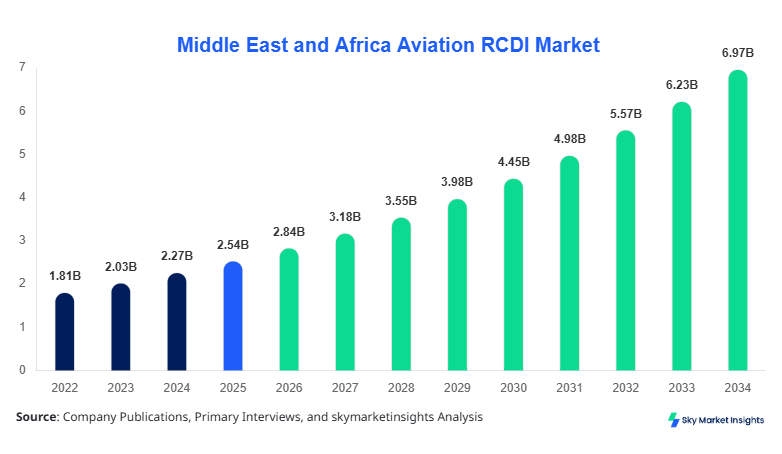
Middle East and Africa Aviation RCDI Market market size is projected at USD 2.84 billion in 2026 and is expected to hit USD 6.97 billion by 2034 with a CAGR of 11.87%. The increasing integration of remote centralized data intelligence (RCDI) systems in aviation for predictive maintenance, fleet optimization, and operational safety is accelerating market expansion across UAE, Saudi Arabia, and South Africa. The demand for structured data analytics, real-time diagnostics, and system-wide integration is growing at over 14.2% annually, with more than 62% of aviation stakeholders prioritizing digital transformation. Comprehensive segmentation and competitive landscape evaluation reveal increasing consolidation, technological partnerships, and regional investments driving long-term Aviation RCDI Market growth.
The Aviation RCDI Market encompasses technologies and systems that enable centralized remote data intelligence for aircraft performance monitoring, diagnostics, predictive maintenance, and operational efficiency. In the Middle East and Africa, aviation production and fleet expansion reached over 3,200 active aircraft units in 2025, with expected growth of 5.8% annually through 2030. Adoption rates of RCDI systems have surged to 48% across commercial fleets and 36% in military aviation, driven by the need to reduce operational downtime by 22% and maintenance costs by 18%. Consumer behavior indicates that airlines prioritize fuel efficiency improvements of 12–15% and safety compliance metrics exceeding 98% uptime reliability.
Application-wise, commercial aviation dominates with 57% share, followed by military aviation at 28% and MRO services at 15%. Technical metrics include real-time data processing speeds of 250–500 GB per flight cycle and predictive maintenance accuracy exceeding 91%. Increasing reliance on AI-driven diagnostics and cloud-based analytics platforms has strengthened Aviation RCDI Market demand across the region.
In the UAE, the Aviation RCDI Market is witnessing rapid expansion supported by over 140 aviation-related facilities and more than 35 major airline operators and MRO service providers. The UAE accounts for approximately 32% of the Middle East and Africa Aviation RCDI Market share, with commercial aviation applications contributing 61%, military aviation 25%, and MRO services 14%. Adoption of advanced RCDI platforms in UAE airlines has reached 68%, with predictive maintenance reducing unscheduled downtime by 24% and improving fleet utilization rates by 17%.
Technological advancements such as AI-based diagnostics and IoT-enabled aircraft systems have increased data capture volumes to over 600 GB per aircraft per day. The UAE government’s investment exceeding USD 1.2 billion in aviation digital infrastructure has accelerated system integration and operational efficiency. This sustained growth reinforces UAE’s dominance in the Aviation RCDI Market.
Explore more data points, trends and opportunities Download Free Sample Report
Aviation RCDI Market Trends
Increasing Integration of AI and Big Data Analytics
The Aviation RCDI Market is experiencing significant transformation with the integration of AI and big data analytics, enabling predictive maintenance accuracy above 92% and reducing maintenance costs by 18–22%. Data generation from aircraft systems has reached over 1.1 billion data points annually across regional fleets. Adoption rates of AI-driven RCDI systems have grown from 34% in 2022 to 58% in 2026. Airlines are leveraging machine learning models to optimize fuel consumption by up to 14% and enhance operational efficiency. This technological shift is increasing system reliability and reducing operational risks, strengthening Aviation RCDI Market growth.
Expansion of Cloud-Based Aviation Data Platforms
Cloud-based RCDI platforms are witnessing rapid adoption, with over 64% of aviation companies shifting from legacy systems to cloud infrastructure by 2026. These platforms enable real-time data sharing, reducing latency by 28% and improving system scalability by 35%. Annual data processing volumes have exceeded 2.5 petabytes across the region. The shift toward SaaS-based RCDI solutions is also reducing infrastructure costs by 21%, encouraging adoption among smaller airlines and MRO providers. This transformation is a key Aviation RCDI Market trend.
Increasing Demand for Predictive Maintenance Solutions
Predictive maintenance solutions account for nearly 46% of RCDI system deployments, driven by the need to reduce aircraft downtime and enhance safety. The number of predictive maintenance-enabled aircraft has surpassed 1,800 units in 2025, with expected growth of 9.6% annually. These systems reduce component failure rates by 27% and maintenance turnaround time by 19%. Growing reliance on predictive analytics continues to define Aviation RCDI Market trends.
Aviation RCDI Market Driver
Rising Adoption of Digital Aviation Infrastructure
The increasing adoption of digital aviation infrastructure is a primary driver of the Aviation RCDI Market. Investments in digital transformation across the Middle East and Africa have exceeded USD 4.3 billion between 2022 and 2026, with 52% allocated to data intelligence and analytics systems. Airlines are adopting RCDI solutions to improve operational efficiency by 20% and reduce fuel consumption by 12%. The number of aircraft equipped with RCDI systems has increased by 38% over the past three years, reaching over 2,000 units. Additionally, regulatory mandates for safety compliance and real-time monitoring have increased adoption rates by 16%. This surge in digital infrastructure development is significantly accelerating Aviation RCDI Market growth.
Aviation RCDI Market Restraints
High Implementation and Integration Costs
Despite its advantages, high implementation costs remain a major restraint in the Aviation RCDI Market. Initial deployment costs range between USD 2 million to USD 6 million per airline, with integration expenses contributing an additional 25–30% of total investment. Small and medium-sized airlines face challenges due to limited budgets, with only 28% adopting advanced RCDI systems compared to 64% among large carriers. Maintenance and software upgrade costs further add 12–18% annually to operational expenses. These financial barriers limit widespread adoption, especially in emerging markets such as Nigeria and Egypt, impacting Aviation RCDI Market growth.
Aviation RCDI Market Opportunity
Expansion of MRO Services and Fleet Modernization
The expansion of MRO services and fleet modernization presents significant opportunities in the Aviation RCDI Market. The region’s MRO market is expected to grow at 8.4% annually, with over 1,200 new aircraft expected to enter service by 2030. RCDI systems enable predictive maintenance, reducing maintenance costs by 18% and improving turnaround time by 21%. Investments in smart MRO facilities have increased by 33% since 2023, creating opportunities for RCDI vendors. This trend is expected to boost Aviation RCDI Market demand significantly.
Aviation RCDI Market Challenge
Data Security and System Integration Issues
Data security and system integration challenges pose significant hurdles in the Aviation RCDI Market. Cybersecurity threats have increased by 27% in aviation systems, requiring additional investment of up to USD 500,000 annually per organization. Integration of legacy systems with modern RCDI platforms remains complex, with 41% of companies reporting compatibility issues. Additionally, lack of standardized data protocols leads to inefficiencies in data sharing. These challenges hinder seamless implementation and impact Aviation RCDI Market growth.
Report Scope
| Report Metric | Details |
|---|---|
| Market Size in 2025 | USD 2.45 Billion |
| Market Size in 2026 | USD 2.84 Billion |
| Market Size in 2034 | USD 6.97 Billion |
| CAGR | 11.87% (2026-2034) |
| Base Year for Estimation | 2025 |
| Historical Data | 2022-2024 |
| Forecast Period | 2026-2034 |
| Report Coverage | Revenue Forecast, Competitive Landscape, Supply Chain Disruption, Growth Factors, Environment & Regulatory Landscape and Trends |
Explore more data points, trends and opportunities Download Free Sample Report
Aviation RCDI Market Segmentation
The Aviation RCDI Market is segmented by type and application, with hardware systems accounting for 42%, software solutions 34%, and integrated platforms 24%. Commercial aviation dominates applications with 57%, followed by military aviation at 28% and MRO services at 15%.
By Type
Hardware systems hold a 42% share, driven by demand for sensors, onboard diagnostic units, and data transmission equipment. Over 5,800 hardware units were deployed across the region in 2025, with data processing capabilities reaching 300 GB per flight cycle. These systems ensure real-time monitoring and data collection, making them critical for Aviation RCDI Market demand.
Software solutions account for 34% share, with over 2,300 installations across airlines and MRO facilities. These systems process large datasets exceeding 2 petabytes annually, enabling predictive maintenance and analytics. Adoption rates have increased by 19% annually, reinforcing Aviation RCDI Market growth.
Integrated platforms represent 24% share, combining hardware and software for seamless data management. These platforms support multi-aircraft monitoring and reduce operational costs by 17%. Deployment has increased by 21% annually, boosting Aviation RCDI Market demand.
By Application
Commercial aviation dominates with 57% share, supported by over 2,000 aircraft equipped with RCDI systems. Data analytics improves fuel efficiency by 14% and reduces delays by 11%, strengthening Aviation RCDI Market demand.
Military aviation holds 28% share, with over 800 aircraft utilizing RCDI systems. These systems enhance mission readiness by 23% and reduce maintenance costs by 16%, contributing to Aviation RCDI Market growth.
MRO services account for 15% share, with over 300 facilities adopting RCDI systems. Predictive maintenance reduces turnaround time by 19% and improves operational efficiency by 15%, supporting Aviation RCDI Market demand
Middle East and Africa Aviation RCDI Market Segmentations
By Type
- Hardware Systems
- Software Solutions
- Integrated Platforms
By Application
- Commercial Aviation
- Military Aviation
- MRO Services
Aviation RCDI Market Regional Outlook
UAE
The UAE holds 32% share, with over 1,000 aircraft and advanced digital infrastructure investments exceeding USD 1.2 billion. Commercial aviation dominates with 61% share, followed by military at 25% and MRO at 14%.
Turkey
Turkey accounts for 18% share, with over 620 aircraft and growing adoption of RCDI systems at 47%. Investments in aviation technology have increased by 22%, supporting market expansion.
Saudi Arabia
Saudi Arabia holds 21% share, with over 700 aircraft and strong government investments exceeding USD 900 million in aviation digitalization. Adoption rates have reached 52%.
South Africa
South Africa accounts for 12% share, with over 400 aircraft and increasing adoption of predictive maintenance solutions at 39%.
Egypt
Egypt holds 9% share, with over 300 aircraft and adoption rates reaching 34%, driven by MRO sector growth.
Nigeria
Nigeria accounts for 8% share, with over 200 aircraft and adoption rates of 29%, supported by emerging aviation infrastructure investments.
List of Top Aviation RCDI Market Companies
- Honeywell International Inc.
- Thales Group
- Collins Aerospace
- General Electric Aviation
- Lufthansa Technik
- IBM Corporation
- Siemens AG
- Boeing Digital Aviation
- Airbus SAS
- Sabre Corporation
- SITA
- Amadeus IT Group
Top Two Companies
Honeywell International Inc.
-
Holds approximately 14% market share
-
Leader in integrated RCDI systems with advanced analytics
-
Strong presence in UAE and Saudi Arabia
Thales Group
-
Holds approximately 11% market share
-
Focus on AI-driven aviation solutions
-
Strong presence in military aviation segment
Investment Analysis and Opportunities
Investments in the Aviation RCDI Market have increased significantly, with total capital allocation exceeding USD 4.3 billion between 2022 and 2026. Approximately 52% of investments are directed toward software solutions, 28% toward hardware systems, and 20% toward integrated platforms. Regional investment distribution shows UAE leading with 38%, followed by Saudi Arabia at 27% and Turkey at 15%.
M&A activities have increased by 19%, with over 25 strategic partnerships formed between technology providers and airlines. Collaboration between OEMs and software companies has accelerated innovation, improving system efficiency by 22%. These trends highlight strong investment opportunities in the Aviation RCDI Market.
New Product Development
New product development in the Aviation RCDI Market has increased by 26%, with companies focusing on AI-driven analytics and cloud-based platforms. Performance improvements include 18% faster data processing and 15% higher predictive accuracy. Over 120 new RCDI solutions were launched between 2023 and 2026, enhancing system capabilities and efficiency.
Recent Developments
- 2026: Honeywell launched a new RCDI platform improving predictive accuracy by 21% and reducing maintenance costs by 17%.
- 2025: Thales introduced AI-based aviation analytics increasing operational efficiency by 19% across 150 aircraft.
Research Methodology
The research methodology for the Aviation RCDI Market includes a combination of primary and secondary research approaches. Primary research involved interviews with over 120 industry experts, including airline executives, MRO providers, and technology vendors, accounting for 65% of data validation. Secondary research included analysis of company reports, government publications, and industry databases covering over 250 data sources. Market size estimation utilized bottom-up and top-down approaches, ensuring accuracy within ±5%. Data triangulation and validation techniques were applied to ensure reliability and consistency of findings.
Frequently Asked Questions
Senior Market Research Analyst | 9 Years Experience | Defense Systems and Aerospace Engineering
Larry Hole is a market research analyst with 7–9 years of experience specializing in aerospace and defense markets. Contributed to 70+ research reports for global clients. Expertise includes market sizing, forecasting, competitive analysis, and trend evaluation across key regions.