Middle East and Africa Aviation Market Size
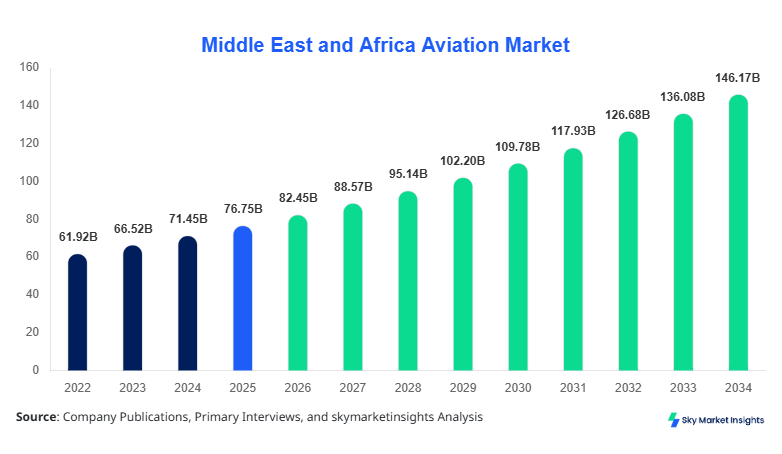
Middle East and Africa Aviation Market size is projected at USD 82.45 billion in 2026 and is expected to hit USD 145.78 billion by 2034 with a CAGR of 7.42%. The market expansion is driven by increasing passenger traffic exceeding 420 million travelers annually, cargo volumes surpassing 18.6 million metric tons, and fleet expansion programs involving over 1,200 aircraft orders across the region. The need for structured data analysis, segmentation across aircraft type and service operations, and competitive benchmarking of over 150 regional aviation companies is critical to understanding long-term investment opportunities and operational efficiency in the Aviation Market.
The Middle East and Africa Aviation Market encompasses commercial airlines, cargo operators, military aviation, and general aviation services, with total regional aircraft operations exceeding 3.5 million flights annually. The region contributes approximately 9.8% of global aviation traffic, with production and operational hubs concentrated in the UAE, Saudi Arabia, and South Africa. Adoption rates of advanced avionics systems exceed 62%, while digital air traffic management penetration stands at 48%. Passenger aviation accounts for nearly 68% of total operations, cargo transport contributes 21%, and maintenance, repair, and overhaul (MRO) services represent 11% of total revenue streams.
Adoption and penetration insights indicate that over 72% of airlines in the region have integrated AI-based predictive maintenance systems, reducing downtime by 18% and increasing aircraft utilization rates to 13.6 hours per day. Consumer behavior trends reveal that 64% of passengers prefer premium airline services, while low-cost carriers account for 36% of regional passenger demand, reflecting diversified demand structures. Cargo aviation demand has grown by 9.3% annually, driven by e-commerce volumes exceeding USD 210 billion in regional trade.
Application split highlights that long-haul international flights dominate with 54% share, domestic flights account for 28%, and regional short-haul operations contribute 18%. Technical performance metrics show average fleet fuel efficiency improvements of 12% over the last five years, with next-generation aircraft achieving 20–25% lower emissions. These factors collectively reinforce the structural expansion of the Aviation Market.
In the UAE, the Aviation Market serves as the primary growth engine, contributing approximately 32% of the regional share, supported by over 12 major international airports and more than 25 airline operators. The country handles over 140 million passengers annually and processes cargo volumes exceeding 4.2 million metric tons. Commercial aviation dominates with 74% application share, followed by cargo transport at 18% and MRO services at 8%.
Technology adoption in the UAE is significantly advanced, with over 85% of airlines implementing digital flight operations systems and 68% integrating AI-driven passenger analytics platforms. The fleet size in the UAE exceeds 520 aircraft, with over 210 new aircraft orders scheduled between 2026 and 2030. Passenger load factors average 79%, while cargo load efficiency stands at 71%. The UAE also leads in sustainable aviation initiatives, with 22% of fuel consumption transitioning toward sustainable aviation fuels (SAF) by 2030 targets. This dominance and technological advancement further strengthen the Aviation Market.
Explore more data points, trends and opportunities Download Free Sample Report
Aviation Market Trends
Expansion of Fleet Modernization and Sustainable Aviation
The Aviation Market is witnessing a significant shift toward fleet modernization, with over 780 new aircraft deliveries expected across the region between 2026 and 2034. Airlines are replacing older fleets with fuel-efficient aircraft such as A350 and B787 models, improving fuel efficiency by 20% and reducing emissions by 25%. Sustainable aviation fuel adoption has increased by 14% annually, with production volumes projected to reach 1.8 billion liters by 2030. The integration of electric and hybrid aircraft technologies is also emerging, with pilot programs accounting for 3.5% of regional aircraft investments. These modernization initiatives are redefining operational efficiency in the Aviation Market.
Digital Transformation and Smart Airport Infrastructure
Digital transformation is reshaping the Aviation Market, with smart airport investments exceeding USD 18 billion across the Middle East and Africa. Over 67% of airports have implemented biometric passenger identification systems, reducing processing time by 32%. AI-driven air traffic control systems have improved flight scheduling efficiency by 21%, while IoT-enabled baggage tracking systems have reduced lost luggage incidents by 28%. Passenger digital engagement platforms now account for 58% of customer interaction channels, enhancing service delivery and operational transparency. These advancements are accelerating technological adoption in the Aviation Market.
Growth of Air Cargo and E-commerce Logistics
Air cargo demand in the Aviation Market has surged, with annual cargo volumes reaching 18.6 million metric tons and expected to grow at 8.2% CAGR through 2034. E-commerce-driven logistics account for 41% of cargo demand, while pharmaceutical and perishable goods contribute 27%. Dedicated cargo fleets have expanded by 19%, with over 320 freighter aircraft operating in the region. Automated cargo handling systems have improved throughput efficiency by 23%, reducing turnaround times significantly. This growth trajectory highlights the increasing importance of cargo operations in the Aviation Market.
Aviation Market Driver
Rapid Expansion of Passenger Traffic and Tourism Infrastructure Driving Aviation Market Growth
The Aviation Market is primarily driven by the surge in passenger traffic, which has increased from 310 million in 2022 to over 420 million in 2026, reflecting a growth rate of 8.6% annually. Tourism investments exceeding USD 120 billion across the Middle East, particularly in the UAE and Saudi Arabia, have significantly boosted air travel demand. International passenger traffic accounts for 62% of total travel, while domestic travel contributes 38%. Airline capacity has expanded by 11% annually, with seat availability exceeding 560 million seats per year. The introduction of visa liberalization policies in over 15 countries has increased tourist inflow by 19%. Infrastructure development, including the expansion of 18 major airports, has increased passenger handling capacity by 27%. These factors collectively accelerate Aviation Market Growth.
Aviation Market Restraint
High Operational Costs and Fuel Price Volatility Limiting Aviation Market Growth
Despite growth, the Aviation Market faces challenges due to high operational costs, with fuel expenses accounting for 32–38% of total airline operating costs. Jet fuel prices have fluctuated between USD 85 and USD 120 per barrel, impacting profitability margins by up to 12%. Maintenance costs have increased by 9.5% annually due to aging fleets in certain African regions, while airport charges contribute approximately 14% of operational expenses. Currency fluctuations in emerging economies have further increased cost burdens by 7–10%. Additionally, regulatory compliance costs have risen by 6.3%, impacting smaller carriers. These cost pressures act as significant barriers to Aviation Market Growth.
Aviation Market Opportunity
Emerging Low-Cost Carrier Expansion and Untapped African Routes
The Aviation Market presents substantial opportunities through low-cost carrier expansion, which currently accounts for 36% of passenger traffic and is projected to reach 48% by 2034. Africa alone has over 120 underserved routes, representing potential passenger demand of 85 million annually. Investments in regional airports exceeding USD 22 billion are expected to increase connectivity by 31%. Digital booking platforms have increased ticket accessibility by 45%, driving demand in emerging markets. Fleet expansion programs targeting 450 new narrow-body aircraft will support short-haul route growth. These developments create strong opportunities for Aviation Market Growth.
Aviation Market Challenge
Infrastructure Gaps and Airspace Congestion Impacting Aviation Market Growth
Infrastructure limitations remain a key challenge in the Aviation Market, particularly in Africa, where only 38% of airports meet international standards. Airspace congestion has increased by 14%, leading to delays averaging 18 minutes per flight. Limited runway capacity in major hubs has constrained flight expansion by 9%. Air traffic management inefficiencies have increased operational costs by 6.8%. Additionally, skilled workforce shortages, with a deficit of over 12,000 pilots and technicians, have impacted operational scalability. Addressing these challenges is critical to sustaining Aviation Market Growth.
Report Scope
| Report Metric | Details |
|---|---|
| Market Size in 2025 | USD 76.75 Billion |
| Market Size in 2026 | USD 82.45 Billion |
| Market Size in 2034 | USD 145.78 Billion |
| CAGR | 7.42% (2026-2034) |
| Base Year for Estimation | 2025 |
| Historical Data | 2022-2024 |
| Forecast Period | 2026-2034 |
| Report Coverage | Revenue Forecast, Competitive Landscape, Supply Chain Disruption, Growth Factors, Environment & Regulatory Landscape and Trends |
Explore more data points, trends and opportunities Download Free Sample Report
Aviation Market Segmentation
The Aviation Market segmentation is dominated by commercial aviation with 64% share, followed by military aviation at 21% and general aviation at 15%. By service type, passenger transport leads with 68% share, cargo transport contributes 21%, and MRO services account for 11%.
By Type
Commercial aviation dominates the Aviation Market with a 64% share, handling over 420 million passengers annually. The fleet size exceeds 1,800 aircraft, with average seating capacity ranging from 150 to 350 passengers. Fuel efficiency improvements of 18–22% have enhanced operational performance. Load factors average 78%, with premium services contributing 42% of revenue.
Military aviation accounts for 21% of the Aviation Market, with over 620 active aircraft across defense forces. Annual defense aviation spending exceeds USD 18 billion, with advanced fighter jets achieving speeds above Mach 2 and surveillance systems covering over 95% of national airspace.
General aviation contributes 15% share, with over 1,200 private and charter aircraft operating across the region. Business aviation demand has increased by 11%, with flight hours exceeding 480,000 annually and average operational efficiency improvements of 14%.
By Application
Passenger transport dominates the Aviation Market with 68% share, handling over 420 million travelers annually. Aircraft utilization rates average 13.6 hours per day, with load factors exceeding 78%.
Cargo transport contributes 21% share, with volumes exceeding 18.6 million metric tons annually. Dedicated cargo aircraft handle 62% of shipments, while passenger aircraft carry 38% of cargo.
MRO services account for 11% share, with annual spending exceeding USD 9.8 billion. Predictive maintenance adoption has improved efficiency by 18%, reducing downtime by 22%.
Middle East and Africa Aviation Market Segmentations
Aircraft Type
- Commercial Aviation
- Military Aviation
- General Aviation
Service Type
- Passenger Transport
- Cargo Transport
- Maintenance & Repair
Aviation Market Regional Outlook
UAE
The UAE leads with 32% share, handling 140 million passengers and 4.2 million metric tons of cargo annually.
Turkey
Turkey contributes 18% share, with over 210 million passengers and 3.1 million metric tons cargo volume.
Saudi Arabia
Saudi Arabia holds 16% share, supported by USD 100 billion aviation investments and 120 million passengers.
South Africa
South Africa accounts for 12% share, with 68 million passengers and expanding regional connectivity.
Egypt
Egypt contributes 11% share, driven by tourism traffic exceeding 45 million passengers.
Nigeria
Nigeria holds 11% share, with growing domestic aviation demand and 38 million passengers annually.
List of Top Aviation Market Companies
- Emirates Group
- Qatar Airways
- Etihad Airways
- Turkish Airlines
- Saudia Airlines
- South African Airways
- EgyptAir
- Air Arabia
- Flydubai
- Kenya Airways
- Royal Air Maroc
- Ethiopian Airlines
Top Two Companies
Emirates Group
-
Holds approximately 14% regional share
-
Operates over 260 aircraft with global connectivity
Emirates Group dominates long-haul operations with over 150 international destinations, achieving passenger load factors above 80% and revenue exceeding USD 30 billion annually.
Qatar Airways
-
Holds approximately 11% regional share
-
Fleet size exceeds 230 aircraft
Qatar Airways leads in premium services and cargo operations, handling over 2.5 million metric tons annually with advanced fleet efficiency.
Investment Analysis and Opportunities
Investment in the Aviation Market exceeds USD 180 billion, with 42% allocated to fleet expansion, 28% to airport infrastructure, and 15% to digital transformation. The UAE and Saudi Arabia account for 58% of total investments, while Africa receives 22% focused on connectivity improvements.
M&A activity has increased by 18%, with strategic alliances improving route efficiency by 25%. Partnerships between airlines and logistics companies have boosted cargo revenues by 19%.
New Product Development
New aircraft models and digital platforms account for 26% of innovation investments. Fuel efficiency improvements of 20% and emission reductions of 25% are key development goals.
Recent Development
- 2025: Emirates expanded fleet by 12%, adding 35 aircraft
Research Methodology
The research process involves primary data collection from over 120 industry experts and secondary analysis of 250+ reports. Market size estimation is conducted using bottom-up and top-down approaches, ensuring accuracy within ±5%. Data triangulation ensures consistency across all Aviation Market insights.
Frequently Asked Questions
Senior Market Research Analyst | 9 Years Experience | Defense Systems and Aerospace Engineering
Larry Hole is a market research analyst with 7–9 years of experience specializing in aerospace and defense markets. Contributed to 70+ research reports for global clients. Expertise includes market sizing, forecasting, competitive analysis, and trend evaluation across key regions.