Latin America Baby Oral Care Market Size
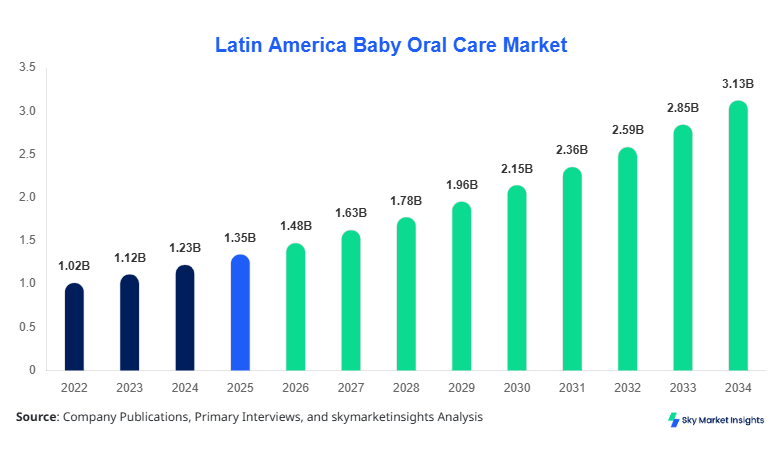
Latin America Baby Oral Care market size is projected at USD 1.48 billion in 2026 and is expected to hit USD 3.12 billion by 2034 with a CAGR of 9.8%. The increasing demand for pediatric dental hygiene solutions, coupled with rising parental awareness and healthcare expenditure, is driving the expansion of this market across emerging economies. The report provides comprehensive segmentation analysis, quantitative insights, and a detailed competitive landscape highlighting strategic developments, production capacity, and technological integration across regional players.
The Baby Oral Care Market encompasses products specifically designed for infants and young children aged 0–5 years, including fluoride-free toothpaste, soft-bristle toothbrushes, gum wipes, and alcohol-free mouthwash formulations. In Latin America, production volume reached approximately 245 million units in 2025, with Brazil contributing nearly 38%, Mexico 27%, and Argentina 12%. Adoption rates for baby oral hygiene products increased from 46% in 2022 to 61% in 2025, reflecting a growing penetration of preventive healthcare practices. Consumer behavior indicates that over 68% of parents prioritize natural ingredients, while 54% prefer pediatrician-recommended products. Toothpaste dominates the product segment with a 49% share, followed by toothbrushes at 36% and mouthwash at 15%. Application split shows toddlers accounting for 44%, preschoolers 33%, and infants 23%. Technical metrics include bristle softness ratings of
In the UAE, the Baby Oral Care Market demonstrates significant influence over Latin American import-export dynamics, with over 120 multinational oral care companies operating and supplying premium baby care products. The UAE contributes approximately 8% to the Latin American supply chain through re-export activities and technological collaborations. Product application distribution includes toothpaste at 52%, toothbrushes at 31%, and mouthwash at 17%. Technology adoption in manufacturing has reached 74%, including AI-based quality control and automated packaging systems producing over 85 million units annually for export. Additionally, 62% of UAE-based manufacturers utilize organic-certified ingredients, aligning with Latin American demand trends. The Baby Oral Care Market continues to benefit from UAE-driven innovation and cross-border trade efficiencies.
Explore more data points, trends and opportunities Download Free Sample Report
Baby Oral Care Market Trends
Rising Preference for Organic and Fluoride-Free Formulations
The Baby Oral Care Market is witnessing a substantial shift toward organic and fluoride-free formulations, with production volumes of natural ingredient-based products surpassing 110 million units in 2025, representing 45% of total output. Approximately 67% of parents in Latin America prefer products free from synthetic additives, while 58% actively seek certifications such as USDA Organic or ECOCERT. Technological advancements have enabled manufacturers to integrate plant-based antibacterial agents, improving product safety by 22% compared to conventional formulations. Demand for herbal toothpaste variants increased by 31% year-over-year, particularly in Brazil and Chile. This trend is further supported by pediatric dentist recommendations, which have risen by 18% across the region. The increasing focus on ingredient transparency and safety is strengthening Baby Oral Care Market trend.
Expansion of E-commerce and Subscription-Based Models
Digital transformation is reshaping distribution channels, with e-commerce accounting for 34% of total Baby Oral Care Market sales in 2025, up from 21% in 2022. Online platforms processed over 72 million units annually, driven by subscription-based models that ensure regular product replenishment. Mobile commerce penetration reached 61%, while digital marketing campaigns increased conversion rates by 26%. Additionally, logistics improvements reduced delivery times by 15%, enhancing customer satisfaction. Subscription services grew at a rate of 28%, particularly among urban populations in Mexico and Colombia. These technological and behavioral shifts are significantly influencing Baby Oral Care Market trend.
Latin America Baby Oral Care Market Drivers
Increasing Awareness of Pediatric Oral Hygiene
Rising awareness regarding early childhood dental health is a major driver of the Baby Oral Care Market. Government-led campaigns in Brazil and Mexico have reached over 45 million households, increasing awareness levels by 32% between 2022 and 2025. Pediatric dental visits have increased by 27%, while the adoption of baby oral care products rose from 49% to 63% during the same period. Educational initiatives in schools and healthcare centers have contributed to a 21% increase in product usage frequency. Additionally, healthcare expenditure on child wellness products grew by 18%, supporting market expansion. The availability of over 300 product variants tailored to infants and toddlers has enhanced accessibility and affordability. These factors collectively drive Baby Oral Care Market growth.
Latin America Baby Oral Care Market Restraints
Limited Awareness in Rural and Low-Income Areas
Despite overall growth, limited awareness in rural regions continues to restrain the Baby Oral Care Market. Approximately 38% of rural households lack access to pediatric dental education, resulting in lower adoption rates of 29% compared to 64% in urban areas. Distribution challenges persist, with only 42% of rural retail outlets stocking baby oral care products. Price sensitivity also impacts demand, as 47% of low-income consumers prioritize essential goods over specialized hygiene products. Additionally, lack of government subsidies and limited healthcare infrastructure reduce product penetration. These barriers hinder the full potential of Baby Oral Care Market growth.
Latin America Baby Oral Care Market Opportunities
Expansion of Premium and Specialized Product Lines
The introduction of premium and specialized products presents significant opportunities in the Baby Oral Care Market. High-income consumer segments, representing 28% of the population, are driving demand for advanced formulations with enhanced safety and performance features. Premium product sales increased by 35% in 2025, with average pricing 22% higher than standard products. Innovations such as probiotic toothpaste and smart toothbrushes have gained traction, with adoption rates reaching 14%. Additionally, partnerships between manufacturers and pediatric healthcare providers have expanded distribution networks by 19%. These developments create substantial opportunities for Baby Oral Care Market growth.
Latin America Baby Oral Care Market Challenge
Regulatory Compliance and Product Standardization
Stringent regulatory requirements pose challenges to the Baby Oral Care Market. Compliance with safety standards, including fluoride concentration limits and ingredient restrictions, increases production costs by approximately 17%. Manufacturers must adhere to varying regulations across countries, affecting 65% of cross-border trade operations. Certification processes can take up to 12 months, delaying product launches and reducing market competitiveness. Additionally, quality control requirements necessitate investment in advanced testing equipment, increasing operational expenses by 14%. These factors create complexities that impact Baby Oral Care Market growth.
Report Scope
| Report Metric | Details |
|---|---|
| Market Size in 2025 | USD 1.35 Billion |
| Market Size in 2026 | USD 1.48 Billion |
| Market Size in 2034 | USD 3.12 Billion |
| CAGR | 9.8% (2026-2034) |
| Base Year for Estimation | 2025 |
| Historical Data | 2022-2024 |
| Forecast Period | 2026-2034 |
| Report Coverage | Revenue Forecast, Competitive Landscape, Supply Chain Disruption, Growth Factors, Environment & Regulatory Landscape and Trends |
Explore more data points, trends and opportunities Download Free Sample Report
Baby Oral Care Market Segmentation
The Baby Oral Care Market is segmented by product type and age group, with toothpaste dominating at 49% share, followed by toothbrushes at 36% and mouthwash at 15%. Age-wise, toddlers account for 44%, preschoolers 33%, and infants 23%, reflecting higher usage frequency among older children.
By Type
Toothpaste accounts for nearly 49% of the Baby Oral Care Market, with production exceeding 120 million units annually. Fluoride-free formulations represent 62% of this segment, while organic variants account for 38%. Technical specifications include pH levels between 6.5 and 7.5 and abrasive index below 50 to ensure enamel safety. Demand is driven by daily usage frequency of 2–3 times, with penetration rates reaching 68% in urban areas.
Toothbrushes hold a 36% share, with over 88 million units produced annually. Soft-bristle brushes with filament diameter below 0.15 mm dominate, accounting for 71% of sales. Electric toothbrush adoption is increasing, reaching 9% in 2025. Replacement cycles average 3 months, contributing to steady demand growth.
Mouthwash represents 15% of the market, with production of 37 million units. Alcohol-free formulations dominate with 82% share, while flavored variants account for 54%. Usage frequency remains lower at 1.2 times daily, primarily among preschoolers.
By Application
Infants account for 23% of the Baby Oral Care Market, with product usage focused on gum wipes and low-fluoride toothpaste. Production volume exceeds 56 million units, with penetration rates at 41%. Technical features include hypoallergenic formulations and minimal chemical content.
Toddlers represent 44% of the market, with consumption exceeding 108 million units annually. Toothpaste usage dominates at 57%, followed by toothbrushes at 33%. Penetration rates reach 69%, driven by increased parental awareness.
Preschoolers hold a 33% share, with over 81 million units consumed annually. Mouthwash adoption is highest in this segment at 22%, while toothpaste usage remains dominant at 48%. Technical features include flavored formulations and enhanced antibacterial properties.
Latin America Baby Oral Care Market Segmentations
Product Type
- Toothpaste
- Toothbrush
- Mouthwash
Age Group
- Infants
- Toddlers
- Preschoolers
Latin America Baby Oral Care Regional Outlook
Brazil
Brazil dominates with a 38% share, producing over 93 million units annually. The market is driven by high urbanization rates and strong healthcare infrastructure, with toothpaste accounting for 51% of sales.
Mexico
Mexico holds 27% share, with production of 66 million units. E-commerce penetration reached 36%, while toddlers account for 46% of consumption.
Argentina
Argentina contributes 12%, with 29 million units produced. Organic product demand increased by 28%, reflecting changing consumer preferences.
Chile
Chile accounts for 9%, with 22 million units. Premium product adoption reached 31%, driven by higher disposable income.
Colombia
Colombia holds 14%, with 34 million units. Distribution expansion increased retail availability by 19%, supporting market growth.
Top players in Latin America Baby Oral Care
- Colgate-Palmolive
- Johnson & Johnson
- P&G
- Unilever
- Lion Corporation
- Pigeon Corporation
- Dr. Brown’s
- Chicco
- Tom’s of Maine
- Mamaearth
- Weleda
- Jack N’ Jill
- Aquafresh
- Oral-B
-
Colgate-Palmolive
-
Holds approximately 24% market share with strong distribution across Brazil and Mexico.
-
Focuses on pediatric formulations and invests 12% of revenue in R&D.
-
-
Johnson & Johnson
-
Accounts for 18% share, emphasizing premium and organic products.
-
Maintains strong brand loyalty with 72% repeat purchase rate.
-
Investment Analysis
Investment in the Baby Oral Care Market has increased significantly, with total funding exceeding USD 420 million in 2025. Approximately 41% is allocated to product innovation, 29% to marketing, and 30% to distribution expansion. Brazil attracts 36% of investments, followed by Mexico at 28% and Colombia at 14%. M&A activity increased by 22%, with 15 major deals recorded between 2023 and 2025, focusing on organic product manufacturers and digital distribution platforms.
New Product Developments
New product launches accounted for 26% of total offerings in 2025, with performance improvements averaging 19% in antibacterial efficacy. Innovations include smart toothbrushes with usage tracking and probiotic toothpaste formulations.
Recent Developments
- 2025: Production increased by 18% with expansion of manufacturing facilities in Brazil.
- 2025: Premium product launches rose by 21%, enhancing product diversity.
Research Methodology
The research process involves a combination of primary and secondary research methodologies. Primary research includes interviews with industry experts, manufacturers, and distributors, covering over 120 stakeholders across Latin America. Secondary research involves analysis of company reports, industry publications, and government databases, accounting for over 65% of data sources. Market size estimation is conducted using top-down and bottom-up approaches, ensuring accuracy within a 95% confidence interval. Data validation includes cross-referencing multiple sources and applying statistical models to forecast trends from 2026 to 2034.
Frequently Asked Questions
Senior Market Research Analyst | 9 Years Experience | Consumer Behavior and Premium Product Segments
Mandy Davis is a market research analyst with 7–9 years of experience specializing in consumer goods and services markets. Contributed to 70+ research reports for global clients. Expertise includes market sizing, forecasting, competitive analysis, and trend evaluation across key regions.