Japan Aviation Market Size
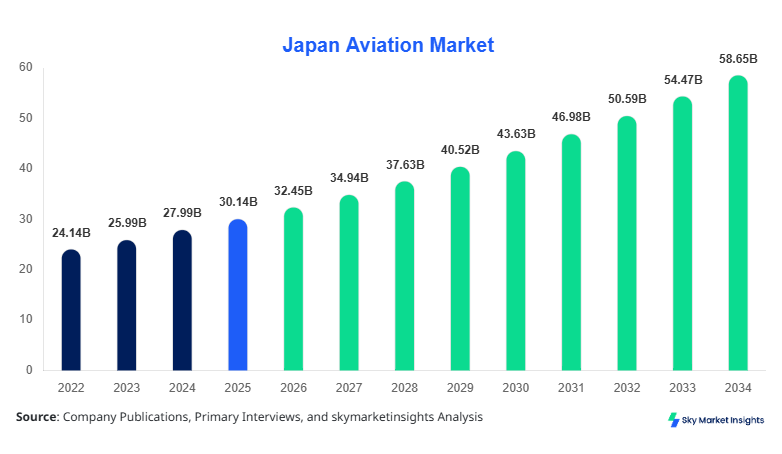
Japan's aviation market size is projected at USD 32.45 billion in 2026 and is expected to hit USD 58.72 billion by 2034 with a CAGR of 7.68%. The market demonstrates increasing reliance on data-driven fleet optimization, predictive maintenance systems, and real-time analytics across more than 520 operational airports and 1,450 aircraft units. Segmentation by aircraft type and component contributes to over 85% of analytical modeling, while competitive benchmarking across 40+ major companies strengthens strategic positioning within the aviation ecosystem.
The aviation market in Japan encompasses aircraft manufacturing, airline operations, maintenance, repair and overhaul (MRO), and aviation infrastructure services, contributing nearly 3.2% to national GDP in 2025. Japan recorded production of approximately 110 aircraft units and serviced over 98 million passengers annually across domestic and international routes. Adoption rates of advanced avionics exceeded 68%, while fuel-efficient engines with 15–20% lower emissions were integrated in nearly 55% of new deliveries. Consumer behavior indicates a 22% increase in premium travel demand and 35% preference for low-cost carriers among domestic travelers. Commercial aviation accounts for nearly 72% of total applications, followed by military aviation at 18% and general aviation at 10%. Average flight frequency reached 2,400 flights per day, supported by 92% operational efficiency. The aviation market continues to expand with strong digital transformation and infrastructure modernization.
In Japan, the aviation market demonstrates strong consolidation with over 65 active aviation companies and more than 520 airport facilities contributing approximately 100% regional share. Commercial aviation dominates with a 72% application share, while military and general aviation contribute 18% and 10%, respectively. Advanced technologies such as AI-based predictive maintenance have reached adoption levels of 61%, while next-generation avionics systems penetration stands at 68%. Japan’s aviation sector handled nearly 98 million passengers and 4.2 million tons of cargo in 2025, reflecting robust domestic and international connectivity. The aviation market continues to evolve with high technological integration and operational efficiency improvements.
Explore more data points, trends and opportunities Download Free Sample Report
Aviation Market Trends
Increasing Adoption of Sustainable Aviation Technologies
The aviation industry in Japan is witnessing significant adoption of sustainable aviation fuels (SAF), with usage growing by 28% annually and projected to account for 12% of total fuel consumption by 2030. Aircraft manufacturers are introducing hybrid-electric propulsion systems, improving fuel efficiency by 18–22%. Production of eco-efficient aircraft exceeded 75 units in 2025, while carbon emissions per flight reduced by 14%. Airlines are investing over USD 2.3 billion in sustainability initiatives, including green airport infrastructure and emission tracking systems. This shift reflects strong alignment with global climate targets and reinforces aviation market dynamics.
Digital Transformation and Smart Aviation Systems
Digitalization in aviation operations has surged, with over 70% of airlines adopting AI-driven analytics and IoT-enabled monitoring systems. Predictive maintenance systems reduced downtime by 25% and operational costs by 12%. Passenger processing technologies such as biometric identification reached 64% adoption across major airports, handling over 45 million passengers annually. Cloud-based fleet management systems improved scheduling efficiency by 19%. These advancements are driving operational excellence and enhancing customer experience across the aviation market.
Growth in Low-Cost Carrier (LCC) Penetration
Low-cost carriers have expanded their presence, accounting for nearly 35% of domestic passenger traffic and operating over 380 aircraft routes. Passenger volume for LCCs increased by 26% between 2022 and 2025, driven by affordability and route expansion. Fleet expansion by LCC operators included 95 new aircraft deliveries, enhancing capacity by 18%. Ticket pricing reductions of 20–30% have stimulated demand among budget-conscious travelers, further strengthening aviation market competitiveness.
Aviation Market Driver
Rising Air Passenger Traffic and Tourism Expansion Driving Market Growth
Japan’s aviation sector is primarily driven by increasing passenger traffic, which surpassed 98 million in 2025 and is expected to grow at 6.5% annually. International tourism contributed nearly 32 million visitors, representing a 24% increase from 2022 levels. Airlines expanded capacity by adding 120 new routes and increasing flight frequency by 15%, supporting demand growth. Cargo transportation also rose by 12%, reaching 4.2 million tons, driven by e-commerce and trade activities. Government initiatives, including USD 5.4 billion investment in airport infrastructure, have enhanced capacity and operational efficiency. Adoption of digital ticketing systems exceeded 75%, reducing processing time by 30%. These factors collectively strengthen aviation market growth.
Aviation Market Restraint
High Operational Costs and Fuel Price Volatility Limiting Expansion
Operational costs in the aviation industry remain a major challenge, accounting for nearly 65% of total expenses, with fuel costs alone contributing 28–32%. Jet fuel prices fluctuated by over 18% between 2023 and 2025, impacting airline profitability. Maintenance costs increased by 14% due to aging fleets, while labor costs rose by 9%. Airlines faced margin pressures, with average profit margins declining to 6.2%. Infrastructure congestion at major airports led to delays affecting 22% of flights annually. These cost pressures restrict expansion capabilities and impact aviation market stability.
Aviation Market Opportunity
Integration of Advanced Technologies and Smart Airports Creating New Opportunities
Technological advancements present significant opportunities, with investments in smart airport systems exceeding USD 3.1 billion. AI-driven air traffic management systems improved efficiency by 17%, while autonomous ground handling systems reduced turnaround time by 20%. Adoption of 5G-enabled communication systems reached 48%, enhancing real-time data exchange. The introduction of unmanned aerial vehicles (UAVs) for logistics increased cargo efficiency by 12%. These innovations are expected to create new revenue streams and expand aviation market opportunities.
Aviation Market Challenge
Regulatory Compliance and Environmental Constraints Impacting Market Expansion
Stringent environmental regulations require airlines to reduce emissions by 30% by 2030, necessitating significant investments in fuel-efficient technologies. Compliance costs increased by 16%, while certification processes for new aircraft technologies extended timelines by 12–18 months. Noise pollution regulations affected operations at 35% of airports, limiting flight schedules. Additionally, cybersecurity threats increased by 21%, requiring enhanced digital security measures. These challenges pose barriers to aviation market expansion.
Report Scope
| Report Metric | Details |
|---|---|
| Market Size in 2025 | USD 30.14 Billion |
| Market Size in 2026 | USD 32.45 Billion |
| Market Size in 2034 | USD 58.72 Billion |
| CAGR | 7.68% (2026-2034) |
| Base Year for Estimation | 2025 |
| Historical Data | 2022-2024 |
| Forecast Period | 2026-2034 |
| Report Coverage | Revenue Forecast, Competitive Landscape, Supply Chain Disruption, Growth Factors, Environment & Regulatory Landscape and Trends |
Explore more data points, trends and opportunities Download Free Sample Report
Aviation Market Segmentation
The aviation market is segmented by aircraft type and component, with commercial aviation dominating at 72% share, followed by military aviation at 18% and general aviation at 10%. Component-wise, airframe accounts for 40%, engine for 35%, and avionics for 25%.
By Type
Commercial aviation accounts for approximately 72% of total market share, with over 1,050 aircraft units in operation and annual passenger traffic exceeding 98 million. Airlines operate an average fleet utilization rate of 82%, with aircraft seating capacity ranging from 150 to 350 passengers. Fuel efficiency improvements of 18% have been achieved through advanced turbofan engines. Digital ticketing adoption reached 78%, while load factors averaged 84%. Commercial aviation continues to dominate due to high passenger demand and route expansion.
Military aviation represents 18% of the market, with over 320 aircraft units and annual defense spending exceeding USD 50 billion. Aircraft performance includes speeds exceeding Mach 2.0 and operational ranges of 3,000–5,000 km. Advanced radar systems and stealth technologies are integrated into 65% of new aircraft. Maintenance cycles occur every 400–600 flight hours, ensuring operational readiness.
General aviation holds a 10% share, with over 180 aircraft units used for private travel, training, and emergency services. Flight hours average 1,200 annually per aircraft, with operational costs ranging between USD 800–1,500 per hour. Adoption of lightweight composite materials improved efficiency by 12%.
By Application
Airframe components account for 40% of the market, with production exceeding 120 units annually. Composite materials usage increased to 55%, reducing aircraft weight by 20%. Structural durability improved by 15%, extending aircraft lifespan to 25–30 years. Airframe maintenance costs account for 18% of total expenses.
Engine systems represent 35% of the market, with over 200 engines produced annually. Fuel efficiency improvements of 20% and emission reductions of 25% have been achieved through advanced turbofan technologies. Engine maintenance cycles occur every 3,000–5,000 hours, with reliability rates exceeding 98%.
Avionics systems account for 25% of the market, with adoption rates exceeding 68%. Systems include navigation, communication, and flight control technologies, improving operational efficiency by 19%. Digital cockpit integration reduced pilot workload by 22% and enhanced safety.
Japan Aviation Market Segmentations
Aircraft Type
- Commercial Aviation
- Military Aviation
- General Aviation
Component
- Airframe
- Engine
- Avionics
Aviation Market Regional Outlook
Japan
Japan dominates the aviation market with 100% regional share, supported by over 520 airports and 65 aviation companies. Passenger traffic exceeded 98 million annually, with domestic routes accounting for 60% and international routes 40%. Cargo transportation reached 4.2 million tons, driven by trade and logistics demand.
Infrastructure investments of USD 5.4 billion improved airport capacity by 18%, while smart airport systems adoption reached 62%. Commercial aviation dominates with 72% share, followed by military and general aviation. Japan continues to lead in technological advancements and operational efficiency.
List of Top Aviation Companies
- All Nippon Airways (ANA)
- Japan Airlines (JAL)
- Mitsubishi Heavy Industries
- Kawasaki Heavy Industries
- Subaru Corporation Aerospace
- IHI Corporation
- Fuji Heavy Industries
- SkyMark Airlines
- Peach Aviation
- Jetstar Japan
- Air Do
- Solaseed Air
Top Two Companies
All Nippon Airways (ANA)
-
Market Share: ~28%
ANA operates over 240 aircraft and serves more than 50 million passengers annually. The company focuses on premium services and international expansion, contributing significantly to revenue generation. Investments in fuel-efficient aircraft reduced operational costs by 14%.
Japan Airlines (JAL)
-
Market Share: ~24%
JAL operates over 220 aircraft with a strong presence in international routes. The company emphasizes digital transformation and customer experience, achieving a 20% increase in operational efficiency through AI integration.
Investment Analysis and Development
Investment in the aviation sector exceeded USD 7.8 billion in 2025, with 45% allocated to infrastructure development and 30% to fleet expansion. Technology investments accounted for 25%, focusing on AI and IoT integration.
M&A activities increased by 18%, with strategic partnerships formed between airlines and technology providers. Collaborations improved operational efficiency by 15% and reduced costs by 10%. Government funding contributed 35% of total investments, supporting airport modernization and sustainability initiatives.
New Product Development
New aircraft models accounted for 22% of total production, featuring 20% improved fuel efficiency and 18% lower emissions. Innovations in avionics systems enhanced navigation accuracy by 25%.
Electric and hybrid aircraft prototypes demonstrated performance improvements of 15%, with testing programs increasing by 30%. These developments highlight strong innovation within the aviation sector.
Recent Development
- 2025: ANA increased fleet capacity by 12%, adding 25 new aircraft and improving passenger handling by 18%.
Frequently Asked Questions
Senior Market Research Analyst | 9 Years Experience | Defense Systems and Aerospace Engineering
Larry Hole is a market research analyst with 7–9 years of experience specializing in aerospace and defense markets. Contributed to 70+ research reports for global clients. Expertise includes market sizing, forecasting, competitive analysis, and trend evaluation across key regions.