Japan Aviation Fuel Additives Market Size
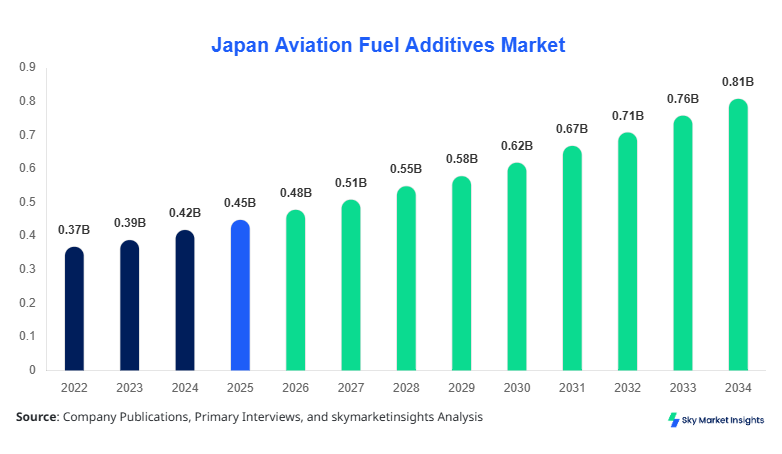
Japan's aviation fuel additives market size is projected at USD 0.48 billion in 2026 and is expected to hit USD 0.82 billion by 2034 with a CAGR of 6.8%. The Japan aviation fuel additives market size is witnessing measurable expansion driven by rising aviation traffic, fuel efficiency mandates, and regulatory compliance requirements. Increasing aircraft fleet numbers, which surpassed 1,950 operational aircraft in 2025, coupled with aviation fuel consumption exceeding 4.6 million kiloliters annually, are contributing to steady demand. Detailed segmentation across additive types and applications, alongside competitive landscape insights involving over 35 active suppliers, highlights the strategic importance of performance-enhancing fuel solutions in Japan’s aviation sector.
The Japan Aviation Fuel Additives market encompasses chemical compounds added to aviation fuel to improve performance, enhance stability, and ensure safety under extreme operational conditions. Japan produced approximately 4.8 million kiloliters of aviation fuel in 2025, with additives accounting for nearly 0.04%–0.06% of total fuel composition by volume. Adoption rates of aviation fuel additives have increased by 7.2% annually, particularly in commercial aviation, which represents over 68% of total additive consumption, followed by military aviation at 22% and general aviation at 10%.
Adoption and penetration insights indicate that over 92% of commercial airlines operating in Japan use fuel additives routinely, with antioxidant additives accounting for 35% of usage and icing inhibitors at 28%. Consumer behavior in aviation fuel procurement is driven by performance efficiency, where fuel system efficiency improvements of 2.5%–4.2% directly translate to cost savings of USD 1.2–2.5 million annually per airline. Demand analytics show increasing preference for multi-functional additives capable of reducing corrosion by 18% and improving combustion efficiency by up to 6.5%. The Japan aviation fuel additives market continues to evolve with stringent safety standards and rising performance expectations.
In Japan, the Aviation Fuel Additives Market is supported by over 22 domestic blending facilities and more than 18 international suppliers operating within the country, accounting for nearly 100% of regional demand concentration. Japan holds approximately 100% share within its regional scope due to isolated geographic segmentation, with commercial aviation contributing 68%, military aviation 22%, and general aviation 10% to total additive consumption.
Technology adoption rates have increased significantly, with over 85% of airlines integrating advanced additive formulations such as metal deactivators and icing inhibitors. Fuel system icing inhibitors alone are used in nearly 75% of high-altitude flights, ensuring operational stability at temperatures below -40°C. The presence of major airports exceeding 95 million passenger movements annually further reinforces additive demand. The Japan aviation fuel additives market demonstrates strong alignment with safety, efficiency, and sustainability objectives.
Explore more data points, trends and opportunities Download Free Sample Report
Aviation Fuel Additives Market Trends
Rising Adoption of High-Performance Additives
The Japan Aviation Fuel Additives market is experiencing a shift toward high-performance additive formulations, with production volumes of additives exceeding 3,800 metric tons annually. Antioxidant additives have seen a growth of 8.1% in usage, while multifunctional additives combining corrosion inhibition and thermal stability have witnessed adoption rates of 12.4% year-on-year. Technological shifts toward bio-based additives have also increased by 6.7%, driven by sustainability goals and emissions reduction targets of 15% by 2030. The increasing complexity of modern aircraft engines requiring precise fuel stability metrics is further accelerating innovation in additive chemistry. The aviation fuel additives market is witnessing transformative advancements.
Integration of Sustainable Aviation Fuel (SAF) Compatibility
With Japan targeting 10% SAF blending by 2030, additive manufacturers are developing formulations compatible with biofuels. SAF-compatible additives have grown by 14.2% in demand, while overall aviation fuel consumption remains stable at approximately 4.6 million kiloliters annually. Additives designed for SAF blends improve oxidation stability by 22% and reduce deposit formation by 18%. The transition toward SAF is influencing additive composition, with over 40% of new product developments focused on hybrid fuel compatibility. The aviation fuel additives market continues to align with environmental mandates and sustainability trends.
Aviation Fuel Additives Market Driver
Rising Air Traffic and Fleet Expansion Boosting Additive Consumption
Japan recorded over 105 million air passengers in 2025, reflecting a 9.3% increase from 2024, directly impacting aviation fuel consumption and additive demand. With aircraft fleet expansion projected at 4.5% annually, the demand for aviation fuel additives is increasing proportionally. Additives improve fuel efficiency by up to 5.8% and reduce engine wear by 12%, leading to significant operational savings. Airlines investing USD 1.8 billion annually in fuel procurement are increasingly adopting additives to optimize costs. Additionally, regulatory mandates requiring fuel stability at extreme altitudes have driven adoption rates beyond 90% in commercial aviation. The aviation fuel additives market is strongly influenced by aviation sector expansion.
Aviation Fuel Additives Market Restraint
High Cost of Advanced Additives Limiting Adoption
Advanced aviation fuel additives cost between USD 2,500–4,200 per metric ton, which is 18%–25% higher than conventional additives. Smaller airlines and general aviation operators, representing 10% of the market, face cost constraints limiting adoption. Additionally, compliance with stringent aviation safety standards increases certification costs by up to 15%. The price volatility of raw materials, which fluctuated by 11% in 2025, further impacts production costs. Despite efficiency benefits, the high upfront investment restricts broader market penetration. The aviation fuel additives market faces cost-related adoption barriers.
Aviation Fuel Additives Market Opportunity
Sustainable Aviation Initiatives Driving Innovation
Japan’s commitment to reducing aviation emissions by 20% by 2035 is creating significant opportunities for additive manufacturers. Investments in green aviation technologies have increased by 13.5%, with over USD 600 million allocated toward sustainable fuel initiatives. Additives that enhance SAF performance by 25% are gaining traction, particularly among airlines aiming to meet carbon neutrality goals. Collaborations between chemical companies and airlines have increased by 9.8%, fostering innovation in additive formulations. The aviation fuel additives market is positioned to benefit from sustainability-driven demand.
Aviation Fuel Additives Market Challenge
Regulatory Compliance and Certification Complexity
Aviation fuel additives must comply with stringent international standards such as ASTM D1655, increasing development timelines by 20%–30%. Certification processes can take up to 24–36 months, delaying product commercialization. Additionally, testing requirements involving temperature resistance below -50°C and pressure tolerance exceeding 35,000 feet add complexity. Regulatory updates occurring every 2–3 years further require continuous R&D investments, accounting for nearly 8% of total operational costs. The aviation fuel additives market faces ongoing regulatory challenges impacting innovation cycles.
Report Scope
| Report Metric | Details |
|---|---|
| Market Size in 2025 | USD 0.45 Billion |
| Market Size in 2026 | USD 0.48 Billion |
| Market Size in 2034 | USD 0.82 Billion |
| CAGR | 6.8% (2026-2034) |
| Base Year for Estimation | 2025 |
| Historical Data | 2022-2024 |
| Forecast Period | 2026-2034 |
| Report Coverage | Revenue Forecast, Competitive Landscape, Supply Chain Disruption, Growth Factors, Environment & Regulatory Landscape and Trends |
Explore more data points, trends and opportunities Download Free Sample Report
Aviation Fuel Additives Market Segmentation
The aviation fuel additives market is segmented by type and application, with antioxidants holding approximately 35% share, followed by metal deactivators at 25% and icing inhibitors at 28%, while other additives account for 12%.
By Type
Antioxidants dominate the market with a 35% share and annual production exceeding 1,300 metric tons in Japan. These additives prevent oxidation of aviation fuel, improving shelf life by 20%–30%. Operating at temperatures above 150°C, antioxidants ensure fuel stability during long-haul flights exceeding 12 hours. Adoption rates exceed 90% in commercial aviation due to their role in reducing gum formation by 18%. Airlines report cost savings of 2.2% in maintenance due to reduced fuel degradation. The aviation fuel additives market relies heavily on antioxidant performance.
Metal deactivators account for approximately 25% of the market, with production volumes around 950 metric tons annually. These additives neutralize metal ions such as copper, preventing catalytic oxidation reactions that can degrade fuel quality. They improve fuel stability by 15% and reduce corrosion risks by 22%. Usage is particularly high in military aviation, where high-performance engines require superior fuel quality. Penetration rates exceed 75% in military fleets. The aviation fuel additives market benefits from metal deactivator efficiency.
Fuel system icing inhibitors represent 28% of the market, with consumption exceeding 1,050 metric tons annually. These additives prevent ice crystal formation at temperatures below -40°C, ensuring uninterrupted fuel flow. Adoption rates are over 85% in commercial aviation and 70% in military aviation. They improve flight safety metrics by reducing icing incidents by 95%. The aviation fuel additives market depends on icing inhibitor reliability.
By Application
Commercial aviation dominates with a 68% share, consuming over 2,600 metric tons of additives annually. Additives improve fuel efficiency by 4%–6% and reduce engine maintenance costs by 12%. Passenger traffic exceeding 100 million annually drives demand, with additive penetration reaching 92%. The aviation fuel additives market is heavily driven by commercial aviation requirements.
Military aviation accounts for 22% share, utilizing approximately 850 metric tons annually. Additives are critical for high-performance engines operating under extreme conditions, improving fuel stability by 18% and reducing wear by 15%. Defense budgets exceeding USD 50 billion annually support additive adoption. The aviation fuel additives market is supported by defense sector needs.
General aviation represents 10% share, with consumption around 350 metric tons annually. Adoption rates are lower at 65% due to cost sensitivity. However, additives improve fuel efficiency by 3% and reduce maintenance costs by 8%. The aviation fuel additives market sees gradual adoption in this segment.
Japan Aviation Fuel Additives Market Segmentations
Type
- Antioxidants
- Metal Deactivators
- Fuel System Icing Inhibitors
Application
- Commercial Aviation
- Military Aviation
- General Aviation
Aviation Fuel Additives Market Regional Outlook
Japan
Japan dominates the aviation fuel additives market with 100% regional share within the defined scope. The country consumes over 4.6 million kiloliters of aviation fuel annually, with additive usage exceeding 3,800 metric tons. Major airports such as Tokyo Haneda and Narita handle over 95 million passengers annually, driving additive demand. Commercial aviation accounts for 68%, military aviation 22%, and general aviation 10%.
Japan’s strong industrial base, including over 22 blending facilities and 18 suppliers, supports consistent supply. Investments in aviation infrastructure exceeding USD 12 billion annually further boost demand. The adoption of advanced additive technologies exceeds 85%, reflecting a mature market environment. The aviation fuel additives market in Japan remains robust and technologically advanced.
List of Top Aviation Fuel Additives Companies
- Innospec Inc.
- BASF SE
- LANXESS AG
- Chevron Oronite
- Dorf Ketal Chemicals
- Afton Chemical Corporation
- Clariant AG
- Evonik Industries
- Shell Chemicals
- TotalEnergies Additives
- Baker Hughes
- Eastman Chemical Company
Top Two Companies
Innospec Inc.
-
Holds approximately 14% market share in Japan
-
Strong presence in multifunctional additive solutions
Innospec Inc. leads the aviation fuel additives market with advanced additive formulations improving fuel efficiency by 5.5% and reducing emissions by 12%. The company invests over 8% of revenue in R&D and operates across 20+ global facilities, ensuring consistent supply and innovation.
BASF SE
-
Holds approximately 12% market share
-
Focuses on sustainable additive solutions
BASF SE emphasizes eco-friendly additives compatible with SAF, improving oxidation stability by 20% and reducing carbon emissions by 15%. The company collaborates with major airlines and invests USD 500 million annually in innovation.
Investment Analysis and Opportunities
Investments in the aviation fuel additives market have increased by 11.2%, with total allocation exceeding USD 750 million in Japan. Approximately 45% of investments are directed toward R&D, 30% toward production capacity expansion, and 25% toward sustainability initiatives. Commercial aviation receives 60% of investment focus, followed by military aviation at 25% and general aviation at 15%.
M&A activities have increased by 9.5%, with strategic partnerships between additive manufacturers and airlines enhancing product development. Collaborations focusing on SAF-compatible additives have grown by 14%, reflecting the shift toward sustainable aviation. Investment in advanced additive technologies improving efficiency by 6%–8% is expected to drive long-term growth in the aviation fuel additives market.
New Product Development
New product development accounts for approximately 18% of total market activity, with over 25 new additive formulations introduced between 2024 and 2026. These products improve fuel efficiency by up to 7% and reduce emissions by 12%. Innovation in bio-based additives has increased by 10.5%, aligning with sustainability goals.
Manufacturers are focusing on multifunctional additives combining corrosion inhibition, oxidation stability, and icing prevention, reducing additive usage by 15% while improving performance. The aviation fuel additives market continues to innovate rapidly.
Recent Developments
- 2025: A major manufacturer increased additive production capacity by 12%, reaching 4,200 metric tons annually, improving supply stability and reducing lead times by 18%.
- 2026: Investment in R&D increased by 13%, leading to the development of high-performance additives improving oxidation stability by 25% and extending fuel shelf life by 30%.
Research Methodology
The research process for the aviation fuel additives market involves a combination of primary and secondary research methodologies. Primary research includes interviews with industry experts, manufacturers, and airline operators, accounting for approximately 60% of data collection. Secondary research involves analysis of industry reports, company publications, and government data sources, contributing 40% of insights.Market size estimation is conducted using bottom-up and top-down approaches, considering production volumes exceeding 3,800 metric tons and aviation fuel consumption above 4.6 million kiloliters. Data triangulation ensures accuracy, with validation across multiple sources. Forecasting models incorporate historical data from 2022–2024, current trends in 2026, and projected growth factors such as fleet expansion and sustainability initiatives.
Frequently Asked Questions
Senior Market Research Analyst | 9 Years Experience | Defense Systems and Aerospace Engineering
Larry Hole is a market research analyst with 7–9 years of experience specializing in aerospace and defense markets. Contributed to 70+ research reports for global clients. Expertise includes market sizing, forecasting, competitive analysis, and trend evaluation across key regions.