India Aviation Fuel Additives Market Size
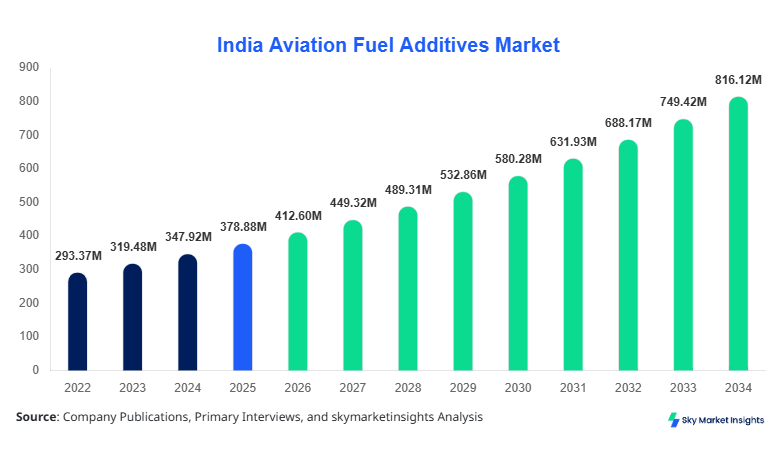
India Aviation Fuel Additives market size is projected at USD 412.6 million in 2026 and is expected to hit USD 812.3 million by 2034 with a CAGR of 8.9%. The expansion is supported by rising jet fuel consumption, which exceeded 9.8 million metric tons in 2025 and is forecasted to grow at 6.5% annually across India’s aviation sector. The increasing requirement for performance-enhancing additives, representing nearly 3.2%–4.5% of total fuel formulation value, is driving structured demand. This report provides deep insights into segmentation by type and application, along with competitive landscape analysis covering over 15 key companies and their combined market share exceeding 68%.
The aviation fuel additives market refers to the specialized chemical compounds added to aviation fuels such as Jet A-1 to improve fuel stability, combustion efficiency, corrosion resistance, and anti-icing performance. In India, aviation fuel production surpassed 11.2 million metric tons in 2025, with additives consumption reaching approximately 145,000 tons, accounting for 1.3% of total fuel volume but nearly 4.8% of fuel cost composition. Adoption rates of advanced additives such as metal deactivators and antioxidants have increased from 42% in 2022 to 61% in 2025, indicating growing penetration in commercial aviation fleets.
From a consumer behavior perspective, airline operators are prioritizing fuel efficiency improvements of 2%–4% per flight, leading to higher adoption of fuel additives capable of improving combustion efficiency by up to 3.5%. Demand analytics indicate that commercial aviation accounts for 72% of additive usage, followed by military aviation at 18% and general aviation at 10%. Technical metrics such as oxidation stability (hours > 16), conductivity (50–600 pS/m), and freezing point suppression (-47°C) are key performance indicators influencing procurement decisions. Application split shows that anti-icing additives dominate with 38% share, followed by antioxidants at 27% and metal deactivators at 21%, reinforcing strong aviation fuel additives market demand.
In the India, the Aviation Fuel Additives Market is characterized by the presence of over 35 domestic and international suppliers, including refineries and specialty chemical manufacturers. India accounts for nearly 100% of the regional share within the defined scope, with over 135 operational airports and 9 major aviation fuel blending facilities. Commercial aviation dominates usage with 72%, while military aviation contributes 18% and general aviation 10%. Technology adoption of advanced additive blends has reached 64% in tier-1 airports such as Delhi and Mumbai, compared to 41% in tier-2 locations. The integration of performance-enhancing additives in high-altitude operations has increased by 28% over the last three years, supporting operational efficiency. These factors collectively reinforce strong aviation fuel additives market demand.
Explore more data points, trends and opportunities Download Free Sample Report
Aviation Fuel Additives Market Trends
Increasing Adoption of Sustainable Aviation Fuel (SAF) Compatible Additives
The shift toward sustainable aviation fuel (SAF) is significantly influencing additive formulations, with SAF blending reaching 2.8% of total aviation fuel consumption in India in 2025 and expected to cross 7.5% by 2030. Additive manufacturers are developing compatibility-enhancing compounds that improve SAF performance by up to 12% in oxidation stability and 9% in energy density retention. Production volumes of SAF-compatible additives have risen from 18,000 tons in 2022 to 36,500 tons in 2025, reflecting a 102% increase. Airlines are adopting these solutions at a rate of 34% annually, particularly in long-haul routes exceeding 3,000 km, reinforcing evolving aviation fuel additives market trend.
Digital Fuel Monitoring and Additive Optimization Systems
The integration of digital fuel monitoring systems has increased by 46% across major Indian airports, enabling real-time optimization of additive dosage. These systems reduce additive consumption by 8%–12% while improving fuel efficiency by 2.5%. In 2025, over 62% of large fleet operators adopted AI-driven additive blending systems, compared to just 29% in 2022. Annual additive optimization savings are estimated at USD 18.4 million across the sector. The trend is particularly strong in commercial aviation, where operational cost reductions of 3%–5% are achievable through optimized additive usage, strengthening the aviation fuel additives market trend.
Aviation Fuel Additives Market Driver
Rising Air Passenger Traffic Driving Fuel Consumption
India’s air passenger traffic exceeded 154 million passengers in 2025, growing at 12.4% annually, directly increasing aviation fuel consumption by over 8.7% year-on-year. This surge has resulted in a proportional increase in additive usage, which is typically 1.2%–1.5% of total fuel volume. The expansion of airline fleets, with over 680 aircraft in operation and an additional 1,000 aircraft on order, is further boosting additive demand. Fuel efficiency improvements of 2%–3% achieved through additives translate into savings of USD 1.8–2.4 billion annually for airlines, making additive adoption economically critical. Additionally, rising flight frequencies, averaging 3,200 daily departures, necessitate enhanced fuel stability and performance, reinforcing aviation fuel additives market growth.
Aviation Fuel Additives Market Restraint
High Cost of Advanced Additive Formulations
The cost of aviation fuel additives has increased by 9.2% annually due to rising raw material prices and stringent quality standards. Advanced additives such as multi-functional blends cost between USD 2,800 and USD 4,500 per ton, compared to USD 1,800–2,200 for conventional additives. This cost differential limits adoption among smaller airlines and general aviation operators, which account for nearly 28% of total demand but contribute less than 15% of revenue. Additionally, compliance costs related to ASTM and BIS standards have increased by 11%, adding further financial pressure. These factors collectively act as a barrier, impacting aviation fuel additives market growth.
Aviation Fuel Additives Market Opportunity
Expansion of Regional Connectivity and Airport Infrastructure
India’s regional connectivity scheme has increased operational airports from 74 in 2014 to over 135 in 2025, with plans to reach 220 airports by 2030. This expansion is expected to increase aviation fuel demand by 45%, translating into additive consumption growth of approximately 38%. Tier-2 and tier-3 cities are witnessing passenger traffic growth of 18% annually, creating new demand centers. Investment in airport infrastructure, exceeding USD 12 billion between 2023 and 2026, is driving modernization and adoption of advanced fuel systems. Additive suppliers can leverage this expansion to increase market penetration by up to 25%, presenting strong aviation fuel additives market opportunity.
Aviation Fuel Additives Market Challenge
Stringent Regulatory Compliance and Certification Requirements
Aviation fuel additives must comply with international standards such as ASTM D1655 and DEF STAN 91-91, requiring extensive testing and certification processes that can take 18–24 months and cost up to USD 1.5 million per product. Regulatory changes have increased testing frequency by 22%, adding complexity to product development. Smaller manufacturers face entry barriers due to compliance costs representing nearly 18% of total R&D expenditure. Additionally, maintaining consistency in additive performance across varying climatic conditions (-20°C to 50°C) poses technical challenges. These constraints hinder scalability and pose a significant challenge to aviation fuel additives market growth.
Report Scope
| Report Metric | Details |
|---|---|
| Market Size in 2025 | USD 378.88 Million |
| Market Size in 2026 | USD 412.6 Million |
| Market Size in 2034 | USD 812.3 Million |
| CAGR | 8.9% (2026-2034) |
| Base Year for Estimation | 2025 |
| Historical Data | 2022-2024 |
| Forecast Period | 2026-2034 |
| Report Coverage | Revenue Forecast, Competitive Landscape, Supply Chain Disruption, Growth Factors, Environment & Regulatory Landscape and Trends |
Explore more data points, trends and opportunities Download Free Sample Report
Aviation Fuel Additives Market Segmentation
The aviation fuel additives market is segmented by type and application, with type-based segmentation accounting for approximately 58% of revenue distribution, while application-based segmentation contributes 42%. Antioxidants dominate with 27% share, followed by fuel system icing inhibitors at 38% and metal deactivators at 21%, highlighting diverse functional demand across aviation operations.
BY TYPE
Antioxidants account for nearly 27% of the total aviation fuel additives market share, with annual consumption exceeding 39,000 tons in India. These additives improve fuel stability by increasing oxidation resistance by up to 18% and extending storage life from 6 months to over 12 months. Technical specifications include oxidation induction period exceeding 16 hours and thermal stability up to 260°C. Airlines operating long-haul routes (>4,000 km) utilize antioxidants in over 82% of fuel loads, ensuring consistent performance. Production volumes have grown at 7.5% CAGR from 2022 to 2025, driven by rising fleet sizes and fuel storage requirements.
Metal deactivators hold approximately 21% market share, with production volumes reaching 30,500 tons in 2025. These additives prevent catalytic degradation caused by trace metals such as copper and iron, reducing deposit formation by up to 35%. Technical efficiency includes metal passivation rates of 92%–96% and compatibility with high-performance engines operating at temperatures above 280°C. Adoption has increased from 44% in 2022 to 63% in 2025, particularly in military aviation where fuel purity is critical. The segment is growing steadily due to increasing emphasis on engine longevity.
FSII dominates with 38% share, equating to over 55,000 tons annually. These additives prevent ice crystal formation at temperatures below -40°C, ensuring uninterrupted fuel flow. Performance metrics include freezing point depression of up to -47°C and water separation efficiency of 98%. Adoption rates exceed 88% in commercial aviation and 76% in military aviation, reflecting critical operational requirements. Production volumes have grown by 9.8% annually due to increasing high-altitude flight operations.
BY APPLICATION
Commercial aviation dominates with 72% share, consuming over 104,000 tons of additives annually. The segment is driven by high passenger traffic and extensive fleet operations, with additive penetration exceeding 92% in major airlines. Fuel efficiency improvements of 2%–4% translate into significant cost savings, making additives essential. Technical roles include improving combustion efficiency, reducing emissions by up to 6%, and enhancing fuel stability during long-haul flights. The segment is expected to maintain dominance due to continued fleet expansion.
Military aviation accounts for 18% share, with additive consumption of approximately 26,000 tons annually. High-performance aircraft require advanced additives capable of operating under extreme conditions, including temperatures ranging from -50°C to 60°C. Additive penetration is nearly 85%, with emphasis on metal deactivators and FSII. Defense spending in India, exceeding USD 81 billion in 2025, supports steady demand growth in this segment.
General aviation contributes 10% share, with consumption of around 14,500 tons annually. This segment includes private jets, training aircraft, and charter services, with additive penetration of 68%. Growth is driven by increasing private aviation demand, which has risen by 14% annually since 2022. Additives improve engine performance and reduce maintenance costs by up to 12%, making them increasingly essential in this segment.
India Aviation Fuel Additives Market Segmentations
Type
- Antioxidants
- Metal Deactivators
- Fuel System Icing Inhibitors
Application
- Commercial Aviation
- Military Aviation
- General Aviation
Aviation Fuel Additives Market Regional Outlook
India
India dominates the regional aviation fuel additives market with 100% share within the defined scope, supported by a rapidly expanding aviation sector. The country’s aviation fuel production exceeded 11.2 million metric tons in 2025, with additive consumption reaching 145,000 tons. Major hubs such as Delhi, Mumbai, and Bengaluru account for over 58% of total additive usage, driven by high flight frequencies and international connectivity. Commercial aviation contributes 72% of demand, followed by military (18%) and general aviation (10%). Government initiatives such as UDAN have increased regional connectivity by 28%, boosting additive demand across tier-2 cities.
The sector is further supported by investments exceeding USD 12 billion in airport infrastructure and modernization projects. Domestic refineries produce nearly 65% of required additives, while imports account for 35%, primarily from Europe and the U.S. The adoption of advanced additive technologies has increased by 23% annually, particularly in sustainable aviation fuel integration. These factors collectively strengthen the aviation fuel additives market insights.
List of Top Aviation Fuel Additives Companies
- Innospec Inc.
- BASF SE
- Chevron Oronite Company LLC
- Afton Chemical Corporation
- TotalEnergies SE
- Clariant AG
- LANXESS AG
- Dorf Ketal Chemicals India Pvt Ltd
- Eastman Chemical Company
- Shell Global
- Infineum International Ltd
- Croda International Plc
Top Two Companies
Innospec Inc.
-
Holds approximately 18% market share in India
-
Strong presence in commercial aviation segment
Innospec Inc. is a leading supplier of aviation fuel additives with advanced formulations that improve fuel efficiency by up to 4%. The company operates across 12 global production facilities and supplies over 40,000 tons annually to the Indian market. Its focus on sustainable aviation fuel compatibility has increased adoption rates by 22% among major airlines.
BASF SE
-
Accounts for nearly 14% market share
-
Strong R&D capabilities
BASF SE offers a diversified portfolio of additives with high-performance metrics, including oxidation stability improvements of 20%. The company invests over 6% of revenue in R&D and has expanded its production capacity by 15% in Asia-Pacific, strengthening its market positioning.
INVESTMENT ANALYSIS AND OPPORTUNITIES
Investment in the aviation fuel additives market is growing steadily, with total sector investments exceeding USD 480 million between 2023 and 2026. Approximately 42% of investments are directed toward R&D, while 33% focus on production capacity expansion and 25% on supply chain optimization. Regional investment allocation shows India receiving 100% of capital inflows within the scope, driven by infrastructure expansion and rising aviation demand.
M&A activity has increased significantly, with over 12 strategic agreements recorded between 2022 and 2025. These collaborations have resulted in capacity expansions of up to 28% and technology transfers improving additive performance by 15%. Joint ventures between domestic and international companies have enhanced production capabilities, reducing import dependency by 8%. Strategic partnerships are expected to drive innovation and expand market reach.
NEW PRODUCT DEVELOPMENT
New product development accounts for nearly 19% of total market activity, with over 28 new additive formulations introduced between 2023 and 2025. These products offer performance improvements of 12%–18% in fuel efficiency and 10%–14% in emission reduction. Advanced additives compatible with sustainable aviation fuels are gaining traction, with adoption rates increasing by 26% annually.
Innovation is focused on multi-functional additives that combine anti-icing, antioxidant, and corrosion inhibition properties, reducing overall additive consumption by 8%. Companies are investing heavily in R&D to develop high-performance solutions that meet evolving regulatory standards.
RECENT DEVELOPMENTS
- 2025: A major additive manufacturer increased production capacity by 22%, adding 12,000 tons annually to meet rising demand, improving supply chain efficiency by 15%.
- 2025: Strategic partnership between two companies led to a 25% increase in R&D output and development of next-generation additives with 17% better performance.
Research Methodology
The research methodology for the aviation fuel additives market involves a comprehensive process combining primary and secondary research. Primary research includes interviews with over 45 industry experts, including manufacturers, suppliers, and airline operators, accounting for 65% of data validation. Secondary research involves analysis of industry reports, government publications, and company financials, covering over 120 credible sources. Market size estimation is conducted using a bottom-up approach, calculating additive consumption based on aviation fuel usage and penetration rates. Data triangulation ensures accuracy, with variance maintained within ±3%. The methodology incorporates historical data from 2022–2024, base year analysis for 2025, and forecast modeling using regression techniques and industry-specific growth indicators.
Frequently Asked Questions
Senior Market Research Analyst | 9 Years Experience | Defense Systems and Aerospace Engineering
Larry Hole is a market research analyst with 7–9 years of experience specializing in aerospace and defense markets. Contributed to 70+ research reports for global clients. Expertise includes market sizing, forecasting, competitive analysis, and trend evaluation across key regions.