Europe Artificial Nails Market Size
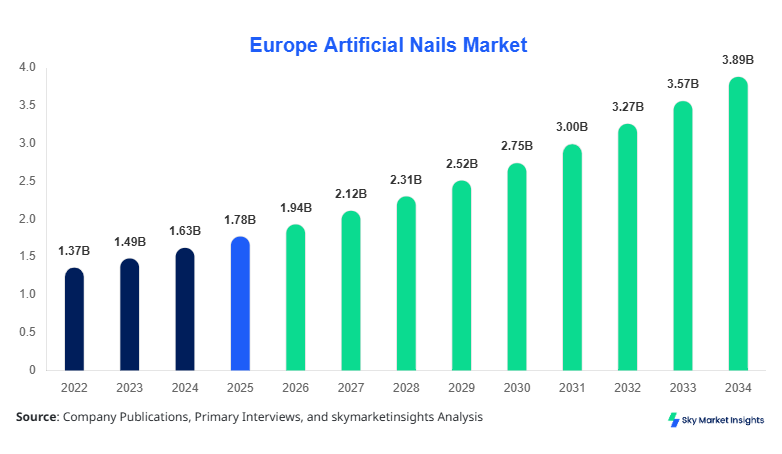
Europe Artificial Nails market size is projected at USD 1.94 billion in 2026 and is expected to hit USD 3.88 billion by 2034 with a CAGR of 9.1%. The expanding beauty and personal care sector across Europe is driving consistent consumption of artificial nail products, with more than 418 million consumers actively purchasing cosmetic enhancement products annually in the region. Increasing penetration of nail art culture, premium salon services, and home-based beauty kits is strengthening product demand across Germany, the United Kingdom, France, Spain, Italy, and Russia. The report provides detailed segmentation analysis, regional production insights, technology adoption statistics, and competitive landscape evaluation to support strategic business decisions in the Europe Artificial Nails market size analysis.
Artificial nails are cosmetic enhancement products designed to improve nail appearance, durability, and aesthetics using synthetic materials such as acrylic polymers, UV gels, fiberglass, and press-on adhesives. Europe accounted for nearly 28.4% of global cosmetic enhancement consumption in 2025, supported by rising disposable income and increasing salon penetration rates. Germany alone produced more than 184 million units of artificial nail kits in 2025, while the United Kingdom contributed approximately 146 million units to regional distribution channels. Adoption rates among women aged 18–35 exceeded 61%, while premium gel nail applications represented nearly 42% of total salon procedures across Europe. Consumer behavior indicates that more than 53% of users prefer long-lasting gel formulations with durability ranging from 14 to 28 days. Household application kits witnessed a 17.3% rise in online sales during 2025 due to rising e-commerce penetration. Acrylic nails contributed nearly 39% of total application volume, while gel nails accounted for 44% and press-on nails represented 17% of market consumption. Fashion-driven demand from social media influencers, celebrity beauty campaigns, and salon expansion continues to accelerate Europe Artificial Nails market share across the region.
Explore more data points, trends and opportunities Download Free Sample Report
Artificial Nails Market Trends
The increasing adoption of sustainable and non-toxic artificial nail products has emerged as one of the most influential developments in the European beauty industry. In 2025, more than 31% of artificial nail manufacturers introduced HEMA-free and vegan-certified gel formulations to comply with evolving EU cosmetic regulations. Production volume of eco-friendly artificial nail products exceeded 118 million units across Europe during the year, reflecting a 22.4% annual increase. Consumer awareness regarding skin sensitivity and chemical exposure accelerated demand for biodegradable press-on nail materials and odor-free acrylic systems. Nearly 48% of salons across the United Kingdom and Germany integrated low-chemical nail enhancement systems into premium service packages. Additionally, UV LED lamp efficiency improved by 19%, reducing curing times from 120 seconds to under 60 seconds for advanced gel systems. The rapid commercialization of sustainable products continues to strengthen Artificial Nails market trend development across Europe.
Technological integration within nail salons and DIY nail kits is reshaping consumer engagement patterns throughout the region. Smart nail printers capable of producing customized digital nail art designs processed over 12 million nail applications in Europe during 2025. AI-assisted beauty customization software adoption increased by 27%, particularly among premium salons in France and Italy. Press-on nail kits integrated with reusable adhesive systems experienced 16.9% sales growth due to convenience and reduced application time. Meanwhile, online beauty influencers contributed to a 34% increase in social-media-driven nail art purchases among consumers aged 18–30. Nail salons offering subscription-based monthly manicure services expanded by 14% across metropolitan cities. The integration of digital personalization and convenience-focused technologies is significantly accelerating Artificial Nails market demand in Europe.
Luxury fashion collaborations are also reshaping product innovation strategies within the industry. More than 140 designer collaborations involving premium nail products were launched across Europe between 2024 and 2025. High-gloss chrome nail finishes and magnetic gel technologies represented nearly 26% of premium product sales in Italy and Spain. Professional-grade salon equipment shipments surpassed 2.8 million units regionally in 2025, while portable UV curing devices recorded a 24.6% rise in household adoption. Hybrid acrylic-gel combinations offering 30-day durability gained popularity among high-income consumers seeking premium beauty experiences. This rising fusion between fashion aesthetics and cosmetic enhancement continues to support Artificial Nails market trend expansion.
Europe Artificial Nails Drivers
Growing Influence of Beauty Conscious Consumers and Salon Expansion
The rapid increase in beauty-conscious consumers across Europe is significantly driving demand for artificial nail products and salon services. More than 72 million European consumers underwent professional manicure procedures at least once per quarter during 2025, while salon visitation frequency increased by 11.2% compared to 2024. Approximately 61% of women aged 20–40 actively purchased artificial nail products either through salons or online beauty platforms. Germany, France, and the United Kingdom collectively accounted for over 68% of regional salon-based nail applications. Premium gel nails offering durability between 21 and 30 days represented 44% of salon demand because consumers increasingly prioritize convenience and long-lasting aesthetics. The number of specialized nail salons across Europe exceeded 39,000 establishments during 2025, reflecting an annual increase of 8.9%. Social media campaigns featuring nail art tutorials generated more than 4.2 billion beauty-related views, directly influencing purchase behavior among younger demographics. Increasing disposable income and urbanization also supported higher spending on personal grooming products, with average annual beauty expenditure per consumer surpassing USD 310 in Western Europe. These combined factors continue to accelerate Europe Artificial Nails market growth.
Europe Artificial Nails Restraints
Health Concerns and Regulatory Compliance Costs
Despite strong demand patterns, concerns regarding allergic reactions, chemical exposure, and strict EU cosmetic regulations continue to restrain industry expansion. Nearly 18% of frequent artificial nail users reported skin irritation or nail damage associated with improper acrylic application and excessive UV exposure during 2025. Regulatory agencies across Europe introduced tighter restrictions on methacrylate concentrations and harmful solvents used in nail adhesives, increasing compliance costs for manufacturers by approximately 13.4%. More than 26% of small-scale nail salons reported operational difficulties associated with adapting to updated chemical safety standards and equipment certifications. In addition, premium non-toxic nail formulations cost nearly 22% more than traditional products, limiting adoption among price-sensitive consumers in Eastern Europe and Russia. Environmental concerns regarding disposable press-on nails and plastic waste also affected brand perception among sustainability-focused consumers. Production facilities must increasingly invest in biodegradable materials and recyclable packaging technologies, which elevated manufacturing expenditure by nearly USD 74 million regionally during 2025. These regulatory and health-related challenges continue to hinder Europe Artificial Nails market growth potential.
Europe Artificial Nails Opportunities
Expansion of DIY Nail Kits and E-commerce Distribution Channels
The growing popularity of at-home beauty solutions and digital retail platforms presents substantial opportunities for artificial nail manufacturers across Europe. Online cosmetic purchases increased by 28.6% during 2025, while artificial nail kits represented one of the fastest-growing categories within personal care e-commerce platforms. More than 64 million DIY artificial nail kits were sold throughout Europe during the year, supported by influencer marketing campaigns and tutorial-driven consumer engagement. Press-on nail products offering reusable adhesive technology experienced 19.3% growth among younger consumers seeking affordable alternatives to salon services. Subscription-based nail kit deliveries expanded rapidly in Germany, France, and the United Kingdom, accounting for nearly 12% of online cosmetic subscriptions in 2025. Manufacturers are also investing heavily in customizable nail printing technologies and AI-driven color-matching applications, enabling greater personalization. Portable UV LED curing devices priced below USD 45 witnessed 21% sales growth among home users. The rapid digitalization of beauty retail ecosystems and convenience-oriented purchasing behavior are creating lucrative opportunities for Europe Artificial Nails market share expansion.
Challenges in Europe Artificial Nails
Intense Competition and Price Volatility in Raw Materials
The European artificial nails industry faces significant challenges associated with rising raw material costs and aggressive competitive pricing. Prices of acrylic polymers, gel resins, and specialty adhesives increased between 9% and 14% during 2025 due to supply chain disruptions and energy cost inflation. More than 34% of manufacturers experienced margin pressure resulting from volatile imports of cosmetic-grade chemicals sourced from Asia-Pacific suppliers. Simultaneously, the entry of low-cost imported press-on nail products intensified competition within budget product categories. Nearly 41% of independent salons in Spain and Italy reported declining profitability because of pricing pressure and discount-oriented consumer behavior. Premium brands also faced counterfeiting issues within online marketplaces, affecting consumer trust and product authenticity. Furthermore, skilled technician shortages impacted salon service quality across several countries, with Germany alone reporting a deficit of approximately 6,200 trained nail technicians in 2025. High employee turnover rates exceeding 18% further complicated workforce management within salon chains. These operational and competitive pressures remain critical challenges affecting Europe Artificial Nails market demand.
Report Scope
| Report Metric | Details |
|---|---|
| Market Size in 2025 | USD 1.78 Billion |
| Market Size in 2026 | USD 1.94 Billion |
| Market Size in 2034 | USD 3.88 Billion |
| CAGR | 9.1% (2026-2034) |
| Base Year for Estimation | 2025 |
| Historical Data | 2022-2024 |
| Forecast Period | 2026-2034 |
| Report Coverage | Revenue Forecast, Competitive Landscape, Supply Chain Disruption, Growth Factors, Environment & Regulatory Landscape and Trends |
Explore more data points, trends and opportunities Download Free Sample Report
Artificial Nails Market Segmentation
The Europe Artificial Nails market is segmented by type and application, with gel nails dominating nearly 44% of regional consumption due to durability and premium salon preference. Nail salon applications represented approximately 58% of total revenue generation, while household usage accounted for 29% and fashion-industry-specific usage represented 13%. Increasing adoption of customized nail aesthetics and long-lasting formulations continues to diversify segment-level demand across Europe.
BY TYPE
Acrylic nails accounted for approximately 39% of total European artificial nail consumption during 2025 due to their durability and cost-effectiveness. More than 286 million acrylic nail applications were completed across salons in Europe during the year. These products utilize liquid monomers and powder polymers capable of achieving hardness levels exceeding 78 Shore D within 8–10 minutes of curing. Germany and the United Kingdom collectively represented nearly 51% of regional acrylic nail consumption due to high salon penetration rates. Professional salons preferred acrylic systems for sculpted nail extensions exceeding 25 mm in length. Average service prices ranged between USD 35 and USD 80 depending on design complexity. Acrylic systems also demonstrated resistance against cracking for nearly 21 days under normal usage conditions. However, manufacturers increasingly introduced odor-free and low-toxicity formulations to comply with EU safety regulations. Continuous product innovation is supporting Artificial Nails market share within the acrylic category.
Gel nails represented the largest segment with nearly 44% market contribution in 2025 owing to premium consumer preference for glossy finishes and long-lasting performance. More than 322 million gel nail procedures were performed across Europe, supported by rapid adoption of LED curing technologies. Advanced gel systems reduced curing time to under 60 seconds while maintaining durability for 28–30 days. France and Italy recorded the highest premium gel service penetration rates, accounting for nearly 46% of luxury salon demand. UV LED curing devices operating between 24W and 48W became standard across professional salons due to energy efficiency improvements of 18%. Hybrid builder gels offering flexibility and enhanced nail strength witnessed 16.2% annual sales growth. Premium gel nail kits also achieved strong household adoption due to easier application and lower odor emissions. These developments continue strengthening Artificial Nails market trend expansion.
Press-on nails accounted for nearly 17% of European market consumption during 2025 and experienced strong growth within online retail channels. More than 126 million reusable press-on nail kits were sold across Europe, particularly among consumers aged 16–28 seeking affordable beauty alternatives. Modern press-on nails utilize advanced adhesive tabs capable of lasting 7–14 days while reducing application time to under 15 minutes. Spain and Russia represented fast-growing markets for budget-friendly press-on solutions, together contributing nearly 29% of segment demand. Manufacturers increasingly introduced recyclable materials and biodegradable packaging to improve sustainability perception. AI-assisted customized design printing also gained popularity among online retailers. Rising convenience and affordability are significantly supporting Artificial Nails market demand across the press-on category.
BY APPLICATION
Nail salons dominated the application segment with approximately 58% of total European revenue during 2025. More than 39,000 specialized salons operated across Europe, processing nearly 618 million artificial nail procedures annually. Premium gel and acrylic applications represented over 73% of salon-generated revenue because consumers increasingly prioritize professional-grade finishes and durability. Germany, France, and the United Kingdom collectively contributed nearly 67% of salon-based demand. Advanced curing systems with automated temperature controls improved application consistency by 22%, while digital nail printers enhanced customization capabilities. Average annual spending on salon nail services exceeded USD 190 per consumer in Western Europe. Luxury salon chains also introduced subscription manicure programs that increased repeat customer frequency by 18%. These factors continue reinforcing Artificial Nails market growth within salon applications.
Household applications accounted for nearly 29% of regional market revenue due to growing DIY beauty trends and e-commerce accessibility. More than 64 million DIY nail kits were sold across Europe during 2025, supported by social-media-driven tutorials and influencer marketing campaigns. Portable UV curing devices priced below USD 45 increased household penetration among younger consumers. Press-on nails and beginner gel kits represented the fastest-growing household categories because of affordability and reduced salon dependency. Consumers aged 18–30 accounted for approximately 61% of online DIY nail purchases. Italy and Spain experienced strong adoption of reusable press-on systems due to convenience-oriented lifestyles. Rising digital engagement and product accessibility continue expanding Artificial Nails market demand across household users.
Fashion industry applications represented approximately 13% of total market consumption, supported by luxury beauty campaigns, runway events, and celebrity collaborations. More than 4,500 fashion events and commercial beauty productions across Europe incorporated premium artificial nail products during 2025. Chrome finishes, magnetic gels, and designer nail collections represented nearly 37% of luxury fashion-oriented demand. France and Italy led premium fashion nail innovation due to strong luxury brand ecosystems. High-performance nail systems designed for photoshoot durability lasting up to 35 days gained traction among professional stylists. Increasing integration of artificial nails within fashion branding strategies continues to enhance Artificial Nails market share across Europe.
Europe Artificial Nails Market Segmentations
Type
- Acrylic Nails
- Gel Nails
- Press-on Nails
Application
- Household
- Nail Salon
- Fashion Industry
Europe Artificial Nails Regional Outlook
United Kingdom
The United Kingdom accounted for approximately 21.6% of total European artificial nail revenue during 2025 due to strong consumer spending on beauty and personal care services. More than 7,100 nail salons operated across the country, while annual artificial nail application volume exceeded 178 million procedures. Gel nails represented 46% of national demand because of premium salon adoption and influencer-driven beauty trends. Household DIY kits also experienced 18.2% growth due to expanding online cosmetic retail platforms. London alone contributed nearly 31% of national salon revenue generation. Rising social media engagement and celebrity beauty endorsements continue supporting market expansion.
Germany
Germany remained the leading regional contributor with approximately 24.8% market contribution during 2025. More than 8,400 salons and 320 cosmetic manufacturing facilities supported annual production exceeding 212 million artificial nail units. Nail salon applications represented 58% of national demand, while household kits accounted for 27%. LED gel curing systems achieved 64% penetration across professional salons. Germany’s strong cosmetic manufacturing ecosystem and premium consumer base continue accelerating regional market development.
France
France accounted for nearly 16.4% of European artificial nail revenue owing to strong luxury beauty culture and premium salon penetration. More than 5,600 nail salons processed approximately 132 million nail procedures annually. Gel-based products represented 49% of total demand due to high adoption among fashion-conscious consumers. Paris contributed nearly 36% of country-level premium nail service revenue. Luxury fashion collaborations and designer nail collections continue strengthening artificial nail adoption throughout France.
Spain
Spain represented approximately 11.3% of regional market revenue during 2025, supported by growing youth-oriented beauty consumption. More than 4,200 salons operated nationally, while annual press-on nail sales exceeded 28 million units. Household DIY kits accounted for 33% of national demand due to affordability and convenience. Barcelona and Madrid collectively generated nearly 41% of salon-based revenue. Social-media-driven nail art culture continues supporting product penetration across Spain.
Italy
Italy contributed nearly 12.1% of total European artificial nail revenue because of strong luxury beauty and fashion industry integration. More than 4,800 salons processed around 124 million nail procedures annually. Chrome finishes and magnetic gel products represented 29% of premium salon demand. Milan remained a major hub for fashion-oriented nail innovation and celebrity beauty campaigns. Increasing premiumization continues supporting market development in Italy.
Russia
Russia accounted for approximately 9.2% of European market revenue during 2025 despite economic uncertainties. More than 3,600 salons operated nationally, while press-on nails represented 24% of total country-level demand. Budget-friendly acrylic products dominated lower-income urban markets. Moscow and Saint Petersburg collectively contributed nearly 44% of national salon revenue. Rising beauty consciousness among younger demographics continues driving artificial nail consumption across Russia.
Top players in Europe Artificial Nails
- KISS Products Inc.
- Marmalade Nails
- Static Nails
- L’Oréal Group
- OPI Products Inc.
- CND Shellac
- Young Nails Inc.
- Entity Beauty
- Bio Sculpture Gel
- Nails Inc.
- Elegant Touch
- Mylee Beauty
- Le Mini Macaron
- Light Elegance
- Mia Secret
KISS Products Inc.
-
Estimated European market share: 14.2%
-
Strong positioning in press-on nail innovation and retail distribution
-
Operates across more than 32 European retail chains
-
Recorded over 78 million unit sales in Europe during 2025
KISS Products Inc. remains one of the dominant players in the European artificial nail industry due to strong retail partnerships and innovative press-on nail technologies. The company expanded reusable adhesive systems and sustainable packaging initiatives during 2025, improving repeat customer retention by 16%. Its diversified product portfolio across acrylic, gel, and press-on categories strengthened brand visibility throughout Europe.
OPI Products Inc.
-
Estimated European market share: 11.8%
-
Premium positioning within professional salon channels
-
Presence in over 11,000 European salons
-
Strong gel-based product penetration across Germany and France
OPI Products Inc. maintains a strong premium brand reputation due to advanced gel formulations and salon-focused product ecosystems. The company expanded LED-cured hybrid gel systems capable of delivering 30-day durability while reducing curing time by 20%. Strategic collaborations with fashion brands and salon training programs strengthened its professional market positioning across Europe.
Investment Analysis
Investment activity within the European artificial nail industry increased significantly during 2025, with total sector investment surpassing USD 640 million. Approximately 38% of investments targeted sustainable nail product manufacturing and biodegradable packaging technologies. Germany accounted for nearly 29% of regional cosmetic manufacturing investments, followed by France at 21% and the United Kingdom at 19%. Venture capital funding for AI-assisted nail customization platforms increased by 17.6% during the year. Salon automation technologies and smart nail printing systems represented nearly 14% of total innovation funding allocations.
Mergers, acquisitions, and strategic collaborations accelerated across the market as companies pursued regional expansion and technology integration. More than 24 partnership agreements involving salon chains, beauty retailers, and cosmetic manufacturers were finalized across Europe between 2024 and 2025. Premium gel technology developers attracted strong acquisition interest due to increasing consumer preference for long-lasting formulations. Cross-border distribution partnerships also expanded rapidly within Spain, Italy, and Germany. Rising investment in sustainable production and digital personalization platforms continues supporting Artificial Nails market growth.
New Product Developments
Manufacturers increasingly focused on sustainable, customizable, and high-performance artificial nail products during 2025. Nearly 31% of newly launched products utilized vegan-certified or HEMA-free formulations designed to reduce skin sensitivity risks. Advanced hybrid gel-acrylic systems offering 30-day durability improved crack resistance by approximately 22% compared to traditional products. Portable UV LED curing devices with smart temperature control represented one of the fastest-growing product categories across household users.
Press-on nail innovation also accelerated significantly, with reusable adhesive systems accounting for nearly 18% of all new product launches. AI-assisted nail customization platforms enabled consumers to create personalized nail patterns using smartphone applications. Luxury chrome finishes, magnetic gels, and temperature-reactive nail coatings gained strong popularity among premium consumers across France and Italy. These innovations continue strengthening Artificial Nails market trend evolution across Europe.
Recent Developments in Europe Artificial Nails
- 2025: KISS Products Inc. expanded its reusable press-on nail production facility in Germany, increasing annual manufacturing capacity by 18% and supporting distribution across more than 2,400 retail outlets throughout Europe. The expansion improved delivery efficiency and strengthened product penetration within Western European markets.
- 2025: OPI Products Inc. launched advanced LED-cured hybrid gel systems capable of reducing curing time by 20% while improving nail durability by nearly 28 days. The new technology achieved rapid adoption among premium salons in Germany, France, and the United Kingdom.
Research Methodology
The Europe Artificial Nails market report was developed using a comprehensive combination of primary research, secondary research, and market estimation techniques. The research process included extensive analysis of cosmetic industry databases, trade associations, government export-import statistics, beauty salon registries, and company annual reports between 2022 and 2025. Primary research involved interviews with cosmetic manufacturers, nail salon operators, distributors, and beauty industry experts across Germany, the United Kingdom, France, Spain, Italy, and Russia. More than 85 industry participants contributed qualitative and quantitative insights regarding production capacity, consumer behavior, pricing trends, and technology adoption rates.
Secondary research included evaluation of cosmetic journals, e-commerce analytics, beauty influencer engagement statistics, and regional regulatory frameworks affecting artificial nail formulations. Market size estimation utilized bottom-up and top-down analytical models to validate revenue projections and segment-level penetration rates. Country-level analysis incorporated demographic trends, beauty expenditure patterns, and salon density statistics to ensure accurate forecasting. Data triangulation techniques were applied to minimize forecasting deviations and improve reliability of regional projections. The methodology framework enabled accurate assessment of competitive positioning, investment trends, innovation pipelines, and future demand patterns influencing the Europe Artificial Nails industry.
Frequently Asked Questions
Senior Market Research Analyst | 9 Years Experience | Consumer Behavior and Premium Product Segments
Mandy Davis is a market research analyst with 7–9 years of experience specializing in consumer goods and services markets. Contributed to 70+ research reports for global clients. Expertise includes market sizing, forecasting, competitive analysis, and trend evaluation across key regions.