Europe Artificial Meat Market Size
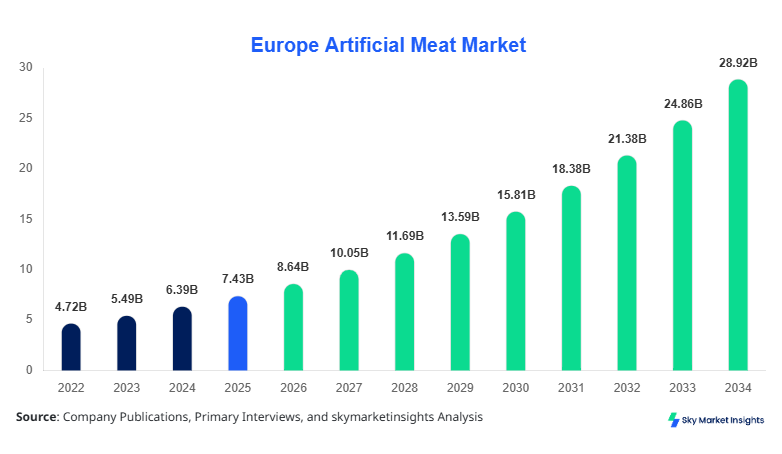
Europe Artificial Meat market size is projected at USD 8.64 billion in 2026 and is expected to hit USD 28.91 billion by 2034 with a CAGR of 16.3%.
The market expansion is being driven by rising vegan consumption patterns, increasing protein substitution rates, and strong investments in cellular agriculture across Europe. More than 42% of European urban consumers are actively reducing red meat intake, while over 31 million consumers regularly purchase plant-based protein products at least once every month. Growing demand for sustainable food alternatives, combined with regulatory support and technological improvements in cultured protein manufacturing, is strengthening the regional competitive landscape. Market participants are increasingly focusing on segmentation by protein source, end-use application, and distribution channels to optimize revenue generation and expand regional penetration.
The Artificial Meat Market refers to the production and commercialization of protein alternatives developed through plant-based formulations, cultured cellular agriculture, and fermentation-based technologies designed to replicate conventional animal meat texture, flavor, and nutritional composition. Europe produced approximately 2.4 million metric tons of plant-derived protein ingredients in 2025, with France, Germany, and the United Kingdom accounting for nearly 58% of regional output. Adoption rates among consumers aged 18–35 exceeded 47% in metropolitan regions, while penetration within retail supermarket chains crossed 72% across Western Europe. The retail application segment contributed nearly 49% of total consumption volume, while foodservice represented 34% and industrial processing accounted for 17% of total demand.
Consumer purchasing behavior indicates that 63% of buyers prioritize environmental sustainability, while 41% consider cholesterol reduction and health optimization as primary purchase factors. Average consumption frequency increased from 2.1 units per month in 2022 to 4.6 units in 2025. Product performance improvements, including protein concentration above 18 grams per serving and moisture retention efficiency exceeding 92%, have accelerated adoption among flexitarian consumers. Plant-based burgers accounted for 38% of total artificial protein sales volume, followed by sausages at 24% and nuggets at 18%. Increasing awareness regarding greenhouse gas reduction and water conservation continues to reinforce long-term Artificial Meat Market expansion across Europe.
Explore more data points, trends and opportunities Download Free Sample Report
Artificial Meat Market Trends
Expansion of Cultured Protein Manufacturing Facilities
The European alternative protein industry has witnessed substantial infrastructure expansion, with cultured protein manufacturing capacity increasing by 68% between 2023 and 2025. More than 74 new bioreactor facilities were commissioned across Europe during 2025, with combined production potential exceeding 92,000 metric tons annually. Advanced cell-cultivation systems capable of reducing growth medium costs by 32% have significantly improved commercial viability. Germany, France, and the United Kingdom collectively represented nearly 63% of all cultured protein investments during the year. Foodservice operators reported a 27% increase in menu integration of cultured protein products, while premium retail shelf availability rose by 41%. The incorporation of precision fermentation and scaffold-free tissue engineering technologies continues accelerating commercialization efficiency and strengthens Artificial Meat Market adoption across urban consumer groups.
Rapid Consumer Transition toward Sustainable Protein Diets
Consumer transition toward sustainable food alternatives has become one of the strongest regional trends influencing protein substitution. Approximately 58% of European consumers reported reducing traditional meat consumption during 2025, while vegan and flexitarian populations increased by 14% year-over-year. Plant-based protein products achieved annual retail sales exceeding 1.8 billion packaged units, with frozen products contributing 46% of total volume. Restaurants offering alternative protein menus increased by 33% across Europe, particularly in France, Spain, and Italy. Environmental sustainability metrics continue shaping purchasing decisions, with 71% of surveyed consumers considering carbon emissions before selecting food products. Additionally, products fortified with vitamin B12, iron, and omega-3 achieved 29% faster sales growth than conventional plant protein products. Rising health awareness and sustainability concerns continue strengthening Artificial Meat Market expansion.
Integration of Advanced Food Processing Technologies
Technological transformation within protein manufacturing has accelerated significantly, particularly through automation and precision ingredient engineering. High-moisture extrusion systems now account for 57% of plant-based protein manufacturing across Europe, improving texture consistency by 26% and reducing energy consumption by 18%. Smart manufacturing systems integrated with AI-based quality monitoring reduced production defects below 3.5%, while fermentation optimization technologies enhanced protein yield by 22%. The average shelf life of refrigerated alternative protein products improved from 9 days in 2022 to 16 days in 2025. Investments in clean-label ingredient technologies increased by 38%, driven by consumer demand for minimally processed formulations. These advancements continue enhancing efficiency, scalability, and profitability across the Artificial Meat Market.
Europe Artificial Meat Drivers
Rising Sustainability Awareness and Carbon Reduction Initiatives
Growing environmental concerns are driving substantial adoption of alternative proteins throughout Europe. Conventional livestock production contributes nearly 14.5% of global greenhouse gas emissions, while artificial protein manufacturing can reduce carbon emissions by up to 78% and water consumption by 82%. European governments allocated more than USD 2.3 billion toward sustainable agriculture and protein transition initiatives between 2023 and 2025. Approximately 61% of consumers under age 40 actively prefer sustainable food products, while retail chains increased shelf space allocation for alternative proteins by 37% during 2025. Food manufacturers reported a 29% increase in private-label plant protein launches, while institutional procurement programs for schools and hospitals expanded by 19%. Urbanization, rising disposable incomes, and growing climate awareness continue reinforcing long-term adoption of sustainable protein solutions, accelerating Artificial Meat Market expansion across Europe.
Europe Artificial Meat Restraints
High Production Costs and Consumer Price Sensitivity
Despite rapid adoption, high manufacturing costs remain a significant restraint for large-scale commercialization. Cultured protein production costs still average USD 14–18 per kilogram, compared with USD 5–7 per kilogram for conventional poultry products. Energy-intensive bioreactor systems contribute nearly 32% of operational expenditures, while advanced growth media represent another 24% of total manufacturing costs. Approximately 46% of European consumers identified premium pricing as the primary barrier to regular purchases. Distribution inefficiencies and cold-chain logistics expenses increased retail product prices by an additional 11% in several European countries. Small-scale manufacturers also face capital investment challenges, with average facility setup costs exceeding USD 60 million. These cost-related limitations continue constraining broader Artificial Meat Market penetration within price-sensitive consumer segments.
Europe Artificial Meat Opportunities
Expansion of Foodservice Partnerships and Institutional Adoption
The increasing integration of alternative proteins within restaurants, institutional catering, and hospitality sectors presents substantial growth opportunities. More than 38,000 European restaurants incorporated plant-based protein menus during 2025, representing a 31% annual increase. Institutional procurement for universities, hospitals, and corporate cafeterias expanded by 22%, particularly in France and Germany. Foodservice applications are projected to account for nearly 40% of total regional demand by 2030. Quick-service restaurant partnerships generated over USD 1.2 billion in alternative protein sales during 2025, while co-branding agreements between manufacturers and retail chains increased by 28%. Investment in frozen and ready-to-cook protein products also accelerated, supported by rising convenience-food consumption. These commercial collaborations continue creating profitable opportunities throughout the Artificial Meat Market.
Europe Artificial Meat Challenge
Regulatory Approval Complexity and Consumer Perception Barriers
Regulatory complexity and consumer skepticism remain major operational challenges for manufacturers. Cultured protein products require extensive safety approvals from European regulatory authorities, often extending commercialization timelines beyond 24 months. More than 36% of surveyed consumers expressed uncertainty regarding long-term health impacts of lab-grown proteins, while 29% questioned ingredient transparency and processing methods. Labeling regulations differ significantly across European countries, creating compliance costs exceeding USD 8 million annually for multinational producers. Public misinformation regarding genetically modified ingredients and synthetic processing has also affected adoption among older demographics. Additionally, supply chain disruptions and ingredient sourcing volatility increased production lead times by 14% during 2025. Addressing these regulatory and perception-related barriers remains critical for sustaining Artificial Meat Market expansion.
Report Scope
| Report Metric | Details |
|---|---|
| Market Size in 2025 | USD 7.43 Billion |
| Market Size in 2026 | USD 8.64 Billion |
| Market Size in 2034 | USD 28.91 Billion |
| CAGR | 16.3% (2026-2034) |
| Base Year for Estimation | 2025 |
| Historical Data | 2022-2024 |
| Forecast Period | 2026-2034 |
| Report Coverage | Revenue Forecast, Competitive Landscape, Supply Chain Disruption, Growth Factors, Environment & Regulatory Landscape and Trends |
Explore more data points, trends and opportunities Download Free Sample Report
Artificial Meat Market Segmentation
The European artificial protein industry is segmented by type and application, with plant-based protein products accounting for approximately 67% of total revenues during 2025. Foodservice and retail channels collectively represented nearly 83% of overall consumption. Growing diversification in protein formulations and distribution channels continues strengthening regional market competitiveness.
By Type
Plant-based meat dominated the regional industry with approximately 67% revenue contribution in 2025. Production volumes exceeded 1.9 million metric tons annually across Europe, supported by advanced extrusion technologies and soy-pea protein blends containing over 18 grams of protein per serving. Germany and France collectively accounted for 48% of total regional plant-based manufacturing capacity. Product innovations in texture replication, flavor stabilization, and clean-label formulations increased repeat consumer purchases by 26%. Refrigerated plant-based products represented 58% of category revenues, while frozen products contributed 42%.
Cultured meat represented nearly 18% of regional alternative protein revenues and remains one of the fastest-growing categories. More than 42 pilot-scale production facilities operated across Europe during 2025, producing approximately 38,000 metric tons of cultured proteins. Advanced bioreactor technologies improved cellular yield efficiency by 31%, while serum-free growth media reduced production costs by 22%. Premium restaurants and luxury retail channels accounted for nearly 61% of cultured protein distribution.
Insect-based protein products accounted for approximately 9% of regional consumption, particularly within nutritional supplements and processed snack applications. Europe produced nearly 120,000 metric tons of insect-derived protein ingredients during 2025. Protein concentration levels exceeded 65%, making these products attractive for industrial food processing. France and the Netherlands led regional adoption with a combined 52% share of production.
Hybrid protein formulations combining plant-based and cultivated ingredients represented nearly 6% of total revenues. Manufacturers increasingly adopted blended formulations to improve sensory characteristics and reduce production costs. These products achieved 18% higher consumer acceptance rates compared with standalone cultured formulations.
By Application
Retail applications accounted for approximately 49% of total regional revenues during 2025. More than 74,000 supermarket outlets across Europe sold alternative protein products, while packaged retail sales exceeded 1.8 billion units annually. Frozen burger patties and ready-to-cook sausages represented 44% of retail sales volume. Consumer penetration rates within urban households crossed 51%, particularly among millennials and Gen Z demographics. Advanced cold-chain logistics systems reduced spoilage rates below 4%, improving operational profitability for retailers.
Foodservice represented nearly 34% of total regional demand. Restaurants, cafes, and quick-service chains integrated alternative proteins into menus at unprecedented rates, with more than 38,000 establishments offering dedicated plant-based options during 2025. Premium burger chains generated nearly USD 620 million in annual sales from artificial protein products. Cultured protein dishes achieved average menu premiums of 18% compared with traditional meat offerings. Hospitality and catering sectors increasingly adopted alternative proteins to align with sustainability commitments and consumer dietary preferences.
Industrial processing applications contributed approximately 17% of regional revenues. Processed foods, frozen meals, and nutritional supplements accounted for the majority of industrial demand. Manufacturers utilized alternative proteins within over 12,000 packaged food products across Europe during 2025. Functional protein concentration above 60% enabled wider adoption in sports nutrition and fortified food formulations. Shelf-stability improvements increased industrial processing efficiency by 19%.
Pet food and specialty nutrition applications also demonstrated strong growth potential. Alternative proteins represented nearly 8% of premium pet food formulations introduced during 2025, driven by sustainability-oriented purchasing behavior among consumers.
Europe Artificial Meat Market Segmentations
Type
- Plant-based Meat
- Cultured Meat
- Insect-based Protein
Application
- Retail
- Foodservice
- Industrial Processing
Europe Artificial Meat Regional Outlook
United Kingdom
The United Kingdom accounted for approximately 21% of regional revenues during 2025, supported by strong vegan adoption and advanced retail infrastructure. More than 9 million consumers regularly purchased plant-based proteins, while retail sales volumes exceeded 420 million packaged units annually. London represented nearly 38% of national demand, driven by premium foodservice penetration and sustainability awareness. Foodservice applications contributed 36% of total revenues, while retail channels represented 51%. Investment in cultured protein startups exceeded USD 420 million during 2025. Government-backed sustainability initiatives and strong supermarket partnerships continue accelerating regional commercialization.
Germany
Germany represented nearly 23% of regional consumption and remains one of Europe’s largest alternative protein manufacturing hubs. Production capacity exceeded 620,000 metric tons annually, supported by advanced extrusion technology facilities and fermentation infrastructure. Approximately 44% of urban consumers purchased artificial protein products monthly. Retail supermarket penetration surpassed 76%, while foodservice integration increased by 28% year-over-year. Germany also led in industrial processing applications, accounting for 31% of regional processed protein ingredient demand. Investments in automation and AI-assisted manufacturing improved operational productivity by 24%.
France
France contributed approximately 24% of regional revenues and remained the dominant innovation center within Europe. More than 185 protein technology facilities operated across the country during 2025. Retail channels represented 46% of national consumption, while foodservice applications accounted for 37%. Paris alone contributed nearly 29% of domestic demand due to premium restaurant integration and consumer sustainability awareness. Cultured protein pilot production capacity exceeded 18,000 metric tons annually. Government funding and private investment collectively surpassed USD 510 million in 2025, supporting commercialization and export expansion.
Spain
Spain accounted for approximately 11% of regional revenues during 2025. Retail sales volumes exceeded 180 million packaged units annually, while foodservice applications represented 33% of national demand. Barcelona and Madrid emerged as key innovation centers, collectively hosting over 45 alternative protein startups. Plant-based sausage and seafood alternatives achieved annual sales growth above 27%. Tourism-driven hospitality demand accelerated adoption within restaurants and hotel chains. Spain also demonstrated increasing consumer participation in flexitarian diets, with nearly 36% of urban households reducing conventional meat intake.
Italy
Italy represented nearly 9% of regional revenues and demonstrated strong growth in premium culinary applications. More than 5,800 restaurants incorporated alternative proteins into menus during 2025, while packaged retail distribution exceeded 22,000 stores nationwide. Plant-based pasta fillings and meat substitutes gained strong traction among younger demographics. Industrial processing applications represented 18% of national revenues, particularly in frozen meal manufacturing. Investments in Mediterranean-style protein formulations increased by 31% during the year.
Russia
Russia accounted for approximately 7% of regional revenues during 2025. Domestic production volumes exceeded 210,000 metric tons annually, primarily driven by plant-based protein manufacturing. Retail applications represented 57% of national demand, while foodservice contributed 24%. Urban population centers including Moscow and Saint Petersburg demonstrated higher adoption rates, with flexitarian consumer penetration surpassing 28%. Local ingredient sourcing and cost-effective manufacturing technologies improved affordability and strengthened regional competitiveness.
Top players in Europe Artificial Meat
- Beyond Meat Inc.
- Impossible Foods Inc.
- Mosa Meat
- Upside Foods
- Nestlé SA
- Unilever PLC
- Meatable
- Vivera
- Quorn Foods
- The Vegetarian Butcher
- Future Meat Technologies
- Aleph Farms
- Eat Just Inc.
- Roquette Frères
- Kerry Group
Beyond Meat Inc.
-
Holds approximately 14% regional market share across Europe.
-
Strong presence in retail and foodservice distribution networks.
-
Operates partnerships with over 22,000 retail stores and restaurant chains.
-
Generated substantial revenue from frozen burger and sausage categories.
-
Expanded production automation capacity by 19% during 2025 to improve manufacturing efficiency and reduce unit costs.
-
Maintains strong penetration within Germany, France, and the United Kingdom through premium sustainability branding and product diversification.
Nestlé SA
-
Accounts for nearly 11% regional revenue contribution.
-
Operates extensive manufacturing and retail distribution infrastructure across Europe.
-
Expanded plant-based product portfolio by 24% between 2023 and 2025.
-
Strong presence in ready-to-cook and frozen meal categories.
-
Invested more than USD 180 million into alternative protein research and development facilities.
-
Maintains competitive positioning through large-scale manufacturing capabilities, advanced ingredient sourcing, and extensive supermarket partnerships.
Investment Analysis
Investment activity within the European alternative protein industry accelerated significantly during 2025, with total funding exceeding USD 4.8 billion. Venture capital investments represented 46% of total funding, while institutional and corporate investments accounted for 39%. France, Germany, and the United Kingdom collectively attracted nearly 68% of total regional investment inflows. Cultured protein technologies received approximately 41% of total capital allocation, followed by plant-based manufacturing at 38% and fermentation technologies at 21%.
Infrastructure expansion remained a major focus area, with more than USD 1.6 billion allocated toward production facilities and automation systems. AI-assisted manufacturing technologies improved operational efficiency by 23%, while investment in bioreactor scalability increased by 34%. Retail partnerships and cold-chain logistics development also received strong investor attention due to rising supermarket demand and export opportunities.
Mergers, acquisitions, and strategic collaborations increased substantially throughout Europe during 2025. More than 48 partnership agreements were signed between food manufacturers, retail chains, and biotechnology companies. Joint ventures focused on cultured protein commercialization increased by 29%, while ingredient supply partnerships expanded by 33%. Cross-border collaborations between French and German manufacturers accelerated research commercialization and strengthened production scalability.
New Product Developments
Product innovation accelerated significantly within Europe during 2025, with more than 1,200 new alternative protein products launched across retail and foodservice channels. Approximately 42% of these launches focused on clean-label and allergen-free formulations. Protein concentration improvements averaging 18% enhanced nutritional performance, while sodium reduction technologies lowered salt content by nearly 14% compared with earlier formulations.
Manufacturers also introduced advanced texture engineering technologies capable of improving meat-like consistency by 26%. Shelf-life enhancements increased refrigerated product durability from 9 days to 16 days. Fermentation-assisted flavor technologies improved consumer acceptance scores by 21%, while fortified products containing iron, vitamin B12, and omega-3 experienced 29% higher retail sales growth.
Recent Developments in Europe Artificial Meat
- 2025: Nestlé expanded its European alternative protein manufacturing network by increasing production capacity by 22%, adding nearly 95,000 metric tons annually. The company also introduced new frozen protein formulations with 18% higher protein density and improved texture stabilization technologies.
- 2025: Beyond Meat partnered with major European supermarket chains to expand retail shelf presence across 12 countries. Distribution volumes increased by 31%, while annual packaged sales exceeded 240 million units. The company also reduced production waste by 17% through advanced automation systems.
Research Methodology
The research process for the Europe Artificial Meat industry involved extensive primary and secondary data collection methodologies focused on production analytics, consumer demand assessment, technological developments, and competitive benchmarking. Primary research included interviews with protein manufacturers, foodservice operators, retail distributors, biotechnology firms, and regulatory authorities across France, Germany, the United Kingdom, Spain, Italy, and Russia. More than 120 industry participants contributed insights regarding manufacturing capacity, pricing structures, technology adoption, and future commercialization strategies.
Secondary research incorporated financial reports, government sustainability publications, trade association statistics, import-export databases, scientific journals, and food technology whitepapers. Market size estimation utilized bottom-up and top-down analytical frameworks integrating production volume data, retail sales analytics, investment flows, and regional consumption patterns. Forecast modeling considered macroeconomic indicators, protein substitution rates, urbanization trends, sustainability initiatives, and technological scalability improvements. Quantitative validation was supported through triangulation of company revenues, manufacturing output, and consumer purchasing behavior to ensure accuracy and consistency throughout the research framework.
Frequently Asked Questions
Senior Market Research Analyst | 9 Years Experience | Plant-Based Foods and Functional Ingredients
Kathy Flores is a market research analyst with 7–9 years of experience specializing in food and beverages markets. Contributed to 70+ research reports for global clients. Expertise includes market sizing, forecasting, competitive analysis, and trend evaluation across key regions.