Europe Aromatherapy Market Size
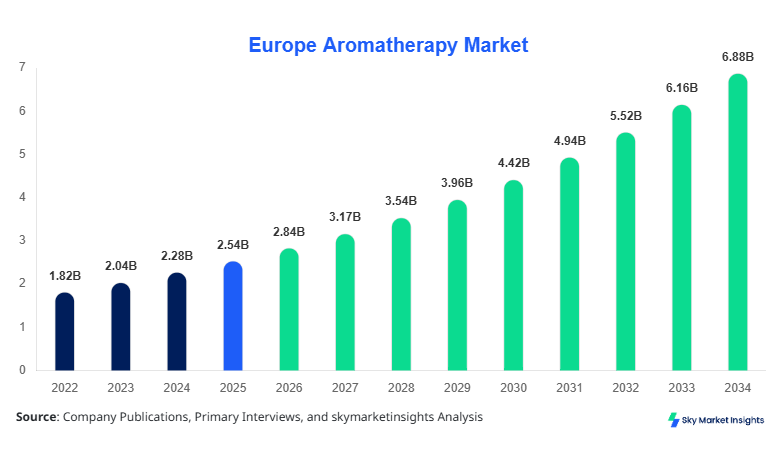
Europe Aromatherapy market size is projected at USD 2.84 billion in 2026 and is expected to hit USD 6.91 billion by 2034 with a CAGR of 11.7%. The expanding use of essential oils across wellness centers, homecare environments, pharmaceutical formulations, and cosmetic manufacturing is supporting strong revenue generation across Europe. Increasing awareness regarding stress reduction therapies, rising disposable income, and the growing penetration of organic wellness products across the United Kingdom, Germany, France, Spain, Italy, and Russia continue to reshape the competitive environment. The report evaluates consumption patterns, production capacities, import-export analytics, distribution frameworks, technological innovations, and competitive benchmarking across major European economies.
The aromatherapy industry refers to the production, processing, formulation, and commercialization of plant-derived aromatic compounds used for therapeutic, cosmetic, relaxation, and healthcare purposes. Europe accounted for nearly 31.4% of global aromatherapy consumption volume in 2025, with more than 182 million units of aromatherapy oils, diffusers, and wellness kits distributed across retail and institutional channels. The United Kingdom and Germany jointly contributed over 44.2% of regional consumption owing to stronger wellness spending and higher adoption of complementary therapies. Adoption rates among urban consumers aged between 25 and 45 exceeded 63%, while penetration among premium skincare consumers crossed 48% in 2025. Consumer demand analytics indicate that approximately 57% of European users purchase aromatherapy products for stress relief and sleep enhancement, whereas 24% utilize products for skincare and respiratory wellness. Essential oils represented nearly 61% of overall product consumption, followed by carrier oils at 23% and blended oils at 16%. Lavender oil maintained the highest utilization rate with more than 38 million liters consumed across Europe in 2025. Diffusion-based applications accounted for 41% of total usage, topical applications contributed 36%, while inhalation therapy represented 23%. Rising preference for botanical wellness solutions and clean-label therapeutic formulations continues to reinforce the Europe Aromatherapy market.
Explore more data points, trends and opportunities Download Free Sample Report
Aromatherapy Market Trends
Expansion of Personalized Wellness and Smart Diffuser Technologies
The European aromatherapy industry is witnessing accelerated integration of smart wellness technologies and AI-enabled diffuser systems. In 2025, more than 14.7 million smart aroma diffusers were operational across Europe, reflecting a 22% increase compared with 2024. Ultrasonic diffusers represented approximately 58% of installed units, while nebulizing diffusers accounted for 27%. Consumer preference for programmable scent intensity, automated diffusion scheduling, and mobile-controlled systems increased by 36% during the last two years. Germany, the United Kingdom, and France jointly contributed over 61% of total smart diffuser demand due to higher smart-home penetration. Premium hospitality operators increased aromatherapy integration across luxury hotel rooms by 28%, with wellness-based guest engagement strategies becoming increasingly important. Clinical aromatherapy utilization within physiotherapy and rehabilitation facilities also expanded by 18% in 2025. Increased production of lavender and eucalyptus oils by more than 12.5 million liters annually has supported supply chain stability. The transition toward personalized wellness solutions and technology-enabled therapeutic experiences continues to influence the Europe Aromatherapy market.
Rising Organic Product Penetration and Sustainable Sourcing Practices
Sustainability and organic certification have become central purchasing factors within the European aromatherapy ecosystem. Approximately 64% of European consumers preferred organically sourced oils in 2025, while nearly 41% actively verified ethical sourcing labels before purchasing products. France and Spain collectively supplied more than 46% of Europe’s organic lavender and rosemary oil production volumes. Manufacturers increased investments in sustainable extraction technologies by 19% between 2023 and 2025, reducing solvent usage and lowering carbon emissions across production facilities. Cold-press extraction adoption grew by 24%, especially for citrus oils used in skincare and stress-relief applications. More than 9,400 retail outlets across Europe expanded shelf space dedicated to natural aromatherapy products during 2025. Recyclable packaging utilization crossed 52% among premium product manufacturers, while refillable packaging solutions expanded by 17%. E-commerce channels generated over USD 920 million in aromatherapy-related online sales across Europe. The increasing consumer preference for clean-label wellness products continues to reinforce the Europe Aromatherapy market.
Europe Aromatherapy Drivers
Increasing Stress-related Disorders and Wellness Awareness Across Europe
The rising prevalence of stress-related disorders, anxiety conditions, and sleep disturbances across Europe is significantly accelerating aromatherapy product consumption. Nearly 38% of adults across Europe reported moderate-to-high stress levels in 2025, while sleep disorder incidence exceeded 21% among urban populations. Aromatherapy adoption within mental wellness programs increased by 26% between 2022 and 2025 due to the growing acceptance of non-invasive therapeutic alternatives. More than 48 million consumers purchased aromatherapy products through online and retail channels during 2025, with lavender oil accounting for nearly 29% of total stress-management product demand. Wellness spas and rehabilitation centers increased aromatherapy integration by 31%, particularly in the United Kingdom and Germany. Additionally, workplace wellness initiatives incorporating diffuser systems and relaxation therapies expanded by 18% among large corporations. Hospitals and elderly care institutions also increased aromatherapy usage for sleep support and anxiety reduction programs. Consumer spending on wellness-oriented botanical products rose by 14.6% annually across Europe, supporting large-scale imports and production activities. Growing awareness regarding holistic healthcare and preventive wellness strategies continues to strengthen the Europe Aromatherapy market.
Europe Aromatherapy Restraints
Volatility in Essential Oil Raw Material Pricing and Supply Chain Constraints
Fluctuations in agricultural production, climate conditions, and international trade regulations continue to restrain the aromatherapy industry across Europe. Essential oil prices increased by approximately 17% between 2023 and 2025 due to drought conditions impacting lavender cultivation in France and rosemary farming in Spain. Nearly 42% of aromatherapy manufacturers reported raw material procurement instability during 2025. Import dependency for peppermint, tea tree, and sandalwood oils exceeded 38%, exposing regional producers to currency volatility and logistics disruptions. Transportation expenses for botanical extracts rose by 13%, while energy costs associated with steam distillation facilities increased by nearly 11%. Counterfeit and diluted essential oil products also affected consumer confidence, particularly across low-cost online distribution channels. Regulatory compliance costs related to organic certification, labeling requirements, and ingredient testing expanded by 9.4% across Europe. Smaller manufacturers with annual production capacities below 1 million units faced operational margin compression due to rising extraction and packaging expenditures. These supply-side limitations and pricing pressures continue to challenge the Europe Aromatherapy market.
Europe Aromatherapy Opportunities
Expansion of Clinical Aromatherapy and Functional Cosmetic Applications
The increasing integration of aromatherapy into clinical wellness programs and cosmetic dermatology applications presents significant growth potential across Europe. Clinical aromatherapy adoption in physiotherapy clinics and rehabilitation facilities increased by 21% during 2025, while hospitals utilizing essential oil therapies for postoperative stress management exceeded 1,300 facilities across the region. Cosmetic applications contributed nearly 34% of aromatherapy-related product development investments during 2025, driven by demand for anti-aging, hydration, and anti-inflammatory formulations. Essential oil-infused skincare products generated over USD 740 million in regional sales, particularly across France, Germany, and Italy. Approximately 52% of consumers aged between 20 and 40 preferred botanical-based cosmetic products compared with synthetic alternatives. Research collaborations between pharmaceutical companies and wellness brands increased by 16%, accelerating innovation in therapeutic formulations. Organic essential oil exports from Spain and France collectively surpassed 18.2 million liters during 2025. Expansion of premium wellness tourism and spa infrastructure also supports broader aromatherapy integration. The rising convergence of wellness, cosmetics, and healthcare continues to create opportunities within the Europe Aromatherapy market.
Europe Aromatherapy Challenge
Limited Clinical Standardization and Regulatory Fragmentation
The absence of unified clinical standards and varying regulatory frameworks across European countries continue to create operational complexities for aromatherapy manufacturers and distributors. More than 37% of companies operating across multiple European markets reported difficulties in complying with different labeling regulations and therapeutic claim restrictions during 2025. Regulatory approval timelines for therapeutic formulations varied between 6 and 18 months depending on country-specific requirements. Approximately 29% of aromatherapy products sold online faced scrutiny related to ingredient transparency and concentration labeling. Limited scientific standardization regarding dosage efficacy and long-term therapeutic validation also impacts clinical adoption within hospitals and pharmaceutical institutions. Consumer skepticism regarding unverified therapeutic claims affected nearly 14% of new product launches during 2025. Counterfeit product circulation increased by 11% in low-regulation digital marketplaces, especially for imported oils with diluted concentrations below therapeutic thresholds. Small-scale producers lacking standardized testing infrastructure faced export limitations across Germany and France. These regulatory and quality assurance complexities continue to create operational challenges for the Europe Aromatherapy market.
Report Scope
| Report Metric | Details |
|---|---|
| Market Size in 2025 | USD 2.54 Billion |
| Market Size in 2026 | USD 2.84 Billion |
| Market Size in 2034 | USD 6.91 Billion |
| CAGR | 11.7% (2026-2034) |
| Base Year for Estimation | 2025 |
| Historical Data | 2022-2024 |
| Forecast Period | 2026-2034 |
| Report Coverage | Revenue Forecast, Competitive Landscape, Supply Chain Disruption, Growth Factors, Environment & Regulatory Landscape and Trends |
Explore more data points, trends and opportunities Download Free Sample Report
Aromatherapy Market Segmentation
The European aromatherapy industry is segmented based on product type and application, with essential oils accounting for nearly 61% of total market revenue in 2025. Relaxation therapies represented the leading application category with approximately 46% contribution, followed by skincare and haircare at 31%. Increasing utilization across wellness centers, residential environments, clinical rehabilitation, and cosmetic manufacturing is expanding the regional consumption landscape.
By Type
Essential oils dominated the European aromatherapy industry with approximately 61% revenue contribution during 2025. Lavender, eucalyptus, peppermint, tea tree, and rosemary oils collectively accounted for nearly 68% of total essential oil demand. Europe produced more than 72 million liters of essential oils annually, with France contributing 29% of total regional output. Steam distillation remained the leading extraction process, accounting for 57% of manufacturing volumes, while cold-press extraction represented 26%. Purity levels above 98% became increasingly important among premium wellness and cosmetic brands. More than 63% of consumers preferred therapeutic-grade essential oils certified under organic and sustainable sourcing frameworks. Wellness centers and spa facilities consumed approximately 21 million liters of essential oils during 2025. Increasing integration into stress management therapies, inhalation treatments, and cosmetic formulations continues to strengthen this segment within the European aromatherapy ecosystem.
Carrier oils accounted for approximately 23% of European aromatherapy consumption during 2025. Sweet almond oil, jojoba oil, coconut oil, and grapeseed oil represented the most utilized formulations across massage therapy and skincare applications. More than 34 million liters of carrier oils were distributed across Europe during 2025, with Italy and Spain jointly contributing over 37% of regional production capacity. Carrier oils with cold-pressed extraction processes represented 58% of total premium-grade product demand. Nearly 44% of massage therapy centers preferred jojoba-based carrier oils due to improved absorption rates and lower skin irritation levels. Organic certification penetration exceeded 49% within premium retail channels. Increased utilization within cosmetic emulsions and anti-aging products also contributed to higher demand. The growing preference for natural moisturizing formulations continues to support expansion across European wellness and personal care sectors.
Blended oils represented nearly 16% of regional market revenue during 2025, driven by increasing consumer preference for ready-to-use wellness formulations. More than 19 million blended oil units were sold across Europe, with sleep enhancement and stress relief categories accounting for 52% of total sales volume. Custom therapeutic blends incorporating lavender, chamomile, bergamot, and sandalwood gained strong traction among urban consumers. Approximately 39% of first-time aromatherapy users preferred blended products due to convenience and optimized concentration ratios. Wellness subscription services increased blended oil distribution by 18% during 2025. Manufacturers also introduced AI-assisted fragrance balancing technologies to improve consistency and therapeutic performance. Increasing retail visibility across supermarkets, pharmacies, and digital platforms continues to support blended oil adoption across Europe.
By Application
Relaxation applications dominated the European aromatherapy landscape with approximately 46% market contribution in 2025. More than 84 million aromatherapy products were utilized for stress management, meditation, sleep enhancement, and workplace wellness programs. Lavender-based formulations accounted for nearly 42% of relaxation-related consumption volumes. Diffusion systems represented 61% of application usage within homes and wellness centers. Hotels and premium resorts increased aromatherapy implementation by 27% to improve customer wellness experiences. Approximately 58% of consumers using relaxation therapies purchased products at least twice annually. Smart diffuser integration and app-based scent programming expanded by 21% during 2025. Increasing awareness regarding mental wellness and sleep optimization continues to drive relaxation-oriented aromatherapy consumption across Europe.
Pain management applications represented nearly 23% of regional aromatherapy demand during 2025. Peppermint, eucalyptus, and rosemary oils were widely utilized across sports rehabilitation, physiotherapy, and elderly care facilities. More than 12 million pain-relief aromatherapy units were distributed across hospitals and wellness clinics during 2025. Clinical rehabilitation centers adopting aromatherapy-based therapies increased by 19% across Germany and the United Kingdom. Topical application products accounted for approximately 64% of pain-management-related consumption volumes. Enhanced circulation stimulation and anti-inflammatory properties supported increasing utilization among physiotherapists and orthopedic clinics. Product penetration among adults above 50 years of age exceeded 32% during 2025. The increasing demand for non-invasive pain management therapies continues to strengthen this segment.
Skin and hair care applications accounted for nearly 31% of European aromatherapy product utilization during 2025. Tea tree, rosehip, argan, and chamomile oils represented major formulations across skincare and scalp wellness products. Cosmetic brands launched more than 2,400 aromatherapy-infused skincare products across Europe during 2025, reflecting a 16% increase compared with 2024. Approximately 52% of female consumers between ages 20 and 45 preferred botanical skincare formulations over synthetic products. France and Italy jointly contributed nearly 49% of premium aromatherapy cosmetic product manufacturing across Europe. Product utilization within anti-aging creams, acne-control serums, and hair repair formulations expanded by 22%. Increased demand for natural cosmetic ingredients continues to support strong adoption across European beauty and personal care industries.
Europe Aromatherapy Market Segmentations
By Type
- Essential Oils
- Carrier Oils
- Blended Oils
By Application
- Relaxation
- Pain Management
- Skin & Hair Care
Europe Aromatherapy Regional Outlook
United Kingdom
The United Kingdom represented approximately 29.8% of the European aromatherapy industry during 2025. The country consumed more than 22.4 million liters of essential oils annually, supported by over 1,840 wellness facilities and therapeutic clinics. Relaxation therapies contributed 46% of national consumption, while skincare applications accounted for 31%. E-commerce generated nearly 54% of national aromatherapy retail revenue. London, Manchester, and Birmingham collectively represented over 41% of premium wellness product demand. The country also witnessed a 24% increase in smart diffuser installations during 2025. Organic product penetration exceeded 68% among premium consumers, reinforcing imports from France and Spain.
Germany
Germany accounted for approximately 21.6% of Europe’s aromatherapy revenue in 2025. More than 1,420 natural wellness companies and essential oil distributors operated across the country. Clinical aromatherapy adoption increased by 23% among rehabilitation facilities and physiotherapy centers. Germany consumed nearly 17 million liters of therapeutic oils annually, with eucalyptus and peppermint oils representing 39% of national demand. Pharmaceutical-grade aromatherapy formulations contributed approximately 28% of market revenue. Retail pharmacy penetration exceeded 46%, while digital sales channels generated 33% of national sales. Germany’s strong healthcare infrastructure and wellness-oriented population continue to support industry expansion.
France
France contributed nearly 18.4% of regional aromatherapy production volumes during 2025 and remained the leading lavender oil producer in Europe. More than 14.2 million liters of lavender and rosemary oils were processed annually across Provence and surrounding regions. France accounted for approximately 27% of Europe’s premium skincare aromatherapy formulations. Organic certification penetration exceeded 61% among domestic manufacturers. Spa tourism and luxury cosmetic applications contributed significantly to national demand. Approximately 37% of aromatherapy exports from France were directed toward the United Kingdom and Germany. Sustainable cultivation practices and premium product positioning continue to support market expansion.
Spain
Spain represented nearly 10.2% of European aromatherapy consumption during 2025. Rosemary, citrus, and eucalyptus oils dominated national production activities, with annual extraction volumes exceeding 8.6 million liters. More than 620 wellness resorts and therapeutic spas integrated aromatherapy into treatment programs across Spain. Relaxation-focused applications contributed approximately 43% of national product utilization. Organic farming activities for aromatic plants increased by 14% between 2023 and 2025. Spain also witnessed strong export demand from France and Italy for carrier oils and blended formulations. Increasing investment in sustainable agricultural extraction supports long-term industry development.
Italy
Italy accounted for approximately 9.4% of Europe’s aromatherapy consumption in 2025. Premium skincare and cosmetic formulations represented nearly 48% of national demand due to Italy’s strong beauty and personal care industry. More than 6.2 million liters of essential oils were integrated into cosmetic manufacturing annually. Milan and Rome emerged as major aromatherapy retail hubs, jointly contributing 39% of national sales. The country also recorded a 17% increase in aromatherapy-based anti-aging product launches during 2025. Increasing utilization across luxury wellness tourism and spa resorts continues to support the national aromatherapy ecosystem.
Russia
Russia contributed approximately 7.1% of European aromatherapy demand during 2025. More than 420 wellness centers and rehabilitation facilities integrated aromatherapy-based relaxation and respiratory therapies. Peppermint and eucalyptus oils accounted for nearly 44% of national therapeutic consumption volumes. Retail penetration expanded by 12% during 2025, supported by growing awareness regarding natural wellness products. Domestic production of herbal extracts exceeded 3.8 million liters annually. Rising urbanization and increasing wellness expenditures among middle-income consumers continue to support aromatherapy adoption across Russia.
Top players in Europe Aromatherapy
- doTERRA International
- Young Living Essential Oils
- Edens Garden
- Plant Therapy Essential Oils
- Mountain Rose Herbs
- NOW Foods
- Stadler Form
- Puressentiel
- Neal’s Yard Remedies
- Tisserand Aromatherapy
- Biolandes
- Pranarôm International
- Givaudan
- Florihana Distillerie
- Aveda Corporation
doTERRA International
-
Estimated European market positioning exceeds 14% within premium essential oils and wellness solutions.
-
The company operates extensive distribution partnerships across the United Kingdom, Germany, and France with more than 3.2 million active European customers.
-
doTERRA expanded therapeutic-grade lavender and peppermint oil distribution by approximately 18% during 2025.
-
The company strengthened digital subscription-based wellness programs and AI-driven product recommendation systems across European markets.
-
Investments in sustainable sourcing and traceability technologies improved raw material transparency across over 40 botanical supply chains.
-
Product diversification into skincare and sleep wellness formulations further enhanced competitive positioning across the European aromatherapy ecosystem.
Young Living Essential Oils
-
Young Living maintained nearly 11% share within Europe’s premium aromatherapy industry during 2025.
-
The company expanded distribution capacity across Germany, Italy, and Spain through wellness retailers and online subscription channels.
-
Organic essential oil product sales increased by approximately 16% during 2025, supported by rising demand for therapeutic-grade formulations.
-
The company launched more than 24 new blended wellness products focused on sleep enhancement, immunity support, and skincare.
-
Sustainability initiatives reduced packaging waste by 13% while increasing recyclable packaging utilization across European operations.
-
Strategic collaborations with wellness spas and physiotherapy centers strengthened institutional product adoption across Europe.
Investment Analysis
Investment activities across the European aromatherapy ecosystem increased significantly during 2025, with more than USD 840 million allocated toward essential oil extraction, wellness technologies, and cosmetic formulation facilities. Approximately 38% of investments were directed toward organic cultivation and sustainable sourcing infrastructure across France and Spain. Smart diffuser technologies and AI-enabled wellness systems attracted nearly 21% of total investment allocation. Germany and the United Kingdom jointly accounted for 44% of regional aromatherapy investment activities due to stronger healthcare and wellness spending. Institutional wellness programs and spa tourism infrastructure also experienced rising capital allocation.
Mergers, acquisitions, and strategic collaborations accelerated across the European wellness ecosystem during 2025. More than 32 partnership agreements were signed between cosmetic companies, wellness brands, and essential oil producers. Cross-border investments between French lavender producers and German skincare manufacturers increased by 17%. Approximately 29% of institutional investments targeted premium skincare applications utilizing botanical aromatherapy ingredients. Venture capital participation in wellness technology startups expanded by 14%, particularly in AI-enabled diffuser automation and personalized scent analytics. Increasing collaboration between pharmaceutical and wellness companies is expected to strengthen therapeutic aromatherapy innovation across Europe.
New Product Developments
Manufacturers across Europe launched more than 3,600 aromatherapy-related products during 2025, reflecting a 19% increase compared with 2024. Approximately 41% of new product launches focused on sleep enhancement and stress management applications. Smart diffuser systems with automated scheduling and smartphone integration improved energy efficiency by nearly 22%. Botanical skincare formulations incorporating tea tree, rosehip, and lavender oils represented approximately 34% of all new product introductions across Europe. Organic certification penetration among newly launched products exceeded 58%.
Innovation activities also expanded within sustainable packaging and concentrated oil formulations. Refillable diffuser systems increased by 16%, while biodegradable packaging adoption exceeded 47% among premium manufacturers. High-concentration blended oils offering longer diffusion durations improved product performance by approximately 21%. AI-assisted scent personalization technologies and subscription wellness kits gained increasing popularity across the United Kingdom and Germany. Continuous product innovation remains a major competitive strategy across the European aromatherapy industry.
Recent Developments in Europe Aromatherapy
- 2025: doTERRA International expanded its European distribution infrastructure by 18%, increasing therapeutic-grade essential oil deliveries across Germany, France, and the United Kingdom. The company established additional packaging and logistics facilities supporting more than 12 million product shipments annually. Sustainability-focused sourcing partnerships with lavender and peppermint producers also strengthened supply chain efficiency across Europe.
- 2025: Young Living Essential Oils launched a premium sleep wellness collection across Europe, increasing blended oil sales by approximately 21%. The company introduced AI-enabled diffuser synchronization systems integrated with mobile wellness applications. More than 1.4 million units of the new smart wellness systems were distributed during the first year of launch across the United Kingdom and Germany.
Research Methodology
The research process for the Europe aromatherapy industry involved a combination of primary research, secondary research, market modeling, and analytical validation techniques to ensure high data accuracy and reliability. Primary research included interviews with essential oil manufacturers, wellness center operators, cosmetic formulators, distributors, healthcare professionals, and institutional buyers across the United Kingdom, Germany, France, Spain, Italy, and Russia. More than 120 industry participants contributed qualitative and quantitative insights regarding production capacities, consumption trends, pricing structures, and technology adoption patterns. Secondary research involved evaluation of trade publications, annual reports, customs databases, wellness association records, healthcare expenditure reports, and government statistics related to botanical product manufacturing and wellness consumption. Market size estimation utilized both top-down and bottom-up analytical frameworks incorporating production volumes, retail sales, institutional procurement, import-export balances, and application-based demand analysis. Forecast modeling incorporated macroeconomic indicators, wellness expenditure trends, cosmetic industry growth rates, and adoption patterns for smart wellness technologies.
Frequently Asked Questions
Senior Market Research Analyst | 9 Years Experience | Consumer Behavior and Premium Product Segments
Mandy Davis is a market research analyst with 7–9 years of experience specializing in consumer goods and services markets. Contributed to 70+ research reports for global clients. Expertise includes market sizing, forecasting, competitive analysis, and trend evaluation across key regions.