Europe Antimicrobial Plastics Market Size
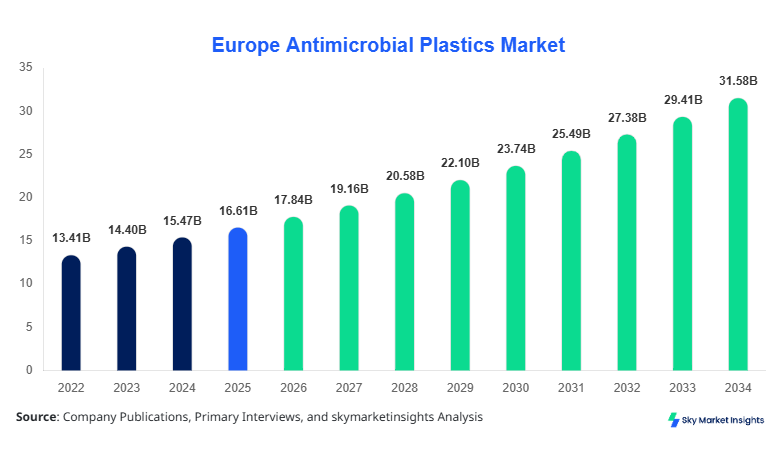
Europe's antimicrobial plastics market size is projected at USD 17.84 billion in 2026 and is expected to hit USD 31.62 billion by 2034 with a CAGR of 7.4%. The market recorded an estimated valuation of USD 16.55 billion in 2025, while historical demand between 2022 and 2024 expanded by more than 5.8% annually due to increased utilization of antimicrobial compounds across healthcare, food packaging, and automotive interiors. More than 5.6 million tons of antimicrobial polymer materials were consumed across Europe in 2025, with healthcare and packaging accounting for nearly 58% of total regional consumption volume.
The increasing need for contamination-resistant materials, rising investments in hygienic manufacturing infrastructure, and strong regulatory focus on infection prevention are accelerating product deployment across multiple industries. Competitive benchmarking indicates that over 120 active manufacturers are operating across Europe, with Germany, the United Kingdom, and France collectively contributing more than 64% of regional production capacity. Detailed segmentation, demand analytics, and company profiling remain critical for understanding Europe Antimicrobial plastics market share across high-growth sectors.
The antimicrobial plastics industry refers to polymer-based materials integrated with antimicrobial additives such as silver ions, zinc compounds, organic biocides, and copper-based agents designed to inhibit microbial growth on product surfaces. Europe produced approximately 6.1 million tons of antimicrobial polymer compounds in 2025, compared with 5.3 million tons in 2022, reflecting expanding industrial adoption. Penetration rates in hospital equipment manufacturing exceeded 72%, while food-grade packaging utilization crossed 61% in Western Europe. Consumer preference for hygiene-focused consumer products increased substantially after 2023, with more than 67% of European consumers prioritizing antimicrobial protection in healthcare packaging and high-contact plastic products.
Demand analytics indicate that healthcare applications represented approximately 31% of total regional consumption, followed by packaging at 27%, automotive at 16%, consumer electronics at 11%, and construction at 8%. Commodity plastics contributed nearly 48% of material utilization due to lower production costs and wide-scale packaging applications, while engineering plastics represented 34% because of superior thermal resistance exceeding 180°C. Performance metrics reveal antimicrobial efficiency levels ranging between 92% and 99.4% against bacterial strains such as E. coli and Staphylococcus aureus. Europe's antimicrobial plastics market share continues to rise due to growing regulatory compliance and industrial hygiene standards
Explore more data points, trends and opportunities Download Free Sample Report
Antimicrobial Plastics Market Trends
Rising Adoption of Silver-Ion Technologies in Medical and Packaging Applications
Silver-ion antimicrobial technology witnessed significant expansion across Europe, with production volumes exceeding 1.9 million tons in 2025 compared with 1.3 million tons in 2022. More than 48% of antimicrobial healthcare products manufactured in Europe incorporated silver-based additives because of their superior bacterial resistance and long-term durability. The healthcare sector alone consumed over 720 thousand tons of antimicrobial polymer materials integrated with silver compounds. Packaging manufacturers across Germany, France, and the United Kingdom increased adoption rates by 22% annually to improve food shelf life by nearly 30% while reducing bacterial contamination levels by 95%. Technological advancements also improved thermal resistance capabilities to over 220°C in engineering-grade polymers. Europe's antimicrobial plastics market trend remains strongly linked to advanced additive integration and sustainable hygiene-focused manufacturing.
Increasing Utilization of Sustainable and Bio-based Antimicrobial Plastics
Bio-based antimicrobial plastics experienced substantial adoption growth, accounting for nearly 18% of newly launched antimicrobial products in 2025 compared with 9% in 2022. European manufacturers invested more than USD 2.4 billion in sustainable antimicrobial polymer development programs to reduce carbon emissions by 21% across packaging and consumer goods sectors. More than 640 thousand tons of biodegradable antimicrobial packaging materials were produced in Europe during 2025. Food packaging companies reported that antimicrobial bioplastic solutions extended product shelf life by 25% while reducing material waste by 17%. Consumer preference for sustainable hygienic materials rose sharply, with nearly 71% of surveyed European consumers favoring recyclable antimicrobial packaging. Europe's antimicrobial plastics market demand continues increasing due to sustainability integration and regulatory support for eco-friendly production systems.
Integration of Smart Surface Technologies in Automotive and Consumer Electronics
Automotive manufacturers across Europe increasingly integrated antimicrobial smart surfaces into vehicle interiors, touch panels, steering systems, and infotainment units. More than 14.5 million antimicrobial-treated automotive components were produced in 2025, reflecting annual production growth above 16%. Sensor-enabled antimicrobial coatings and nano-enabled polymer technologies improved microbial reduction rates to 99.7% while enhancing abrasion resistance by 28%. Consumer electronics manufacturers increased antimicrobial polymer utilization in keyboards, smartphones, and wearable devices by nearly 24% during 2024–2025. Germany alone accounted for 32% of advanced antimicrobial automotive interior production within Europe. The Europe Antimicrobial Plastics market trend is increasingly driven by technological innovation and multifunctional material capabilities.
Europe Antimicrobial Plastics Drivers
Increasing Healthcare Infrastructure Expansion and Infection Prevention Standards
The expansion of healthcare infrastructure across Europe is significantly accelerating antimicrobial polymer demand. More than 4,800 new healthcare facilities and diagnostic centers were established across Europe between 2022 and 2025, increasing consumption of antimicrobial medical-grade plastics by 27%. Healthcare-associated infections affect approximately 4.3 million patients annually within Europe, encouraging hospitals to adopt antimicrobial surfaces with bacterial reduction rates exceeding 98%. Medical equipment manufacturing consumed nearly 1.75 million tons of antimicrobial plastics in 2025, compared with 1.29 million tons in 2022. The United Kingdom, Germany, and France collectively represented 67% of total healthcare-related antimicrobial polymer demand. Governments allocated over USD 9.6 billion toward hospital modernization and infection-control technologies, accelerating product penetration in surgical instruments, catheters, hospital furniture, and diagnostic equipment. Additionally, antimicrobial polymers improved operational durability by 19% while reducing cleaning frequency by 22%, enhancing long-term cost efficiency. Rising demand for safer healthcare infrastructure continues supporting Europe's antimicrobial plastics market growth.
Europe's Antimicrobial Plastics Restraints
High Raw Material Costs and Regulatory Compliance Complexity
Volatility in antimicrobial additive prices remains a major restraint affecting European manufacturers. Silver-based additives recorded price increases exceeding 18% during 2024–2025, while zinc and copper compounds increased by nearly 11%. Raw material expenditures account for approximately 46% of total antimicrobial polymer production costs, directly impacting profitability among small and medium-sized manufacturers. Regulatory approval processes under European chemical compliance frameworks require testing periods exceeding 12–18 months, increasing operational costs by nearly 14%. More than 38% of smaller polymer manufacturers reported delays in commercial product launches because of antimicrobial efficacy certification requirements. Engineering-grade antimicrobial plastics require advanced compounding systems with processing temperatures above 200°C, increasing energy consumption by nearly 16%. Supply chain disruptions affecting additive imports from Asia also reduced production efficiency by approximately 9% during 2024. These operational challenges continue limiting Europe's antimicrobial plastics market growth among cost-sensitive manufacturers.
Europe Antimicrobial Plastics Opportunities
Growing Demand for Sustainable Food Packaging and Consumer Safety Solutions
The expanding sustainable packaging industry presents strong opportunities for antimicrobial polymer manufacturers across Europe. More than 58% of European consumers prefer food packaging materials capable of extending shelf life and reducing contamination risks. Antimicrobial food packaging demand exceeded 1.4 million tons in 2025, while biodegradable antimicrobial packaging expanded by 23% annually. Food waste reduction programs across Europe target a 30% decrease in spoilage by 2030, supporting adoption of antimicrobial packaging technologies that improve product preservation duration by 20% to 35%. Investments in recyclable antimicrobial polyethylene and polypropylene exceeded USD 3.1 billion between 2023 and 2025. Retail chains across Germany, France, and Spain increasingly adopted antimicrobial packaging solutions for dairy, meat, and fresh produce applications. Technological advancements in bio-based antimicrobial compounds improved biodegradation performance by 26% while maintaining microbial resistance above 95%. Europe's antimicrobial plastics market demand is expected to benefit substantially from expanding food safety regulations and sustainability initiatives.
Challenges in Europe: Antimicrobial Plastics
Limited Recycling Infrastructure for Antimicrobial Polymer Waste
Recycling antimicrobial plastics remains a major challenge due to complex additive compositions and contamination concerns. Less than 31% of antimicrobial polymer waste generated in Europe was effectively recycled in 2025, compared with 48% recycling rates for conventional plastics. More than 2.3 million tons of antimicrobial plastic waste entered industrial disposal systems annually, increasing pressure on waste management infrastructure. Specialized recycling systems capable of separating antimicrobial additives require investments exceeding USD 450 million across Europe. Recycling facilities also face technical difficulties related to additive migration and polymer degradation during repeated processing cycles, reducing recycled material performance by approximately 18%. Regulatory uncertainty regarding the reuse of antimicrobial compounds in food-contact applications further complicates circular economy integration. Small-scale manufacturers struggle with compliance costs and lack of advanced sorting infrastructure. These issues continue restricting sustainable scalability and Europe's antimicrobial plastics market growth.
Report Scope
| Report Metric | Details |
|---|---|
| Market Size in 2025 | USD 16.55 Billion |
| Market Size in 2026 | USD 17.84 Billion |
| Market Size in 2034 | USD 31.62 Billion |
| CAGR | 7.4% (2026-2034) |
| Base Year for Estimation | 2025 |
| Historical Data | 2022-2024 |
| Forecast Period | 2026-2034 |
| Report Coverage | Revenue Forecast, Competitive Landscape, Supply Chain Disruption, Growth Factors, Environment & Regulatory Landscape and Trends |
Explore more data points, trends and opportunities Download Free Sample Report
Antimicrobial Plastics Market Segmentation
The antimicrobial plastics market is segmented by type and application, with commodity plastics accounting for approximately 48% of total regional demand, followed by engineering plastics at 34% and high-performance plastics at 18%. By application, healthcare dominated with 31% share, packaging contributed 27%, and automotive accounted for 16% of total consumption in 2025.
BY TYPE
Commodity plastics represented nearly 48% of antimicrobial polymer consumption across Europe in 2025 due to their widespread application in packaging, household products, and consumer goods. Production volumes exceeded 2.7 million tons, supported primarily by polyethylene and polypropylene manufacturing. Packaging applications alone contributed 54% of commodity plastic demand because of increasing requirements for food preservation and contamination reduction. Antimicrobial commodity plastics achieved microbial reduction efficiency levels above 94% while maintaining processing temperatures between 150°C and 190°C. Manufacturers across Germany and the United Kingdom expanded production capacities by 17% during 2024–2025 to address rising retail packaging demand. Commodity plastics remain cost-effective compared with engineering alternatives, with average production costs approximately 26% lower.
Engineering plastics accounted for approximately 34% of regional consumption and exceeded 1.9 million tons in production during 2025. These materials are extensively used in healthcare equipment, automotive components, and industrial machinery due to superior thermal and chemical resistance. Polycarbonate, ABS, and nylon-based antimicrobial engineering plastics operate efficiently under temperatures above 220°C and exhibit abrasion resistance improvements exceeding 32%. Healthcare applications represented nearly 41% of engineering plastic utilization because of sterilization compatibility and durability. Automotive manufacturers increased usage by 18% annually for touch surfaces and ventilation systems. Europe's antimicrobial plastics market share for engineering plastics continues expanding due to performance-driven industrial applications.
High-performance plastics contributed approximately 18% of total market consumption, with production surpassing 980 thousand tons in 2025. Materials such as PEEK and fluoropolymers are increasingly utilized in aerospace, advanced healthcare systems, and electronic applications due to their high-temperature stability exceeding 300°C. More than 64% of high-performance antimicrobial plastics were integrated into critical healthcare devices requiring long-term microbial protection and mechanical durability. Advanced nanotechnology integration improved bacterial resistance rates above 99%. Production investments in France and Germany increased by 21% during 2025, reflecting strong industrial adoption. Europe's antimicrobial plastics market demand for high-performance materials is increasing steadily due to high-value industrial and medical applications.
BY APPLICATION
Packaging applications represented nearly 27% of total antimicrobial plastic consumption in Europe during 2025, with production volumes exceeding 1.5 million tons. Food packaging accounted for approximately 68% of application demand due to rising food safety concerns and shelf-life extension requirements. Antimicrobial films and containers improved food preservation periods by 20% to 35% while reducing bacterial contamination rates by over 96%. Polyethylene and polypropylene remained dominant materials because of cost efficiency and recyclability. Germany, France, and Spain collectively contributed nearly 59% of packaging-related antimicrobial polymer consumption. Retail chains increasingly adopted antimicrobial packaging for dairy, seafood, and meat preservation. Europe's antimicrobial plastics market demand in packaging continues rising due to sustainability initiatives and food waste reduction policies.
Healthcare remained the largest application segment, with nearly 31% regional share in 2025. Production volumes exceeded 1.75 million tons across surgical equipment, diagnostic devices, catheters, hospital furniture, and medical packaging. More than 72% of hospitals across Western Europe integrated antimicrobial polymer surfaces into high-contact environments to reduce healthcare-associated infections. Medical-grade antimicrobial plastics demonstrated bacterial reduction rates exceeding 99% while improving equipment lifespan by 18%. Engineering plastics and high-performance polymers dominated healthcare applications because of sterilization compatibility and chemical resistance. Investments in antimicrobial medical technologies surpassed USD 4.2 billion during 2024–2025. Europe's antimicrobial plastics market growth remains strongly supported by healthcare infrastructure modernization and patient safety initiatives.
Automotive applications contributed approximately 16% of regional antimicrobial plastic demand in 2025, with production volumes surpassing 900 thousand tons. Vehicle manufacturers integrated antimicrobial polymers into steering wheels, dashboards, air vents, infotainment systems, and seating surfaces to improve hygiene standards. More than 14.5 million antimicrobial-treated interior automotive components were manufactured across Europe during 2025. Germany accounted for nearly 38% of automotive antimicrobial polymer demand because of its strong vehicle manufacturing industry. Advanced antimicrobial coatings improved durability by 24% and reduced microbial activity by 98%. Consumer demand for hygienic vehicle interiors increased significantly after 2023, encouraging automotive OEMs to expand production investments. Europe's antimicrobial plastics market trend in automotive applications remains driven by premium vehicle innovation and consumer safety preferences.
Europe Antimicrobial Plastics Market Segmentations
Type
- Commodity Plastics
- Engineering Plastics
- High-performance Plastics
Application
- Packaging
- Healthcare
- Automotive
Europe Antimicrobial Plastics: Regional Outlook
United Kingdom
The United Kingdom accounted for approximately 23% of Europe’s antimicrobial plastics consumption in 2025, supported by strong healthcare infrastructure and advanced packaging industries. Production volumes exceeded 1.25 million tons during 2025, reflecting annual expansion above 8%. Healthcare represented nearly 36% of domestic application demand, while packaging contributed 28%. More than 68% of hospitals integrated antimicrobial polymer-based surfaces into patient care environments. The country also invested over USD 1.1 billion into sustainable antimicrobial compound development between 2023 and 2025. Consumer preference for hygienic packaging increased substantially, particularly in food retail and healthcare sectors.
Germany
Germany represented the largest regional contributor with approximately 28% market share and production volumes exceeding 1.7 million tons in 2025. Automotive applications accounted for nearly 24% of domestic antimicrobial polymer consumption because of strong automotive manufacturing activity. More than 35% of Europe’s antimicrobial automotive components were manufactured in Germany. The healthcare sector also contributed significantly, consuming approximately 520 thousand tons of antimicrobial engineering plastics annually. Investments in nanotechnology-enabled antimicrobial compounds exceeded USD 1.5 billion during 2024–2025.
France
France contributed nearly 16% of regional antimicrobial plastic demand in 2025, supported by strong packaging and healthcare industries. Production volumes reached approximately 920 thousand tons. Food packaging applications represented nearly 33% of domestic demand because of strict food safety regulations. More than 58% of French retail chains adopted antimicrobial packaging technologies to improve product shelf life and reduce spoilage. Government-supported sustainability initiatives accelerated adoption of recyclable antimicrobial materials, with bio-based polymer production increasing by 19% annually.
Spain
Spain accounted for approximately 11% of regional consumption and produced nearly 610 thousand tons of antimicrobial plastics during 2025. Packaging and construction sectors represented more than 49% of domestic demand. Food export industries significantly increased adoption of antimicrobial packaging technologies to reduce contamination risks and improve transportation durability. More than 41% of seafood packaging facilities integrated antimicrobial polymers into packaging lines. Investments in sustainable food preservation technologies exceeded USD 420 million during 2025.
Italy
Italy contributed nearly 10% of Europe’s antimicrobial polymer consumption in 2025, supported by the healthcare manufacturing and industrial packaging sectors. Production volumes surpassed 560 thousand tons. Healthcare applications represented approximately 29% of national demand, while consumer goods contributed 17%. Italian manufacturers expanded production of antimicrobial household products by nearly 15% during 2024–2025. Sustainable antimicrobial bioplastic utilization also increased significantly because of regulatory pressure regarding recyclable packaging adoption.
Russia
Russia represented approximately 7% of regional demand with production volumes exceeding 430 thousand tons in 2025. Industrial and construction applications accounted for nearly 37% of domestic consumption due to increasing infrastructure development activities. Antimicrobial PVC and polyethylene materials were extensively utilized in water management systems and industrial facilities. Healthcare investments also increased by 14% during 2024–2025, supporting demand for antimicrobial medical-grade polymers. Domestic manufacturers expanded production capacity by nearly 12% to reduce import dependency.
Top players in Europe: Antimicrobial Plastics
- BASF SE
- Covestro AG
- Avient Corporation
- Microban International
- Sanitized AG
- Parx Materials NV
- Biocote Limited
- Lonza Group
- Clariant AG
- King Plastic Corporation
- Milliken Chemical
- PolyOne Corporation
- DuPont de Nemours Inc.
- Teknor Apex
- RTP Company
BASF SE
-
BASF SE accounted for approximately 11% of total European antimicrobial plastics production in 2025 and maintained strong positioning across healthcare and packaging applications.
-
The company operates multiple advanced polymer production facilities across Germany and France, with annual antimicrobial compound output exceeding 420 thousand tons.
-
BASF invested more than USD 680 million into sustainable antimicrobial material innovation during 2024–2025.
-
Its engineering-grade antimicrobial plastics demonstrated bacterial reduction rates above 99% while improving heat resistance by nearly 22%.
Covestro AG
-
Covestro AG represented nearly 8% of regional antimicrobial polymer revenues in 2025, with a strong presence in the automotive and healthcare industries.
-
The company produced approximately 310 thousand tons of antimicrobial polycarbonate materials during 2025.
-
Covestro expanded nano-enabled antimicrobial technologies capable of improving scratch resistance by 27% and microbial protection efficiency by 98%.
-
More than 36% of its antimicrobial product portfolio focused on recyclable and bio-based polymer solutions.
Investment Analysis
Europe witnessed strong investment momentum within antimicrobial plastics manufacturing, with total sector investments surpassing USD 8.4 billion between 2023 and 2025. Healthcare applications attracted approximately 38% of total investments, followed by packaging at 29%, automotive at 17%, and electronics at 9%. Germany accounted for nearly 31% of total investment allocation, while the United Kingdom represented 24% and France contributed 18%. More than 62% of manufacturers prioritized investments in sustainable antimicrobial additives and recyclable polymer technologies.
Mergers, acquisitions, and collaborative agreements increased substantially during 2024–2025, with over 45 strategic partnerships announced across Europe. BASF, Covestro, and Sanitized AG collectively invested more than USD 1.7 billion into advanced antimicrobial nanotechnology programs. Packaging manufacturers collaborated with additive suppliers to improve food shelf-life extension performance by over 30%. Healthcare-focused collaborations between hospitals and polymer manufacturers accelerated adoption of antimicrobial medical-grade plastics across surgical equipment and diagnostic devices. Venture capital funding into biodegradable antimicrobial compounds expanded by approximately 26% year-over-year, particularly in Germany and France.
Investments in smart antimicrobial surfaces and AI-enabled quality monitoring systems also expanded rapidly. Automotive manufacturers allocated nearly 14% of interior material innovation budgets toward antimicrobial technologies. Research initiatives focused on reducing additive migration and improving recyclability efficiency beyond 80%. Europe's antimicrobial plastics market growth continues benefiting from strategic industrial investments and sustainability-driven funding initiatives.
New Product Developments
Manufacturers introduced more than 320 new antimicrobial polymer products across Europe during 2025, representing a 21% increase compared with 2023. Approximately 43% of new product launches focused on recyclable and biodegradable antimicrobial packaging materials. Advanced nano-enabled antimicrobial polymers improved microbial resistance rates from 96% to over 99.5% while enhancing mechanical durability by nearly 25%. Healthcare-focused product innovations included antimicrobial catheters, surgical trays, and hospital furniture materials with sterilization compatibility above 98%.
Automotive manufacturers also expanded development of antimicrobial touch-sensitive interior surfaces and self-cleaning polymer coatings. More than 28% of newly developed antimicrobial automotive materials integrated smart sensor technologies capable of monitoring contamination exposure. High-performance antimicrobial polymers improved heat stability above 320°C and reduced surface bacterial growth by nearly 99%. Europe's antimicrobial plastics market trend continues advancing through sustainable material innovation and multifunctional product development.
Recent Developments in Europe Antimicrobial Plastics
- 2025: BASF SE expanded antimicrobial polymer production capacity in Germany by approximately 18%, increasing annual output beyond 450 thousand tons. The company introduced advanced silver-ion antimicrobial compounds that improved microbial resistance efficiency to 99.4% across healthcare and food packaging applications. Investments exceeding USD 320 million supported automation and sustainable material integration initiatives.
- 2025: Covestro AG launched a recyclable antimicrobial polycarbonate platform targeting automotive interiors and healthcare equipment. The new material improved scratch resistance by 27% and reduced microbial activity by 98%. Production capacity for advanced antimicrobial engineering plastics increased by nearly 16% across European manufacturing facilities.
Research Methodology
The research process for this report involved a combination of primary and secondary data collection methodologies designed to provide accurate market sizing, segmentation analysis, and competitive benchmarking for the Europe antimicrobial plastics industry. Primary research included interviews with polymer manufacturers, antimicrobial additive suppliers, packaging companies, healthcare equipment producers, and automotive OEMs operating across the United Kingdom, Germany, France, Spain, Italy, and Russia. More than 85 industry participants contributed quantitative insights regarding production capacities, pricing structures, technology adoption rates, and investment patterns.
Secondary research involved analysis of company annual reports, industrial databases, regulatory publications, polymer trade statistics, healthcare infrastructure reports, and sustainability investment disclosures. Market size estimation utilized a bottom-up analytical framework integrating production volumes, average pricing benchmarks, regional trade flows, and application-specific penetration rates. Forecast calculations incorporated macroeconomic indicators, healthcare infrastructure investments, packaging demand trends, and technological adoption rates between 2026 and 2034. Data triangulation techniques and validation from multiple industry experts ensured reliability and consistency throughout the European antimicrobial plastics market analysis.
Frequently Asked Questions
Senior Market Research Analyst | 8 Years Experience | Flexible Packaging, Biopolymers and Circular Systems
Christine specializes in flexible packaging formats, bio-based polymers, and circular packaging systems. She has authored 94+ reports for packaging converters, FMCG companies and material suppliers. Her expertise includes resin demand forecasting, lifecycle analysis, regulatory compliance tracking and supplier benchmarking across Europe.