Europe Antimicrobial Additives Market Size
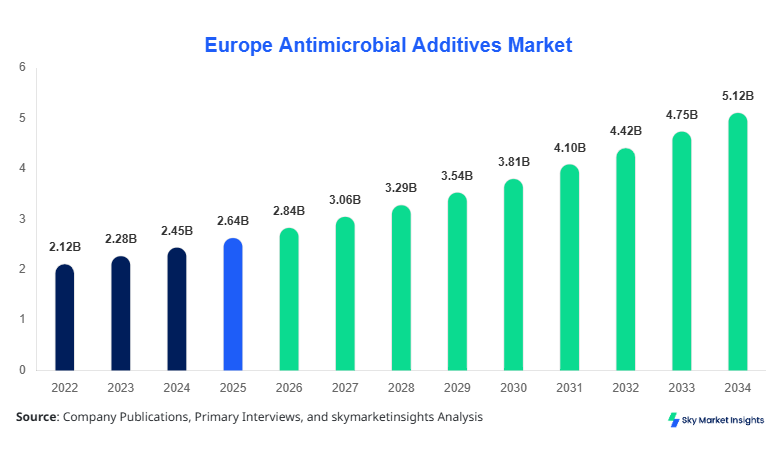
Europe's antimicrobial additives market size is projected at USD 2.84 billion in 2026 and is expected to hit USD 5.12 billion by 2034 with a CAGR of 7.64%.The increasing incorporation of antimicrobial technologies across plastics, coatings, healthcare packaging, and construction materials is accelerating market expansion throughout Europe. Growing industrial demand for contamination-resistant materials, combined with stricter European Union hygiene standards, is creating strong opportunities for manufacturers operating in the antimicrobial additives ecosystem. The report evaluates detailed segmentation, production volumes, pricing analysis, end-user adoption, and competitive landscape across the European antimicrobial additives market.
The antimicrobial additives industry comprises chemical and mineral-based compounds incorporated into substrates to inhibit microbial growth, including bacteria, algae, mold, fungi, and viruses. These additives are extensively used in plastics, paints, textiles, medical devices, food packaging, and construction materials to improve hygiene performance and extend product life cycles. Europe produced more than 1.92 million metric tons of antimicrobial-treated industrial materials in 2025, with France, Germany, and the United Kingdom accounting for over 58% of regional production output. Organic antimicrobial additives contributed approximately 41% of total consumption volume, while inorganic antimicrobial additives represented nearly 49% owing to their longer durability and superior thermal stability above 300°C. Adoption penetration in healthcare infrastructure applications exceeded 68% in Western Europe during 2025, while antimicrobial coatings used in commercial buildings recorded utilization growth of 11.8% year-over-year. Consumer demand analytics indicate that over 63% of European packaging companies increased procurement spending on antimicrobial additives due to food safety concerns and shelf-life enhancement requirements. Plastics applications accounted for nearly 36% of total application revenue, followed by paints & coatings with 31% and pulp & paper with 18%. The European antimicrobial additives market continues to witness rising industrial deployment across automotive interiors, HVAC systems, and consumer appliances.
Explore more data points, trends and opportunities Download Free Sample Report
Antimicrobial Additives Market Trends
Rising Integration of Silver-Ion and Nano-enabled Technologies
The increasing deployment of silver-ion antimicrobial systems and nano-engineered additives is transforming product efficiency across European industrial applications. In 2025, more than 46% of newly launched antimicrobial additives in Europe incorporated nano-silver or copper nanoparticle technologies due to their enhanced microbial inhibition efficiency exceeding 99.7%. Production volumes for silver-based antimicrobial compounds surpassed 214,000 metric tons across Europe, with Germany and France jointly contributing over 52% of total regional manufacturing output. Demand from healthcare infrastructure, medical textiles, and HVAC systems increased by 13.2% year-over-year due to heightened infection-control awareness. Nano-enabled antimicrobial additives demonstrated durability improvements of nearly 27% compared to conventional organic systems, while thermal resistance performance exceeded 350°C in industrial polymer applications. Automotive manufacturers in Europe integrated antimicrobial-treated interior plastics into nearly 38% of premium vehicle models during 2025. The antimicrobial additives market continues to experience accelerated industrial transformation driven by high-performance nano-enabled solutions.
Expansion of Sustainable and Bio-based Antimicrobial Formulations
European manufacturers are increasingly investing in bio-based antimicrobial additives derived from essential oils, chitosan, and plant extracts to align with sustainability targets and REACH compliance standards. Bio-based antimicrobial additive production increased by 15.6% during 2025, reaching nearly 118,000 metric tons across Europe. More than 43% of packaging manufacturers shifted toward environmentally compliant antimicrobial systems to reduce synthetic chemical dependency. Consumer preference for recyclable antimicrobial packaging increased significantly, particularly in food and beverage applications where biodegradable solutions recorded penetration rates above 29%. Natural antimicrobial additives demonstrated bacterial reduction efficiencies between 91% and 96% in paper and textile applications while reducing volatile organic compound emissions by nearly 18%. Several European coating companies launched water-based antimicrobial paints with durability cycles exceeding 8 years in commercial buildings. The antimicrobial additives market is increasingly influenced by sustainability-oriented production trends and eco-friendly material innovation.
Europe Antimicrobial Additives Drivers
Increasing Hygiene Standards Across Healthcare and Food Packaging Industries
The expansion of stringent hygiene regulations across healthcare facilities, pharmaceutical packaging, and food processing industries is significantly driving antimicrobial additive demand in Europe. More than 72% of hospitals across Western Europe upgraded infrastructure materials with antimicrobial-treated surfaces between 2023 and 2025. The healthcare sector consumed approximately 286,000 metric tons of antimicrobial compounds in 2025, reflecting annual growth of 12.1%. Food packaging manufacturers increased procurement spending by 14.6% due to growing concerns surrounding microbial contamination and shelf-life optimization. Antimicrobial packaging films reduced bacterial growth rates by up to 98% while improving packaged food shelf life by nearly 21%. Over 64% of European consumers indicated a preference for hygienic packaging materials during retail purchasing decisions. Additionally, regulatory compliance under EU food-contact safety directives has accelerated additive integration into polymer packaging and coated surfaces. The increasing prevalence of hospital-acquired infections, which affected nearly 3.8 million patients annually in Europe, is further encouraging antimicrobial infrastructure investments. The European antimicrobial additives market is strongly supported by expanding hygiene-focused industrial applications.
Europe's Antimicrobial Additives Restraints
Volatility in Raw Material Prices and Regulatory Compliance Costs
Fluctuating prices of silver, zinc, copper compounds, and specialty chemical intermediates continue to restrain profitability across antimicrobial additive manufacturing operations. Silver prices increased by approximately 18% during 2025, directly impacting production costs for premium inorganic antimicrobial additives used in healthcare plastics and coatings. Compliance with REACH regulations and environmental toxicity testing requirements increased operational expenses by nearly 11% for European manufacturers. More than 34% of small-scale additive producers reported delays in commercial product approvals due to evolving toxicological assessment procedures. Organic antimicrobial additives face increasing scrutiny over biocide migration risks and environmental persistence concerns, particularly in food-contact materials. Manufacturing facilities operating in Europe spent nearly USD 184 million collectively on regulatory testing, certification, and sustainability documentation during 2025. Limited availability of high-purity raw materials and rising energy prices also increased manufacturing overhead costs by 9.3% year-over-year. The European antimicrobial additives market faces operational challenges associated with stringent compliance frameworks and raw material instability.
Europe Antimicrobial Additives Opportunities
Rapid Expansion of Antimicrobial Solutions in Smart Building Infrastructure
The increasing development of smart buildings, sustainable infrastructure, and energy-efficient public facilities presents significant opportunities for antimicrobial additive manufacturers across Europe. More than 31% of newly constructed commercial buildings in Europe incorporated antimicrobial coatings, treated HVAC systems, and antimicrobial polymer surfaces during 2025. Government-backed infrastructure modernization projects in France, Germany, and the United Kingdom allocated over USD 2.6 billion toward hygienic public infrastructure materials. Demand for antimicrobial-treated paints and coatings in educational institutions increased by 16.8%, while smart transportation systems recorded additive adoption growth exceeding 13%. Construction materials incorporating antimicrobial compounds demonstrated fungal resistance improvements above 95% and reduced maintenance frequency by approximately 22%. Additionally, IoT-enabled building systems increasingly utilize antimicrobial polymers in touch-sensitive surfaces and ventilation components to minimize contamination risks. The European antimicrobial additives market is expected to benefit considerably from expanding hygienic smart infrastructure initiatives.
Challenges in Europe: Antimicrobial Additives
Performance Degradation and Compatibility Limitations in Complex Applications
One of the major challenges affecting antimicrobial additive manufacturers involves maintaining long-term efficacy and substrate compatibility across diverse industrial environments. Approximately 26% of polymer manufacturers in Europe reported difficulties integrating antimicrobial additives without compromising mechanical strength, color stability, or processing temperature thresholds. Organic antimicrobial systems often exhibit reduced efficiency after prolonged UV exposure, with performance degradation reaching nearly 19% after extended outdoor usage. Compatibility limitations are particularly significant in high-temperature engineering plastics operating above 280°C, where additive dispersion consistency becomes difficult to maintain. Furthermore, antimicrobial migration in food packaging applications remains a technical concern for nearly 21% of European packaging converters. Manufacturers also face challenges related to balancing antimicrobial concentration levels with environmental safety standards and product recyclability objectives. Testing cycles for long-term microbial efficacy can extend beyond 12 months, increasing commercialization timelines and operational expenses. The European antimicrobial additives market continues to address performance optimization challenges across advanced industrial applications.
Report Scope
| Report Metric | Details |
|---|---|
| Market Size in 2025 | USD 2.64 Billion |
| Market Size in 2026 | USD 2.84 Billion |
| Market Size in 2034 | USD 5.12 Billion |
| CAGR | 7.64% (2026-2034) |
| Base Year for Estimation | 2025 |
| Historical Data | 2022-2024 |
| Forecast Period | 2026-2034 |
| Report Coverage | Revenue Forecast, Competitive Landscape, Supply Chain Disruption, Growth Factors, Environment & Regulatory Landscape and Trends |
Explore more data points, trends and opportunities Download Free Sample Report
Antimicrobial Additives Market Segmentation
The antimicrobial additives industry is segmented by type and application, with inorganic antimicrobial additives accounting for approximately 49% of regional revenue owing to superior durability and heat resistance. Plastics applications dominated with nearly 36% market contribution, supported by packaging, consumer appliances, and automotive interiors. Europe produced more than 1.92 million metric tons of antimicrobial-treated industrial materials during 2025, while healthcare-related applications represented over 28% of total end-use demand.
BY TYPE
Organic antimicrobial additives accounted for nearly 41% of Europe’s total consumption volume in 2025 due to their cost efficiency and broad compatibility across plastics and textile applications. Quaternary ammonium compounds, triclosan derivatives, and isothiazolinone-based additives remained widely used in consumer goods and packaging materials. Annual production volumes surpassed 384,000 metric tons across Europe, while utilization in flexible packaging applications increased by 12.7%. These additives demonstrated microbial reduction efficiency levels between 92% and 97% in controlled industrial environments. However, organic additives generally operate within lower thermal tolerance ranges between 120°C and 220°C, limiting their application in high-temperature industrial polymers. Germany and France together contributed more than 48% of organic additive manufacturing output in Europe. Demand for consumer appliances and healthcare textiles continued to expand steadily across the regional antimicrobial additives industry.
Inorganic antimicrobial additives dominated the European industry, with approximately 49% revenue contribution during 2025, owing to their superior long-term stability, non-volatility, and high-temperature resistance. Silver-ion, zinc oxide, and copper-based additives represented the leading product categories. Production output exceeded 516,000 metric tons, while silver-based antimicrobial compounds accounted for nearly 38% of total inorganic additive revenue. These additives maintained microbial inhibition performance exceeding 99% even after prolonged industrial exposure cycles. Inorganic antimicrobial systems also demonstrated thermal stability above 300°C, making them suitable for engineering plastics, medical devices, and automotive interiors. More than 57% of healthcare-grade antimicrobial plastics produced in Europe utilized inorganic additive formulations. Demand from infrastructure and transportation applications increased significantly due to enhanced durability and regulatory compliance advantages.
Natural antimicrobial additives represented approximately 10% of Europe’s total antimicrobial additive consumption but recorded the fastest expansion rate during 2025. Plant-derived compounds, essential oils, chitosan, and enzyme-based antimicrobial systems gained traction among sustainable packaging manufacturers and eco-friendly coating producers. Production volumes reached nearly 118,000 metric tons across Europe, while demand from biodegradable packaging applications increased by 15.6% year-over-year. Natural antimicrobial compounds achieved bacterial reduction efficiency between 91% and 96% in paper, textile, and coating applications. More than 29% of premium food packaging companies in Europe integrated bio-based antimicrobial additives into sustainable product lines. France and Italy emerged as leading innovators in environmentally compliant antimicrobial systems used in paper and food-contact materials.
BY APPLICATION
Plastics applications accounted for nearly 36% of total regional revenue within the antimicrobial additives industry during 2025. More than 694,000 metric tons of antimicrobial-treated plastics were produced across Europe, driven by strong demand from food packaging, automotive interiors, medical devices, and consumer appliances. Polypropylene and polyethylene represented over 58% of treated polymer consumption due to their extensive use in packaging and healthcare products. Antimicrobial additives reduced bacterial colonization by up to 99.5% on treated plastic surfaces while extending product usability cycles by nearly 18%. Healthcare plastics alone contributed approximately 27% of application demand, while automotive interior plastics accounted for 19%. Manufacturers increasingly adopted silver-ion and zinc-based antimicrobial systems in high-contact plastic surfaces such as touch panels, handles, and HVAC vents. The antimicrobial additives industry continues to benefit from increasing polymer-based hygiene applications.
Paints & coatings represented approximately 31% of Europe’s antimicrobial additive consumption during 2025, supported by increasing demand for hygienic building infrastructure and healthcare coatings. More than 518,000 metric tons of antimicrobial-treated paints and coatings were manufactured across Europe during the year. Hospitals, educational facilities, commercial offices, and public transportation systems represented key end-use sectors. Antimicrobial coatings demonstrated fungal resistance performance above 95% while reducing microbial surface contamination by nearly 98%. Water-based coatings incorporating antimicrobial compounds accounted for approximately 44% of total coating demand due to low VOC emissions and regulatory compliance benefits. France and Germany jointly represented nearly 46% of regional antimicrobial coating production. Demand from smart building infrastructure and sustainable architectural projects further strengthened industry expansion across Europe.
Pulp & paper applications contributed approximately 18% of total industry revenue during 2025 due to rising demand for hygienic packaging, tissue products, and specialty paper materials. Europe produced nearly 286,000 metric tons of antimicrobial-treated paper products, while food-contact paper packaging applications accounted for over 42% of segment demand. Antimicrobial additives improved bacterial resistance levels by 94% and extended shelf-life performance for packaged food products by approximately 21%. Tissue manufacturers increasingly integrated organic and bio-based antimicrobial compounds into premium hygiene products. More than 33% of European paper packaging companies introduced antimicrobial product lines targeting the healthcare and food service sectors. The antimicrobial additives industry is witnessing growing utilization in recyclable and biodegradable paper packaging solutions.
Europe Antimicrobial Additives Market Segmentations
Type
- Organic Antimicrobial Additives
- Inorganic Antimicrobial Additives
- Natural Antimicrobial Additives
Application
- Plastics
- Paints & Coatings
- Pulp & Paper
Europe Antimicrobial Additives: Regional Outlook
United Kingdom
The United Kingdom accounted for approximately 17% of Europe’s total antimicrobial additives revenue during 2025, supported by expanding healthcare infrastructure and food-packaging industries. The country produced nearly 238,000 metric tons of antimicrobial-treated industrial materials, with plastics applications representing 34% of domestic demand. More than 190 manufacturers and compounders actively integrated antimicrobial technologies into coatings, packaging films, and construction materials. Healthcare-related consumption exceeded 61,000 metric tons due to infection-control initiatives implemented across hospitals and medical facilities. Silver-ion additives accounted for approximately 43% of total antimicrobial compound usage because of their long-term efficacy and thermal stability. Demand for antimicrobial coatings in educational institutions and public transport systems increased by 12.4% year-over-year. Consumer awareness regarding hygienic packaging and sustainable materials also accelerated adoption across retail and food service sectors.
Germany
Germany remained the largest manufacturing hub for antimicrobial additives in Europe during 2025, contributing approximately 28% of total regional production output. The country produced over 544,000 metric tons of antimicrobial-enhanced materials, supported by its strong automotive, healthcare, and specialty chemical industries. Plastics applications represented 39% of domestic demand, while coatings and healthcare infrastructure contributed 29% and 18%, respectively. Germany hosted more than 260 active antimicrobial additive manufacturing and formulation facilities during 2025. Advanced inorganic additive technologies, particularly silver-ion and zinc oxide systems, achieved penetration rates above 64% among industrial polymer manufacturers. Automotive interior applications recorded demand growth of 13.6% due to increasing integration of hygienic touch surfaces in premium vehicles. Germany also led Europe in nano-enabled antimicrobial technology development, accounting for nearly 31% of total regional R&D expenditure.
France
France represented nearly 24.6% of Europe’s antimicrobial additives revenue during 2025 and continued to dominate healthcare packaging and antimicrobial coating applications. The country manufactured approximately 412,000 metric tons of antimicrobial-treated industrial materials across plastics, paints, and specialty packaging sectors. Healthcare infrastructure applications contributed 33% of total domestic consumption, followed by food packaging with 27%. More than 57% of architectural coating manufacturers integrated antimicrobial technologies into premium commercial building products. France recorded antimicrobial coating demand growth of 14.1% in hospitals and educational facilities during 2025. Bio-based antimicrobial additives gained notable traction, particularly within paper and biodegradable packaging applications where adoption penetration surpassed 26%. The country also maintained strong export activity to neighboring European economies due to its established specialty chemical manufacturing ecosystem.
Spain
Spain accounted for approximately 9% of Europe’s antimicrobial additive consumption during 2025, driven by rising demand across construction materials, food packaging, and public infrastructure sectors. The country produced nearly 146,000 metric tons of antimicrobial-enhanced materials, while coatings applications represented over 32% of domestic demand. Spain experienced significant expansion in hospitality and healthcare infrastructure investments, increasing antimicrobial coating utilization by 11.3% year-over-year. Food-contact packaging applications accounted for approximately 24% of antimicrobial additive demand due to strict hygiene regulations and export-oriented food industries. More than 37% of packaging converters adopted antimicrobial polymer technologies in flexible food packaging solutions. Bio-based antimicrobial additives gained increasing popularity in sustainable paper packaging and consumer goods applications across Spain.
Italy
Italy represented approximately 11% of Europe’s antimicrobial additive industry revenue during 2025 owing to its strong textile, healthcare, and packaging manufacturing sectors. The country produced over 188,000 metric tons of antimicrobial-treated materials, while textile and consumer goods applications contributed nearly 28% of domestic demand. Italy experienced significant growth in antimicrobial-treated fabrics used in healthcare apparel, hospitality linens, and consumer textiles. Organic antimicrobial additives accounted for nearly 46% of national consumption due to broad compatibility with textile fibers and packaging materials. Demand from food-contact packaging applications increased by 10.9% annually, while healthcare-related coatings recorded utilization growth of 12.2%. Italy also emerged as an important innovator in natural antimicrobial formulations derived from essential oils and plant extracts.
Russia
Russia accounted for approximately 10% of regional antimicrobial additive demand during 2025, supported by increasing investments in healthcare infrastructure and industrial manufacturing modernization. The country produced nearly 171,000 metric tons of antimicrobial-treated materials, with plastics and coatings applications contributing more than 63% of total demand. Public infrastructure projects increased procurement of antimicrobial paints and polymer materials by 13.4% year-over-year. Healthcare packaging and pharmaceutical applications represented approximately 21% of national antimicrobial additive consumption. Inorganic antimicrobial compounds dominated the Russian market due to their long-term durability and lower replacement frequency in industrial environments. Demand for antimicrobial HVAC systems and public transportation materials also expanded steadily across urban infrastructure projects.
Top players in Europe: Antimicrobial Additives
- BASF SE
- Clariant AG
- Avient Corporation
- Milliken Chemical
- Sanitized AG
- Biocote Limited
- Lonza Group
- Microban International
- LyondellBasell Industries
- Dow Inc.
- Troy Corporation
- Akzo Nobel N.V.
- Lanxess AG
- Addmaster Holdings
- BioCote Europe
BASF SE
-
BASF SE accounted for approximately 12.8% of Europe’s antimicrobial additive industry revenue during 2025 and maintained strong positioning across plastics, coatings, and packaging applications.
-
The company operates multiple production facilities across Germany and France with annual antimicrobial compound output exceeding 142,000 metric tons.
-
BASF’s inorganic antimicrobial systems demonstrated microbial reduction efficiency above 99%, while its healthcare-grade polymer additives achieved penetration rates exceeding 46% among European medical plastics manufacturers.
-
The company invested significantly in nano-enabled antimicrobial technologies and sustainable additive formulations targeting recyclable packaging applications.
Clariant AG
-
Clariant AG represented nearly 9.6% of Europe’s antimicrobial additive industry revenue during 2025 and remained a leading supplier of specialty antimicrobial compounds for coatings and consumer goods.
-
The company produced approximately 96,000 metric tons of antimicrobial formulations annually across European facilities.
-
Clariant expanded its portfolio of bio-based antimicrobial additives, achieving adoption growth of 14.2% in sustainable packaging applications.
-
The company maintained strong distribution partnerships across France, Italy, and the United Kingdom while focusing on low-toxicity and REACH-compliant antimicrobial technologies.
Investment Analysis
European investments in antimicrobial additive manufacturing and specialty chemical infrastructure exceeded USD 3.4 billion during 2025. Approximately 38% of total investment allocation targeted healthcare-grade antimicrobial plastics and coatings, while sustainable packaging applications represented nearly 24% of regional investment activity. France and Germany collectively attracted over 52% of total capital inflows due to advanced specialty chemical manufacturing capabilities and strong regulatory compliance ecosystems. Private equity participation in antimicrobial technology startups increased by 17.6% year-over-year, particularly in nano-enabled and bio-based antimicrobial compounds.
Mergers, acquisitions, and strategic collaborations intensified across Europe as manufacturers sought technological diversification and regional expansion. More than 26 partnership agreements were signed during 2025 involving specialty chemical producers, packaging manufacturers, and healthcare material suppliers. Approximately 31% of collaboration agreements focused on sustainable antimicrobial formulations compatible with recyclable polymers and biodegradable packaging systems. BASF SE and multiple regional packaging firms jointly invested in silver-ion antimicrobial film development projects exceeding USD 120 million. Cross-border collaborations between French and German manufacturers increased significantly to accelerate antimicrobial coating innovation for smart building infrastructure.
Regional governments also expanded funding programs supporting hygienic infrastructure modernization and sustainable materials development. Public-sector investments represented nearly 18% of total industry financing during 2025, particularly across healthcare and transportation applications. Smart building projects incorporating antimicrobial coatings and HVAC systems attracted substantial institutional investment across Western Europe.
New Product Developments
Manufacturers across Europe introduced a significant number of advanced antimicrobial products during 2025, with nearly 34% of newly launched additives focused on sustainable and nano-enabled technologies. Silver-ion nanoparticle systems achieved bacterial reduction improvements above 99.7%, while next-generation zinc-based additives improved thermal resistance performance by nearly 22%. More than 41% of product launches targeted food packaging and healthcare infrastructure applications due to rising hygiene requirements across Europe.
Bio-based antimicrobial additives derived from essential oils and chitosan demonstrated performance enhancements of approximately 16% in biodegradable packaging applications. Several European companies launched antimicrobial water-based coatings with VOC emissions reduced by nearly 18% compared to conventional systems. Product innovation activity also accelerated in antimicrobial textiles, HVAC materials, and automotive interior components, particularly within France and Germany.
Recent Developments in Europe Antimicrobial Additives
- 2025: BASF SE expanded its antimicrobial additive production capacity in Germany by approximately 14%, increasing annual output by nearly 18,000 metric tons to address rising healthcare packaging demand across Europe. The expansion focused on silver-ion polymer additives and antimicrobial coating technologies used in hospitals and smart infrastructure applications. The project also improved manufacturing efficiency by 11% through automation upgrades and advanced quality monitoring systems.
- 2025: Clariant AG launched a new line of bio-based antimicrobial additives for food packaging applications, improving biodegradable packaging performance by approximately 17%. The product line targeted sustainable retail packaging markets across France, Italy, and Spain. Production capacity for natural antimicrobial compounds increased by nearly 9,000 metric tons annually, while bacterial resistance performance exceeded 95% under commercial testing conditions.
Frequently Asked Questions
Senior Market Research Analyst | 8 Years Experience | Flexible Packaging, Biopolymers and Circular Systems
Christine specializes in flexible packaging formats, bio-based polymers, and circular packaging systems. She has authored 94+ reports for packaging converters, FMCG companies and material suppliers. Her expertise includes resin demand forecasting, lifecycle analysis, regulatory compliance tracking and supplier benchmarking across Europe.