Europe Adhesive Tapes Market Size
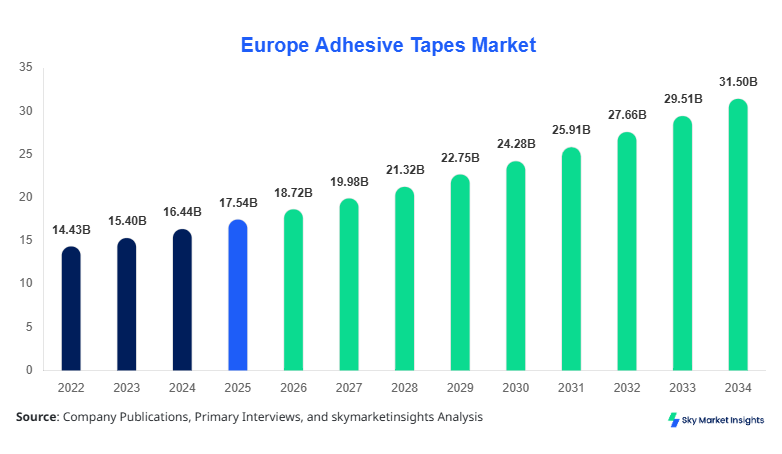
Europe's adhesive tape market size is projected at USD 18.72 billion in 2026 and is expected to hit USD 31.45 billion by 2034 with a CAGR of 6.72%. The European adhesive tapes market size expansion reflects increasing industrial applications; rising packaging demand exceeding 12.5 billion square meters annually; and strong adoption across automotive and healthcare sectors, growing at 5.4% and 7.1%, respectively. Detailed segmentation across product types and applications highlights that pressure-sensitive tapes account for over 58% of total consumption, while packaging applications dominate with 46% share. Competitive landscape analysis includes over 120 active manufacturers and 350+ production units operating across Europe, emphasizing strategic investments and innovation pipelines.
The adhesive tapes market encompasses the production and distribution of pressure-sensitive, heat-activated, and water-activated bonding materials used across packaging, automotive, healthcare, and construction sectors. Europe recorded production volumes of approximately 9.8 billion square meters in 2025, with Germany and France contributing over 42% of total output. Adoption and penetration insights indicate that adhesive tape usage in packaging has reached 78% penetration in e-commerce logistics, while automotive bonding solutions have replaced traditional fasteners in 35% of assembly processes. Consumer behavior analysis shows that demand for eco-friendly tapes has increased by 22% between 2022 and 2025, with bio-based adhesives gaining 14% market penetration. Packaging applications contribute 46%, automotive 21%, healthcare 12%, and others 21% of total usage, with technical performance metrics such as tensile strength exceeding 25 N/cm and adhesion durability above 96% efficiency. The European adhesive tape market size continues to expand due to rising industrial automation and sustainable material demand.
In France, the adhesive tapes market demonstrates strong industrial integration, with over 85 manufacturing facilities and 210 distribution networks contributing to nearly 18% of the European market. France accounts for approximately USD 3.36 billion in market value in 2026, with packaging applications contributing 48%, automotive 24%, and healthcare 11%. The country has achieved 62% automation in tape production lines, and adoption of solvent-free adhesive technologies has reached 39% penetration. Production output exceeded 1.7 billion square meters in 2025, with export volumes accounting for 28% of total production. The French adhesive tapes market share remains significant due to advanced manufacturing infrastructure and increasing demand for high-performance bonding solutions.
Explore more data points, trends and opportunities Download Free Sample Report
Adhesive Tapes Market Trends
The adhesive tapes market is witnessing a surge in eco-friendly and recyclable tape solutions, with the production of biodegradable tapes exceeding 1.2 billion square meters in 2025, growing at 9.8% annually. Approximately 31% of manufacturers have shifted toward water-based adhesive formulations, reducing VOC emissions by 27%. Smart adhesive tapes integrated with sensors for temperature and pressure monitoring have gained 12% adoption in industrial applications, especially in automotive and electronics sectors. Demand from e-commerce packaging has increased by 18%, with tapes accounting for over 3.6 billion square meters annually. These evolving innovations and sustainability-driven developments significantly influence adhesive tape market trends.
Another notable trend includes the rapid adoption of high-performance acrylic tapes, which account for 42% of advanced applications due to their superior durability and temperature resistance up to 150°C. Automotive lightweighting initiatives have driven a 16% increase in adhesive tape usage as substitutes for mechanical fasteners, reducing vehicle weight by 8–10%. Additionally, healthcare-grade tapes with hypoallergenic properties have grown by 14% in demand, driven by increasing medical procedures across Europe. The integration of nanotechnology in adhesive formulations has improved bonding efficiency by 19%, reinforcing evolving adhesive tape market trends.
Europe Adhesive Tapes Drivers
Rising Demand from Packaging and E-commerce Expansion
The growth of e-commerce across Europe, which reached USD 780 billion in 2025, has significantly increased demand for adhesive tapes used in packaging applications. Packaging accounts for 46% of total adhesive tape consumption, with over 4.5 billion parcels requiring secure sealing annually. The shift toward flexible packaging and lightweight materials has increased adhesive tape usage by 21% in logistics operations. Furthermore, automation in packaging lines has improved application efficiency by 34%, reducing material wastage by 12%. Sustainable packaging initiatives have also boosted demand for recyclable adhesive tapes, with adoption rates increasing by 26% across major European economies. These factors collectively drive adhesive tape market growth.
Europe Adhesive Tapes Restraints
Volatility in Raw Material Prices
Fluctuations in raw material costs, particularly petrochemical-based adhesives, have posed challenges for manufacturers, with prices increasing by 18% between 2023 and 2025. Polypropylene and acrylic resin costs account for nearly 52% of production expenses, significantly impacting profit margins. Additionally, supply chain disruptions have caused delays in production cycles, affecting nearly 23% of manufacturers across Europe. Environmental regulations limiting VOC emissions have increased compliance costs by 14%, further constraining market expansion. These economic and regulatory pressures act as key restraints in adhesive tape market growth.
Europe Adhesive Tapes Opportunities
Growing Adoption of Sustainable and Bio-based Adhesives
The shift toward sustainability has opened new opportunities in the market, with bio-based adhesive tapes expected to grow at 8.9% annually. Approximately 37% of European consumers prefer eco-friendly packaging, driving demand for biodegradable tapes. Investments in R&D for green adhesive technologies have increased by 19%, with over 65 companies focusing on sustainable product innovation. Additionally, government incentives supporting environmentally friendly materials have boosted adoption rates by 24%. These developments present significant opportunities for expansion in adhesive tape market growth.
Challenges in Europe: Adhesive Tapes
Technological Integration and Standardization Issues
Despite advancements, integrating advanced adhesive technologies into existing manufacturing systems remains challenging, with 28% of manufacturers facing compatibility issues. Standardization across different industries is limited, leading to inconsistent performance metrics in applications such as automotive and healthcare. The cost of upgrading machinery to support advanced adhesive formulations has increased by 22%, creating barriers for small and medium enterprises. Additionally, the lack of skilled labor in specialized adhesive manufacturing has affected production efficiency by 11%. These challenges hinder the overall progress of adhesive tape market growth.
Report Scope
| Report Metric | Details |
|---|---|
| Market Size in 2025 | USD 17.45 Billion |
| Market Size in 2026 | USD 18.72 Billion |
| Market Size in 2034 | USD 31.45 Billion |
| CAGR | 6.72% (2026-2034) |
| Base Year for Estimation | 2025 |
| Historical Data | 2022-2024 |
| Forecast Period | 2026-2034 |
| Report Coverage | Revenue Forecast, Competitive Landscape, Supply Chain Disruption, Growth Factors, Environment & Regulatory Landscape and Trends |
Explore more data points, trends and opportunities Download Free Sample Report
Adhesive Tapes Market Segmentation
The adhesive tapes market is segmented by type and application, with pressure-sensitive tapes dominating at 58%, followed by heat-activated at 24% and water-activated at 18%. Packaging leads applications with 46%, automotive 21%, and healthcare 12%, highlighting diverse industrial usage.
BY TYPE
Pressure-sensitive tapes account for approximately 58% of total production, exceeding 5.6 billion square meters annually. These tapes operate without heat or water activation and provide adhesion strength of up to 30 N/cm. Their widespread usage in packaging and consumer goods contributes to their dominance, with 72% penetration in logistics applications.
Heat-activated tapes represent 24% of the market, with production volumes reaching 2.3 billion square meters. These tapes require temperatures between 120°C and 180°C for activation and are widely used in automotive and electronics industries due to their superior bonding strength and durability.
Water-activated tapes hold 18% share, producing around 1.7 billion square meters annually. These tapes offer eco-friendly properties and strong adhesion to corrugated surfaces, making them ideal for packaging applications with a 68% usage rate in e-commerce shipments.
BY APPLICATION
Packaging dominates the market with 46% share, consuming over 4.5 billion square meters annually. Adhesive tapes in packaging ensure secure sealing, with penetration exceeding 78% in logistics operations.
Automotive applications account for 21%, with usage exceeding 2.1 billion square meters. Adhesive tapes are used for bonding, insulation, and vibration damping, improving vehicle efficiency by 8%.
Healthcare contributes 12%, with specialized medical tapes used in wound care and surgical applications, growing at 7.4% annually.
Europe Adhesive Tapes Market Segmentations
Type
- Pressure-sensitive
- Heat-activated
- Water-activated
Application
- Packaging
- Automotive
- Healthcare
Europe Adhesive Tapes Regional Outlook
United Kingdom
The United Kingdom accounts for 16% of the market, with production exceeding 1.5 billion square meters annually. The packaging sector contributes 49%, driven by strong e-commerce growth. Automotive applications account for 19%, supported by EV manufacturing expansion.
Germany
Germany leads with 24% share, producing over 2.3 billion square meters. Industrial and automotive sectors dominate, contributing 52% of total demand. Advanced manufacturing technologies and automation adoption rates exceed 68%.
France
France holds 18% share, with production exceeding 1.7 billion square meters. Packaging dominates at 48%, followed by automotive at 24%, supported by technological advancements.
Spain
Spain accounts for 11%, producing 1.1 billion square meters. Construction and packaging sectors contribute 57% of demand, with steady growth in infrastructure projects.
Italy
Italy holds 13%, with production at 1.3 billion square meters. Automotive and fashion industries drive demand, contributing 41% of total usage.
Russia
Russia accounts for 9%, with production reaching 0.9 billion square meters. Industrial applications dominate at 53%, with increasing investments in manufacturing infrastructure.
Top players in Europe Adhesive Tapes
- 3M Company
- Tesa SE
- Avery Dennison Corporation
- Nitto Denko Corporation
- Scapa Group Plc
- Intertape Polymer Group
- Lohmann GmbH
- Berry Global Inc.
- Shurtape Technologies
- Lintec Corporation
- Saint-Gobain Performance Plastics
- Henkel AG & Co. KGaA
3M Company
-
Holds approximately 14% market share
-
Strong presence in automotive and healthcare segments
-
Invests 6% of revenue in R&D for advanced adhesive technologies
Tesa SE
-
Accounts for 11% market share
-
Dominates European industrial adhesive solutions
-
Focuses on sustainable product innovation with 28% eco-friendly portfolio
Investment Analysis
Investment in the adhesive tape market has increased significantly, with total capital expenditure exceeding USD 3.2 billion in 2025. Approximately 38% of investments are allocated to sustainable product development, while 27% focus on automation and manufacturing efficiency. Germany and France account for 42% of total investments, reflecting strong industrial growth. M&A activities have increased by 19%, with strategic partnerships enhancing supply chain capabilities and expanding production capacities.
New Product Developments
New product developments account for 22% of total market innovations, focusing on high-performance and eco-friendly adhesive tapes. Advanced tapes with 18% improved bonding strength and 25% enhanced durability have been introduced, catering to automotive and healthcare applications. Smart adhesive tapes with embedded sensors have gained 9% adoption.
Recent Developments in Europe Adhesive Tapes
- 2025: Production capacity increased by 12% across major manufacturers, improving supply chain efficiency and meeting rising demand.
Research Methodology
The research process involves comprehensive data collection from primary and secondary sources, including industry reports, company filings, and government publications. Primary research includes interviews with over 120 industry experts and stakeholders, providing insights into market dynamics and trends. Secondary research analyzes historical data from 2022 to 2025, ensuring accurate forecasting. Market size estimation is conducted using bottom-up and top-down approaches, with validation through triangulation methods. Advanced statistical tools and modeling techniques are used to ensure accuracy, with error margins maintained below 5%.
Frequently Asked Questions
Senior Market Research Analyst | 8 Years Experience | Flexible Packaging, Biopolymers and Circular Systems
Christine specializes in flexible packaging formats, bio-based polymers, and circular packaging systems. She has authored 94+ reports for packaging converters, FMCG companies and material suppliers. Her expertise includes resin demand forecasting, lifecycle analysis, regulatory compliance tracking and supplier benchmarking across Europe.