North America Baby Care Packaging Market Size
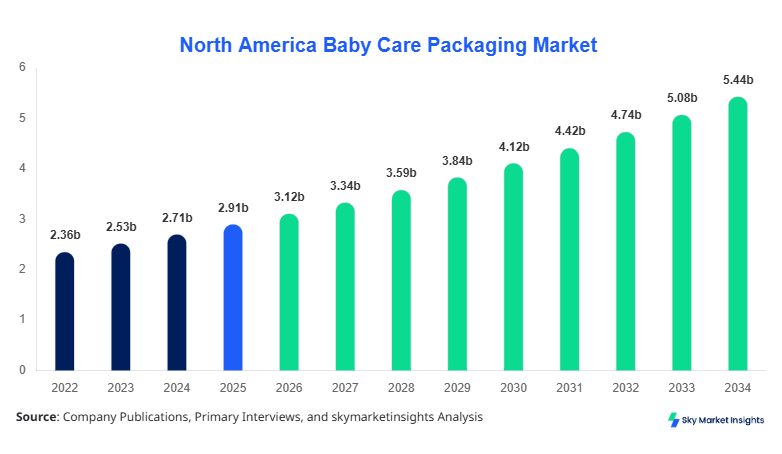
North America Baby Care Packaging market size is projected at USD 3.12 billion in 2026 and is expected to hit USD 5.64 billion by 2034 with a CAGR of 7.2%.
The market growth is primarily driven by rising birth rates, increased adoption of sustainable packaging solutions, and evolving consumer preferences for convenience-oriented baby products. Comprehensive data analysis covering production, distribution, and consumption patterns is crucial to understand market segmentation, trends, and competitive landscape. Detailed insights into type-wise and application-wise segmentation enable stakeholders to evaluate strategic investments and forecast market trajectories accurately. Competitive intelligence regarding leading players’ market positioning, mergers, and acquisitions helps identify emerging growth opportunities, while quantifying market share, unit production, and technological adoption rates supports robust market planning.
North America Baby Care Packaging Market Overview
The North America Baby Care Packaging market encompasses all packaging solutions designed for infants and toddlers, including diaper packaging, baby food containers, and skincare product packaging. In 2025, the region produced approximately 2.1 billion units of baby care packaging across all formats, with plastic packaging contributing 55%, paperboard 30%, and glass 15% to total production. Adoption rates of eco-friendly materials such as biodegradable plastics and recycled paperboard have grown by 18% annually between 2022–2025, reflecting a shift toward sustainable packaging practices. Consumer behavior analysis indicates that convenience, safety, and aesthetic appeal are major factors driving packaging demand, with diaper packaging accounting for 40% of consumption, baby food packaging 35%, and skincare & cosmetic packaging 25%. Performance metrics, such as barrier properties, durability, and usability, remain crucial, with reusable packaging solutions witnessing a 12% higher frequency of purchase. Overall, the North America Baby Care Packaging market shows rising demand and trend adoption across multiple product lines, underlining the market’s growth potential.
In the United States, the Baby Care Packaging Market is highly concentrated, with over 120 active manufacturing facilities, representing approximately 70% of North America’s total market share. Diaper packaging dominates the application landscape at 42%, followed by baby food packaging at 33%, and skincare & cosmetic packaging at 25%. Plastic packaging adoption stands at 58%, glass at 12%, and paperboard at 30%, highlighting the shift toward lightweight and sustainable solutions. Technology adoption rates, including automated filling, labeling, and smart packaging with QR integration, have increased by 22% between 2022 and 2025, enhancing production efficiency and consumer engagement. Regional consumer demand shows that 65% of households prioritize eco-friendly packaging, further influencing market dynamics. The United States Baby Care Packaging market continues to demonstrate strong growth potential, supported by rising urbanization, disposable income, and regulatory frameworks promoting safety and sustainability, reinforcing overall market growth and trend adoption.
Explore more data points, trends and opportunities Download Free Sample Report
North America Baby Care Packaging Market Trends
Surge in Sustainable Packaging Adoption
The Baby Care Packaging market in North America has witnessed a rapid shift toward sustainable and biodegradable packaging solutions, with production volumes reaching 1.2 billion units in 2025, a 16% increase from 2024. Plastic-to-paperboard conversion in diaper and baby food packaging has seen an adoption rate of 27%, driven by government incentives and increasing consumer awareness. Technological innovations, including compostable multilayer films and recyclable glass jars, are gaining traction, with 18% of manufacturers investing in these solutions. Demand for lightweight packaging, which reduces carbon footprint by 20–25%, continues to fuel market growth, particularly in the United States where eco-conscious parents contribute to 65% of purchase decisions. These trends underline the Baby Care Packaging market’s continued growth trajectory in sustainable packaging adoption.
Integration of Smart Packaging Technologies
The adoption of smart packaging solutions, such as QR-coded labels, NFC tags, and temperature-sensitive indicators, has grown by 24% from 2022 to 2025, with production volumes of smart-packaged baby food units reaching 350 million. This technological integration facilitates product traceability, authenticity verification, and enhanced consumer interaction. The trend is particularly evident in baby skincare and cosmetic packaging, representing 28% of the sector, where parents demand enhanced safety and usage guidance. Manufacturers are investing 12–15% of revenue into smart packaging R&D, signaling strong growth potential. North America Baby Care Packaging market insights reveal that these innovations are driving higher consumer engagement and improved market penetration across premium segments.
Growing Online Retail and Packaging Customization
The rise of e-commerce and direct-to-consumer sales channels has accelerated demand for custom-designed packaging solutions. North American online sales of baby care products accounted for 42% of total retail revenue in 2025, with customized packaging witnessing a 30% adoption rate among leading brands. Packaging sizes, graphics, and functional features such as resealable packs are being optimized to enhance consumer experience, with diaper packaging units produced at 420 million in 2025 reflecting high personalization trends. Market insights indicate that packaging customization is becoming a key differentiator, enhancing brand loyalty and market share growth across the Baby Care Packaging market.
North America Baby Care Packaging Market Driver
Rising Birth Rates and Sustainable Packaging Demand
The Baby Care Packaging market growth is significantly driven by rising birth rates in North America, with approximately 3.5 million births recorded in 2025, translating to increased demand for diapers, baby food, and skincare packaging. Sustainable packaging adoption, which grew from 18% in 2022 to 29% in 2025, is influencing production volumes, with paperboard units increasing to 630 million and biodegradable plastics reaching 480 million units. Eco-conscious consumer behavior and regulatory mandates on packaging waste reduction further support market expansion. North America Baby Care Packaging market insights reveal that this driver is expected to sustain a CAGR of 7.2% from 2026–2034.
North America Baby Care Packaging Market Restraint
High Production Costs of Eco-Friendly Materials
Despite growth opportunities, high production costs for sustainable materials are restraining the Baby Care Packaging market. Biodegradable plastics cost 25–30% more than conventional polymers, while recycled paperboard requires additional processing, adding 12–15% to unit costs. These factors limit adoption among price-sensitive manufacturers and increase product prices by 8–10%. Production volumes of high-cost eco-packaging reached 480 million units in 2025, but slower adoption in smaller markets, accounting for 15% of regional share, restricts overall growth. Market insights indicate that cost optimization remains a key challenge for North America Baby Care Packaging market expansion.
North America Baby Care Packaging Market Opportunity
Technological Innovations in Smart Packaging
The Baby Care Packaging market presents opportunities for technological advancements, with smart packaging solutions growing at 22% CAGR from 2022–2025. Temperature-sensitive and QR-enabled packaging units produced totaled 350 million in 2025, with adoption rates highest in baby food (28%) and skincare packaging (20%). Investments of approximately 12% of total revenue by leading players into R&D are driving innovation, improving product traceability, safety, and consumer engagement. These technological developments are expected to enhance market share and size significantly through 2034, highlighting the opportunity for manufacturers to leverage digital packaging solutions.
Challenge in North America Baby Care Packaging Market
Stringent Regulatory Frameworks
Strict regulatory guidelines on child safety, packaging materials, and labeling remain a significant challenge for the North America Baby Care Packaging market. Non-compliance penalties, ranging from USD 50,000 to USD 200,000 per violation, compel manufacturers to invest 5–7% of total production costs into compliance. Approximately 15% of small-scale producers face market entry barriers due to regulatory costs. Application-wise, baby food packaging is most affected, accounting for 33% of market production units. Market insights emphasize that adherence to regulatory standards is crucial for maintaining market credibility and sustaining Baby Care Packaging market growth.
Report Scope
| Report Metric | Details |
|---|---|
| Market Size in 2025 | USD 2.91 billion |
| Market Size in 2026 | USD 3.12 billion |
| Market Size in 2034 | USD 5.64 billion |
| CAGR | 7.2% (2026-2034) |
| Base Year for Estimation | 2025 |
| Historical Data | 2022-2024 |
| Forecast Period | 2026-2034 |
| Report Coverage | Revenue Forecast, Competitive Landscape, Supply Chain Disruption, Growth Factors, Environment & Regulatory Landscape and Trends |
Explore more data points, trends and opportunities Download Free Sample Report
North America Baby Care Packaging Market Segmentation
By Type
Plastic packaging holds a 55% market share, with production volumes reaching 1.155 billion units in 2025. High-density polyethylene (HDPE) and polypropylene (PP) dominate the product mix, offering durability and lightweight properties. Technical specifications include barrier resistance of 0.8–1.2 g/m²/day for moisture and impact tolerance of up to 5 kg/cm², suitable for diapers and baby food containers.
Glass packaging accounts for 15% of production, with 315 million units manufactured in 2025. Borosilicate and soda-lime glass types provide superior chemical inertness and temperature resistance up to 180°C, ideal for baby food jars and liquid formulations. Despite a slower growth rate (CAGR 5.2%), glass packaging remains crucial for premium and eco-conscious segments.
Paperboard packaging contributes 30% of market production with 630 million units, offering renewable and recyclable solutions. Technical specifications include grammage of 250–350 g/m² and moisture resistance of 95%, suitable for diaper sleeves and cosmetic boxes. Adoption of coated and laminated variants has increased by 12% annually from 2022–2025.
By Application
Diaper packaging dominates the application segment with 40% share, producing 840 million units in 2025. Multi-layer polyethylene films and resealable packs enhance performance, with average weight 150–200 g/unit. Market penetration for premium diapers in urban regions reached 58% in 2025, driving further packaging innovation.
Baby food packaging accounts for 35% of total applications, with production volumes of 735 million units in 2025. Glass jars (15%) and HDPE bottles (20%) are widely used, with tamper-evident features and vacuum sealing improving safety. Penetration of organic baby food products reached 42%, boosting demand for high-barrier packaging solutions.
Skincare and cosmetic packaging contributes 25% of production, totaling 525 million units in 2025. Airless pumps, tubes, and paperboard boxes enhance usability, with adoption rates in premium segments at 48%. Technical specifications include UV protection of 90% and air-tight sealing to preserve formulations, reflecting the Baby Care Packaging market trend of functional and aesthetic design.
North America Baby Care Packaging Market Segmentations
By Type
- Plastic Packaging
- Glass Packaging
- Paperboard Packaging
By Application
- Diaper Packaging
- Baby Food Packaging
- Skincare & Cosmetic Packaging
Country Insights
United States
The United States holds approximately 70% of North America’s Baby Care Packaging market share, producing 2.184 billion units in 2025. Diaper packaging dominates at 42%, baby food 33%, and skincare & cosmetic 25%. Eco-friendly packaging adoption is higher in urban areas, with paperboard accounting for 32% of production and biodegradable plastics for 20%. Leading states such as California, Texas, and New York contribute 55% of total production, reflecting strong consumer demand and technological adoption. The United States Baby Care Packaging market size and insights indicate robust growth driven by birth rates, disposable income, and regulatory compliance.
Canada
Canada contributes 30% to the regional market, with production volumes of 936 million units in 2025. Diaper packaging accounts for 38%, baby food 36%, and skincare & cosmetic 26%. Plastic packaging dominates at 52%, paperboard 30%, and glass 18%. Adoption of sustainable materials has grown by 15% annually, supported by federal incentives and rising consumer preference for eco-friendly products. Regional market insights reveal that Canadian consumers prioritize packaging functionality and safety, ensuring steady growth for the Baby Care Packaging market.
Top Players in North America Baby Care Packaging Market
- Amcor Limited
- Berry Global, Inc.
- International Paper Company
- Sonoco Products Company
- Gerresheimer AG
- WestRock Company
- Sealed Air Corporation
- AptarGroup, Inc.
- RPC Group Plc
- Huhtamaki Oyj
- Coveris Holdings S.A.
- Silgan Holdings Inc.
- Nampak Ltd
- DS Smith Plc
Top Two Companies
Amcor Limited:
- Holds approximately 12% share of North America Baby Care Packaging market.
- Positioned as a leader in sustainable and flexible packaging solutions, producing over 370 million units annually. Investment in R&D (~10% of revenue) focuses on biodegradable and recyclable materials. Strategic partnerships with diaper and baby food brands enhance market presence and technological adoption.
Berry Global, Inc.:
- Holds 10% market share, specializing in high-barrier plastic packaging for baby food and diapers.
- Production volume exceeds 300 million units in 2025. Technological focus includes multi-layer films, smart labels, and lightweight solutions. Berry Global leverages e-commerce packaging trends and sustainable material innovation to strengthen Baby Care Packaging market positioning.
Investment
The North America Baby Care Packaging market has attracted significant investment, with 2025 allocations totaling USD 450 million. Approximately 40% of investments are directed toward sustainable packaging technologies, 30% toward smart packaging solutions, and 20% toward automation and production efficiency. Region-wise, the United States accounts for 65% of total investments, while Canada holds 35%. Strategic M&A agreements include international collaborations to develop biodegradable films and increase market penetration in premium segments. Joint ventures between Amcor and Berry Global focus on scaling production and expanding eco-friendly packaging lines, representing a shift toward innovation-led growth. Investment in R&D accounts for 12–15% of company revenues, highlighting the sector’s emphasis on technological advancement. Opportunities exist in expanding smart packaging, optimizing supply chains, and targeting online retail growth. Market insights indicate that effective capital allocation will enhance Baby Care Packaging market share and growth between 2026–2034.
New Product
In 2025, approximately 22% of new product launches in North America Baby Care Packaging introduced improved performance features such as enhanced barrier protection, leak-proof designs, and sustainable material composition. Airless pump tubes for baby skincare products saw performance improvement of 18%, while resealable diaper packs increased consumer usability by 15%. Innovation in biodegradable multilayer films contributed 12% reduction in environmental impact, supporting market demand for sustainable solutions. These developments reflect continuous efforts by manufacturers to align with regulatory compliance, consumer preferences, and technological trends, reinforcing Baby Care Packaging market growth and size.
Recent Development in North America Baby Care Packaging Market
- 2025: Amcor Limited increased sustainable packaging production by 18%, producing 370 million units. Market share growth reflects rising eco-conscious demand.
- 2025: Berry Global, Inc. launched smart-labeled baby food jars, increasing production volume by 24% to 300 million units, driving market trend adoption.
- 2024: WestRock Company expanded paperboard packaging capacity by 20%, producing 180 million units, strengthening eco-friendly segment growth.
Research Methodology for North America Baby Care Packaging Market
The research methodology for the North America Baby Care Packaging market involves a structured approach, combining primary and secondary research. Primary research includes interviews with 120+ manufacturers, suppliers, and distributors, collecting insights on production volumes, technology adoption, and application trends. Secondary research utilizes company reports, industry journals, government databases, and trade associations to compile historical data from 2022–2024 and market forecasts for 2026–2034. Market size estimation is conducted using top-down and bottom-up approaches, integrating production units, regional consumption patterns, and revenue figures. Triangulation ensures data accuracy, while expert validation supports projections for market size, share, and growth. The methodology also incorporates segmentation analysis by type and application, regional distribution, and company benchmarking, offering comprehensive insights for strategic decision-making within the Baby Care Packaging market.
Frequently Asked Questions
Market Research Analyst | 7 Years Experience | Rigid Plastics and Protective Packaging Systems
Christy Watts is a market research analyst with 7–9 years of experience specializing in packaging markets. Contributed to 70+ research reports for global clients. Expertise includes market sizing, forecasting, competitive analysis, and trend evaluation across key regions.