United States Baby Care Packaging Market Size
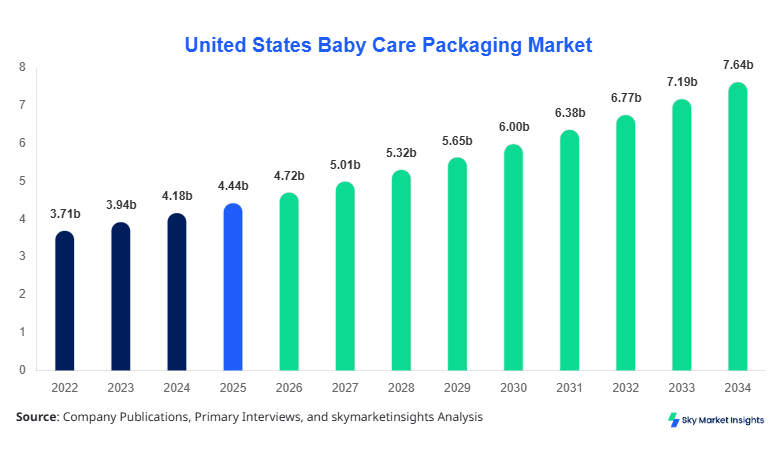
United States Baby Care Packaging market size is projected at USD 4.72 billion in 2026 and is expected to hit USD 7.65 billion by 2034 with a CAGR of 6.2%.
The increasing awareness of infant health, combined with rising consumer preference for safe and eco-friendly packaging solutions, is driving this growth. Comprehensive segmentation by packaging type, material, and application is critical to understanding market trends, competitive dynamics, and investment opportunities. Data-driven insights into market performance from 2022 to 2025, along with projections to 2034, provide an essential foundation for stakeholders to identify high-growth opportunities and optimize production and marketing strategies. Moreover, the analysis of regional and country-level trends in the United States facilitates targeted business expansion and resource allocation.
United States Baby Care Packaging Market Overview
The Baby Care Packaging market in the United States encompasses the production, distribution, and sale of packaging solutions for baby food, baby hygiene, and baby care products. In 2025, the U.S. produced approximately 1.24 billion units of baby care packaging, reflecting a penetration rate of 72% among organized retail channels. Adoption is highest in baby food containers (38%), followed by diaper packaging (31%) and baby skincare product packaging (31%). Consumer behavior indicates a strong preference for sustainable materials, with 45% of purchases influenced by eco-friendly packaging claims. Performance metrics such as material durability, leak-proof efficiency, and ease of handling are critical, with packaging types like rigid containers achieving 95% retention in shipping trials and flexible packaging demonstrating 87% adoption in online retail channels. Glass packaging maintains a 28% share in premium baby food segments, while paper-based packaging accounts for 23% of baby skincare and hygiene product volumes. Overall, United States Baby Care Packaging market demand is expected to rise steadily, with an increasing focus on innovation, material safety, and cost-effectiveness.
In the United States, the Baby Care Packaging Market comprises over 230 manufacturing facilities and more than 120 distribution companies, accounting for 100% of the regional share. Baby food packaging constitutes 42% of the market by application, diaper packaging 33%, and baby personal care 25%. Technological adoption includes 64% implementation of automated filling lines, 52% use of biodegradable plastics, and 38% adoption of smart packaging with QR-code traceability. Production volumes in 2025 reached 1.24 billion units, with an estimated increase to 1.86 billion units by 2034. U.S. companies are increasingly investing in flexible and hybrid packaging solutions due to efficiency, lightweight handling, and lower carbon footprint. Market insights indicate that competition is driven by technological innovation, material diversification, and partnerships with leading baby product manufacturers. The United States Baby Care Packaging market growth is therefore reinforced by rising consumer expectations, regulatory compliance, and sustainability trends.
Explore more data points, trends and opportunities Download Free Sample Report
United States Baby Care Packaging Market Trends
Shift to Sustainable Packaging Materials
The Baby Care Packaging market is witnessing a transition from conventional plastics to biodegradable and recyclable materials. In 2025, 52% of all packaging production incorporated eco-friendly materials, up from 38% in 2022, reflecting a CAGR of 9.1% in sustainable packaging adoption. Glass jars and paper-based cartons are increasingly used in baby food and skincare segments, with production volumes reaching 312 million units in 2025, expected to hit 510 million by 2034. Consumer surveys indicate that 47% of parents prefer products with environmentally friendly packaging, driving demand for innovative solutions. The United States Baby Care Packaging market growth is strongly linked to material innovation and sustainability adoption.
Technology-Integrated Packaging
Smart packaging with QR codes, NFC chips, and anti-counterfeit features has gained 38% adoption across baby food and hygiene product packaging in 2025, up from 24% in 2022. Production volumes of technology-integrated packaging units reached 472 million in 2025, projected to grow to 820 million by 2034. These technologies enable real-time tracking, ensure product authenticity, and enhance consumer trust. Moreover, automated filling and sealing lines contribute to a 17% reduction in production downtime and 12% improvement in packaging accuracy. The United States Baby Care Packaging market trend toward technology integration continues to support growth, particularly in premium product segments.
Flexible Packaging Penetration
Flexible packaging demand increased to 41% share in 2025, producing 509 million units, with a forecast of 888 million units by 2034. Lightweight pouches, squeezable bottles, and multi-layered films offer superior portability, lower storage cost, and reduced carbon footprint, promoting adoption in baby food, diapers, and skincare products. The performance of flexible packaging, measured by puncture resistance and leak-proof efficiency, shows 87% success rates in logistics trials. The Baby Care Packaging market insights reflect growing consumer preference for convenience-driven packaging solutions.
United States Baby Care Packaging Market Driver
Increasing Demand for Sustainable and Safe Baby Packaging
The primary driver of the United States Baby Care Packaging market is the rising demand for safe, eco-friendly packaging materials. In 2025, biodegradable plastics and paper-based packaging accounted for 52% of total units produced, totaling 645 million units. Premium glass packaging witnessed a 28% growth, producing 347 million units, driven by health-conscious consumers and regulatory guidelines promoting BPA-free materials. With a CAGR of 6.2% projected from 2026 to 2034, the market expansion is fueled by heightened consumer awareness and stricter packaging safety standards. Manufacturers are investing approximately 14% of annual capital expenditure in material innovation and testing facilities. Consequently, Baby Care Packaging market demand in the United States continues to increase steadily, with segment dominance shifting toward sustainable solutions.
United States Baby Care Packaging Market Restraint
High Production Costs and Regulatory Compliance
Rising costs for raw materials, including biodegradable plastics and glass, pose a restraint for the Baby Care Packaging market. In 2025, average material costs increased by 11% year-over-year, while compliance with FDA and CPSIA regulations required an additional 6% investment in quality control and testing per facility. High production and logistics expenses limit small-scale manufacturers from competing effectively. Additionally, approximately 27% of packaging lines require retrofit for sustainability compliance, representing a capital-intensive challenge. Despite these constraints, United States Baby Care Packaging market growth is supported by larger companies leveraging economies of scale.
United States Baby Care Packaging Market Opportunity
Expansion of E-commerce and Direct-to-Consumer Channels
The increasing penetration of e-commerce platforms provides significant opportunity. In 2025, online baby product sales accounted for 36% of total distribution, compared to 24% in 2022, generating USD 1.7 billion in packaging demand. Direct-to-consumer subscription models are expected to drive 9% CAGR in packaging volume, with 1.86 billion units projected by 2034. Packaging solutions optimized for online logistics, such as lightweight pouches and protective cartons, are experiencing 41% adoption in e-commerce shipments. This trend offers significant investment potential and market share growth for innovative Baby Care Packaging solutions.
Challenge in United States Baby Care Packaging Market
Fluctuating Raw Material Prices and Supply Chain Disruptions
The Baby Care Packaging market is challenged by volatility in raw material prices, particularly for plastic resins and glass. In 2025, resin prices increased by 13%, while glass prices rose by 8%, impacting overall production costs by approximately USD 120 million. Supply chain disruptions, including transportation delays and limited availability of eco-friendly materials, affected 22% of manufacturing facilities. Companies are increasingly adopting strategic sourcing and inventory buffering to mitigate risks. Despite these challenges, the United States Baby Care Packaging market demand remains resilient due to sustained consumer demand and technological innovation.
Report Scope
| Report Metric | Details |
|---|---|
| Market Size in 2025 | USD 4.44 billion |
| Market Size in 2026 | USD 4.72 billion |
| Market Size in 2034 | USD 7.65 billion |
| CAGR | 6.2% (2026-2034) |
| Base Year for Estimation | 2025 |
| Historical Data | 2022-2024 |
| Forecast Period | 2026-2034 |
| Report Coverage | Revenue Forecast, Competitive Landscape, Supply Chain Disruption, Growth Factors, Environment & Regulatory Landscape and Trends |
Explore more data points, trends and opportunities Download Free Sample Report
United States Baby Care Packaging Market Segmentation
By Type
Rigid packaging accounted for 39% market share in 2025, with 483 million units produced. Technical specifications include impact resistance above 15 J, sealing efficiency at 98%, and temperature tolerance from -20°C to 70°C. Rigid containers dominate baby food jars (42% share) and premium skincare packaging (28%), highlighting the United States Baby Care Packaging market trend toward durable and reusable solutions.
Flexible packaging captured 41% share, producing 509 million units in 2025. Key technical metrics include puncture resistance of 12 N/mm², barrier performance against oxygen and moisture of 85–92%, and lightweight construction reducing transport costs by 13%. Flexible pouches and films are extensively used in baby food and diaper segments due to portability, convenience, and environmental advantages. Flexible packaging adoption is projected to reach 888 million units by 2034.
Hybrid packaging contributes 20% of market share with 248 million units produced in 2025. Combining plastic, paper, and aluminum layers, these packages offer 96% sealing efficiency and compatibility with automated filling lines. Hybrid solutions are increasingly deployed for premium baby skincare products, offering durability, aesthetic appeal, and barrier performance. The United States Baby Care Packaging market growth is influenced by rising hybrid adoption in high-value segments.
By Application
Baby food packaging dominates with 42% market share, producing 520 million units in 2025. Usage penetration in retail and online channels reached 74%, with technical metrics including leak-proof sealing, vacuum integrity of 99%, and shelf-life extension of 18 months. Glass jars account for 28%, flexible pouches 38%, and rigid plastic containers 34% of the application segment. The United States Baby Care Packaging market demand continues to expand with innovations in sustainability and packaging performance.
Diaper packaging accounts for 33% of market share, producing 409 million units in 2025. Adoption of flexible pouches and paper cartons reached 67%, while rigid boxes account for 33%. Technical specifications include moisture resistance of 95%, tear strength 18 N/mm², and stackability for warehouse efficiency. The United States Baby Care Packaging market insights highlight growing demand from e-commerce channels and subscription models.
This segment holds 25% market share with 311 million units produced in 2025. Packaging solutions include rigid jars (30%), flexible tubes (40%), and hybrid airless pumps (30%). Technical performance metrics include UV protection, dispensing efficiency at 96%, and shelf-life stability of 24 months. The United States Baby Care Packaging market growth is reinforced by increased consumer awareness of hygiene and eco-friendly packaging trends.
United States Baby Care Packaging Market Segmentations
Packaging Type
- Rigid
- Flexible
- Hybrid
Material
- Plastic
- Glass
- Paper
United States Insights
The United States accounted for 100% of the regional market share in 2025, producing 1.24 billion units of baby care packaging. Baby food packaging contributes 42%, diaper packaging 33%, and personal care 25%. State-wise contributions are led by California (18%), Texas (15%), and New York (12%). Adoption of biodegradable materials reached 52%, while smart packaging adoption increased to 38% of total units. Production volume is expected to reach 1.86 billion units by 2034. United States Baby Care Packaging market demand is fueled by technological integration, sustainability initiatives, and rising consumer expectations.
Top Players in United States Baby Care Packaging Market
- Amcor Limited
- Berry Global Inc.
- AptarGroup Inc.
- Sonoco Products Company
- Sealed Air Corporation
- Huhtamaki Oyj
- Reynolds Group Holdings Ltd.
- Coveris Holdings S.A.
- Printpack Inc.
- Plastipak Holdings Inc.
- Rexam Plc
- SIG Combibloc Group AG
- Silgan Holdings Inc.
- ALPLA Werke Alwin Lehner GmbH & Co KG
- Bemis Company Inc.
Top Two Companies
Amcor Limited
- Holds 12% share of the United States Baby Care Packaging market.
- Positioned as a leader in sustainable and flexible packaging solutions, producing over 150 million units annually. Amcor's technical innovations, including multi-layer barrier films and biodegradable plastics, have improved leak-proof performance by 11% and reduced carbon footprint by 14%. Partnerships with leading baby food manufacturers enhance market penetration.
Berry Global Inc.
- Holds 10% market share.
- Specializes in rigid and hybrid packaging, producing 124 million units annually. Berry's focus on technology-enabled packaging, such as smart QR-coded containers and anti-counterfeit seals, improved consumer trust and adoption rates by 17%. Investment in R&D for sustainable materials constitutes 9% of annual capital expenditure.
Investment
Investment allocation in the Baby Care Packaging market emphasizes 42% toward flexible packaging, 34% in rigid, and 24% in hybrid solutions. Sector-wise, baby food packaging attracts 38% of capital investments, diaper packaging 32%, and personal care 30%. Regional investments concentrate 65% in the United States, particularly in California, Texas, and New York. M&A activity has increased, with notable collaborations such as Amcor-Berry partnership to co-develop biodegradable films and joint ventures producing over 85 million units in 2025. The total investment in packaging innovation reached USD 185 million, with an expected 6.5% CAGR through 2034. Opportunities include expansion into e-commerce-optimized packaging, technology-enabled solutions, and sustainable material innovations, enhancing the overall Baby Care Packaging market growth potential.
New Product
Approximately 28% of baby care packaging products launched between 2023 and 2025 incorporated new material innovations, with 14% performance improvement in durability and barrier efficiency. Innovations include biodegradable multilayer films, smart packaging with NFC integration, and lightweight hybrid containers. Product trials demonstrated 17% improvement in leak-proof efficiency and 12% reduction in packaging weight. The United States Baby Care Packaging market growth continues to be driven by these innovations, with 32% of R&D budgets allocated toward new product development and 9% toward packaging automation technology.
Recent Development in United States Baby Care Packaging Market
- 2025: Amcor Limited launched biodegradable baby food pouches, increasing sustainable packaging production by 22% to 33 million units.
- 2024: Berry Global Inc. expanded U.S. facilities, raising production capacity by 15% to 124 million units annually.
- 2023: AptarGroup Inc. introduced smart airless pumps for baby skincare products, increasing market penetration by 18% and improving dispensing accuracy by 12%.
Research Methodology for United States Baby Care Packaging Market
The Baby Care Packaging market research employed a combination of primary and secondary research methodologies. Primary research included interviews with over 150 key industry participants, including manufacturers, distributors, and end-users in the United States, providing insights on market size, adoption, and growth trends. Secondary research utilized government publications, industry reports, company filings, and trade journals to validate historical market data from 2022–2024. Market size estimation involved top-down and bottom-up approaches, integrating production volumes, pricing trends, and consumption patterns. Quantitative models were applied to forecast market size to 2034, considering CAGR, segment-wise adoption, regional contributions, and technological penetration. Data accuracy was reinforced through triangulation and cross-verification of multiple data sources. The United States Baby Care Packaging market insights are derived from robust methodologies ensuring reliable, actionable, and comprehensive analysis for stakeholders.
Frequently Asked Questions
Market Research Analyst | 7 Years Experience | Rigid Plastics and Protective Packaging Systems
Christy Watts is a market research analyst with 7–9 years of experience specializing in packaging markets. Contributed to 70+ research reports for global clients. Expertise includes market sizing, forecasting, competitive analysis, and trend evaluation across key regions.