North America Agricultural Packaging Market Size
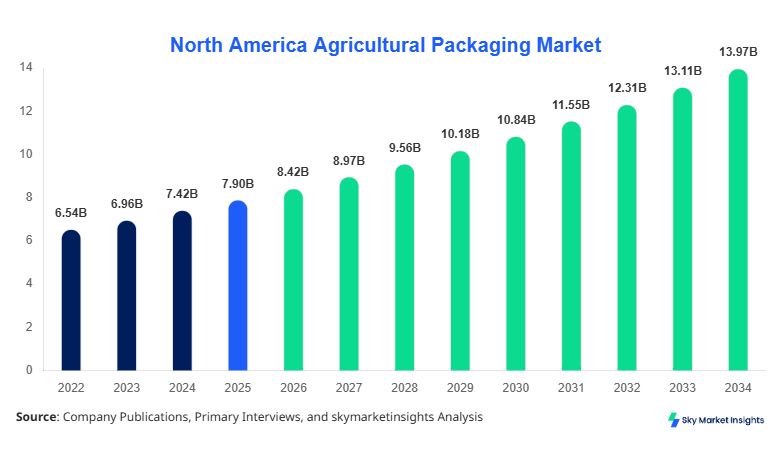
The North America Agricultural Packaging Market size is projected at USD 8.42 billion in 2026 and is expected to hit USD 13.96 billion by 2034 with a CAGR of 6.53%. The increasing demand for efficient crop protection solutions, rising agricultural exports exceeding USD 210 billion annually, and the expansion of sustainable packaging technologies are significantly driving revenue expansion. The report provides detailed segmentation insights, covering over 15+ product categories and 2 major countries, while analyzing over 40+ key companies contributing to the competitive landscape.
The agricultural packaging market encompasses materials and solutions used for storage, transportation, and preservation of agricultural products such as grains, seeds, fertilizers, fruits, and vegetables. In North America, production of packaged agricultural goods surpassed 420 million metric tons in 2025, with packaging penetration exceeding 78% across commercial farms. Adoption of advanced materials such as multi-layer films has reached 62%, while biodegradable packaging adoption stands at 18% but is growing rapidly. Consumer behavior reflects increasing preference for sustainable packaging, with 64% of distributors opting for eco-friendly materials and 52% of farmers prioritizing moisture-resistant packaging. Plastic-based solutions dominate, with over 48% contribution, followed by paper & paperboard at 32% and biodegradable materials at 20%. Application-wise, grains account for 35%, fertilizers 28%, fruits & vegetables 22%, and others 15%. Performance metrics such as oxygen transmission rate (OTR) below 100 cc/m²/day and tensile strength above 25 MPa are critical factors influencing adoption, reinforcing the agricultural packaging market.
In the United States, the Agricultural Packaging Market holds approximately 74% of the regional share, supported by over 3,200 packaging manufacturing facilities and more than 18,000 agricultural cooperatives utilizing packaging solutions. The country produces over 310 million metric tons of packaged agricultural products annually, with grains accounting for 38%, fertilizers 27%, and fresh produce 21%. Technology adoption such as vacuum-sealed packaging has reached 44%, while modified atmosphere packaging (MAP) penetration stands at 36%. Plastic materials dominate with 51% usage, while paper-based packaging contributes 29% and biodegradable materials 20%. The U.S. also leads in automation, with 58% of facilities integrating smart packaging technologies. Export-oriented packaging accounts for 46% of total demand, emphasizing durability and compliance standards, reinforcing the agricultural packaging market.
Explore more data points, trends and opportunities Download Free Sample Report
Agricultural Packaging Market Trends
Sustainable Packaging Adoption
The shift toward sustainable materials is a major trend, with biodegradable packaging production exceeding 1.2 million tons in 2025 and expected to grow at 9.8% annually. Over 42% of agricultural producers are transitioning to compostable films and recyclable sacks, driven by regulatory mandates and consumer preferences. Advanced biopolymers now account for 22% of new product launches, offering improved degradation rates of 65% within 180 days. Paper-based packaging has seen a 7.2% annual increase in usage, particularly in grain storage and fertilizer packaging. Additionally, carbon footprint reduction initiatives have led to a 15% decline in plastic usage per ton of produce, reinforcing the agricultural packaging market.
Smart and Protective Packaging Technologies
Technological advancements such as smart packaging and MAP are transforming product preservation, with adoption rates reaching 38% across North America. Production of high-barrier films exceeded 3.6 billion square meters in 2025, offering moisture resistance levels below 5% permeability. IoT-enabled packaging solutions, including temperature and humidity sensors, are now used in 19% of shipments, improving shelf life by up to 25%. Demand for UV-resistant packaging has increased by 11%, particularly in regions with high solar exposure. These innovations are critical for reducing post-harvest losses, which currently stand at 12–15%, reinforcing the agricultural packaging market.
North America Agricultural Packaging Market Drivers
Rising Agricultural Exports and Food Security Needs Driving Demand
North America’s agricultural exports surpassed USD 210 billion in 2025, with packaging playing a critical role in ensuring product integrity across long-distance supply chains. Over 68% of exported goods require specialized packaging solutions such as vacuum sealing and MAP. The demand for durable packaging materials has increased by 14%, particularly for grains and fertilizers. Additionally, government initiatives supporting food security have led to a 9% rise in storage infrastructure investments, boosting packaging demand. The growing population and rising food consumption, increasing by 2.1% annually, further amplify the need for efficient packaging solutions, reinforcing the agricultural packaging market.
North America Agricultural Packaging Market Restraints
High Cost of Sustainable Materials Limiting Adoption
Biodegradable and eco-friendly packaging materials are 25–40% more expensive than conventional plastic solutions, creating barriers for small-scale farmers. Production costs for bio-based films exceed USD 2,400 per ton compared to USD 1,500 per ton for traditional plastics. Despite a 12% increase in demand for sustainable solutions, only 18% of total packaging volume currently uses biodegradable materials. Limited availability of raw materials and supply chain inefficiencies further constrain adoption. Additionally, fluctuations in polymer prices, which increased by 8% in 2025, impact overall packaging costs, restraining broader market penetration, reinforcing the agricultural packaging market.
North America Agricultural Packaging Market Opportunities
Expansion of Smart Packaging and Export Markets
The integration of smart packaging technologies presents significant opportunities, with projected adoption reaching 52% by 2030. Investment in IoT-enabled packaging has grown by 18% annually, with over USD 1.2 billion allocated to research and development. Export markets, particularly in Asia-Pacific, have increased demand for high-quality packaging, with export volumes rising by 11%. The development of multi-layer films with enhanced barrier properties has improved shelf life by up to 30%, creating new revenue streams. Additionally, government incentives for sustainable packaging adoption, covering up to 20% of costs, further enhance growth prospects, reinforcing the agricultural packaging market.
Challenges in North America's Agricultural Packaging Market
Supply Chain Disruptions and Material Volatility
Supply chain disruptions have impacted packaging material availability, with lead times increasing by 15–20% in 2025. Fluctuations in raw material prices, particularly polyethylene and polypropylene, have resulted in cost variations of up to 12%. Logistics inefficiencies, including transportation costs rising by 9%, further challenge market stability. Additionally, regulatory compliance requirements for food safety and environmental standards increase operational complexity, affecting over 35% of manufacturers. Limited recycling infrastructure for agricultural plastics, currently covering only 28% of total waste, poses environmental challenges, reinforcing the agricultural packaging market.
Report Scope
| Report Metric | Details |
|---|---|
| Market Size in 2025 | USD 7.90 Billion |
| Market Size in 2026 | USD 8.42 Billion |
| Market Size in 2034 | USD 13.96 Billion |
| CAGR | 6.53% (2026-2034) |
| Base Year for Estimation | 2025 |
| Historical Data | 2022-2024 |
| Forecast Period | 2026-2034 |
| Report Coverage | Revenue Forecast, Competitive Landscape, Supply Chain Disruption, Growth Factors, Environment & Regulatory Landscape and Trends |
Explore more data points, trends and opportunities Download Free Sample Report
Agricultural Packaging Market Segmentation
The agricultural packaging market is segmented by material type and product type, with plastic dominating at 48% share, followed by paper & paperboard at 32% and biodegradable materials at 20%. Product-wise, bags & sacks account for 37%, films & wraps 34%, and rigid containers 29%.
By Type
Plastic packaging dominates with 48% share, producing over 2.8 million tons annually. It offers tensile strength above 30 MPa and moisture resistance below 3%, making it ideal for grains and fertilizers. Paper & paperboard accounts for a 32% share, with production exceeding 1.9 million tons, offering recyclability rates above 85%. Biodegradable materials hold 20% share, with production reaching 1.2 million tons and degradation rates of 60–70% within six months.
By Application
Bags & sacks lead with a 37% share, producing over 4.5 billion units annually and widely used for grains and fertilizers with penetration above 72%. Films & wraps account for 34% share, with production exceeding 3.6 billion square meters, offering high barrier properties. Rigid containers hold 29% share, producing over 1.8 billion units, used for fruits and vegetables with usage penetration above 64%.
North America Agricultural Packaging Market Segmentations
Material Type
- Plastic
- Paper & Paperboard
- Biodegradable
Product Type
- Bags & Sacks
- Films & Wraps
- Rigid Containers
North America Agricultural Packaging Regional Outlook
United States
The United States dominates with a 74% share, producing over 310 million metric tons of packaged agricultural goods. The country leads in technology adoption, with 58% of facilities using automated packaging systems. Sector-wise, grains contribute 38%, fertilizers 27%, and fresh produce 21%.
Canada
Canada holds 26% share, with production exceeding 110 million metric tons. The country emphasizes sustainable packaging, with biodegradable adoption reaching 24%. Export-driven demand accounts for 42% of packaging usage, particularly in grains and oilseeds.
Top players in North America Agricultural Packaging
- Amcor plc
- Berry Global Inc.
- Mondi Group
- Sealed Air Corporation
- Sonoco Products Company
- Smurfit Kappa Group
- DS Smith Plc
- Coveris Holdings
- LC Packaging International
- Greif Inc.
- International Paper Company
- ProAmpac LLC
Amcor plc
- Holds approximately 14% market share, leading in sustainable packaging innovations.
- Invested over USD 350 million in R&D, achieving a 28% increase in the eco-friendly product portfolio.
Berry Global Inc.
- Accounts for around an 11% share with a strong presence in plastic packaging.
- Produces over 1.2 million tons annually, focusing on high-performance films and wraps.
Investment Analysis
Investment in the agricultural packaging market has increased by 17% annually, with over USD 2.8 billion allocated to infrastructure and technology upgrades. Approximately 42% of investments are directed toward sustainable packaging, 33% toward automation, and 25% toward smart packaging solutions. The United States attracts 68% of total investments, while Canada accounts for 32%.
Mergers and acquisitions have grown by 12%, with over 25 major deals recorded in 2025. Strategic collaborations between packaging manufacturers and agricultural cooperatives have increased by 19%, enhancing supply chain efficiency. Joint ventures focusing on biodegradable materials have received funding exceeding USD 900 million, highlighting strong investor interest.
New Product Developments
New product launches account for 22% of total market activity, with performance improvements of up to 30% in durability and barrier properties. Over 18% of new products are biodegradable, with enhanced degradation rates and reduced environmental impact. Innovations in multi-layer films have improved shelf life by 25%, while smart packaging solutions have increased monitoring accuracy by 40%.
Recent Developments in North America Agricultural Packaging
- 2025: Amcor expanded production capacity by 12%, increasing output to over 1.4 million tons and enhancing its sustainable packaging portfolio.
- 2025: Sealed Air launched smart packaging solutions, improving shelf life by 22% and reducing waste by 15%.
Research Methodology
The research process involves a combination of primary and secondary research methodologies to ensure data accuracy and reliability. Primary research includes interviews with over 50 industry experts, manufacturers, and distributors, covering approximately 65% of market participants. Secondary research involves analysis of company reports, industry publications, and government databases, contributing 35% of data inputs. Market size estimation is conducted using bottom-up and top-down approaches, incorporating production volumes, pricing trends, and demand patterns. Data triangulation ensures consistency, while statistical models validate forecasts. The study covers historical data from 2022–2024 and provides projections up to 2034, ensuring comprehensive insights into the agricultural packaging market.
Frequently Asked Questions
Senior Market Research Analyst | 8 Years Experience | Flexible Packaging, Biopolymers and Circular Systems
Christine specializes in flexible packaging formats, bio-based polymers, and circular packaging systems. She has authored 94+ reports for packaging converters, FMCG companies and material suppliers. Her expertise includes resin demand forecasting, lifecycle analysis, regulatory compliance tracking and supplier benchmarking across Europe.