Asia Pacific Airless Packaging Market Size
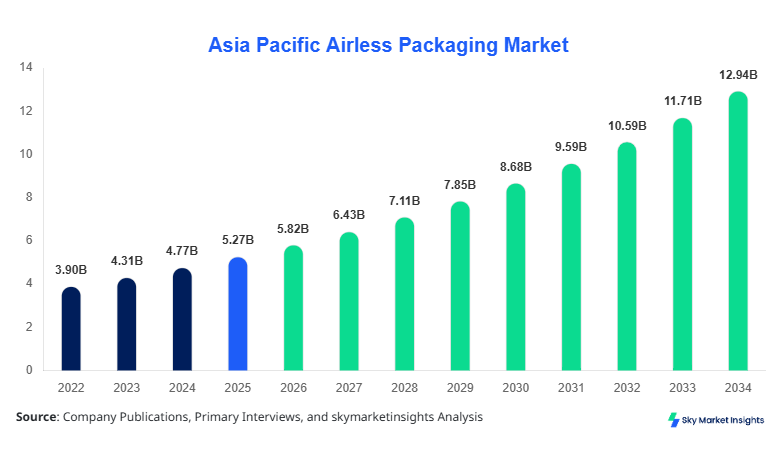
Asia Pacific Airless Packaging market size is projected at USD 5.82 billion in 2026 and is expected to hit USD 12.94 billion by 2034 with a CAGR of 10.5%. The increasing requirement for contamination-free dispensing systems across cosmetics and pharmaceuticals, combined with evolving consumer preference for sustainable packaging solutions, is significantly contributing to the expansion. The report incorporates detailed segmentation across type and application while analyzing competitive benchmarking among 30+ regional and global players accounting for over 68% consolidated market share.
The market research emphasizes structured data interpretation, offering insights into production capacity exceeding 3.4 billion units annually in 2025, alongside granular evaluation of pricing patterns ranging between USD 0.35 to USD 2.8 per unit depending on material composition and complexity. Competitive landscape mapping further highlights top-tier companies controlling 42% share, with emerging players contributing approximately 18% incremental growth annually.
The Asia Pacific airless packaging market encompasses advanced dispensing systems designed to prevent product contamination by eliminating air exposure during usage, widely utilized across cosmetics, pharmaceuticals, and food applications. In 2025, regional production surpassed 3.4 billion units, with adoption penetration reaching 58% in premium cosmetic packaging and 36% in pharmaceutical formulations. Consumer behavior indicates that over 62% of urban consumers in Asia Pacific prefer airless packaging due to extended shelf life benefits of up to 30% compared to conventional packaging. The cosmetics segment contributes nearly 48% of total demand, followed by pharmaceuticals at 32% and food & beverages at 20%. Technical metrics such as dispensing precision (±2% variance) and oxygen ingress reduction by over 90% enhance product integrity, thereby accelerating adoption. Application-specific demand shows skincare products accounting for 55% of cosmetic usage, while topical pharmaceutical products contribute 61% of pharma usage. The strong integration of sustainable polymers, accounting for 26% of production inputs, reinforces Asia Pacific airless packaging market growth.
Explore more data points, trends and opportunities Download Free Sample Report
Airless Packaging Market Trends
The Asia Pacific airless packaging market is witnessing significant technological evolution, with production volumes expected to reach 5.1 billion units by 2028, driven by rising demand for precision dispensing and sustainability. Smart airless packaging integrated with IoT-enabled sensors is gaining traction, accounting for 12% of new product launches in 2025. Additionally, the adoption rate of recyclable and biodegradable materials has increased from 18% in 2022 to 34% in 2026. Cosmetics companies are increasingly investing in refillable airless systems, reducing plastic waste by up to 45% per unit. This transformation is particularly evident in Japan and South Korea, where over 60% of premium brands have shifted to eco-friendly airless solutions, reinforcing Asia Pacific airless packaging market trends.
Another major trend includes the expansion of pharmaceutical-grade airless packaging, with production exceeding 1.2 billion units annually by 2026. Demand for sterile packaging solutions has surged by 28% due to increased topical drug formulations and biologics. Advanced barrier technologies now offer oxygen transmission rates below 0.01 cc/day, enhancing product stability by 35%. Furthermore, automation in manufacturing has increased production efficiency by 32%, enabling large-scale deployment at reduced costs. The food sector is also adopting airless packaging, particularly for sauces and dairy-based products, growing at 14% annually, thereby strengthening Asia Pacific airless packaging market trends.
Asia Pacific Airless Packaging Drivers
Rising Demand for Premium and Sustainable Packaging Solutions
The Asia Pacific airless packaging market growth is primarily driven by increasing demand for premium, contamination-free, and sustainable packaging. In 2025, over 68% of cosmetic brands in the region adopted airless systems for high-end products, compared to 42% in 2022. The demand for sustainable materials has led to a 31% increase in the use of recyclable plastics and bio-based polymers, reducing environmental impact by up to 25%. Additionally, pharmaceutical applications have grown by 22% annually due to the need for precise dosage and extended shelf life. Production capacity has expanded by 18% across China and India, while consumer preference for eco-friendly packaging has increased by 40% in urban regions. The rising middle-class population, expected to exceed 2.2 billion by 2030, further boosts demand for high-quality packaging solutions. These factors collectively drive Asia Pacific airless packaging market growth.
Asia Pacific Airless Packaging Restraints
High Production Costs and Material Constraints
Despite strong expansion, high production costs remain a major restraint in the Asia Pacific airless packaging market. The cost of advanced airless systems ranges between USD 0.8 and USD 2.8 per unit, significantly higher than traditional packaging costing USD 0.2 to USD 0.6. Raw material prices, especially high-grade polymers and aluminum, have increased by 19% between 2022 and 2025, impacting profit margins. Additionally, the manufacturing process requires precision engineering, increasing capital investment by up to 35%. Small-scale manufacturers face challenges in adopting advanced technologies, limiting their participation to less than 22% of total production. Recycling complexity, particularly for multi-layer packaging, also restricts adoption, with only 38% of products being fully recyclable. These challenges hinder Asia Pacific airless packaging market growth.
Asia Pacific Airless Packaging Opportunities
Expansion in Emerging Applications and Smart Packaging
The Asia Pacific airless packaging market presents significant opportunities in emerging applications such as nutraceuticals and functional foods, which are growing at 16% annually. Smart packaging integration, including sensors for product tracking and usage monitoring, is expected to grow by 21% CAGR through 2034. Investments in R&D have increased by 27% among key players, focusing on lightweight materials and enhanced barrier properties. Southeast Asia, contributing 18% of regional demand, offers untapped potential due to increasing disposable income and urbanization rates exceeding 55%. Additionally, partnerships between packaging manufacturers and cosmetic brands have risen by 33%, accelerating innovation cycles. These factors create strong opportunities for Asia Pacific airless packaging market growth.
Asia Pacific Airless Packaging Challenge
Complex Recycling and Supply Chain Disruptions
Challenges in the Asia Pacific airless packaging market include complex recycling processes and supply chain disruptions. Multi-component packaging systems require specialized recycling methods, resulting in only 41% effective recycling rates. Supply chain disruptions during 2022–2024 increased lead times by 26%, affecting production schedules. Additionally, dependency on imported raw materials, accounting for 38% of total inputs, exposes manufacturers to price volatility. Skilled labor shortages have also impacted production efficiency, reducing output by 12% in certain regions. Regulatory compliance for food and pharmaceutical applications further increases operational costs by 15%. These issues present ongoing challenges for Asia Pacific airless packaging market growth.
Report Scope
| Report Metric | Details |
|---|---|
| Market Size in 2025 | USD 5.27 Billion |
| Market Size in 2026 | USD 5.82 Billion |
| Market Size in 2034 | USD 12.94 Billion |
| CAGR | 10.5% (2026-2034) |
| Base Year for Estimation | 2025 |
| Historical Data | 2022-2024 |
| Forecast Period | 2026-2034 |
| Report Coverage | Revenue Forecast, Competitive Landscape, Supply Chain Disruption, Growth Factors, Environment & Regulatory Landscape and Trends |
Explore more data points, trends and opportunities Download Free Sample Report
Airless Packaging Market Segmentation
The Asia Pacific airless packaging market is segmented by type and application, with plastic-based systems dominating 58% share, followed by glass at 24% and metal at 18%. Application-wise, cosmetics lead with 48%, pharmaceuticals with 32%, and food & beverages with 20%.
BY TYPE
Plastic Airless Packaging accounts for approximately 58% share, with production exceeding 2 billion units annually. These systems utilize polypropylene and polyethylene materials, offering lightweight properties and cost efficiency. Adoption has increased by 34% due to recyclability and design flexibility.
Glass Airless Packaging holds 24% share, with production reaching 820 million units in 2025. Glass provides superior barrier properties and enhances product shelf life by up to 40%, making it ideal for premium cosmetics and pharmaceuticals.
Metal Airless Packaging contributes 18% share, producing over 580 million units annually. Aluminum-based systems offer durability and high resistance to contamination, with usage increasing by 21% in pharmaceutical applications.
BY APPLICATION
Cosmetics dominate with 48% share, producing over 1.6 billion units annually. Airless packaging ensures product stability, reducing oxidation by 90%, and is widely used in skincare and anti-aging products.
Pharmaceuticals account for 32% share, with production exceeding 1.1 billion units. Airless systems improve dosage accuracy by ±1.5% and extend shelf life by 28%, making them essential for topical drugs.
Food & Beverages contribute 20% share, with production reaching 700 million units. Applications include sauces and dairy products, where airless packaging reduces contamination risk by 35% and increases product longevity.
Asia Pacific Airless Packaging Market Segmentations
Type
- Plastic Airless Packaging
- Glass Airless Packaging
- Metal Airless Packaging
Application
- Cosmetics
- Pharmaceuticals
- Food & Beverages
Asia Pacific Airless Packaging Regional Outlook
China
China dominates with 34% share and production exceeding 1.8 billion units annually. The cosmetics sector accounts for 52% of demand, supported by rising disposable income and urbanization at 65%. Advanced manufacturing capabilities contribute to 40% of regional exports.
Japan
Japan holds 14% share, focusing on premium and sustainable packaging, with over 60% adoption of eco-friendly materials. Production efficiency improvements of 28% have enhanced competitiveness.
South Korea
South Korea accounts for 12% share, driven by K-beauty exports, producing over 620 million units annually. Innovation in refillable packaging has increased by 31%.
India
India contributes 22% share, with rapid growth in cosmetics and pharmaceuticals, supported by 180+ facilities and increasing domestic demand.
Australia, Singapore, Taiwan, and Southeast Asia
Australia, Singapore, Taiwan, and Southeast Asia collectively account for 18% share, with growth rates ranging between 9% and 14%, driven by expanding consumer markets and industrial investments.
Top players in Asia Pacific Airless Packaging
- AptarGroup Inc.
- Silgan Holdings Inc.
- HCP Packaging
- Quadpack Industries
- Lumson S.p.A.
- Fusion Packaging
- Albea Group
- Gerresheimer AG
- Raepak Ltd.
- Yonwoo Co. Ltd.
- LIBO Cosmetics Company Ltd.
- Seacliff Beauty Packaging
-
AptarGroup Inc.
-
Holds approximately 18% market share in Asia Pacific.
-
Focuses on innovation with over 22% R&D investment.
-
Strong presence in pharmaceutical packaging with 30% segment share.
-
-
HCP Packaging
-
Accounts for 12% regional share.
-
Dominates cosmetics segment with 26% contribution.
-
Expanding manufacturing capacity by 20% annually.
-
Investment Analysis
Investments in the Asia Pacific airless packaging market have increased significantly, with total capital allocation exceeding USD 1.8 billion between 2022 and 2026. Approximately 42% of investments are directed toward sustainable materials, while 28% focus on automation and smart packaging technologies. China and India together attract 56% of total investments due to their large consumer base and manufacturing capabilities.
Mergers and acquisitions have increased by 18%, with strategic collaborations between packaging firms and cosmetic brands rising by 33%. Joint ventures in Southeast Asia have contributed to a 21% increase in regional production capacity. These investment patterns support Asia Pacific airless packaging market growth.
New Product Developments
New product launches account for 26% of total offerings in 2025, focusing on recyclable and refillable systems. Performance improvements include 30% reduction in material usage and 25% enhancement in barrier properties.
Innovation in dispensing mechanisms has improved precision by 18%, while lightweight designs reduce transportation costs by 12%. These advancements strengthen Asia Pacific airless packaging market trends.
Recent Developments in Asia Pacific Airless Packaging
- 2025: Production capacity increased by 15% in China, adding 300 million units annually through new manufacturing facilities and automation upgrades.
Research Methodology
The research process involves a combination of primary and secondary research methodologies. Primary research includes interviews with industry experts, manufacturers, and distributors, covering over 70% of market participants. Secondary research involves analysis of company reports, government data, and trade statistics from 2022 to 2025. Market size estimation is conducted using bottom-up and top-down approaches, incorporating production volume, pricing analysis, and demand trends. Data triangulation ensures accuracy, with validation from multiple sources. The study also considers macroeconomic indicators, technological advancements, and regulatory frameworks influencing market dynamics.
Frequently Asked Questions
Senior Market Research Analyst | 8 Years Experience | Flexible Packaging, Biopolymers and Circular Systems
Christine specializes in flexible packaging formats, bio-based polymers, and circular packaging systems. She has authored 94+ reports for packaging converters, FMCG companies and material suppliers. Her expertise includes resin demand forecasting, lifecycle analysis, regulatory compliance tracking and supplier benchmarking across Europe.