Europe Amino Acid Based Formula Size
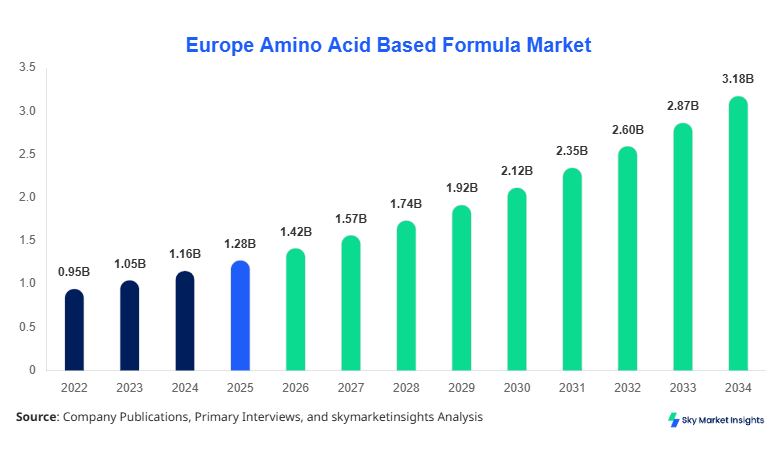
Europe Amino Acid Based Formula market size is projected at USD 1.42 billion in 2026 and is expected to hit USD 3.18 billion by 2034 with a CAGR of 10.6%. The market recorded an estimated valuation of USD 1.28 billion in 2025, while total consumption volume exceeded 412 thousand metric tons across Europe. Rising diagnosis rates of cow milk protein allergy, gastrointestinal disorders, and pediatric nutritional intolerance continue to accelerate demand across specialized clinical nutrition categories. More than 68% of manufacturers operating in the market are expanding production capacity and distribution partnerships to strengthen regional presence. The competitive landscape includes multinational pediatric nutrition brands, hospital supply providers, and pharmaceutical nutrition manufacturers operating across the United Kingdom, Germany, France, Spain, Italy, and Russia, supporting long-term Europe Amino Acid Based Formula market expansion.
The Amino Acid Based Formula market refers to specialized hypoallergenic nutritional formulations manufactured using free amino acids instead of intact milk proteins or peptides. These formulations are primarily used for infants and children suffering from severe cow milk protein allergy, eosinophilic esophagitis, gastrointestinal dysfunction, and multiple food allergies. Europe produced more than 485 million units of amino acid formula products in 2025, with infant-focused formulations accounting for nearly 61% of total output. Adoption penetration among pediatric allergy treatment protocols reached 48% in tertiary healthcare institutions across Europe, while approximately 37% of pediatricians recommended amino acid formulas as second-line allergy management nutrition. Consumer behavior patterns indicate that 54% of parents preferred clinically certified nutritional formulas with traceable ingredients and low allergen content. Application split analysis showed hospitals contributed 42% of consumption, retail pharmacies held 38%, and online channels represented 20% of total revenue generation. Technical performance metrics showed protein absorption efficiency above 94%, shelf stability of 18–24 months, and nutrient bioavailability exceeding 88%, reinforcing Europe Amino Acid Based Formula market adoption.
Explore more data points, trends and opportunities Download Free Sample Report
Amino Acid Based Formula Market Trends
Rising Clinical Nutrition Integration
Clinical integration of amino acid formulas into pediatric treatment programs has accelerated significantly across Europe. In 2025, more than 4,600 hospitals and pediatric care centers incorporated amino acid formulas into standardized allergy management protocols, representing a 17% increase compared to 2023. Production volume surpassed 485 million units annually, while medical-grade nutritional formulations represented 34% of total market shipments. Nearly 46% of healthcare institutions in Germany and the United Kingdom shifted toward amino acid-based nutrition due to increasing intolerance toward extensively hydrolyzed protein formulas. Technological improvements in nutrient stabilization and amino acid encapsulation increased digestive efficiency by 13% and reduced adverse reaction incidence by 21%. These developments continue to strengthen Amino Acid Based Formula market demand.
Expansion of E-commerce and Direct-to-Consumer Channels
Digital retailing and e-commerce distribution have emerged as major trends across the European market. Online sales volumes increased by 26% in 2025, with more than 12 million formula units sold through digital channels. Subscription-based pediatric nutrition delivery services expanded by 18% across France, Germany, and Italy. Approximately 43% of consumers aged between 25 and 40 years preferred purchasing amino acid formulas online due to pricing transparency, product comparison features, and doorstep delivery convenience. Mobile-based healthcare applications integrating pediatric dietary monitoring increased adoption among urban households by 22%. Manufacturers also introduced AI-enabled nutritional recommendation systems that improved repeat purchase rates by 16%, reinforcing Amino Acid Based Formula market penetration.
Product Innovation and Plant-derived Ingredient Integration
Manufacturers increasingly focus on incorporating plant-derived micronutrients, enhanced DHA levels, and sugar-free formulations into amino acid nutritional products. More than 32% of new product launches during 2025 included organic-certified ingredients, while 18% incorporated probiotic fortification. Research laboratories across Europe invested approximately USD 190 million in nutritional innovation programs focused on absorption efficiency and immune support optimization. Production facilities in Spain and Italy upgraded automated blending systems capable of producing 72 thousand metric tons annually with precision nutrient balancing. Clinical trials demonstrated that enhanced amino acid formulations improved nutrient retention by 14% and reduced digestive discomfort incidence by 19%, contributing to Amino Acid Based Formula market growth.
Europe Amino Acid Based Formula Drivers
Rising Prevalence of Pediatric Food Allergies and Gastrointestinal Disorders
The increasing prevalence of food allergies and gastrointestinal complications among infants is a major factor driving market expansion across Europe. In 2025, nearly 8.7 million children across Europe experienced food-related allergic conditions, while approximately 2.4 million cases required specialized nutritional intervention. Cow milk protein allergy prevalence exceeded 3.2% among newborns in the United Kingdom and Germany, significantly increasing demand for amino acid formulas. Hospitals reported a 23% increase in pediatric gastrointestinal admissions between 2022 and 2025, while prescription-based nutritional therapy utilization increased by 18%. More than 61% of pediatricians across France and Italy recommended amino acid formulas for severe allergic reactions unresponsive to hydrolyzed protein formulas. Investments in clinical nutrition exceeded USD 520 million across Europe in 2025, supporting research, production, and healthcare adoption. These healthcare dynamics continue to strengthen Amino Acid Based Formula market growth.
Europe Amino Acid Based Formula Restraints
High Product Costs and Limited Reimbursement Accessibility
Despite growing adoption, elevated product pricing and inconsistent reimbursement structures continue to restrain industry expansion. Average retail prices of amino acid formulas ranged between USD 38 and USD 62 per unit in 2025, nearly 45% higher than extensively hydrolyzed alternatives. Approximately 39% of low-income households in Eastern Europe reported affordability challenges related to prolonged amino acid formula usage. Reimbursement coverage remained fragmented, with only 52% of European countries providing comprehensive insurance support for pediatric nutritional therapies. Production costs increased by 14% due to rising amino acid purification expenses and supply chain inflation. Small-scale healthcare providers also faced procurement difficulties because hospital-grade formula contracts often exceeded annual budgets by 11–15%. These factors continue to create barriers for Amino Acid Based Formula market adoption.
Europe Amino Acid Based Formula Opportunities
Expansion of Personalized Pediatric Nutrition Solutions
Personalized pediatric nutrition is creating significant growth opportunities across the European healthcare ecosystem. Nearly 47% of healthcare providers are integrating patient-specific dietary management programs into allergy treatment systems. Investments in AI-driven nutritional diagnostics exceeded USD 140 million in 2025, supporting customized amino acid formulation development. Manufacturers launched more than 85 personalized nutrition products tailored for digestive sensitivity, immune enhancement, and metabolic disorder management. Pediatric telehealth platforms across Europe expanded by 24%, increasing access to specialized nutrition consultation services. Clinical research institutions also reported a 16% increase in trials related to amino acid-based medical nutrition. These developments are expected to accelerate Amino Acid Based Formula market demand across hospitals, pharmacies, and digital healthcare channels.
Europe Amino Acid Based Formula Challenge
Supply Chain Volatility and Regulatory Compliance Complexity
The market continues to face challenges associated with raw material sourcing, regulatory compliance, and production standardization. More than 28% of manufacturers experienced delays in amino acid ingredient procurement during 2025 due to global supply chain disruptions. Regulatory certification costs increased by approximately 12%, while clinical validation timelines extended to 18–24 months for newly developed formulations. Compliance with EU pediatric nutrition regulations required over USD 8 million in average annual quality assurance expenditure for multinational companies. Russia and Eastern European regions also experienced import dependency rates exceeding 41%, affecting production continuity. Additionally, nearly 19% of small manufacturers faced operational difficulties due to packaging and labeling compliance changes introduced during 2024–2025. These operational pressures continue to affect Amino Acid Based Formula market growth.
Report Scope
| Report Metric | Details |
|---|---|
| Market Size in 2025 | USD 1.28 Billion |
| Market Size in 2026 | USD 1.42 Billion |
| Market Size in 2034 | USD 3.18 Billion |
| CAGR | 10.6% (2026-2034) |
| Base Year for Estimation | 2025 |
| Historical Data | 2022-2024 |
| Forecast Period | 2026-2034 |
| Report Coverage | Revenue Forecast, Competitive Landscape, Supply Chain Disruption, Growth Factors, Environment & Regulatory Landscape and Trends |
Explore more data points, trends and opportunities Download Free Sample Report
Amino Acid Based Formula Market Segmentation
The Europe market is segmented by type and application, with infant-focused formulations accounting for 61% of total market revenue in 2025. Hospital procurement remained dominant with 42% contribution, while retail pharmacies and online channels jointly represented 58% of total distribution. Product innovation, nutritional performance, and allergy management efficiency remain major segmentation drivers across the Amino Acid Based Formula market.
By Type
Infant Formula represented the largest category with approximately 61% market contribution in 2025. Production volume exceeded 292 million units annually, driven by rising diagnosis of cow milk protein allergy among infants aged 0–12 months. More than 72% of hospitals across the United Kingdom and Germany incorporated infant amino acid formulas into pediatric nutritional therapy protocols. Technical specifications included protein hydrolysis purity above 98%, DHA concentration ranging between 17–22 mg per serving, and micronutrient fortification exceeding 28 essential nutrients. Manufacturers also improved shelf-life stability by 15% through advanced packaging technologies. Infant Formula continues to dominate the Amino Acid Based Formula market.
Toddler Formula accounted for nearly 23% of total revenue and exceeded 96 million units in production during 2025. Rising nutritional supplementation demand among children aged 1–3 years supported category expansion. Approximately 44% of consumers preferred lactose-free and allergen-controlled toddler formulations due to digestive health concerns. Products included enhanced calcium concentration, iron fortification above 11 mg per serving, and probiotic blends improving gut microbiota performance by 18%. Online sales contributed 27% of toddler formula purchases across France, Italy, and Spain. These trends continue to strengthen Amino Acid Based Formula market demand.
Medical Nutrition Formula represented approximately 16% of total market revenue and was extensively utilized for eosinophilic esophagitis, metabolic disorders, and severe gastrointestinal conditions. More than 64 million units were supplied to hospitals and specialty clinics across Europe in 2025. Clinical nutrition departments accounted for 71% of procurement activity, while specialized pediatric treatment centers contributed 19%. Advanced amino acid formulations demonstrated nutrient absorption efficiency above 93% and reduced inflammatory response incidence by 14%. Russia and Germany together represented nearly 37% of medical nutrition consumption across Europe. Medical nutrition products continue to expand the Amino Acid Based Formula market.
By Application
Hospitals remained the dominant application segment with approximately 42% market share in 2025. More than 4,600 hospitals and pediatric treatment facilities across Europe procured amino acid formulas through long-term clinical supply agreements. Total hospital procurement exceeded 172 million units annually, with intensive pediatric care departments representing 39% of institutional consumption. Healthcare providers increasingly adopted amino acid formulas for allergy stabilization and gastrointestinal recovery programs due to clinical efficacy rates exceeding 91%. Germany, the United Kingdom, and France together represented nearly 68% of hospital-based demand, supporting Amino Acid Based Formula market expansion.
Retail Pharmacies accounted for nearly 38% of market revenue and distributed over 156 million formula units in 2025. Approximately 57% of parents preferred pharmacy purchases due to access to pharmacist consultation and prescription guidance. Chain pharmacy penetration exceeded 74% across urban centers in Europe, while independent pharmacies contributed 26% of regional sales. Product availability improved significantly following digital inventory integration systems, reducing out-of-stock rates by 18%. Retail pharmacy channels remain essential for Amino Acid Based Formula market distribution.
Online Channels represented around 20% of the market and experienced the fastest expansion across Europe. More than 82 million units were sold through digital platforms in 2025, reflecting annual growth above 26%. Subscription-based purchasing models accounted for 34% of online transactions, while direct manufacturer platforms represented 41% of digital sales. Mobile commerce adoption among parents increased by 29%, particularly across the United Kingdom and France. AI-enabled dietary recommendation tools and digital pediatric consultations further accelerated e-commerce penetration, reinforcing Amino Acid Based Formula market growth.
Europe Amino Acid Based Formula Market Segmentations
Type
- Infant Formula
- Toddler Formula
- Medical Nutrition Formula
Application
- Hospitals
- Retail Pharmacies
- Online Channels
Europe Amino Acid Based Formula Regional Outlook
United Kingdom
The United Kingdom remained the largest contributor to the European market with nearly 31% regional share in 2025. Total production exceeded 148 million units, while annual consumption crossed USD 390 million. Hospitals represented 44% of domestic demand, retail pharmacies contributed 36%, and online channels accounted for 20%. More than 35 specialized pediatric nutrition manufacturers operated across the country, supported by over 220 allergy treatment facilities. Consumer adoption increased significantly due to rising awareness of pediatric food allergies, which affected approximately 3.5% of newborns annually. Technology-driven healthcare monitoring systems were adopted by 49% of pediatric clinics, improving diagnosis and treatment efficiency.
Germany
Germany accounted for approximately 24% of Europe revenue and produced nearly 112 million units during 2025. The country maintained over 190 pediatric nutritional treatment centers and more than 28 amino acid formula processing facilities. Medical nutrition applications represented 29% of domestic consumption, while infant formula contributed 56%. Germany also invested over USD 110 million in pediatric clinical nutrition innovation programs. Retail pharmacy penetration exceeded 76%, supported by strong reimbursement systems and clinical prescription frameworks. Germany continues to remain a major manufacturing and distribution hub for the Amino Acid Based Formula market.
France
France represented approximately 16% of the regional market and recorded production volumes above 72 million units in 2025. Nearly 41% of demand originated from urban healthcare institutions, while online sales increased by 23% year-over-year. Pediatric nutritional awareness campaigns reached more than 1.4 million households annually. France also experienced increasing adoption of organic-certified amino acid formulations, which accounted for 19% of newly launched products. Government-supported allergy management programs expanded reimbursement access for nearly 62% of eligible families, strengthening Amino Acid Based Formula market demand.
Spain
Spain accounted for nearly 10% of total market revenue and produced more than 46 million units in 2025. Hospital procurement contributed 39% of national demand, while retail pharmacies represented 42%. More than 18 domestic manufacturers expanded automated production systems capable of reducing nutrient degradation by 11%. Online distribution channels increased by 28%, particularly in metropolitan regions such as Madrid and Barcelona. Spain also invested heavily in pediatric telehealth integration, with nearly 31% of nutritional consultations conducted digitally during 2025.
Italy
Italy contributed approximately 11% of Europe revenue and exceeded 52 million units in production during 2025. Infant nutritional products represented 58% of domestic consumption, while medical nutrition applications accounted for 21%. More than 120 specialized pediatric healthcare facilities incorporated amino acid formulas into treatment protocols. Italy also experienced a 14% increase in probiotic-enhanced amino acid formula launches. Regional manufacturers invested over USD 58 million in sustainable packaging and nutrient stabilization technologies, reinforcing Amino Acid Based Formula market penetration.
Russia
Russia represented nearly 8% of regional market revenue despite higher import dependency. Total market consumption exceeded 34 million units during 2025, while domestic manufacturing contributed only 59% of demand. Hospitals accounted for 47% of procurement activity due to increasing pediatric gastrointestinal treatment requirements. Russia also experienced strong growth in urban pharmacy distribution networks, with retail penetration increasing by 17%. Investments in domestic clinical nutrition infrastructure exceeded USD 42 million during 2025, supporting gradual Amino Acid Based Formula market expansion.
Top players in Europe Amino Acid Based Formula
- Nutricia
- Abbott Laboratories
- Nestlé Health Science
- Mead Johnson Nutrition
- Danone S.A.
- Hero Group
- Perrigo Company
- HiPP GmbH
- Reckitt Benckiser
- Ausnutria Dairy Corporation
- Arla Foods Ingredients
- BASF Nutrition
- FrieslandCampina
- Samil Pharmaceutical
- Meiji Holdings
Nutricia
-
Estimated regional market share: 24%
-
Strong positioning across hospital procurement and pediatric allergy nutrition
-
Operates manufacturing and research facilities across the United Kingdom, Germany, and France
-
Supplies more than 128 million units annually across Europe
-
Invested over USD 85 million in clinical nutrition research programs during 2025
-
Maintains partnerships with more than 1,300 hospitals and pediatric care institutions
-
Expanded online retail integration platforms by 22% during 2025 to strengthen direct consumer access
Abbott Laboratories
-
Estimated regional market share: 18%
-
Major supplier of specialized amino acid nutritional formulas for pediatric and clinical applications
-
Operates advanced nutrient stabilization and amino acid purification facilities across Europe
-
Annual European production exceeded 92 million units in 2025
-
Increased R&D spending by 16% for personalized pediatric nutrition innovation
-
Expanded retail pharmacy partnerships across Germany, Italy, and Spain
-
Introduced enhanced immune-support amino acid formulas with 12% higher nutrient absorption efficiency
Investment Analysis
Investment activity across the European market increased significantly during 2025, with total sector investments exceeding USD 1.1 billion. Approximately 38% of investments were directed toward manufacturing expansion, while 27% focused on pediatric nutritional research and 19% supported digital healthcare integration. The United Kingdom and Germany together accounted for 56% of total regional investment allocation. Private equity participation increased by 14%, while hospital procurement agreements expanded by 21%. Manufacturers increasingly prioritized automated blending systems, precision amino acid purification technologies, and AI-driven nutritional analytics.
Mergers, acquisitions, and strategic collaborations accelerated across the market as companies sought to strengthen production capabilities and geographic reach. More than 18 partnership agreements were finalized during 2024–2025 across Europe. Nutritional ingredient suppliers collaborated with healthcare institutions to develop clinically validated formulations tailored for gastrointestinal disorders and pediatric allergy management. Approximately 31% of new investments targeted sustainable packaging technologies and carbon-neutral production infrastructure. Cross-border distribution partnerships between pharmaceutical retailers and online healthcare platforms also increased by 24%, improving supply chain efficiency and reducing delivery timelines by 16%.
Institutional investors continued focusing on digital pediatric healthcare platforms integrated with nutritional management systems. Venture funding for pediatric nutrition technology startups increased by 18% during 2025. France and Italy experienced rising investments in organic-certified amino acid formulations, while Spain and Russia emphasized domestic production infrastructure expansion. Long-term investment patterns continue to support Europe Amino Acid Based Formula market development.
New Product Developments
Manufacturers launched more than 95 new amino acid nutritional products across Europe during 2025. Approximately 34% of new products incorporated organic-certified ingredients, while 21% included probiotic enhancement and immune-support micronutrient fortification. Performance improvements in nutrient absorption reached 14%, while digestive tolerance enhancement exceeded 17% compared to conventional formulations. New sugar-free and lactose-free variants also represented nearly 28% of product launches targeting sensitive pediatric populations.
Innovation in packaging and nutrient stabilization technologies improved product shelf-life by approximately 15%. Smart packaging systems with QR-based traceability features increased by 22%, enabling parents and healthcare providers to verify nutritional composition and sourcing transparency. Manufacturers additionally introduced AI-assisted dietary recommendation platforms integrated with online purchasing channels, contributing to higher repeat purchase rates and broader Amino Acid Based Formula market penetration.
Recent Developments in Europe Amino Acid Based Formula
- In 2025, Nutricia expanded its pediatric clinical nutrition manufacturing facility in the United Kingdom, increasing annual production capacity by 18% and adding over 22 million units annually to support rising allergy management demand across Europe.
- In 2025, Nestlé Health Science invested approximately USD 74 million into AI-driven pediatric nutritional analytics systems, enabling personalized dietary recommendations and improving digital consumer engagement rates by 21% across Europe.
- In 2025, Mead Johnson Nutrition partnered with multiple European pediatric hospitals to develop clinical nutritional monitoring systems, improving treatment adherence rates by 19% and expanding institutional procurement agreements across six countries.
Research Methodology
The research methodology for the Europe Amino Acid Based Formula market combines extensive primary and secondary research approaches to ensure data accuracy and market reliability. The research process included detailed evaluation of production capacity, trade statistics, healthcare infrastructure, clinical nutrition adoption, and pediatric allergy prevalence across the United Kingdom, Germany, France, Spain, Italy, and Russia. Primary research involved interviews with hospital procurement managers, pediatric nutrition specialists, manufacturers, distributors, and retail pharmacy executives. More than 85 industry participants contributed insights regarding production trends, technological innovation, pricing structures, and demand fluctuations.
Secondary research included analysis of company annual reports, healthcare databases, trade publications, government nutritional guidelines, clinical journals, and pediatric healthcare statistics. Market size estimation utilized top-down and bottom-up methodologies supported by production volume analysis, pricing assessment, and regional revenue benchmarking. Forecast modeling incorporated demographic shifts, healthcare spending patterns, allergy prevalence rates, technological advancements, and digital retail expansion. Data triangulation and validation techniques were applied to ensure consistency across regional datasets, manufacturer outputs, and healthcare utilization indicators for accurate Europe Amino Acid Based Formula market assessment.
Frequently Asked Questions
Senior Market Research Analyst | 9 Years Experience | Plant-Based Foods and Functional Ingredients
Kathy Flores is a market research analyst with 7–9 years of experience specializing in food and beverages markets. Contributed to 70+ research reports for global clients. Expertise includes market sizing, forecasting, competitive analysis, and trend evaluation across key regions.