Europe Allulose Market Size
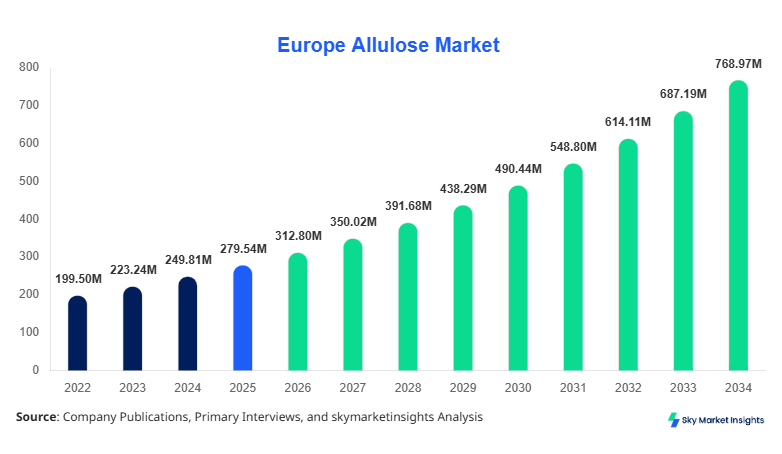
Europe's allulose market size is projected at USD 312.8 million in 2026 and is expected to hit USD 768.4 million by 2034 with a CAGR of 11.9%. The market expansion is being driven by increasing demand for low-calorie sweeteners, rapid adoption of sugar alternatives in processed foods, and rising investments in specialty carbohydrate manufacturing across Europe. The report provides detailed analysis on production capacity, application-based segmentation, consumption trends, regulatory landscape, and competitive benchmarking of major manufacturers operating in the regional industry ecosystem.
The European allulose industry represents a rapidly developing specialty sweetener segment focused on low-calorie monosaccharide solutions used in food processing, beverages, pharmaceuticals, and nutrition applications. Europe produced nearly 42.6 thousand metric tons of allulose in 2025, compared to 31.2 thousand metric tons in 2022, reflecting an annual production increase of 10.8%. Adoption penetration in sugar-free beverages reached 27.4% among premium beverage manufacturers in 2025, while bakery and confectionery applications accounted for nearly 39.6% of overall utilization. Consumer behavior analytics indicate that more than 61% of European consumers actively seek low-calorie sweetener labels, and nearly 46% prefer natural sugar alternatives over synthetic sweeteners. Food and beverages contributed approximately 68.2% of application consumption, pharmaceuticals held 18.5%, and personal care represented 13.3% in 2025. Technical performance metrics show that allulose provides nearly 70% sweetness equivalence to sucrose with only 0.4 kcal/g compared to 4 kcal/g in traditional sugar formulations. Increasing product reformulation initiatives, sugar tax implementation across European economies, and rising health awareness continue to reinforce Europe's allulose market demand.
In the United Kingdom, the allulose market accounted for nearly 28.7% of the European regional revenue in 2025 owing to strong food processing infrastructure and growing demand for reduced-calorie formulations. The country operated more than 120 active low-calorie sweetener manufacturing and blending facilities, with over 340 food and beverage companies incorporating allulose into product lines. Bakery applications contributed 34.5% of domestic demand, beverage formulations represented 29.1%, dairy products accounted for 18.8%, and nutritional supplements held 10.2%. More than 54% of functional beverage manufacturers in the UK adopted allulose-based sweetening systems in 2025, compared to 37% in 2022. The retail penetration of low-sugar packaged products surpassed 48% in urban supermarket chains, while sugar-free confectionery production crossed 112 million units annually. Investments exceeding USD 96 million were allocated toward alternative sweetener processing technologies during 2024–2025. Increased consumer awareness regarding obesity reduction, diabetes management, and calorie-controlled diets continues to strengthen the European allulose market demand.
Explore more data points, trends and opportunities Download Free Sample Report
Allulose Market Trends
Expansion of Low-Calorie Beverage Manufacturing
The rapid expansion of low-calorie beverage manufacturing across Europe has emerged as a dominant industry trend. Beverage manufacturers increased allulose procurement volumes by nearly 32% between 2023 and 2025 due to growing demand for reduced-sugar carbonated drinks and energy beverages. Europe produced approximately 1.8 billion liters of low-calorie beverages containing specialty sweeteners in 2025, with allulose accounting for 18.4% of formulation inclusion. Germany, the United Kingdom, and France collectively contributed more than 63% of beverage-based allulose utilization. Technology shifts toward enzymatic conversion processing improved production efficiency by 22%, reducing operational costs by nearly 14% during the last three years. Nearly 49% of beverage innovation pipelines in Europe incorporated allulose as a primary sugar substitute because of its stability under high-temperature processing and improved mouthfeel performance. Functional drinks targeting diabetic and fitness-conscious consumers witnessed annual demand increases of 15.7%, reinforcing Europe's allulose market trend dynamics.
Rising Adoption in Bakery and Confectionery Products
Bakery and confectionery manufacturers are increasingly integrating allulose into premium and sugar-free product portfolios. European confectionery output utilizing low-calorie sweeteners exceeded 6.7 billion units in 2025, with allulose representing nearly 24% of ingredient substitution volumes. More than 41% of premium bakery brands launched reformulated low-sugar products during 2024–2025, driven by sugar reduction regulations and changing consumer preferences. Advanced crystallization technologies enhanced shelf-life stability by 17% while improving moisture retention by nearly 21% in baked products. Italy and Spain together accounted for 29% of allulose utilization in bakery applications due to strong artisanal dessert manufacturing. Foodservice chains increased sugar-free dessert offerings by 26% in metropolitan European markets. The growing popularity of ketogenic diets, diabetic-friendly products, and clean-label formulations continues to stimulate the Europe allulose market trend expansion.
Technological Advancements in Enzymatic Production
Production technology advancements are transforming industrial scalability within the European allulose ecosystem. Enzymatic bioconversion facilities increased from 18 operational plants in 2022 to 31 facilities in 2025 across Europe. Manufacturers improved conversion yield efficiency from 28% to nearly 43% through optimized microbial fermentation and enzyme engineering technologies. Production capacity exceeded 58 thousand metric tons annually by the end of 2025, while energy consumption per ton declined by 16%. Automation adoption rates in sweetener manufacturing plants reached 57%, improving batch consistency and reducing contamination risks by 12%. France and Germany led investments in biotechnology-based carbohydrate processing, collectively accounting for USD 182 million in industrial innovation spending during 2024. Continuous investments in precision fermentation and low-cost substrate utilization remain central to the European allulose market trend development.
Europe Allulose Market Drivers
Growing Consumer Preference for Low-Calorie and Diabetic-Friendly Sweeteners
The increasing prevalence of obesity and diabetes across Europe has significantly accelerated demand for low-calorie sweetening solutions. More than 61 million adults in Europe were diagnosed with diabetes in 2025, while obesity prevalence surpassed 23% among the adult population. Consumers reduced refined sugar intake by approximately 14% between 2022 and 2025, directly supporting specialty sweetener adoption. Food manufacturers introduced over 2,400 new reduced-sugar product SKUs during 2025 alone, with nearly 31% utilizing allulose formulations. Government sugar taxation programs in the United Kingdom, France, and Spain encouraged beverage reformulation, reducing sugar content by 18% on average. Retail sales of diabetic-friendly foods crossed USD 7.2 billion in Europe during 2025, while online health-food purchases grew by 22%. The superior thermal stability, low glycemic impact, and taste profile of allulose continue to increase product integration across beverages, confectionery, and nutrition products, driving Europe's allulose market growth.
Europe Allulose Market Restraints
High Production Costs and Regulatory Approval Challenges
Despite increasing demand, the market faces substantial restraints associated with elevated production costs and regulatory complexities. The average production cost of allulose remained approximately 2.7 times higher than traditional sucrose production in 2025 due to enzyme costs, fermentation infrastructure, and purification requirements. European manufacturers spent nearly USD 38 million annually on compliance and food safety certification procedures. Limited large-scale manufacturing capacity across Europe also resulted in supply volatility, with import dependency accounting for 34% of raw material sourcing. Regulatory inconsistencies among European countries delayed product approvals and label standardization, extending commercialization timelines by 8–14 months in several cases. More than 27% of small food processors cited high ingredient costs as a major barrier to adoption. Transportation and cold-chain expenses increased by 11% during 2024 due to energy price fluctuations. These factors continue to restrict Europe's allulose market growth potential.
Europe Allulose Market Opportunities
Expansion of Functional Foods and Nutraceutical Applications
The growing functional foods and nutraceutical sector presents major opportunities for market participants. Europe’s functional nutrition industry exceeded USD 41 billion in 2025, with low-calorie sweeteners representing approximately 12% of ingredient demand. Protein bars, sports beverages, and dietary supplements using allulose formulations increased by 28% between 2023 and 2025. Nearly 44% of health-conscious consumers preferred products labeled as natural sweetener-based, while fitness-focused product launches rose by 19%. Pharmaceutical applications also expanded significantly, particularly in diabetic oral syrups and calorie-controlled formulations, which represented 16% of new specialty medicine launches in 2025. Investments in clean-label nutraceutical manufacturing surpassed USD 620 million across Europe during 2024–2025. Cross-industry collaborations between biotechnology firms and food manufacturers are expected to improve production scalability and broaden commercial applications, creating significant European allulose market opportunities.
Challenges in the European Allulose Market
Supply Chain Constraints and Consumer Price Sensitivity
Supply chain limitations and pricing pressures remain major challenges affecting industry expansion. Europe imported approximately 36% of specialty carbohydrate feedstock requirements in 2025, exposing manufacturers to currency fluctuations and logistics disruptions. Freight expenses increased by nearly 13% between 2023 and 2025, while raw material availability shortages affected production continuity in Germany and France. Consumer price sensitivity also impacts mass-market penetration, as products containing allulose are typically priced 18–32% higher than standard sugar-based alternatives. More than 39% of retail consumers in lower-income regions cited pricing as the primary deterrent to purchasing low-calorie sweetened products. Small and medium-sized manufacturers struggled to achieve economies of scale due to limited infrastructure and low production volumes below 2,000 tons annually. Inconsistent consumer awareness regarding allulose benefits across Eastern and Southern Europe further complicates adoption rates. These operational and economic factors continue to challenge Europe's allulose market expansion.
Report Scope
| Report Metric | Details |
|---|---|
| Market Size in 2025 | USD 279.3 Million |
| Market Size in 2026 | USD 312.8 Million |
| Market Size in 2034 | USD 768.4 Million |
| CAGR | 11.9% (2026-2034) |
| Base Year for Estimation | 2025 |
| Historical Data | 2022-2024 |
| Forecast Period | 2026-2034 |
| Report Coverage | Revenue Forecast, Competitive Landscape, Supply Chain Disruption, Growth Factors, Environment & Regulatory Landscape and Trends |
Explore more data points, trends and opportunities Download Free Sample Report
Allulose Market Segmentation
The European allulose industry is segmented by type and application, with food and beverage utilization dominating overall consumption. Powder variants accounted for approximately 46% of regional volume in 2025 due to superior blending characteristics and storage stability, while food and beverages contributed more than 68% of total application demand. Growing industrial utilization across nutrition, confectionery, and pharmaceutical sectors continues to diversify market penetration.
By Type
Powder allulose represented nearly 46% of the European market volume in 2025, supported by extensive utilization in bakery, confectionery, and dry nutritional formulations. Production exceeded 19 thousand metric tons annually, with Germany and the United Kingdom accounting for over 57% of total powder output. Powder variants offer improved shelf stability exceeding 24 months and moisture control efficiency above 91%, making them highly suitable for industrial food processing applications. More than 48% of bakery manufacturers preferred powder formulations due to superior dispersion and ease of transport. Industrial blending systems achieved batch consistency improvements of 14% using micro-particle powder technologies. Nutritional supplement producers increased powder allulose adoption by 26% during 2024–2025 due to rising sports nutrition demand. Europe exported approximately 6.2 thousand metric tons of powder allulose products to neighboring regions during 2025. The expanding integration of powdered low-calorie sweeteners in processed foods continues supporting Europe's allulose market demand.
Liquid allulose accounted for approximately 33% of regional consumption in 2025 owing to its increasing utilization in beverages, dairy applications, and syrups. Production volumes surpassed 13.4 thousand metric tons, while beverage manufacturers represented nearly 61% of end-user demand for liquid variants. The product delivers high solubility efficiency exceeding 96% and demonstrates strong thermal stability during pasteurization processes above 120°C. France and Spain collectively contributed more than 38% of liquid allulose manufacturing due to strong beverage-processing sectors. Nearly 52% of premium energy drink launches in Europe utilized liquid allulose systems because of reduced aftertaste compared to synthetic sweeteners. Dairy manufacturers reported viscosity stabilization improvements of 11% when using liquid allulose in yogurt formulations. Automation in liquid filling and dosing systems improved manufacturing through the allulose market in 2023 and 2025. Increasing adoption in ready-to-drink formulations continues to strengthen industrial utilization.
Crystal allulose held around 21% of the market share in 2025 and is primarily utilized in premium confectionery, pharmaceutical coatings, and specialty nutrition products. Annual production volumes exceeded 8.7 thousand metric tons across Europe, with Italy emerging as a leading manufacturing hub contributing nearly 29% of crystal output. Crystal variants exhibit purity levels above 99% and controlled particle structures, enhancing sweetness consistency and texture optimization. Pharmaceutical applications accounted for nearly 24% of crystal-grade consumption because of improved dissolution characteristics in oral dosage formulations. High-end confectionery brands increased crystal allulose integration by 17% during 2024–2025 due to growing premium sugar-free product demand. Advanced crystallization equipment reduced production waste by approximately 9%, while packaging innovations extended product shelf life by 13%. Expanding specialty food manufacturing remains a major factor supporting industrial consumption.
By Application
Food and beverages dominated the application landscape with nearly 68.2% share in 2025, supported by rising demand for low-calorie processed foods and functional beverages. Industrial consumption exceeded 28 thousand metric tons annually, while beverage formulations alone represented 34% of total utilization. Bakery applications contributed approximately 22%, dairy products accounted for 17%, and confectionery represented 15% within the segment. More than 53% of European consumers purchased at least one reduced-sugar packaged product monthly in 2025. Technical advantages, including browning capability, freezing point depression, and moisture retention, significantly increased allulose integration into food processing operations. The United Kingdom and Germany together contributed over 46% of food-grade allulose demand due to advanced packaged food industries. Premium beverage launches utilizing allulose increased by 31% during 2024–2025, while sugar-free bakery product sales rose by 19%. Expanding health-conscious consumption patterns continue to support the segment.
Pharmaceutical applications represented nearly 18.5% of market utilization in 2025 due to increasing incorporation in diabetic formulations, syrups, and nutraceutical supplements. Europe consumed approximately 7.5 thousand metric tons of pharmaceutical-grade allulose during the year. More than 420 pharmaceutical manufacturers across Europe integrated low-glycemic sweeteners into product pipelines. Oral liquid medicines represented 43% of pharmaceutical utilization, while nutraceutical chewables contributed 27%. Stability under varying pH conditions and low caloric contribution improved formulation efficiency in diabetic treatment products. Germany accounted for nearly 31% of pharmaceutical allulose demand because of its strong specialty medicine production infrastructure. R&D investments in sugar-free medicinal products exceeded USD 210 million during 2025. Consumer preference for calorie-controlled supplements and pediatric medicines continues to accelerate segment demand.
Personal care applications accounted for approximately 13.3% of total demand in 2025, supported by growing use in oral care products, cosmetic formulations, and skincare applications. Production utilization surpassed 5 thousand metric tons annually, while oral care products represented nearly 46% of personal care demand. Allulose demonstrates humectant efficiency above 87% and moisture stabilization characteristics beneficial for cosmetic emulsions. France and Italy collectively contributed 42% of cosmetic-based utilization because of strong luxury skincare manufacturing. More than 18% of natural cosmetic launches during 2025 incorporated low-calorie sugar derivatives for texture and hydration performance. Personal care manufacturers increased investment in clean-label formulations by 23% between 2023 and 2025. Rising consumer awareness regarding ingredient transparency and functional cosmetic formulations continues driving industrial application expansion.
Europe Allulose Market Segmentations
Type
- Powder
- Liquid
- Crystal
Application
- Food & Beverages
- Pharmaceuticals
- Personal Care
Europe Allulose Market Regional Outlook
United Kingdom
The United Kingdom remained the largest contributor to the European market with approximately 28.7% regional share in 2025. Domestic production volumes exceeded 12.1 thousand metric tons, supported by more than 340 food processing companies integrating specialty sweeteners into product portfolios. Beverage manufacturing represented 31% of national demand, bakery accounted for 27%, and nutrition supplements contributed 14%. Government sugar taxation policies accelerated low-calorie product reformulation, reducing sugar content in packaged beverages by nearly 19% since 2022. Retail sales of sugar-free products surpassed USD 2.4 billion in 2025. Investments in enzymatic conversion facilities exceeded USD 96 million during the last two years. The country’s advanced retail infrastructure and growing health-conscious consumer base continue supporting market expansion.
Germany
Germany accounted for nearly 22.4% of the European market revenue in 2025 due to strong biotechnology capabilities and advanced food manufacturing industries. Production capacity exceeded 10 thousand metric tons annually across more than 70 industrial processing facilities. Bakery and confectionery applications represented 36% of demand, while pharmaceutical applications accounted for 21%. Germany invested approximately USD 118 million in low-calorie sweetener R&D initiatives during 2024–2025. More than 58% of packaged food reformulations launched in Germany incorporated sugar-reduction strategies. Industrial automation adoption in allulose processing plants surpassed 62%, improving operational efficiency and lowering waste generation. The country continues to lead innovation in precision fermentation and enzymatic production technologies.
France
France contributed around 17.3% of regional consumption in 2025, supported by strong dairy, beverage, and cosmetic manufacturing sectors. Annual production volumes crossed 7.4 thousand metric tons, while beverage applications accounted for 29% of national utilization. France operated more than 50 specialty carbohydrate manufacturing units focused on clean-label sweeteners. Cosmetic and personal care applications contributed nearly 18% of total domestic demand because of the country’s premium beauty industry. Consumer preference for natural ingredients increased by 24% between 2022 and 2025, supporting low-calorie sweetener integration. Government-backed nutrition programs encouraging sugar reduction also stimulated industrial demand.
Spain
Spain represented approximately 11.8% of the regional market in 2025 owing to increasing utilization in bakery, confectionery, and beverage products. Domestic consumption exceeded 5 thousand metric tons annually, while bakery applications contributed nearly 34% of overall utilization. Spain witnessed a 21% increase in low-sugar food product launches during 2024–2025. More than 46% of urban consumers actively preferred reduced-calorie packaged foods. Beverage manufacturers increased allulose procurement volumes by 18% due to rising functional beverage demand. Industrial investments in alternative sweetener blending facilities surpassed USD 48 million during 2025. Expanding foodservice adoption continues strengthening national demand.
Italy
Italy accounted for nearly 10.6% of the European market revenue in 2025 because of strong artisanal confectionery and premium dessert industries. Production volumes exceeded 4.3 thousand metric tons annually, while confectionery applications represented 39% of total demand. Crystal allulose manufacturing contributed significantly to regional exports, with nearly 1.4 thousand metric tons exported during 2025. More than 29% of premium dessert launches in Italy incorporated low-calorie sweeteners. Investments in advanced crystallization technologies improved production efficiency by 12% and reduced waste generation by 9%. Consumer demand for clean-label and diabetic-friendly desserts continues supporting market expansion.
Russia
Russia represented approximately 9.2% of the regional market in 2025, supported by expanding packaged food production and rising diabetic nutrition demand. Annual consumption volumes exceeded 3.8 thousand metric tons, while beverage and bakery sectors collectively accounted for 57% of utilization. More than 140 food manufacturers adopted low-calorie sweetener systems between 2023 and 2025. Retail demand for sugar-free packaged foods increased by 17%, particularly in metropolitan regions. Domestic investments in specialty carbohydrate production exceeded USD 36 million during 2025. Increasing healthcare awareness and nutritional product adoption continue supporting industrial growth.
Top players in Europe Allulose Market
- Tate & Lyle PLC
- CJ CheilJedang Corporation
- Ingredion Incorporated
- Matsutani Chemical Industry Co. Ltd.
- Samyang Corporation
- Anderson Advanced Ingredients
- Apura Ingredients
- Bonumose LLC
- Shandong Baolingbao Biotechnology Co. Ltd.
- Galam Group
- Heartland Food Products Group
- Zhejiang Huakang Pharmaceutical Co. Ltd.
- Foodchem International Corporation
- Icon Foods
- Biosynth Carbosynth
Tate & Lyle PLC
-
Tate & Lyle PLC accounted for approximately 14.8% of Europe's regional revenue in 2025 through extensive distribution networks and advanced specialty ingredient manufacturing capabilities.
-
The company operates multiple low-calorie ingredient processing facilities across Europe with combined production capacity exceeding 9 thousand metric tons annually.
-
Nearly 38% of its allulose sales were generated through beverage applications, while bakery and dairy products contributed 29% and 17%, respectively.
-
The company invested more than USD 42 million in product innovation and enzymatic processing technologies during 2024–2025.
-
Strategic collaborations with beverage and nutrition brands strengthened its market positioning across the United Kingdom, Germany, and France.
Ingredion Incorporated
-
Ingredion Incorporated held nearly 11.2% regional market share in 2025 owing to strong product diversification and partnerships with food manufacturers.
-
The company supplied allulose ingredients to more than 210 European food processing firms and increased annual production capacity by 18% during 2024.
-
Beverage applications represented 33% of company sales, while nutritional supplements contributed 21%.
-
Ingredion allocated approximately USD 31 million toward clean-label sweetener R&D and process optimization initiatives across Europe.
-
Expansion of functional food ingredient portfolios and investments in precision fermentation technologies strengthened the company’s competitive positioning.
Investment Analysis
Investments in low-calorie sweetener infrastructure across Europe exceeded USD 820 million during 2024–2025, with biotechnology processing representing nearly 41% of total allocation. Food and beverage manufacturing attracted approximately 52% of industry investments, while pharmaceutical applications accounted for 21% and personal care applications contributed 11%. Germany, the United Kingdom, and France collectively represented over 67% of regional investment activity because of strong industrial ecosystems and advanced food innovation capabilities.
Mergers, acquisitions, and collaboration agreements increased significantly as manufacturers focused on capacity expansion and technological innovation. More than 18 strategic partnerships were signed between biotechnology firms and food ingredient companies during 2024–2025. Joint ventures focusing on enzymatic conversion and precision fermentation technologies represented nearly 34% of collaborative investment initiatives. European ingredient manufacturers allocated approximately USD 190 million toward capacity expansion projects, while cross-border acquisitions in specialty carbohydrate manufacturing exceeded USD 240 million. Private equity participation in health-oriented food ingredients increased by 16%, reflecting rising investor confidence in reduced-calorie sweetener markets.
Institutional investments in clean-label food processing technologies also accelerated across Southern and Western Europe. Nearly 27% of funding was directed toward automation systems improving yield efficiency and reducing energy consumption in carbohydrate conversion plants. Government-backed innovation grants supporting sugar reduction strategies contributed more than USD 95 million during 2025. Increasing consumer demand for diabetic-friendly and ketogenic nutrition products is expected to sustain long-term industrial investment momentum.
New Product Developments
Manufacturers significantly expanded product innovation pipelines during 2024–2025 to address increasing demand for sugar-free and clean-label formulations. More than 420 new food and beverage products launched across Europe incorporated allulose-based sweeteners in 2025, representing an increase of 29% compared to 2023. Beverage formulations accounted for nearly 37% of new product launches, while bakery and confectionery represented 28%. Product reformulation initiatives improved sweetness performance by approximately 14% and reduced calorie content by up to 90% compared to conventional sugar-based products.
Biotechnology advancements also improved production efficiency and ingredient stability. Manufacturers introduced high-purity crystal variants with purity levels exceeding 99.2% and moisture resistance improvements of 18%. More than 22% of newly launched diabetic nutrition products incorporated allulose because of low glycemic characteristics and thermal stability. Packaging innovations and advanced crystallization technologies further enhanced product shelf life and transportation efficiency across Europe.
Recent Developments in Europe Allulose Market
- 2025: Tate & Lyle expanded specialty sweetener production capacity in the United Kingdom by 18%, increasing annual allulose output above 2.4 thousand metric tons and improving distribution efficiency across Western Europe through automated processing systems and supply chain optimization initiatives.
- 2025: Ingredion Incorporated entered a biotechnology collaboration agreement with European food ingredient manufacturers to improve enzymatic conversion yield efficiency by 21%, reducing production costs and increasing availability for bakery and beverage applications across Germany and France.
- 2025: Matsutani Chemical Industry invested approximately USD 28 million in specialty carbohydrate R&D projects focused on improving purity levels and reducing energy consumption by 12% in crystal allulose manufacturing processes serving pharmaceutical and nutraceutical sectors.
Research Methodology
The research process for this report involved extensive primary and secondary data collection methodologies focused on Europe’s specialty sweetener ecosystem. Primary research included interviews with more than 65 industry participants, including manufacturers, distributors, biotechnology firms, food processors, and regulatory experts across the United Kingdom, Germany, France, Spain, Italy, and Russia. Secondary research incorporated company annual reports, industrial databases, trade publications, food processing journals, government nutrition statistics, import-export records, and regulatory documents associated with sugar reduction initiatives and low-calorie sweetener approvals.
Market size estimation was conducted using bottom-up and top-down analytical approaches integrating production capacity analysis, consumption trends, pricing models, and application-based demand forecasting. Quantitative modeling included volume-to-revenue mapping, utilization rate analysis, and country-level penetration assessments across bakery, beverages, pharmaceuticals, and personal care applications. Forecasting assumptions considered macroeconomic indicators, health awareness trends, sugar taxation policies, biotechnology investments, and industrial capacity expansion plans across Europe. Data triangulation and validation techniques ensured consistency and accuracy of all statistical findings presented in the report
Frequently Asked Questions
Senior Market Research Analyst | 9 Years Experience | Plant-Based Foods and Functional Ingredients
Kathy Flores is a market research analyst with 7–9 years of experience specializing in food and beverages markets. Contributed to 70+ research reports for global clients. Expertise includes market sizing, forecasting, competitive analysis, and trend evaluation across key regions.