Europe Alginates & Derivatives Market Size
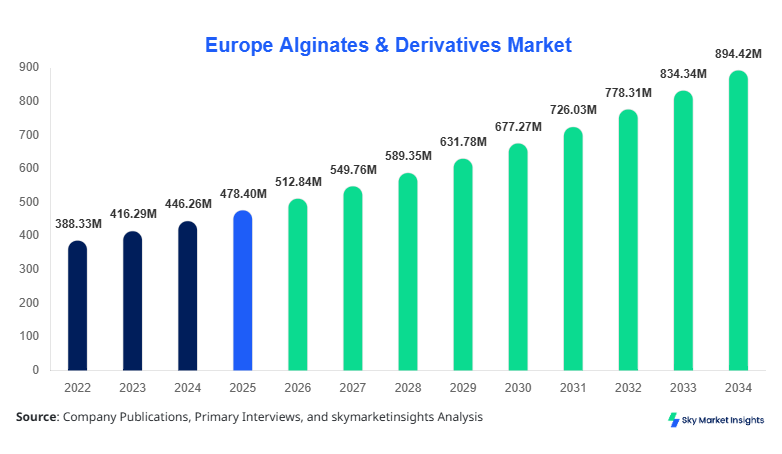
Europe Alginates & Derivatives market size is projected at USD 512.84 million in 2026 and is expected to hit USD 896.27 million by 2034 with a CAGR of 7.2%. The regional industry recorded a valuation of USD 476.15 million in 2025, while total consumption volume exceeded 142.6 thousand metric tons across Europe. Increasing utilization of seaweed-derived hydrocolloids in food stabilization, pharmaceutical formulations, and industrial thickening applications continues to support long-term expansion. The market assessment incorporates detailed segmentation analysis, production capacity evaluation, import-export analytics, and competitive landscape benchmarking across Europe.
The Europe Alginates & Derivatives industry is witnessing accelerated integration into food processing, nutraceutical manufacturing, and wound care applications due to improved viscosity control, emulsification efficiency, and biocompatibility. More than 61% of total regional demand originated from food-grade alginates in 2025, while pharmaceutical-grade derivatives accounted for 24.7% of total consumption. Growing investment in sustainable marine biomass extraction and advanced purification technologies is expected to further strengthen Europe Alginates & Derivatives market size over the forecast period.
The alginates and derivatives industry refers to the manufacturing, processing, and commercialization of alginic acid-based compounds extracted primarily from brown seaweed species including Laminaria hyperborea, Ascophyllum nodosum, and Macrocystis pyrifera. Europe produced approximately 418 thousand metric tons of brown algae biomass in 2025, of which nearly 28% was processed into alginate derivatives for commercial use. Adoption rates of alginate-based stabilizers in dairy products exceeded 54% across premium beverage formulations, while penetration within pharmaceutical excipient manufacturing reached 37% in Western Europe.
Consumer purchasing behavior indicates increasing preference for clean-label and plant-derived additives, with 68% of processed food manufacturers in Europe shifting toward natural hydrocolloids between 2023 and 2025. Food and beverage applications contributed nearly 49.2% of total demand, pharmaceuticals represented 27.4%, industrial applications accounted for 14.8%, and cosmetics contributed 8.6%. Technical performance metrics show sodium alginate viscosity stability ranging between 200–1,200 mPa.s depending on concentration and molecular weight distribution. Furthermore, encapsulation efficiency in nutraceutical applications exceeded 82% in advanced formulations, reinforcing Europe Alginates & Derivatives market share across diversified industrial sectors.
Explore more data points, trends and opportunities Download Free Sample Report
Alginates & Derivatives Market Trends
Rising Adoption of Clean-Label Hydrocolloids in Food Manufacturing
The transition toward clean-label food ingredients has emerged as one of the most influential developments shaping industrial consumption patterns. In 2025, Europe processed over 31.4 thousand metric tons of food-grade alginates for bakery, dairy, confectionery, and beverage applications. Nearly 72% of premium dairy manufacturers across Germany, France, and the United Kingdom incorporated alginate-based stabilizers into low-fat and vegan formulations. Beverage stabilization demand increased by 13.6% owing to rising consumption of functional drinks and fortified nutritional products.
Advanced extraction technologies capable of improving purity levels above 97% are becoming increasingly commercialized across Europe. Manufacturers are implementing enzyme-assisted extraction systems that reduce processing energy consumption by 18–24% while increasing yield recovery by approximately 14%. Simultaneously, adoption of biodegradable hydrocolloids in meat analog products expanded substantially, with plant-based food manufacturers accounting for 16.3% of incremental demand in 2025. These technological transitions continue to strengthen Europe Alginates & Derivatives market trend across food manufacturing industries.
Expansion of Pharmaceutical and Biomedical Applications
Biomedical utilization of alginate derivatives is expanding significantly due to their non-toxic, biocompatible, and gel-forming properties. Pharmaceutical-grade alginate production surpassed 18.6 thousand metric tons in Europe during 2025, while wound dressing applications represented nearly 39% of medical consumption. Calcium alginate dressings demonstrated absorption capacity exceeding 20 times their dry weight, improving their adoption in chronic wound treatment and post-surgical care applications.
Drug delivery systems utilizing alginate microencapsulation technology increased by 17.8% between 2023 and 2025. More than 41% of European nutraceutical companies integrated alginate coatings into probiotic delivery systems to improve gastrointestinal stability and shelf life. Investments in tissue engineering and regenerative medicine also accelerated, with biomedical research funding related to seaweed-derived polymers exceeding USD 184 million in Europe during 2025. Increasing innovation in controlled-release pharmaceuticals and bioactive wound care continues to reinforce Europe Alginates & Derivatives market demand.
Europe Alginates & Derivatives Market Drivers
Rising Demand for Natural Food Stabilizers and Sustainable Hydrocolloids
The increasing replacement of synthetic emulsifiers and stabilizers with natural hydrocolloids is a major growth catalyst across Europe. In 2025, nearly 64% of processed food manufacturers reported active reformulation strategies focused on plant-based ingredients, while consumer surveys indicated that 71% of buyers preferred clean-label packaged food products. Food-grade alginate utilization in dairy beverages increased by 15.1%, while bakery and confectionery applications expanded by 11.8% during the year. Europe imported more than 92 thousand metric tons of seaweed-derived hydrocolloids in 2025 to meet industrial demand requirements.
The pharmaceutical sector also demonstrated strong demand acceleration, particularly for wound care products and oral drug delivery systems. Hospital procurement of calcium alginate dressings increased by 12.4% year-on-year, while pharmaceutical encapsulation applications exceeded 6.8 thousand metric tons. Sustainability initiatives within Europe are encouraging bio-based alternatives to petroleum-derived thickeners, leading to higher adoption across industrial coatings and textile printing. In addition, innovations in low-temperature extraction and membrane purification improved production efficiency by approximately 19%, supporting cost optimization across the supply chain. Increasing utilization across multiple end-use sectors continues to reinforce Europe Alginates & Derivatives market growth.
Europe Alginates & Derivatives Market Restraints
Volatility in Seaweed Supply and High Processing Costs
Despite rising industrial utilization, inconsistent availability of brown seaweed biomass remains a major challenge for regional manufacturers. Europe experienced approximately 8.7% fluctuations in raw material availability during 2024–2025 due to climate variability, marine ecosystem disruption, and harvesting regulations. Harvesting costs for Laminaria species increased by nearly 14% because of labor shortages and environmental compliance requirements. Additionally, transportation costs associated with imported seaweed from Norway and Iceland rose by 9.2% during the year.
Advanced extraction and purification processes require significant capital expenditure, with installation costs for membrane filtration systems ranging between USD 3.2 million and USD 8.6 million depending on production scale. Energy-intensive drying operations contributed nearly 22% of total manufacturing expenditure in 2025. Small and medium-scale producers continue to face profitability pressure due to fluctuating utility prices and strict European environmental standards. Furthermore, competition from alternative hydrocolloids such as carrageenan, xanthan gum, and guar gum affects pricing flexibility within food manufacturing contracts. These operational constraints continue to limit Europe Alginates & Derivatives market share expansion across certain industrial segments.
Europe Alginates & Derivatives Market Opportunities
Growing Biomedical and Nutraceutical Applications Across Europe
Biomedical research and nutraceutical product innovation are creating substantial expansion opportunities for alginate derivative manufacturers. Europe recorded more than USD 246 million in investments toward bio-based medical polymers and regenerative medicine technologies during 2025. Controlled-release drug formulations using sodium alginate increased by 18.9%, while probiotic encapsulation technologies demonstrated adoption growth exceeding 21% among nutraceutical producers.
Demand for personalized healthcare products and advanced wound management solutions is driving increased procurement of calcium alginate dressings and bioactive gels. The European elderly population exceeded 102 million in 2025, contributing to higher incidence of chronic wounds and diabetic ulcers requiring advanced absorbent dressings. Furthermore, the cosmetics industry is increasing incorporation of alginate-based masks and skincare stabilizers, with premium cosmetic formulations accounting for 9.7% of incremental derivative demand. Industrial partnerships between biotechnology firms and seaweed processors are accelerating innovation in tissue scaffolding, bio-printing, and hydrogel technologies. Rising commercialization of these high-value applications presents significant long-term Europe Alginates & Derivatives market demand opportunities.
Challenges in Europe Alginates & Derivatives Market
Regulatory Compliance and Product Standardization Challenges
Manufacturers operating within Europe face stringent regulatory frameworks concerning marine harvesting, food additive approval, and pharmaceutical excipient validation. More than 37% of alginate processors reported increased compliance expenditure during 2025 due to stricter environmental sustainability assessments and traceability documentation requirements. Product standardization remains difficult because alginate viscosity, gel strength, and molecular composition vary significantly depending on seaweed species, harvesting conditions, and extraction techniques.
Quality inconsistency can affect industrial applications requiring precise rheological properties, particularly within pharmaceuticals and biomedical manufacturing. Nearly 19% of downstream users reported formulation adjustments due to variability in gel performance and water-binding capacity. Additionally, certification processes for pharmaceutical-grade derivatives can require 12–24 months of validation testing, delaying commercialization timelines and increasing operational expenditure. Marine biodiversity protection laws across France, Norway, and the United Kingdom also restrict harvesting expansion in ecologically sensitive coastal regions. These regulatory and standardization complexities continue to challenge Europe Alginates & Derivatives market trend across industrial and pharmaceutical supply chains.
Report Scope
| Report Metric | Details |
|---|---|
| Market Size in 2025 | USD 476.15 Million |
| Market Size in 2026 | USD 512.84 Million |
| Market Size in 2034 | USD 896.27 Million |
| CAGR | 7.2% (2026-2034) |
| Base Year for Estimation | 2025 |
| Historical Data | 2022-2024 |
| Forecast Period | 2026-2034 |
| Report Coverage | Revenue Forecast, Competitive Landscape, Supply Chain Disruption, Growth Factors, Environment & Regulatory Landscape and Trends |
Explore more data points, trends and opportunities Download Free Sample Report
Alginates & Derivatives Market Segmentation
The European industry is segmented by type and application, with sodium alginate dominating nearly 47% of total consumption due to its extensive use in food stabilization and pharmaceutical formulations. By application, food and beverage processing accounted for 49.2% of total revenue generation in 2025, followed by pharmaceuticals at 27.4% and industrial applications at 14.8%. Rising demand for clean-label ingredients and biomedical polymers continues to diversify consumption patterns across Europe.
By Type
Sodium alginate represented approximately 47% of total European consumption in 2025, with production volumes surpassing 66 thousand metric tons. The derivative is extensively utilized in dairy beverages, bakery fillings, frozen desserts, and pharmaceutical encapsulation due to its superior thickening and gelling capabilities. Viscosity ranges typically vary between 300–1,200 mPa.s depending on molecular weight and concentration levels. Food processing companies accounted for nearly 58% of sodium alginate procurement, while nutraceutical applications contributed 16%. Demand growth is further supported by increasing adoption in vegan and plant-based product formulations.
Calcium alginate accounted for nearly 29% of industry revenue due to extensive biomedical utilization. Production exceeded 41 thousand metric tons in 2025, supported by rising hospital procurement of wound dressing products. Calcium alginate dressings demonstrated absorption efficiency exceeding 20 times dry weight, making them highly suitable for chronic wound management. Pharmaceutical applications contributed more than 61% of total calcium alginate demand, while cosmetics represented approximately 11%. Technological innovations in bioactive gels and regenerative medicine continue to expand consumption potential.
Propylene glycol alginate contributed approximately 18% of total regional demand in 2025. The derivative is widely utilized in acidic beverages, beer stabilization, and salad dressings because of its emulsification and acid-resistant properties. Production volumes reached nearly 25 thousand metric tons across Europe. Beverage manufacturers accounted for 49% of consumption, followed by sauces and processed food applications at 27%. Increased demand for long-shelf-life functional beverages and ready-to-eat products is strengthening industrial utilization.
By Application
The food and beverage industry dominated application demand with nearly 49.2% revenue contribution in 2025. Consumption volumes exceeded 70 thousand metric tons due to widespread utilization in dairy products, bakery fillings, confectionery gels, and beverage stabilization systems. Dairy applications represented 38% of food-grade usage, while bakery and confectionery contributed 31%. More than 67% of premium food manufacturers in Europe adopted natural hydrocolloids to replace synthetic stabilizers. Alginate derivatives improve viscosity stability, freeze-thaw resistance, and emulsion consistency in processed foods, supporting long-term industrial adoption.
Pharmaceutical applications accounted for approximately 27.4% of regional demand, supported by rising use in wound care products, drug delivery systems, and encapsulation technologies. Europe produced over 18 thousand metric tons of pharmaceutical-grade alginates during 2025. Wound dressing products contributed nearly 39% of medical utilization, while oral drug delivery systems accounted for 28%. Controlled-release formulations using alginate matrices improved drug stability by 22–34%, increasing demand across advanced therapeutic manufacturing.
Industrial applications represented nearly 14.8% of total market consumption in 2025. Textile printing, paper coating, welding rods, and water treatment applications generated substantial procurement volumes exceeding 21 thousand metric tons. Textile printing contributed 41% of industrial utilization due to improved dye consistency and viscosity control. Water treatment systems increasingly utilize alginate-based absorbents for heavy metal removal, with adoption rates increasing by 12.6% during 2025. Growing sustainability initiatives continue supporting industrial demand for biodegradable polymers.
Europe Alginates & Derivatives Market Segmentations
Type
- Sodium Alginate
- Calcium Alginate
- Propylene Glycol Alginate
Application
- Food & Beverage
- Pharmaceuticals
- Industrial
Europe Alginates & Derivatives Regional Outlook
United Kingdom
The United Kingdom accounted for approximately 18.7% of total European revenue generation in 2025. Domestic demand exceeded 26 thousand metric tons, primarily supported by advanced food manufacturing and pharmaceutical industries. Food applications contributed 46% of total consumption, pharmaceuticals represented 33%, and industrial applications accounted for 14%. More than 38 ingredient manufacturers and biomedical companies actively utilized alginate derivatives across the country. Investments in clean-label food production and advanced wound care technologies continue driving procurement growth.
Germany
Germany represented nearly 24.3% of regional consumption in 2025, making it the largest national market across Europe. Production and import volumes surpassed 34 thousand metric tons due to extensive utilization in food processing, nutraceutical manufacturing, and industrial applications. Beverage stabilization and dairy applications contributed 41% of domestic demand, while pharmaceutical-grade derivatives represented 29%. Germany also led Europe in hydrocolloid processing automation, with technology adoption rates exceeding 71% across large-scale extraction facilities.
France
France contributed approximately 21.8% of regional revenue and remained a critical manufacturing and innovation hub for seaweed-derived hydrocolloids. Domestic production volumes exceeded 29 thousand metric tons in 2025. Food processing represented 51% of consumption, while pharmaceutical applications accounted for 31%. More than 126 processing and formulation facilities operated across Brittany and coastal industrial regions. Government support for sustainable marine biotechnology and bio-based polymers continues strengthening industrial expansion.
Spain
Spain accounted for nearly 11.2% of regional consumption due to increasing seafood processing, food manufacturing, and industrial applications. Domestic demand exceeded 15 thousand metric tons during 2025. Beverage stabilization and processed food formulations represented 48% of national utilization. Spain also expanded investment in marine biomass harvesting technologies, increasing seaweed extraction output by approximately 13% during the year. Pharmaceutical applications demonstrated strong growth potential across wound care and nutraceutical industries.
Italy
Italy represented approximately 9.6% of total European demand in 2025. Food and beverage processing dominated domestic utilization with a 57% application share, particularly within dairy desserts, confectionery, and bakery fillings. Industrial procurement exceeded 3.8 thousand metric tons, while pharmaceutical demand continued increasing due to higher consumption of bio-based excipients. Investments in premium processed food manufacturing and clean-label ingredients are expected to strengthen long-term industrial adoption.
Russia
Russia contributed nearly 7.4% of regional demand in 2025, supported by increasing industrial utilization and food processing activities. Domestic consumption exceeded 10 thousand metric tons, while industrial applications represented 36% of total procurement. Textile printing and water treatment sectors demonstrated increasing adoption of alginate derivatives due to improved environmental sustainability performance. Rising investment in domestic hydrocolloid production infrastructure is expected to reduce import dependency over the forecast period.
Top players in Europe Alginates & Derivatives
- FMC Corporation
- KIMICA Corporation
- Cargill Incorporated
- Ingredion Incorporated
- DuPont Nutrition & Biosciences
- Ashland Global Holdings Inc.
- Shandong Jiejing Group Corporation
- Qingdao Bright Moon Seaweed Group
- Meron Group
- Algaia SA
- SNAP Natural & Alginate Products
- Ceamsa
- Marine Hydrocolloids
- Kalsec Inc.
- BASF SE
FMC Corporation
-
FMC Corporation accounted for approximately 13.8% of total European revenue generation in 2025.
-
The company maintained strong positioning across pharmaceutical and food-grade alginate manufacturing.
-
Production capacity exceeded 22 thousand metric tons annually across European and global facilities.
-
FMC focused heavily on biomedical innovation, controlled-release drug systems, and high-purity hydrocolloid technologies.
-
The company invested nearly USD 48 million toward extraction optimization and sustainable marine biomass sourcing between 2024 and 2025.
KIMICA Corporation
-
KIMICA Corporation represented approximately 11.2% of regional industry revenue in 2025.
-
The company maintained extensive penetration within beverage stabilization and dairy formulation applications.
-
Production efficiency improvements reduced extraction energy consumption by nearly 17% during 2025.
-
KIMICA expanded collaborations with European nutraceutical companies for encapsulation technologies and functional ingredient applications.
-
Advanced purification technologies enabled purity levels above 97%, strengthening premium product positioning across pharmaceutical and food sectors.
Investment Analysis
Investment activity across Europe accelerated significantly due to increasing demand for sustainable marine-based polymers and clean-label hydrocolloids. In 2025, total capital investment in alginate extraction, purification, and downstream processing infrastructure exceeded USD 684 million. Food-grade production facilities accounted for 46% of total investment allocation, pharmaceutical applications represented 32%, and industrial processing technologies contributed 15%. Germany, France, and the United Kingdom collectively attracted more than 68% of regional investment expenditure.
Mergers, acquisitions, and strategic collaborations increased substantially between 2023 and 2025. Biotechnology firms partnered with marine biomass suppliers to secure raw material availability and improve sustainability compliance. More than 14 strategic partnerships were announced during 2025 involving biomedical hydrogel development, wound dressing innovation, and nutraceutical encapsulation systems. Pharmaceutical collaborations represented nearly 38% of all commercial agreements, while food processing partnerships accounted for 41%. Rising investment in regenerative medicine and tissue engineering technologies is expected to accelerate commercialization of high-margin alginate derivatives across Europe.
New Product Developments
Manufacturers across Europe increasingly focused on high-purity and application-specific derivative formulations during 2025. More than 22% of newly launched hydrocolloid products incorporated advanced viscosity stabilization technologies and enhanced gel performance properties. Food manufacturers introduced acid-resistant beverage stabilizers capable of extending shelf life by approximately 18–24%, while pharmaceutical companies launched calcium alginate dressings with improved absorption efficiency and antimicrobial functionality.
Innovation in encapsulation technologies also accelerated significantly, with microencapsulation efficiency improving by nearly 27% in advanced probiotic formulations. Several European biomedical companies introduced bioactive alginate hydrogels designed for tissue scaffolding and regenerative medicine applications. Product development investment exceeded USD 112 million across Europe during 2025, reflecting increasing competition and innovation intensity throughout the regional industry.
Recent Developments in Europe Alginates & Derivatives
- 2025: FMC Corporation expanded pharmaceutical-grade alginate production capacity by approximately 16% across European facilities, increasing annual biomedical polymer output above 8 thousand metric tons. The expansion supported rising wound dressing demand and controlled-release pharmaceutical applications across Germany and France.
- 2025: Algaia SA invested nearly USD 34 million into sustainable seaweed extraction technologies in France, improving biomass utilization efficiency by 21%. The project also reduced processing energy consumption by approximately 14%, strengthening environmentally sustainable production capabilities.
Research Methodology
The Europe Alginates & Derivatives industry assessment was developed using a combination of primary and secondary research methodologies to ensure high data accuracy and comprehensive market evaluation. The research process involved extensive collection of production statistics, trade analytics, company financials, industrial procurement trends, and regulatory information across Europe. Primary research included interviews with hydrocolloid manufacturers, seaweed processors, pharmaceutical companies, food ingredient suppliers, and industry experts operating within Germany, France, the United Kingdom, Italy, Spain, and Russia. More than 65 industry participants contributed qualitative and quantitative insights during the research phase.
Secondary research incorporated company annual reports, trade journals, customs databases, government publications, marine biotechnology studies, and industrial association statistics. Market size estimation utilized both top-down and bottom-up analytical frameworks, integrating production volume analysis, pricing trends, application demand patterns, and regional consumption data. Forecast modeling included assessment of macroeconomic indicators, sustainability regulations, technological innovation rates, biomedical investment trends, and clean-label food adoption patterns. Cross-validation techniques were implemented to ensure consistency across revenue estimations, volume analysis, and industrial penetration metrics throughout the Europe Alginates & Derivatives industry forecast period.
Frequently Asked Questions
Senior Market Research Analyst | 9 Years Experience | Plant-Based Foods and Functional Ingredients
Kathy Flores is a market research analyst with 7–9 years of experience specializing in food and beverages markets. Contributed to 70+ research reports for global clients. Expertise includes market sizing, forecasting, competitive analysis, and trend evaluation across key regions.