Europe Air Traffic Control (ATC) Market Size
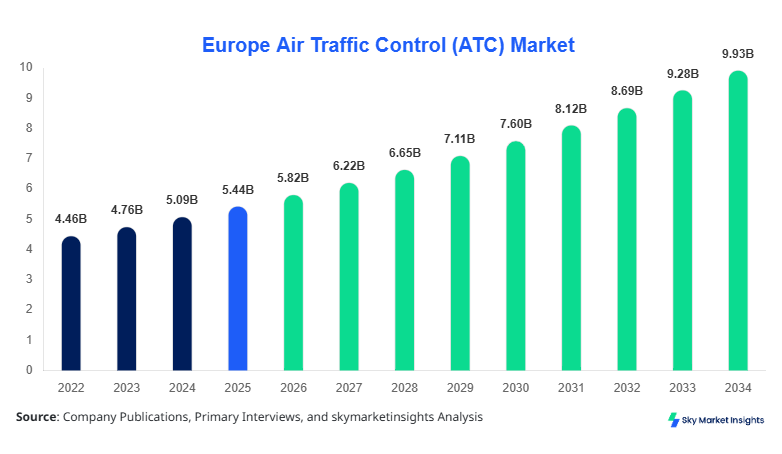
The European Air Traffic Control (ATC) market size is projected at USD 5.82 billion in 2026 and is expected to hit USD 9.94 billion by 2034 with a CAGR of 6.9%.
The market expansion is being supported by increasing aircraft movements across Europe, rising airport modernization programs, and the integration of advanced communication and surveillance technologies in air navigation infrastructure. More than 11.8 million flights were managed across European airspace during 2025, while over 480 airports in the region invested nearly USD 3.1 billion in digital ATC infrastructure upgrades. The competitive landscape includes multinational avionics suppliers, airport technology providers, and defense electronics manufacturers focusing on AI-assisted traffic management, remote tower systems, and satellite-based navigation solutions.
The Air Traffic Control (ATC) market refers to the ecosystem of technologies, systems, software platforms, communication networks, and operational services utilized to regulate aircraft movement on the ground and in controlled airspace to ensure safety, efficiency, and optimized traffic flow. Europe handled approximately 1.42 billion passengers in 2025, representing a 7.4% increase from 2024 levels, while regional air navigation service providers coordinated nearly 33,000 daily flights during peak summer operations. Commercial aviation accounted for nearly 72% of total ATC system deployment across Europe, followed by military aviation at 18% and general aviation at 10%. Surveillance systems contributed approximately 39% of total system installations owing to the rapid adoption of ADS-B, multilateration, and radar modernization technologies.
Adoption and penetration of digital tower systems increased significantly, with over 115 airports implementing remote or hybrid ATC operations by 2025. Satellite-enabled navigation systems recorded a penetration rate exceeding 64% among medium-to-large airports, while AI-assisted conflict detection software achieved implementation across 29% of European control centers. Communication frequencies between 118 MHz and 137 MHz remain standard for VHF aviation communication networks, while modern surveillance systems now support data refresh rates below 1 second for enhanced situational awareness. Increasing flight density, congestion reduction initiatives, and operational efficiency requirements continue to strengthen Europe Air Traffic Control (ATC) market size.
In Germany, the Air Traffic Control (ATC) market accounted for nearly 24% of total European ATC infrastructure spending in 2025, supported by strong aviation activity, extensive airport modernization, and advanced defense aviation integration. Germany operated more than 39 major commercial airports and over 260 regional aviation facilities, collectively handling approximately 248 million passengers and 2.7 million aircraft movements during 2025. Commercial aviation represented 68% of ATC deployments in the country, while military aviation contributed 22% and general aviation accounted for 10%.
Technology adoption across German airports accelerated rapidly, with 71% of major airports integrating advanced surface movement radar systems and 58% deploying AI-enabled traffic optimization software. Frankfurt Airport alone processed over 1,400 daily aircraft movements, making it one of the busiest ATC-managed hubs in Europe. Germany also invested nearly USD 820 million in digital air traffic infrastructure modernization programs, including satellite-based navigation upgrades and cybersecurity reinforcement. The implementation of multilateration surveillance systems increased by 31% between 2023 and 2025, while remote tower technologies expanded across regional airports. Growing aviation capacity requirements and digital transformation programs continue to reinforce Air Traffic Control (ATC) market share across Germany.
Explore more data points, trends and opportunities Download Free Sample Report
Air Traffic Control (ATC) Market Trends
The European aviation industry is experiencing a rapid transition toward digitalized air traffic management systems, driven by increasing aircraft density and pressure on airport infrastructure. More than 58% of European air navigation service providers adopted cloud-based traffic coordination software during 2025, compared to 41% in 2022. Remote tower deployments expanded significantly, reaching 115 operational installations across Europe, while over 1,900 surveillance radar units were upgraded with ADS-B capabilities. The integration of artificial intelligence into predictive traffic flow management improved route optimization efficiency by nearly 22% and reduced average flight delays by approximately 11%. Passenger traffic recovery also accelerated investment momentum, with Europe recording more than 11.8 million flights in 2025. Increasing adoption of AI-enabled analytics and digital tower solutions continues to influence Air Traffic Control (ATC) market trends.
The increasing implementation of Single European Sky ATM Research (SESAR) programs is another major industry transformation factor. Europe allocated approximately USD 2.4 billion toward SESAR modernization projects between 2023 and 2025, focusing on interoperable communication systems, automated conflict detection, and trajectory-based operations. More than 47% of airports upgraded communication infrastructure to support controller-pilot data link communication systems, while satellite navigation deployment increased by 33% during the same period. Demand for cybersecurity-enabled ATC systems also surged due to growing digitalization, with cybersecurity spending accounting for nearly 9% of total ATC infrastructure budgets. The growing requirement for seamless cross-border flight management and fuel-efficient routing continues to strengthen the Air Traffic Control (ATC) market trend.
The military aviation sector is increasingly integrating dual-use ATC systems capable of supporting both civilian and defense operations. Europe witnessed nearly 14% annual growth in defense-related ATC procurement programs during 2025, driven by rising geopolitical tensions and expanded aerial surveillance missions. Advanced 3D radar systems achieved detection ranges exceeding 470 kilometers, while automated command-and-control platforms reduced operational response time by approximately 19%. Investments in unmanned aerial vehicle (UAV) traffic management systems also increased sharply, with over 240 pilot projects initiated across European countries. The rising integration of military-grade surveillance technologies and unmanned traffic management platforms continues to accelerate the Air Traffic Control (ATC) market trend.
Europe Air Traffic Control (ATC) Drivers
Rising Air Passenger Traffic and Airport Expansion Programs
The increasing number of air passengers and growing airport infrastructure development programs across Europe are major factors driving market expansion. European passenger traffic exceeded 1.42 billion travelers in 2025, compared to nearly 1.16 billion in 2022, representing substantial operational pressure on regional ATC infrastructure. More than 68 airport expansion projects valued above USD 14 billion were underway across Europe during 2025, including runway extensions, terminal upgrades, and integrated ATC modernization systems. Major aviation hubs such as Frankfurt, Heathrow, Paris Charles de Gaulle, and Madrid-Barajas collectively handled over 6.5 million aircraft movements annually, requiring advanced surveillance and communication systems to maintain operational safety.
Digital transformation programs are also fueling demand for next-generation ATC platforms. Nearly 61% of European airports upgraded air traffic management systems between 2023 and 2025, while AI-assisted traffic management software deployment increased by 28%. Satellite-based navigation adoption surpassed 64% across medium and large airports, improving route precision and reducing fuel consumption by approximately 8%. Furthermore, increasing deployment of remote tower systems reduced operational costs by nearly 17% for regional airports. Growing airspace congestion and rising investments in automated traffic management solutions continue to stimulate Air Traffic Control (ATC) market growth.
Europe Air Traffic Control (ATC) Restraints
High Infrastructure Modernization Costs and Regulatory Complexity
The high capital expenditure associated with ATC infrastructure modernization remains a major challenge limiting market expansion across several European countries. The installation cost of advanced surveillance radar systems ranges between USD 18 million and USD 65 million per unit depending on operational range and technological sophistication. Similarly, implementation of integrated communication and navigation systems at large airports can exceed USD 120 million per project. Smaller regional airports, which represent approximately 43% of Europe’s airport network, often face budget constraints restricting adoption of advanced ATC technologies.
Regulatory fragmentation across Europe also creates implementation complexity. Despite the SESAR initiative, operational standards and procurement frameworks still vary among several countries, increasing deployment timelines by 12% to 18% for multinational projects. Cybersecurity compliance costs have risen significantly, accounting for nearly 9% of total ATC operational budgets in 2025. Additionally, workforce shortages continue to affect operational capacity, with Europe facing an estimated deficit of over 3,500 certified air traffic controllers. Lengthy certification processes and interoperability requirements continue to restrain Air Traffic Control (ATC) market growth.
Europe Air Traffic Control (ATC) Opportunities
Expansion of UAV Traffic Management and AI-Integrated Airspace Systems
The rapid emergence of unmanned aerial vehicles and urban air mobility platforms presents significant opportunities for ATC technology providers across Europe. More than 520,000 commercial drones were operational across Europe during 2025, while UAV-related aviation activity increased by nearly 26% annually. Governments and aviation authorities launched over 240 unmanned traffic management pilot programs focused on integrating drone operations into controlled airspace. Investments in UAV-compatible surveillance and communication systems exceeded USD 780 million in 2025, creating substantial demand for next-generation ATC software platforms.
Artificial intelligence integration also offers strong commercial opportunities. AI-powered predictive analytics reduced airspace congestion by approximately 15% and improved operational efficiency across several major airports. Nearly 36% of European air navigation centers initiated AI deployment projects by 2025, focusing on automated conflict detection, weather forecasting integration, and traffic flow optimization. Cloud-based ATC systems are expected to achieve adoption rates exceeding 55% by 2030 due to scalability and lower infrastructure maintenance costs. Expanding drone traffic management ecosystems and intelligent aviation infrastructure continue to create long-term air traffic control (ATC) market demand.
Challenges in European Air Traffic Control (ATC)
Cybersecurity Risks and Increasing Airspace Complexity
The increasing digitalization of air traffic management systems has significantly expanded cybersecurity vulnerabilities across Europe’s aviation ecosystem. More than 37% of aviation operators reported attempted cyber intrusions targeting operational networks during 2025, while ransomware attacks on airport infrastructure increased by approximately 21% compared to 2023 levels. ATC systems now process millions of data exchanges daily, creating elevated risks related to network disruptions, signal interference, and unauthorized system access. Cybersecurity mitigation costs exceeded USD 540 million across European aviation infrastructure in 2025 alone.
Airspace complexity is another major operational challenge. Europe handled nearly 33,000 flights daily during peak travel periods, with congestion levels rising by approximately 18% at major airports. Integration of drones, military operations, and commercial flights into shared airspace environments further complicates traffic management. Air traffic controllers in busy control centers often manage more than 50 aircraft simultaneously during peak operations, increasing operational pressure and workforce fatigue. Delays linked to airspace congestion exceeded 18 million minutes across Europe during 2025. Rising cybersecurity threats and complex multi-aircraft operational environments continue to challenge air traffic control (ATC) market demand.
Report Scope
| Report Metric | Details |
|---|---|
| Market Size in 2025 | USD 5.44 Billion |
| Market Size in 2026 | USD 5.82 Billion |
| Market Size in 2034 | USD 9.94 Billion |
| CAGR | 6.9% (2026-2034) |
| Base Year for Estimation | 2025 |
| Historical Data | 2022-2024 |
| Forecast Period | 2026-2034 |
| Report Coverage | Revenue Forecast, Competitive Landscape, Supply Chain Disruption, Growth Factors, Environment & Regulatory Landscape and Trends |
Explore more data points, trends and opportunities Download Free Sample Report
Air Traffic Control (ATC) Market Segmentation
The market is segmented by system type and application, with surveillance systems accounting for approximately 39% of total installations due to increasing radar modernization and ADS-B deployment programs. Commercial aviation dominated application demand with nearly 72% share, driven by passenger traffic growth and airport expansion activities across Europe.
BY TYPE
Communication systems represented approximately 31% of total ATC infrastructure deployment across Europe during 2025. These systems include VHF radios, controller-pilot data link communication platforms, voice communication systems, and satellite-based communication networks. More than 4,200 communication towers and ground stations were operational across European airports and regional control centers. Controller-pilot data link communication adoption increased by 27% between 2023 and 2025 due to the need for improved communication reliability and reduced voice congestion. Digital voice communication systems improved operational clarity by nearly 18%, while encrypted communication networks became mandatory across several defense-related aviation facilities. Airports handling over 20 million passengers annually increasingly integrated cloud-based communication systems to improve operational scalability and redundancy. The rapid modernization of aviation communication infrastructure continues to support the European Air Traffic Control (ATC) market size.
Navigation systems accounted for nearly 30% of overall market installations and remain critical for route optimization and aircraft positioning accuracy. Satellite-based navigation systems using GNSS and SBAS technologies achieved adoption across 64% of medium and large European airports. Navigation precision improved significantly, reducing aircraft route deviations by approximately 11% and fuel consumption by nearly 8%. More than 1,100 instrument landing systems were operational across Europe during 2025, supporting aircraft operations under low-visibility conditions. The increasing transition from conventional navigation aids toward performance-based navigation systems accelerated investment in digital flight management integration platforms. Airports in Germany, France, and the United Kingdom collectively invested over USD 1.1 billion in navigation modernization programs during 2025.
Surveillance systems emerged as the dominant segment with nearly 39% market contribution due to increasing implementation of advanced radar and ADS-B technologies. Europe operated more than 1,900 surveillance radar installations and over 2,600 ADS-B ground receivers during 2025. Advanced 3D surveillance radars now support aircraft detection ranges exceeding 470 kilometers while delivering sub-second data refresh rates. Multilateration systems achieved deployment across approximately 41% of European airports, improving aircraft tracking accuracy on runways and taxiways. Surveillance modernization programs significantly reduced runway incursion incidents by nearly 13% and improved situational awareness for air traffic controllers. Rising investments in integrated surveillance infrastructure continue to strengthen air traffic control (ATC) market share.
BY APPLICATION
Commercial aviation dominated the application segment, with nearly a 72% share of total ATC deployments across Europe. More than 1.42 billion passengers traveled through European airports during 2025, generating substantial demand for efficient traffic management systems. Large airports handled over 6.5 million aircraft movements annually, requiring integrated communication, navigation, and surveillance technologies to minimize congestion and maintain safety standards. AI-based traffic optimization software reduced average delays by approximately 11%, while advanced arrival management systems improved runway utilization efficiency by nearly 16%. Commercial aviation operators increasingly adopted digital tower solutions, with over 115 remote or hybrid ATC towers operational by 2025. Expanding airline fleets and airport modernization initiatives continue to support air traffic control (ATC) market demand.
Military aviation accounted for approximately 18% of total application deployment owing to rising defense modernization programs and enhanced aerial surveillance requirements. European defense agencies allocated over USD 2.3 billion toward aviation command-and-control infrastructure upgrades during 2025. Military ATC systems increasingly integrate encrypted communication platforms, long-range radar systems, and interoperable surveillance technologies capable of supporting joint operations with civilian aviation authorities. Advanced surveillance radars achieved aircraft tracking ranges exceeding 470 kilometers, while automated defense traffic coordination systems reduced operational response times by nearly 19%. NATO-related aviation exercises and increased border monitoring operations accelerated adoption of dual-use ATC platforms capable of supporting both civilian and military aircraft.
General aviation represented nearly 10% of the market and includes private aircraft, business jets, flight training operations, and recreational aviation. Europe recorded over 5.8 million general aviation flight hours during 2025, supported by approximately 3,400 operational airfields and regional airports. General aviation operators increasingly adopted digital navigation and communication platforms to improve operational safety and fuel efficiency. ADS-B compliance rates exceeded 57% among business aviation operators, while satellite-based navigation systems improved route optimization for regional and charter flights. Regional airports deploying remote ATC tower systems reduced operational costs by nearly 17%, improving service availability for low-traffic aviation hubs. The increasing use of business aviation and pilot training activities continues to support air traffic control (ATC) market demand.
Europe Air Traffic Control (ATC) Market Segmentations
System Type
- Communication Systems
- Navigation Systems
- Surveillance Systems
Application
- Commercial Aviation
- Military Aviation
- General Aviation
Europe Air Traffic Control (ATC) Regional Outlook
United Kingdom
The United Kingdom accounted for nearly 19% of Europe’s total ATC infrastructure expenditure during 2025. Heathrow Airport alone handled approximately 480,000 aircraft movements annually, while the country collectively managed over 2.3 million flights across commercial and regional airports. Commercial aviation contributed nearly 74% of total ATC deployments in the country, supported by rising passenger traffic and airport modernization initiatives. The United Kingdom invested approximately USD 690 million in digital airspace transformation programs between 2023 and 2025, including remote tower systems and AI-enabled traffic management software.
Advanced surveillance system deployment increased significantly, with more than 260 ADS-B ground stations and multilateration systems installed across national aviation networks. AI-assisted traffic optimization platforms improved airspace efficiency by nearly 14%, while cloud-based communication systems achieved deployment across 48% of large airports. The increasing integration of unmanned aerial vehicle traffic management systems is also reshaping the country’s aviation ecosystem.
Germany
Germany represented approximately 24% of the regional ATC industry due to its extensive aviation infrastructure and strong technology adoption. Frankfurt, Munich, and Berlin collectively handled more than 1.2 million aircraft movements during 2025. Germany invested over USD 820 million in ATC modernization programs focused on digital communication systems, cybersecurity infrastructure, and satellite-based navigation technologies. Commercial aviation accounted for 68% of national deployment demand, while military aviation represented 22%.
The country also accelerated implementation of AI-enabled predictive traffic management platforms capable of reducing congestion by nearly 15%. More than 71% of major German airports upgraded surface movement radar systems, while remote tower technology deployment increased across regional aviation hubs. Germany remains a leading contributor to European aviation modernization programs.
France
France accounted for approximately 16% of Europe’s ATC spending in 2025, supported by strong commercial aviation activity and extensive airport infrastructure. Paris Charles de Gaulle processed over 520,000 aircraft movements annually, making it one of Europe’s busiest aviation hubs. France invested approximately USD 610 million in air navigation modernization initiatives, including advanced radar systems and trajectory-based operations.
The adoption of satellite-based navigation technologies exceeded 62% among medium and large airports, while ADS-B implementation improved aircraft tracking precision by nearly 13%. Commercial aviation contributed 70% of application demand, while military aviation accounted for 19%. The country also launched multiple SESAR-related modernization projects focused on reducing flight delays and improving cross-border airspace interoperability.
Spain
Spain represented nearly 11% of the European market owing to rising tourism-related aviation activity and airport expansion programs. Madrid-Barajas and Barcelona-El Prat collectively handled over 760,000 aircraft movements during 2025. The country allocated approximately USD 430 million toward digital ATC infrastructure upgrades, including multilateration surveillance systems and cloud-based communication platforms.
Commercial aviation dominated deployment with nearly 76% application share due to the country’s strong tourism sector. Spain also expanded remote tower systems across low-traffic regional airports, reducing operational costs by approximately 16%. AI-enabled traffic flow management software improved route optimization efficiency and reduced seasonal congestion during peak tourism periods.
Italy
Italy accounted for approximately 9% of regional market deployment, supported by increasing passenger traffic and airport modernization initiatives. Rome Fiumicino and Milan Malpensa collectively processed more than 670,000 aircraft movements in 2025. Italy invested over USD 350 million in surveillance radar upgrades and communication infrastructure modernization programs.
Commercial aviation represented nearly 71% of total application demand, while general aviation activity remained strong due to business jet and recreational aviation operations. ADS-B surveillance implementation exceeded 58% among medium-sized airports, while integrated weather-monitoring ATC systems improved operational reliability during adverse weather conditions.
Russia
Russia contributed approximately 12% of Europe’s ATC deployment landscape owing to its extensive airspace coverage requirements and defense aviation operations. The country operated more than 230 radar surveillance installations covering long-distance aviation corridors. Military aviation represented nearly 31% of national ATC deployment demand due to strategic airspace monitoring activities.
Russia invested approximately USD 520 million in long-range radar systems, encrypted communication infrastructure, and automated traffic coordination platforms. Advanced surveillance radars supported aircraft detection ranges exceeding 500 kilometers, while integrated command systems improved operational coordination efficiency by nearly 18%. Increasing modernization of long-haul aviation corridors continues to support national ATC infrastructure development.
Top players in European Air Traffic Control (ATC)
- Thales Group
- Indra Sistemas
- Raytheon Technologies
- Saab AB
- Frequentis AG
- Leonardo S.p.A.
- Honeywell International Inc.
- Northrop Grumman Corporation
- L3Harris Technologies
- BAE Systems
- RTX Corporation
- Aeronext Systems
- NATS Holdings
- DFS Deutsche Flugsicherung
- HENSOLDT AG
Thales Group
-
Thales Group accounted for approximately 14% of the European ATC technology landscape during 2025 and maintained strong positioning across surveillance, communication, and digital tower systems.
-
The company supplied integrated ATC platforms to more than 130 airports globally and invested nearly USD 420 million annually in aviation R&D activities.
-
Thales expanded deployment of AI-based traffic optimization software and advanced radar systems capable of delivering sub-second aircraft tracking refresh rates.
-
The company maintained strong partnerships with SESAR modernization initiatives and regional air navigation service providers.
Indra Sistemas
-
Indra Sistemas represented nearly 11% of regional ATC infrastructure deployment and remained a major supplier of air navigation and surveillance systems.
-
The company deployed over 5,700 air traffic management installations worldwide and expanded multilateration surveillance technologies across several European airports.
-
Indra invested approximately 8% of annual revenue into digital aviation innovation programs focused on cybersecurity, AI analytics, and remote tower systems.
-
The company strengthened market positioning through defense aviation integration projects and advanced command-and-control software platforms.
Investment Analysis
Investment activity in Europe’s aviation infrastructure accelerated significantly due to rising passenger traffic and airspace modernization requirements. More than USD 14 billion was allocated toward airport expansion and ATC modernization programs between 2023 and 2025. Surveillance systems attracted approximately 39% of total investments, followed by communication systems at 31% and navigation systems at 30%. Germany, the United Kingdom, and France collectively accounted for nearly 59% of regional aviation infrastructure spending. Public-private partnership investments increased by approximately 21% during 2025, particularly for remote tower deployment and AI-based traffic optimization platforms.
Defense-related aviation infrastructure also witnessed strong capital inflows. Military aviation modernization represented nearly 24% of total ATC investment allocation across Europe, supported by rising geopolitical tensions and expanded aerial surveillance operations. NATO-related procurement programs contributed significantly to radar modernization and encrypted communication infrastructure deployment. Venture capital investment in UAV traffic management platforms increased by approximately 27%, reflecting growing interest in drone integration technologies.
Mergers, acquisitions, and strategic collaborations intensified across the industry as technology providers sought to strengthen digital aviation capabilities. Several ATC solution vendors entered collaborative agreements with cloud computing and cybersecurity companies to support integrated digital airspace management platforms. Joint ventures between airport authorities and avionics manufacturers expanded implementation of AI-enabled traffic flow systems and remote tower infrastructure. Strategic alliances related to SESAR modernization initiatives also accelerated interoperability-focused technology development programs.
New Product Developments
Manufacturers increasingly focused on introducing AI-powered ATC platforms, integrated surveillance systems, and cloud-enabled communication technologies. Nearly 34% of newly launched ATC products during 2025 incorporated machine learning functionality for predictive traffic analysis and conflict detection. Advanced radar systems improved aircraft tracking precision by approximately 16%, while next-generation communication platforms reduced controller response latency by nearly 12%.
Remote tower systems emerged as a major innovation area, with over 28 new product deployments recorded across European regional airports during 2025. Modern digital towers integrated 4K camera systems, thermal imaging, and AI-assisted situational awareness software capable of improving operational visibility during adverse weather conditions. Companies also introduced UAV-compatible traffic management solutions supporting automated drone identification and route coordination across controlled airspace environments.
Recent Developments in Europe Air Traffic Control (ATC)
- 2025: Thales Group expanded deployment of AI-based traffic flow management systems across multiple European airports, improving operational efficiency by approximately 15% and reducing average flight delays by nearly 11%. The company also upgraded more than 180 surveillance installations with enhanced ADS-B integration capabilities supporting higher aircraft tracking precision.
- 2025: Indra Sistemas launched a next-generation remote tower solution integrating 4K imaging, AI-assisted aircraft recognition, and cloud-based communication infrastructure. The deployment improved runway visibility performance by approximately 18% and reduced operational staffing costs at regional airports by nearly 14%.
Research Methodology
The research methodology for the Europe Air Traffic Control (ATC) industry involved a combination of primary and secondary research techniques designed to ensure accurate market estimation and competitive assessment. The research process included extensive collection of aviation infrastructure statistics, airport modernization data, aircraft movement analytics, and regional aviation investment figures from government aviation authorities
Frequently Asked Questions
Senior Market Research Analyst | 9 Years Experience | Defense Systems and Aerospace Engineering
Larry Hole is a market research analyst with 7–9 years of experience specializing in aerospace and defense markets. Contributed to 70+ research reports for global clients. Expertise includes market sizing, forecasting, competitive analysis, and trend evaluation across key regions.