Europe Aerospace And Defense Market Size
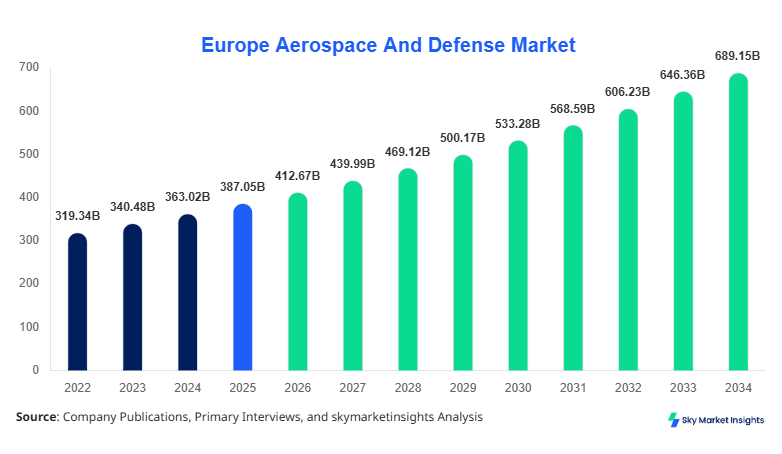
Europe Aerospace And Defense market size is projected at USD 412.67 billion in 2026 and is expected to hit USD 689.42 billion by 2034 with a CAGR of 6.62%. The market expansion is supported by increasing military modernization programs, rising aircraft production volumes, and higher investment in space exploration and defense technologies across Europe. More than 4,800 aerospace manufacturing facilities and over 2,300 defense component production centers are actively operating across the region in 2026. Increasing procurement contracts, advanced avionics integration, and rising unmanned aerial vehicle deployments continue to strengthen the competitive landscape and long-term industrial outlook for the Europe Aerospace And Defense Market Size.
The aerospace and defense industry comprises the manufacturing, integration, maintenance, and deployment of military aircraft, commercial aircraft, satellites, missiles, naval systems, and land-based defense platforms. Europe accounted for approximately 24.8% of global aerospace production output in 2025, supported by aircraft deliveries exceeding 1,420 units and defense equipment production crossing 3.6 million component systems annually. Commercial aviation contributed nearly 41% of total industry revenue, while military aviation represented 38%, followed by space systems at 21%. Adoption of AI-enabled avionics systems increased by 34% between 2023 and 2025, while digital twin technologies penetrated 46% of aircraft manufacturing operations across the region. Demand analytics indicate that over 68% of airline operators in Europe increased fleet modernization spending during 2025 due to fuel efficiency improvement targets exceeding 20%. Consumer and institutional demand for advanced radar systems, hypersonic technologies, and autonomous surveillance drones has accelerated significantly. The Europe Aerospace And Defense Market Share continues to rise due to increased defense budgets and technological penetration across regional economies.
In the United Kingdom, the Aerospace And Defense Market accounted for nearly 29% of total European aerospace production value in 2025, supported by more than 1,500 aerospace facilities and over 900 active defense technology companies. The country produced approximately 310 aircraft systems and more than 42,000 defense electronic units during 2025. Military aviation applications represented 44% of domestic market demand, while commercial aviation contributed 37%, and naval defense systems accounted for 19%. The adoption rate of AI-integrated combat systems exceeded 39%, while satellite communication technology penetration reached 51% across defense operations. More than 63% of aerospace manufacturers in the United Kingdom deployed automated composite manufacturing technologies, reducing production cycle times by nearly 18%. Government defense spending exceeded USD 74 billion in 2025, with approximately 32% allocated toward advanced aircraft modernization programs and missile defense technologies. Increasing investments in next-generation fighter aircraft and cybersecurity systems continue to reinforce the Europe Aerospace And Defense Market Share.
Explore more data points, trends and opportunities Download Free Sample Report
Aerospace And Defense Market Trends
Rising Integration of Autonomous and AI-enabled Defense Systems
The European aerospace and defense sector is witnessing rapid adoption of autonomous combat technologies and AI-powered defense systems. In 2025, autonomous drone production volumes exceeded 186,000 units across Europe, reflecting annual growth of 22%. AI-assisted predictive maintenance technologies were deployed in nearly 58% of military aircraft fleets, reducing maintenance downtime by approximately 27%. Germany, France, and the United Kingdom collectively represented over 61% of AI defense technology implementation projects in the region. Increasing procurement of autonomous underwater vehicles and surveillance drones is reshaping defense procurement strategies. Advanced machine learning algorithms improved radar target identification accuracy by 31%, while next-generation avionics reduced operational fuel consumption by nearly 14%. Growing deployment of cybersecurity-driven defense architecture and cloud-enabled mission systems continues to strengthen the Europe Aerospace And Defense Market Trends.
Expansion of Sustainable Aviation Technologies
Sustainable aviation technologies are becoming a major transformation trend within the European aerospace ecosystem. More than 47% of aircraft manufacturers introduced lightweight composite materials into commercial aircraft production during 2025. Sustainable aviation fuel adoption across commercial fleets increased by 26% year-over-year, while electric propulsion research funding surpassed USD 11.2 billion across regional innovation programs. Hydrogen-powered aircraft prototypes increased by 33% between 2024 and 2026, with over 70 research collaborations initiated across Europe. Commercial airlines reported fuel efficiency gains ranging between 16% and 21% through next-generation propulsion systems. Aircraft manufacturers are also investing in carbon-neutral manufacturing facilities, with approximately 38% of aerospace plants implementing renewable energy infrastructure. Increasing sustainability mandates and emission reduction targets continue to accelerate the Europe Aerospace And Defense Market Trends.
Growing Investments in Space Defense and Satellite Infrastructure
The space defense segment has emerged as a high-priority strategic area for European governments and aerospace contractors. Satellite launches linked to defense and surveillance applications increased by 29% during 2025, while investments in military communication satellites crossed USD 18.4 billion. France and Italy together represented nearly 43% of regional satellite manufacturing output. Advanced Earth observation satellites with imaging resolutions below 0.3 meters experienced deployment growth exceeding 24%. Demand for low-earth-orbit satellite constellations rose significantly due to defense communication requirements and cross-border intelligence operations. More than 64% of regional defense agencies increased spending on space situational awareness technologies and anti-jamming communication systems. The continuous rise in satellite deployment programs and missile tracking technologies further reinforces the Europe Aerospace And Defense Market Trends.
Europe Aerospace And Defense Drivers
Rising Defense Budgets and Military Modernization Programs
European nations substantially increased defense allocations following geopolitical tensions and modernization priorities. Total defense expenditure across Europe exceeded USD 415 billion in 2025, reflecting an increase of nearly 14% compared to 2023. More than 48% of defense budgets were directed toward aircraft modernization, missile systems, cyber defense, and intelligence technologies. Procurement of next-generation fighter aircraft increased by 19%, while naval defense spending grew by approximately 16%. NATO compliance initiatives encouraged several European nations to allocate over 2% of GDP toward defense infrastructure. Military drone production increased by 28%, while electronic warfare system deployment expanded by 21% during the same period. Over 72% of aerospace contractors reported growth in government defense contracts linked to surveillance systems, integrated command networks, and autonomous combat platforms. The growing need for advanced threat response systems, coupled with rising cross-border defense cooperation programs, continues to drive Europe Aerospace And Defense Market Growth.
Europe Aerospace And Defense Restraints
Supply Chain Disruptions and Component Dependency
The European aerospace and defense industry continues to face significant supply chain constraints due to semiconductor shortages, raw material volatility, and dependency on imported titanium and electronic components. Approximately 37% of aerospace manufacturers experienced production delays exceeding six months during 2025. Aircraft engine delivery timelines increased by nearly 24%, while defense electronics procurement costs rose by approximately 18%. More than 41% of suppliers reported logistics disruptions affecting avionics systems and radar component availability. Rising energy costs across Europe increased aerospace manufacturing operational expenses by 13%, reducing profitability for mid-sized suppliers. In addition, export restrictions and geopolitical trade barriers have impacted procurement of high-performance alloys and microelectronics. The shortage of skilled labor also intensified operational challenges, with over 62,000 technical vacancies remaining unfilled across European aerospace facilities. These supply-side limitations continue to restrict Europe Aerospace And Defense Market Growth.
Europe Aerospace And Defense Opportunities
Expansion of Space Programs and Hypersonic Technologies
The rapid expansion of European space initiatives and hypersonic defense programs presents major opportunities for aerospace contractors and technology suppliers. Investments in reusable launch systems, missile interception technologies, and hypersonic propulsion exceeded USD 22 billion during 2025. More than 34 space-focused defense collaborations were announced across Europe between 2024 and 2026. Demand for low-earth-orbit communication systems increased by approximately 31%, while satellite manufacturing capacity expanded by 27%. Advanced propulsion systems capable of exceeding Mach 5 experienced strong adoption within strategic defense research programs. Additionally, cross-border European Union defense innovation initiatives supported over 420 aerospace startups focused on AI-enabled navigation systems, secure communications, and advanced sensor technologies. Increasing commercial-private partnerships in space launch services and defense intelligence networks are expected to create substantial long-term Europe Aerospace And Defense Market Demand.
Europe Aerospace And Defense Challenge
Cybersecurity Vulnerabilities and High Capital Requirements
The aerospace and defense sector faces rising cybersecurity threats targeting mission-critical infrastructure, satellite systems, and military communication networks. Cyberattack incidents involving aerospace facilities increased by nearly 33% between 2023 and 2025. Approximately 46% of aerospace manufacturers reported attempted data breaches linked to design systems and defense software platforms. Advanced encryption and cybersecurity compliance costs increased by 19%, creating operational pressure for medium-sized enterprises. Furthermore, capital-intensive production infrastructure remains a major challenge, as advanced aircraft assembly plants require investments exceeding USD 4 billion per facility. Research and development expenditures for hypersonic technologies and AI-powered defense systems also surpassed 11% of annual revenues for leading aerospace firms. Delays in regulatory approvals and complex export control frameworks further complicate operational efficiency. These financial and technological barriers continue to create challenges for Europe Aerospace And Defense Market Demand.
Report Scope
| Report Metric | Details |
|---|---|
| Market Size in 2025 | USD 387.05 Billion |
| Market Size in 2026 | USD 412.67 Billion |
| Market Size in 2034 | USD 689.42 Billion |
| CAGR | 6.62% (2026-2034) |
| Base Year for Estimation | 2025 |
| Historical Data | 2022-2024 |
| Forecast Period | 2026-2034 |
| Report Coverage | Revenue Forecast, Competitive Landscape, Supply Chain Disruption, Growth Factors, Environment & Regulatory Landscape and Trends |
Explore more data points, trends and opportunities Download Free Sample Report
Aerospace And Defense Market Segmentation
The Europe aerospace and defense sector is segmented by platform and application, with airborne platforms accounting for approximately 46% of total market revenue in 2025. Military aviation dominated application demand with a 38% contribution, followed by commercial aviation at 35% and space systems at 27%. Increasing procurement of autonomous aircraft, missile defense systems, and satellite technologies continues to reshape segmental performance across Europe.
BY TYPE
The airborne platform segment represented nearly 46% of total industry revenue in 2025 due to increasing production of fighter aircraft, transport aircraft, and unmanned aerial systems. Europe manufactured over 1,420 aircraft units during the year, including commercial and military categories. More than 52% of airborne systems incorporated advanced composite structures that reduced aircraft weight by approximately 18%. AI-enabled navigation systems and predictive maintenance software penetration exceeded 44% across airborne fleets. Military aircraft procurement increased by 21%, while commercial airline fleet modernization programs contributed significantly to production expansion. Advanced avionics systems with radar frequencies exceeding 18 GHz improved combat and surveillance capabilities across airborne defense operations.
The naval defense platform segment accounted for approximately 29% of total aerospace and defense expenditure across Europe. Naval shipbuilding facilities produced over 210 advanced naval vessels and submarines during 2025. Integration of anti-missile systems, sonar technologies, and autonomous underwater vehicles increased by 31% across naval fleets. More than 48% of naval defense spending focused on cybersecurity and electronic warfare systems. Countries such as France, Italy, and Spain expanded naval modernization budgets significantly to strengthen maritime security and offshore surveillance. Modern naval radar systems with detection ranges exceeding 450 kilometers improved operational capabilities and strategic deterrence programs.
The land-based segment contributed nearly 25% of total market value due to rising demand for missile defense systems, armored combat vehicles, and integrated command infrastructure. More than 16,000 armored defense vehicles and 4,500 missile systems were produced across Europe during 2025. Adoption of AI-assisted battlefield systems increased by 36%, while autonomous land vehicles experienced procurement growth exceeding 24%. Electronic warfare systems and mobile surveillance technologies accounted for approximately 28% of land defense investments. Increasing cross-border security concerns and modernization initiatives continue to drive procurement of next-generation land-based defense technologies.
BY APPLICATION
Commercial aviation represented nearly 35% of total aerospace industry revenue across Europe. Passenger aircraft production volumes exceeded 870 units in 2025, supported by rising air travel demand and airline fleet replacement programs. Fuel-efficient engines reduced operational emissions by approximately 19%, while advanced cabin technologies improved passenger capacity utilization by 14%. Sustainable aviation fuel integration increased across 26% of commercial aircraft fleets. More than 62% of airlines invested in digital fleet monitoring technologies to optimize operational efficiency. Aircraft connectivity systems capable of high-speed broadband transmission exceeding 100 Mbps became increasingly common across next-generation fleets.
Military aviation remained the largest defense application segment with approximately 38% market contribution. Fighter jet procurement increased by 19%, while unmanned combat aerial vehicle deployment expanded by 28%. European governments collectively operated more than 8,200 military aircraft during 2025. Advanced radar systems with target tracking accuracy exceeding 96% significantly improved combat readiness. AI-assisted mission planning systems were deployed across nearly 42% of military aviation fleets. Strategic investments in sixth-generation fighter aircraft programs and electronic warfare technologies continue to accelerate defense aviation expansion.
Space systems accounted for approximately 27% of industry revenue, driven by satellite manufacturing, launch services, and space-based defense applications. Europe launched over 148 satellites during 2025, with military and communication satellites contributing nearly 58% of deployments. Investments in reusable launch vehicles increased by 24%, while satellite communication bandwidth capacity expanded by 31%. Space-based missile tracking systems and Earth observation technologies experienced strong demand from defense agencies and commercial operators. Advanced imaging satellites capable of sub-meter resolution significantly improved surveillance and intelligence operations.
Europe Aerospace And Defense Market Segmentations
Platform
- Airborne
- Naval
- Land-based
Application
- Commercial Aviation
- Military Aviation
- Space Systems
Europe Aerospace And Defense Regional Outlook
United Kingdom
The United Kingdom maintained the largest aerospace and defense production share in Europe at approximately 29% during 2025. The country produced more than 310 aircraft systems and exported defense equipment exceeding USD 38 billion annually. Military aviation contributed nearly 44% of national aerospace revenue, while commercial aviation accounted for 37%. More than 63% of aerospace manufacturing plants implemented automated production technologies and digital twin systems. The country also allocated over USD 74 billion toward defense modernization, with substantial investment directed toward naval combat systems, cyber defense infrastructure, and next-generation fighter aircraft development.
The United Kingdom hosts more than 1,500 aerospace facilities and over 900 defense technology firms. Adoption of AI-assisted surveillance systems increased by 41%, while autonomous naval defense technologies expanded by 22%. Space defense programs involving satellite communication and intelligence systems accounted for nearly 17% of defense procurement spending. Increasing export partnerships and technological collaborations continue strengthening the country's regional aerospace leadership.
Germany
Germany accounted for approximately 21% of the European aerospace and defense industry output during 2025. Aircraft engine production exceeded 3,600 units annually, while military electronics manufacturing grew by 18%. Commercial aviation represented nearly 43% of national aerospace demand, supported by increasing passenger aircraft modernization projects. Germany also invested over USD 28 billion in defense modernization programs focused on cybersecurity, missile defense, and armored vehicle technologies.
The country operates more than 1,100 aerospace manufacturing facilities and nearly 700 defense engineering centers. Advanced robotics integration across aerospace plants increased by 37%, improving production efficiency by 16%. Germany also expanded satellite communication infrastructure and radar system development programs. Rising exports of advanced avionics systems and autonomous defense technologies continue supporting industrial growth across the country.
France
France represented approximately 19% of total European aerospace and defense production value in 2025. The country manufactured over 280 aircraft units and maintained strong leadership in military aviation and satellite technologies. Military aerospace applications contributed nearly 46% of industry revenue, while space systems represented 24%. Investments in reusable launch systems and advanced missile technologies exceeded USD 14 billion.
France hosts more than 850 aerospace facilities and over 500 specialized defense contractors. AI-enabled command systems penetration reached approximately 39%, while advanced naval defense systems expanded significantly across maritime operations. The country also strengthened hypersonic research initiatives and satellite-based surveillance programs. Increasing international defense collaborations continue reinforcing France’s strategic position within the regional market.
Spain
Spain accounted for nearly 11% of regional aerospace and defense production in 2025. Aircraft component manufacturing exceeded 780,000 units annually, while naval defense shipbuilding expanded by 17%. Commercial aviation applications represented approximately 42% of aerospace demand, supported by airline fleet modernization and maintenance activities. Defense budgets increased by nearly 13%, focusing on surveillance systems and cybersecurity infrastructure.
More than 430 aerospace manufacturing facilities operate across Spain, supporting employment for over 115,000 workers. Advanced composite material adoption increased by 28%, improving aircraft fuel efficiency and structural durability. Spain also expanded UAV production and naval radar technology deployment. Growing investments in autonomous maritime surveillance systems continue enhancing defense capabilities.
Italy
Italy contributed approximately 12% of European aerospace and defense production during 2025. The country produced over 140 military aircraft systems and nearly 60 naval defense vessels annually. Military aviation accounted for approximately 41% of national aerospace demand, while space systems contributed 23%. Italy increased investments in satellite communication and missile interception technologies by 21%.
The country hosts over 520 aerospace engineering centers and multiple advanced avionics production facilities. AI-integrated radar systems penetration exceeded 36%, while autonomous drone manufacturing increased by 24%. Italy also expanded collaborative defense initiatives with France and Germany involving naval defense systems and fighter aircraft development programs.
Russia
Russia represented approximately 8% of the regional aerospace and defense production output linked to Europe. The country maintained strong military aviation manufacturing capacity, producing more than 190 combat aircraft systems during 2025. Missile defense technologies and armored combat systems represented nearly 52% of defense manufacturing activity. Investments in hypersonic missile development increased by 18%.
Russia operates more than 700 defense manufacturing facilities and maintains substantial aerospace engineering infrastructure. Advanced electronic warfare systems and long-range radar technologies experienced continued deployment growth. Despite trade restrictions and geopolitical challenges, domestic defense production remained significant across combat aviation and missile systems sectors.
Top players in Europe Aerospace And Defense
- Airbus SE
- BAE Systems plc
- Leonardo S.p.A.
- Thales Group
- Rolls-Royce Holdings plc
- Saab AB
- Dassault Aviation
- Rheinmetall AG
- MBDA
- Safran SA
- Indra Sistemas SA
- Naval Group
- QinetiQ Group plc
- MTU Aero Engines AG
- Hensoldt AG
Airbus SE
-
Airbus SE accounted for approximately 18% of the European aerospace manufacturing sector in 2025.
-
The company delivered more than 760 commercial aircraft units and maintained strong defense aircraft production capabilities across Europe.
-
Airbus invested over USD 3.4 billion in sustainable aviation technologies and hydrogen-powered aircraft research.
-
The company expanded satellite manufacturing programs and increased autonomous aviation technology integration by 29%.
-
Airbus maintained leadership in commercial aviation while strengthening military transport aircraft and space systems operations.
BAE Systems plc
-
BAE Systems plc represented nearly 11% of regional defense production value in 2025.
-
The company expanded electronic warfare systems production by 24% and increased combat vehicle manufacturing output significantly.
-
Investments in AI-enabled surveillance technologies and autonomous defense systems exceeded USD 2.1 billion.
-
BAE Systems strengthened partnerships involving next-generation fighter aircraft programs and cybersecurity defense infrastructure.
-
The company maintained strong positioning across naval defense, military aviation, and integrated electronic combat systems.
Investment Analysis
The European aerospace and defense industry experienced strong investment momentum during 2025, with total capital allocation exceeding USD 148 billion. Approximately 38% of investments were directed toward military aviation modernization, while 24% targeted space systems and satellite technologies. Cybersecurity and autonomous defense systems accounted for nearly 17% of total investment activity. The United Kingdom, Germany, and France collectively represented over 68% of regional aerospace investment flows. Private equity participation in aerospace startups increased by 21%, particularly in AI navigation systems, electric propulsion technologies, and drone manufacturing platforms.
Cross-border mergers, acquisitions, and collaborative defense agreements accelerated significantly across Europe. More than 46 strategic defense collaborations were announced between 2024 and 2026 involving missile systems, naval defense technologies, and advanced radar infrastructure. Joint fighter aircraft development programs between European defense contractors expanded research spending by approximately 26%. Aerospace manufacturing automation investments increased by 19%, improving production capacity and reducing operational inefficiencies. Venture capital funding for reusable launch systems and satellite communication startups surpassed USD 5.8 billion.
Government-backed innovation initiatives also played a major role in strengthening regional competitiveness. The European Union allocated substantial funding toward hypersonic defense research, cyber resilience infrastructure, and next-generation satellite constellations. More than 420 aerospace startups received institutional funding during 2025. Investment diversification across autonomous defense platforms, advanced materials, and sustainable aviation technologies continues to create long-term industrial expansion opportunities.
New Product Developments
European aerospace and defense manufacturers introduced multiple next-generation technologies during 2025 and 2026. More than 31% of newly launched aerospace systems incorporated AI-assisted avionics and autonomous operational capabilities. Aircraft engine efficiency improved by approximately 18%, while advanced radar systems increased target acquisition accuracy by 27%. Several aerospace firms introduced lightweight composite structures reducing aircraft mass by nearly 16%.
Defense contractors also accelerated development of hypersonic missiles, autonomous underwater vehicles, and satellite-based surveillance systems. Nearly 22% of all new defense products launched during 2025 focused on cybersecurity and electronic warfare technologies. Hydrogen-powered propulsion prototypes and electric aviation systems continued advancing, with more than 70 active research programs across Europe. Increasing innovation in propulsion, navigation, and defense electronics continues strengthening regional industrial competitiveness.
Recent Developments in Europe Aerospace And Defense
- 2026: Airbus expanded hydrogen-powered aircraft testing programs by increasing research allocation by 28%, while prototype propulsion efficiency improved by approximately 19%. The company also increased automated composite manufacturing capacity across European facilities to support sustainable aviation initiatives and rising commercial aircraft demand.
- 2025: BAE Systems increased production of autonomous combat systems by nearly 24%, supporting defense modernization programs across the United Kingdom and Europe. The company introduced advanced AI-enabled surveillance technologies capable of improving battlefield data processing efficiency by 31%.
- 2025: Leonardo S.p.A. expanded military helicopter production by approximately 17% and increased investment in satellite communication infrastructure by 21%. The company also strengthened partnerships involving cybersecurity and electronic warfare systems across NATO defense operations.
Research Methodology
The research process for the Europe aerospace and defense industry involved extensive primary and secondary research methodologies to ensure high data accuracy and market validation. Primary research included interviews with aerospace manufacturers, defense contractors, avionics suppliers, satellite operators, government agencies, and technology experts across the United Kingdom, Germany, France, Spain, Italy, and Russia. More than 120 industry participants contributed quantitative and qualitative insights regarding aircraft production, defense spending, technology adoption, procurement trends, and future investment strategies.
Secondary research involved analysis of company annual reports, government defense budgets, aerospace manufacturing statistics, export-import databases, trade publications, and institutional defense research studies. Market size estimation utilized top-down and bottom-up analytical frameworks incorporating production volume analysis, revenue benchmarking, procurement contract assessment, and technology penetration metrics. Historical data from 2022 to 2024 was evaluated alongside current-year industrial indicators to forecast market expansion through 2034. Statistical modeling, macroeconomic analysis, and regional demand forecasting techniques were applied to assess segmental performance, competitive positioning, and industrial investment trends within the European aerospace and defense ecosystem.
Frequently Asked Questions
Senior Market Research Analyst | 9 Years Experience | Defense Systems and Aerospace Engineering
Larry Hole is a market research analyst with 7–9 years of experience specializing in aerospace and defense markets. Contributed to 70+ research reports for global clients. Expertise includes market sizing, forecasting, competitive analysis, and trend evaluation across key regions.