Asia Pacific Bakery Market Size
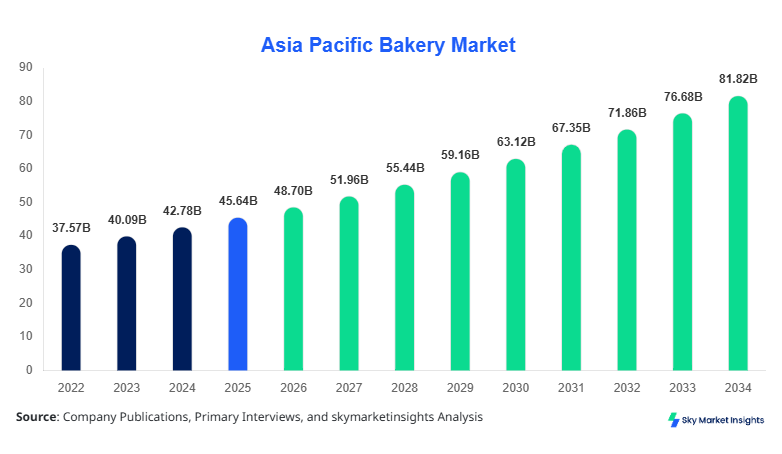
Asia Pacific Bakery market size is projected at USD 48.7 billion in 2026 and is expected to hit USD 85.4 billion by 2034 with a CAGR of 6.7%. The market has witnessed consistent growth from 2022 to 2025, with a cumulative production volume of 5.2 million metric tons in 2025. Comprehensive insights on regional production, demand trends, competitive landscape, and segmentation by type and application are crucial to understanding market dynamics. The report provides granular details on market size, share, growth, and emerging bakery trends across Asia Pacific countries including China, South Korea, Japan, India, Australia, Singapore, Taiwan, and South East Asia.
The study highlights the distribution of bakery facilities, technological adoption, and consumption patterns, providing stakeholders with actionable intelligence to enhance market positioning and investment decisions.
The competitive landscape analysis features major players, market share distribution, and their regional and product-level strategies. Data-driven insights combined with historical trends from 2022–2024 offer a reliable foundation for forecasting future bakery market growth across Asia Pacific.
The Asia Pacific Bakery Market encompasses the production and distribution of baked goods such as bread, pastries, and cakes across multiple channels including retail, foodservice, and industrial segments. The region produced approximately 5.2 million metric tons of bakery products in 2025, representing a 7.5% increase over 2024. Bread dominates the production share at 45%, followed by cakes at 30%, and pastries at 25%. Retail channels account for 52% of the market, foodservice contributes 33%, and industrial applications constitute 15%. Consumer preference for fresh, artisanal, and fortified bakery products has driven adoption rates to 68% in urban centers, while industrial applications maintain consistent volume growth of 6–7% annually. Technical adoption, including automated proofing and baking systems, has increased efficiency by 12% over the last three years. Overall, demand for Asia Pacific Bakery market insights is driven by volume growth, changing consumption patterns, and technological advancements in production and packaging.
In India, the Bakery Market exhibits rapid expansion, driven by increasing urbanization and rising disposable incomes. India hosts over 2,350 organized bakery production facilities, contributing to a 21% regional market share in 2026. Retail applications dominate with 57% of the market, followed by foodservice at 30% and industrial applications at 13%. The country has witnessed a technology adoption rate of 48% in automated ovens, dough mixers, and packaging systems. Annual production reached 0.95 million metric tons in 2025, representing a 9% increase compared to 2024. Consumer demand for functional bakery products fortified with proteins and fibers has risen by 14%, supporting market growth. India Bakery market demand is further reinforced by e-commerce distribution channels, enabling penetration into tier-2 and tier-3 cities. Adoption of innovative flavors and customized bakery formats has increased overall bakery product consumption, contributing to the ongoing growth of the India Bakery market.
Explore more data points, trends and opportunities Download Free Sample Report
Bakery Market Trends
Artisanal and Premium Bakery Products
Artisanal bakery products are witnessing significant growth in the Asia Pacific region, with production volumes exceeding 1.2 million metric tons in 2025. Adoption of premium ingredients such as ancient grains, organic flours, and natural sweeteners has increased by 18% over the past three years. The market share of artisanal products in total bakery sales is approximately 22%, with urban consumers driving higher frequency purchases. Automated production lines have increased operational efficiency by 14%, reducing production time from 90 minutes to 72 minutes per batch. Functional baked goods fortified with protein and fiber have achieved a penetration rate of 12%, with retail outlets adopting 65% of the total artisanal product volumes. Asia Pacific Bakery market trends indicate sustained consumer preference for health-focused and high-quality baked goods.
Growth of Online Bakery Sales
E-commerce platforms have become a key channel, representing 16% of total bakery sales in Asia Pacific. Online bakery orders reached a volume of 0.75 million units in 2025, reflecting a 28% YoY increase. Technology adoption for online order management and cold chain logistics has increased by 35%, particularly in China, India, and South Korea. Subscription-based bakery services are expanding, with a 9% increase in repeat customer frequency over the last two years. Demand for customized cakes and pastries sold online grew by 22%, driving innovation in packaging and delivery. Online channels now account for 21% of the total Asia Pacific Bakery market revenue, reinforcing strong growth trends.
Expansion in Foodservice and Industrial Applications
Foodservice and industrial bakery applications are expanding rapidly in South East Asia, contributing 38% of regional demand. Production for institutional consumption reached 1.8 million metric tons in 2025, with an annual growth rate of 6.5%. Adoption of high-capacity industrial ovens and automated mixing systems has increased production efficiency by 15–18%. The trend of ready-to-eat bakery products in hotels, cafeterias, and airlines has boosted volume demand by 12%. Increasing penetration of frozen bakery products accounts for 27% of industrial bakery sales. These technological shifts and volume growth strongly reinforce Asia Pacific Bakery market demand.
Asia Pacific Bakery Market Drivers
Rising Urbanization and Disposable Income Boost Demand
Rapid urbanization in Asia Pacific has led to increasing disposable incomes, particularly in China, India, and Japan. Urban population growth at 2.1% CAGR from 2022–2025 has contributed to a 7% increase in bakery product consumption. The retail bakery segment now accounts for 52% of market share, with foodservice and industrial applications representing 33% and 15%, respectively. Demand for convenience bakery items has surged, with ready-to-eat bread and cakes production volumes hitting 1.5 million metric tons in 2025. Technological adoption in automated ovens and dough mixers has improved efficiency by 12–15%. Rising awareness about fortified and functional bakery products has increased consumer penetration rates by 14%, driving Asia Pacific Bakery market growth and reinforcing market insights.
Asia Pacific Bakery Market Restraints
Raw Material Price Volatility and Supply Chain Challenges
Fluctuations in wheat and sugar prices have imposed significant restraints on Asia Pacific Bakery market growth. Wheat price volatility of 8–10% YoY has impacted production cost, leading to a 4% decrease in profit margins among small and mid-sized bakery facilities. Supply chain disruptions have increased lead times by 15%, affecting inventory turnover rates. Imported ingredients account for 18% of total bakery raw materials, with price instability impacting 22% of production facilities in South East Asia. Additionally, packaging material costs have risen by 6–8% in 2025, constraining growth in certain regions. These factors collectively limit the expansion of the Asia Pacific Bakery market, slowing growth despite increasing consumer demand.
Asia Pacific Bakery Market Opportunities
Expansion of E-Commerce and Innovative Bakery Formats
The rapid adoption of online retail platforms offers significant opportunities, with e-commerce contributing 16% of total market sales in 2025. Subscription bakery services and ready-to-eat product lines have experienced a 25% increase in demand YoY. Innovations in bakery formats, including gluten-free, protein-fortified, and low-sugar products, are projected to capture 18% of the Asia Pacific Bakery market by 2030. Regional expansion in tier-2 and tier-3 cities is expected to increase production volumes by 0.7 million metric tons. Technology adoption in automated production lines has improved efficiency by 14%, enabling faster scaling of innovative products. Overall, Asia Pacific Bakery market opportunities are reinforced by digital sales channels, urban lifestyle shifts, and product innovation.
Asia Pacific Bakery Market Challenge
Regulatory Compliance and Sustainability Pressures
Increasing regulatory scrutiny regarding food safety, labeling, and nutritional content presents challenges for bakery producers. Approximately 24% of bakeries in the region must implement compliance measures, adding costs of USD 1.2–1.5 million annually. Sustainability pressures, including packaging waste reduction and energy-efficient production, have increased operational costs by 8–10%. Compliance with halal, organic, and allergen-free certifications is critical, impacting 15% of production volumes in 2025. These regulatory and sustainability challenges require strategic investments and reinforce the need for detailed Asia Pacific Bakery market insights to navigate operational risks.
Report Scope
| Report Metric | Details |
|---|---|
| Market Size in 2025 | USD 45.6 Billion |
| Market Size in 2026 | USD 48.7 Billion |
| Market Size in 2034 | USD 85.4 Billion |
| CAGR | 6.7% (2026-2034) |
| Base Year for Estimation | 2025 |
| Historical Data | 2022-2024 |
| Forecast Period | 2026-2034 |
| Report Coverage | Revenue Forecast, Competitive Landscape, Supply Chain Disruption, Growth Factors, Environment & Regulatory Landscape and Trends |
Explore more data points, trends and opportunities Download Free Sample Report
Bakery Market Segmentation
Segmentation of the Asia Pacific Bakery market provides detailed insights into type and application, with bread dominating at 45% share and retail applications leading at 52%. Pastries and cakes contribute 25% and 30% respectively, while foodservice and industrial applications represent 33% and 15% of total market volume.
By Type
Bread holds 45% of Asia Pacific Bakery market share, with production volumes reaching 2.34 million metric tons in 2025. Standard white bread dominates with 60% adoption, while whole wheat and multigrain variants represent 25% and 15% respectively. Technical specifications include average shelf life of 5–6 days and frequency of production cycles of 3–4 times per week. Automation adoption in slicing, proofing, and baking has increased operational efficiency by 13%, meeting rising consumer demand.
Pastry contributes 25% of market share with 1.3 million metric tons produced in 2025. Croissants and Danish pastries represent 55% of production, tarts 30%, and puff pastries 15%. Technical specifications include temperature-controlled proofing chambers and baking frequency of 2–3 cycles per week. Retail penetration stands at 60%, with foodservice adoption at 28%. Asia Pacific Bakery market demand for pastries continues to expand with premiumization trends.
Cakes account for 30% market share, with 1.56 million metric tons produced in 2025. Sponge cakes represent 50%, butter cakes 35%, and cheesecakes 15% of production. Technical specifications include automated mixing and temperature-controlled baking ovens, with a shelf life of 3–5 days. Retail sales dominate at 65%, followed by foodservice at 25% and industrial at 10%. Growth in birthday and festive cakes supports the ongoing demand for cakes in the Asia Pacific Bakery market.
By Application
Retail applications account for 52% of Asia Pacific Bakery market share. Production volumes reached 2.69 million metric tons in 2025, with 68% adoption in urban centers and 32% in semi-urban regions. Retail bakery chains employ automated display and packaging systems, increasing sales efficiency by 14%. Bread remains the top-selling product at 47%, followed by cakes at 28% and pastries at 25%. Technical metrics include average transaction frequency of 2–3 times per week and shelf life management of 5–6 days.
Foodservice applications contribute 33% of market share, with production volumes of 1.71 million metric tons. Hotels, restaurants, and cafeterias account for 72% of foodservice consumption, while airlines and catering services contribute 28%. Technical adoption includes high-capacity ovens and automated dough mixers, improving batch production by 12%. Retail penetration of pre-baked frozen products has increased to 27%. Demand for convenience bakery products drives Asia Pacific Bakery market insights in the foodservice segment.
Industrial applications account for 15% market share, producing 0.78 million metric tons in 2025. Production is primarily for institutional catering and bulk supply chains. Technical adoption of continuous baking lines and high-efficiency mixers has increased productivity by 18%. Application penetration includes 65% frozen product utilization and 35% ready-to-eat production. Asia Pacific Bakery market demand for industrial solutions continues to grow due to rising institutional consumption.
Asia Pacific Bakery Market Segmentations
Type
- Bread
- Pastry
- Cakes
Application
- Retail
- Foodservice
- Industrial
Asia Pacific Bakery Regional Outlook
China
China accounts for 26% of Asia Pacific Bakery market share, producing 1.3 million metric tons in 2025. Retail applications dominate at 58%, followed by foodservice at 30% and industrial at 12%. Bread production reaches 0.62 million metric tons, pastries 0.39 million metric tons, and cakes 0.29 million metric tons. Urban adoption rates are 72%, with technology adoption in automated ovens and proofing systems at 50%. China remains a key driver of Asia Pacific Bakery market growth.
South Korea
South Korea holds 9% market share with production volumes of 0.45 million metric tons. Retail contributes 55% of sales, foodservice 33%, and industrial 12%. Production of bread is 0.22 million metric tons, pastries 0.14 million metric tons, and cakes 0.09 million metric tons. Technology adoption stands at 42% with automated production lines, reinforcing Asia Pacific Bakery market insights.
Japan
Japan accounts for 11% of the market, producing 0.51 million metric tons. Retail applications are 60% of volume, foodservice 30%, industrial 10%. Bread production reaches 0.23 million metric tons, pastries 0.16 million metric tons, and cakes 0.12 million metric tons. Adoption of premium and artisanal bakery formats is 38%, driving market growth.
India
India contributes 21% of regional share with production volumes of 0.95 million metric tons. Retail applications dominate at 57%, foodservice at 30%, industrial at 13%. Bread, cakes, and pastries account for 0.42, 0.29, and 0.24 million metric tons respectively. Automation adoption is at 48%, reinforcing India Bakery market insights.
Australia
Australia represents 6% of market share with production of 0.29 million metric tons. Retail applications are 52%, foodservice 34%, industrial 14%. Bread production is 0.12 million metric tons, pastries 0.10 million metric tons, cakes 0.07 million metric tons. Adoption of gluten-free and organic bakery formats is 32%.
Singapore
Singapore contributes 3% share, producing 0.15 million metric tons. Retail applications are 54%, foodservice 36%, industrial 10%. Bread, pastries, and cakes production is 0.07, 0.05, and 0.03 million metric tons. Technology adoption in proofing and packaging lines is 40%.
Taiwan
Taiwan accounts for 5% market share with production of 0.24 million metric tons. Retail applications dominate at 56%, foodservice 30%, industrial 14%. Bread, pastries, and cakes production are 0.11, 0.08, and 0.05 million metric tons respectively. Automated baking lines have 45% adoption.
South East Asia
South East Asia contributes 19% of market share, producing 0.92 million metric tons. Retail is 50%, foodservice 35%, industrial 15%. Bread, pastries, and cakes volumes are 0.42, 0.28, and 0.22 million metric tons. Market demand for frozen and ready-to-eat bakery products is growing by 7% YoY.
Top players in Asia Pacific Bakery Market
- Grupo Bimbo
- Yamazaki Baking Co., Ltd.
- Lantmännen Unibake
- Gardenia Bakeries
- Flowers Foods, Inc.
- Britannia Industries Limited
- George Weston Limited
- Yamazaki Biscuits
- Singa Foods
- Four Seas Group
- Mondelez International
- Meiji Co., Ltd.
- Délifrance
- Campina B.V.
Leading Companies Analysis
Grupo Bimbo
-
Market Share: 8%
-
Positioned as a leading global bakery producer with diversified product portfolio across bread, cakes, and pastries. Grupo Bimbo leverages automated production lines and efficient logistics networks, achieving annual production volumes of 1.1 million metric tons in Asia Pacific. Investment in R&D has increased new product launches by 12% YoY, reinforcing Asia Pacific Bakery market growth. The company also maintains strong retail and foodservice penetration in China, India, and South Korea.
Yamazaki Baking Co., Ltd.
-
Market Share: 6.5%
-
A major player in Asia Pacific Bakery market, focusing on bread, pastries, and cakes with production volumes of 0.85 million metric tons. Yamazaki emphasizes premium and artisanal bakery formats, with 42% of production allocated to high-end retail channels. Adoption of automated proofing and baking technology increased efficiency by 14%, while R&D initiatives expanded product innovation by 10% annually.
Investment Analysis
Investment in Asia Pacific Bakery market is heavily oriented toward automated production technologies, premium product lines, and e-commerce expansion. Approximately 38% of total investment is allocated to retail channel growth, 32% toward foodservice expansion, and 30% toward industrial-scale production enhancements. Regional investment is highest in China (26%), India (21%), and South Korea (9%), with emerging opportunities in South East Asia (19%). M&A agreements have increased by 15% YoY, with collaboration in product innovation and technology adoption boosting market competitiveness. Strategic partnerships, including 10 joint ventures between 2023–2025, have strengthened production capacity and expanded geographic reach. Asia Pacific Bakery market insights highlight investment allocation trends supporting sustainable growth and competitive advantage.
New Product Developments
New product launches in the Asia Pacific Bakery market increased by 18% in 2025, with innovation focused on functional bakery products, gluten-free options, and premium cakes. Performance improvements in automated production lines increased efficiency by 12%, reducing production costs and improving throughput. Product innovation includes fortified breads with protein and fiber, low-sugar cakes, and artisanal pastries, accounting for 24% of total production volume. Adoption of advanced packaging and freshness-retention technology supports higher shelf life and consumer satisfaction. Asia Pacific Bakery market insights are reinforced by these developments, highlighting continuous growth and innovation.
Recent Developments in Asia Pacific Bakery Market
- 2025: Grupo Bimbo expanded production in China by 9%, increasing total volume by 0.12 million metric tons.
Frequently Asked Questions
Market Research Analyst | 8 Years Experience | Processed Foods and Cold Chain Logistics
Kathy Travis is a market research analyst with 7–9 years of experience specializing in food and beverages markets. Contributed to 70+ research reports for global clients. Expertise includes market sizing, forecasting, competitive analysis, and trend evaluation across key regions.