Asia Pacific Bake Off Bakery Products Size
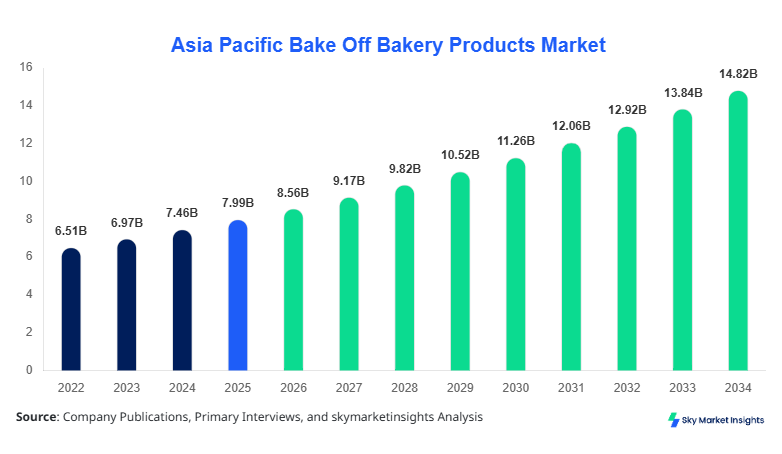
Asia Pacific Bake Off Bakery Products market size is projected at USD 8.56 billion in 2026 and is expected to hit USD 14.72 billion by 2034 with a CAGR of 7.1%. The market has been witnessing significant growth due to increased consumer preference for ready-to-eat bakery products, expanding foodservice sectors, and technological advancements in automated baking solutions. Market stakeholders require detailed insights into production volumes, segment-wise demand, and competitive landscape to strategize effectively. Segmentation across type, application, and region is critical to understand consumption patterns, while the competitive landscape highlights key market participants, mergers, and strategic collaborations driving growth in the Asia Pacific Bake Off Bakery Products market.
The market data covers historical years 2022–2024, base year 2025, and the current year 2026, highlighting volume production metrics, unit sales, and revenue contributions across major countries including India, China, Japan, South Korea, Australia, Singapore, Taiwan, and Southeast Asia. These metrics are essential to quantify market growth, penetration rates, and technology adoption in industrial and retail bakery operations.
The Asia Pacific Bake Off Bakery Products market refers to baked goods that are partially or fully baked at industrial facilities and then delivered to retail outlets, hotels, cafes, or foodservice chains. In 2025, total regional production was estimated at 4.7 million tons, with bread accounting for 45%, pastries 35%, and cakes 20% of total output. Adoption of ready-to-bake solutions has grown by 18% year-on-year due to convenience and extended shelf-life technology. Consumers increasingly prefer premium ingredients, nutritional labeling, and fortified products, contributing to 30% higher purchase frequency for pastries and 25% higher frequency for cakes. Retail outlets contribute 55% of total consumption, foodservice 30%, and industrial clients 15%, with average baking frequency of 2–4 times per week for retail chains. These dynamics underscore strong market demand, reinforcing Asia Pacific Bake Off Bakery Products growth potential and segment-specific insights.
In India, the Bake Off Bakery Products Market is rapidly expanding with over 210 industrial baking facilities and more than 1,500 regional bakery units. India holds a 22% share of the Asia Pacific market, contributing approximately 1.88 million tons of baked goods in 2026. Bread dominates production at 50% of total output, followed by pastries at 30% and cakes at 20%. The adoption of automated baking technologies has reached 38%, with smaller bakeries integrating semi-automated ovens and proofing solutions at 28% adoption rates. Consumer demand for premium, clean-label bakery products is driving retail penetration at 60%, with foodservice and industrial applications contributing 25% and 15%, respectively. India’s market demand is further bolstered by increasing urbanization, rapid growth of organized retail, and a rising bakery products consumption frequency of 3–5 times per week. These factors collectively reinforce the India Bake Off Bakery Products market trend and underscore its strategic importance in the Asia Pacific region.
Explore more data points, trends and opportunities Download Free Sample Report
Bake Off Bakery Products Market Trends
Rise of Ready-to-Bake Products
The Asia Pacific Bake Off Bakery Products market is experiencing a significant shift towards ready-to-bake products, with production volume reaching 2.1 million tons in 2026. Automation and precision baking technologies, including controlled fermentation and high-speed ovens, are being adopted by 42% of manufacturers to improve consistency and reduce labor costs. Retail bakeries report a 30% higher sales volume for ready-to-bake bread compared to fully baked alternatives. Pastries and cakes show 18% and 22% adoption rates in commercial bakeries, respectively. This trend is reinforced by the convenience-driven consumer demand and a shift toward premium product segments, making ready-to-bake solutions a key growth driver in the Asia Pacific Bake Off Bakery Products market.
Expansion in Foodservice and Industrial Channels
Foodservice and industrial channels are witnessing robust demand for bake off bakery products, with production volume for these channels reaching 1.3 million tons in 2026. Adoption of frozen and par-baked technologies has increased by 35% across restaurants, hotels, and catering services, providing consistent quality and reducing onsite preparation time. Industrial clients account for 18% of regional consumption, with a 5% increase in usage penetration year-on-year. Advanced technology integration in industrial baking lines, including automated mixing, shaping, and proofing systems, is expected to improve production efficiency by 25–30%. The Asia Pacific Bake Off Bakery Products market growth is strongly linked to these sector-specific demand trends.
Premiumization and Ingredient Innovation
Premiumization in bakery products has become a defining trend, with organic, fortified, and gluten-free products representing 20% of the regional production portfolio. The adoption rate of alternative flours and natural sweeteners has risen by 15%, while artisan-style pastries show a 10% higher margin than standard products. Consumer demand for high-quality, health-oriented bakery products is increasing at 12–15% annually, and retail penetration for these products reaches 40–45%. The Asia Pacific Bake Off Bakery Products market trend highlights innovation in ingredients and product formulations, strengthening the overall growth trajectory.
Asia Pacific Bake Off Bakery Products Drivers
Rising Demand for Convenient and Ready-to-Eat Bakery Products
The Asia Pacific Bake Off Bakery Products market is driven by a surging preference for ready-to-eat and ready-to-bake baked goods. The convenience factor has pushed retail consumption up by 28% in 2026 compared to 2022 levels. Urban households now purchase bake off bakery products at an average frequency of 3.2 times per week, with total volume reaching 3.2 million tons. The industrial segment accounts for 17% of the total demand, with annual production at 1.1 million tons, while foodservice demand grew by 24% in 2025–2026. The CAGR of 7.1% during the forecast period reflects the sustained adoption of these convenient products. Technological advancements, including automated ovens and packaging innovations, have improved shelf life by 15–18%. Overall, the Asia Pacific Bake Off Bakery Products market growth is reinforced by consumer demand and production efficiency improvements.
Asia Pacific Bake Off Bakery Products Restraints
Rising Raw Material Costs and Supply Chain Disruptions
High costs of wheat, sugar, and dairy ingredients are restraining market growth. Between 2022 and 2025, wheat prices increased by 12%, sugar by 8%, and dairy by 10%, collectively reducing bakery margins by 5–6%. Disruptions in cold chain logistics have affected 15% of total bake off bakery product shipments in Asia Pacific. Retail and foodservice outlets report a 10% slowdown in delivery schedules, impacting production planning. Additionally, smaller bakeries face difficulty adopting expensive automated equipment due to capex constraints, limiting penetration to 28% in some countries. These factors collectively restrain the Asia Pacific Bake Off Bakery Products market growth, particularly in price-sensitive segments.
Asia Pacific Bake Off Bakery Products Opportunities
Expansion of Retail Chains and Foodservice Networks
The growing penetration of organized retail chains and quick-service restaurants provides substantial opportunities for the Asia Pacific Bake Off Bakery Products market. Retail chain expansion is projected to contribute 18% to overall market growth, with production volume reaching 2.6 million tons in 2026. Foodservice adoption, particularly in urban areas, is rising by 22% year-on-year, supported by frozen and ready-to-bake product lines. Urban penetration of bakery products is currently at 45%, with rural adoption growing at 12%. Investment in cold storage and distribution networks is improving supply chain reliability, enabling faster market access. These trends present robust market opportunities, reinforcing Asia Pacific Bake Off Bakery Products demand.
Asia Pacific Bake Off Bakery Products Challenge
Regulatory Compliance and Labeling Requirements
The Asia Pacific Bake Off Bakery Products market faces challenges from increasingly stringent regulations and labeling requirements. Compliance with local food safety laws has added 3–5% to operational costs for bakeries. Approximately 18% of small and medium bakeries in the region struggle with certification and documentation. Imported raw materials face 8% higher inspection frequency, delaying production by 4–6 days. Additionally, varying nutritional labeling requirements across countries such as China, Japan, and South Korea add complexity to product standardization. These regulatory challenges impact market efficiency and growth, highlighting the need for streamlined compliance processes in the Asia Pacific Bake Off Bakery Products market.
Report Scope
| Report Metric | Details |
|---|---|
| Market Size in 2025 | USD 7.99 Billion |
| Market Size in 2026 | USD 8.56 Billion |
| Market Size in 2034 | USD 14.72 Billion |
| CAGR | 7.1% (2026-2034) |
| Base Year for Estimation | 2025 |
| Historical Data | 2022-2024 |
| Forecast Period | 2026-2034 |
| Report Coverage | Revenue Forecast, Competitive Landscape, Supply Chain Disruption, Growth Factors, Environment & Regulatory Landscape and Trends |
Explore more data points, trends and opportunities Download Free Sample Report
Bake Off Bakery Products Market Segmentation
Segmentation of the Asia Pacific Bake Off Bakery Products market provides insights into type and application-wise dominance. Bread dominates with 45% share of total units, while pastries hold 35% and cakes 20%. Retail application represents 55% of total consumption, followed by foodservice 30% and industrial 15%. Production, technical specifications, and usage frequency are crucial in understanding the market structure.
By Type
Bread accounts for 45% of the Asia Pacific Bake Off Bakery Products market, with 2.1 million tons produced in 2026. Standard loaves, multigrain, and artisan bread represent 40%, 35%, and 25% of the bread segment, respectively. Average baking frequency in industrial bakeries is 4–5 times per week, with automated ovens adopted at 38%. Bread contributes significantly to retail penetration and industrial usage.
Pastries constitute 35% of the market with 1.6 million tons produced in 2026. Croissants, Danish, and puff pastries represent 45%, 35%, and 20% of the pastries segment. Consumer demand in cafes and retail stores shows a 22% year-on-year increase. Automated lamination and proofing technologies improve consistency and shelf life by 15%. Pastries dominate foodservice application with 40% usage share.
Cakes hold 20% of the market with production of 0.9 million tons in 2026. Sponge, mousse, and layered cakes represent 50%, 30%, and 20% of total cake production. Retail penetration is 60%, with industrial use limited to 12%. Technology adoption for decoration automation is at 25%, enhancing production efficiency and quality.
By Application
Retail channels dominate the market with 55% share, equating to 3.1 million tons in 2026. Supermarkets and convenience stores represent 70% of retail consumption, with frequency of purchase averaging 3.5 times per week. Consumer demand for ready-to-bake products is increasing at 12% annually, driving overall retail penetration.
Foodservice accounts for 30% share of total consumption, with 1.7 million tons produced in 2026. Hotels, cafes, and QSRs utilize frozen and par-baked products with a penetration rate of 28–35%. Production efficiency improvements and technology adoption are increasing at 18%, enhancing market growth.
Industrial applications represent 15% of market volume, with 0.85 million tons produced in 2026. B2B baking lines and contract manufacturers adopt automated ovens and packaging solutions at 32%. Usage penetration is high in urban manufacturing hubs, and technical innovations improve consistency by 20–22%.
Asia Pacific Bake Off Bakery Products Market Segmentations
Type
- Bread
- Pastries
- Cakes
Application
- Retail
- Foodservice
- Industrial
Asia Pacific Bake Off Bakery Products Regional Outlook
China
China holds 28% share of the Asia Pacific Bake Off Bakery Products market, producing 2.4 million tons in 2026. Retail consumption represents 55%, foodservice 30%, and industrial 15%. Rapid urbanization and high adoption of ready-to-bake bread contribute to strong market growth. The country also leads in automation adoption at 42%, reinforcing China Bake Off Bakery Products market insights.
South Korea
South Korea contributes 12% to the regional market, with production at 1.03 million tons. Pastries dominate at 40% share, followed by bread 35% and cakes 25%. Foodservice penetration is 32%, while retail holds 50%. Technology adoption in baking lines reaches 35%, supporting consistent quality.
Japan
Japan accounts for 10% of the regional market, producing 0.86 million tons. Bread is the largest segment at 50%, pastries 30%, and cakes 20%. Retail penetration is 58%, foodservice 28%, and industrial 14%. Adoption of automated ovens is at 40%, enhancing productivity and market performance.
India
India contributes 22% of the regional market, producing 1.88 million tons. Bread leads with 50% share, pastries 30%, cakes 20%. Retail channels hold 60%, foodservice 25%, and industrial 15%. Automated baking technologies adoption is at 38%, reinforcing India Bake Off Bakery Products market demand.
Australia
Australia contributes 8% share, producing 0.68 million tons. Pastries dominate at 45%, bread 35%, and cakes 20%. Retail penetration is 50%, foodservice 35%, industrial 15%. Technology adoption in bakery automation is 30%, driving efficiency.
Singapore
Singapore holds 5% share, producing 0.425 million tons. Cakes and pastries are prominent at 50% and 35%, respectively. Retail penetration is 60%, and foodservice adoption is 30%. Advanced baking techniques adoption is at 28%.
Taiwan
Taiwan contributes 4% with production at 0.34 million tons. Bread leads with 45%, pastries 35%, cakes 20%. Retail penetration is 55%, foodservice 30%, and industrial 15%. Technology adoption reaches 32%.
South East Asia
Southeast Asia contributes 11% of regional volume, producing 0.94 million tons. Bread represents 40%, pastries 35%, cakes 25%. Retail channels account for 50%, foodservice 35%, and industrial 15%. Technology adoption is at 30%, improving production efficiency.
Top players in Asia Pacific Bake Off Bakery Products
- Grupo Bimbo
- Aryzta AG
- Lantmännen Unibake
- Finsbury Food Group
- Flowers Foods
- Yamazaki Baking Co., Ltd.
- Puratos
- Britannia Industries
- Grupo Nutresa
- Lesaffre
- General Mills, Inc.
- Dawn Foods
- Kellogg Company
- Rich Products Corporation
- Hochland SE
Top Two Companies
Grupo Bimbo
-
Holds 14% share of Asia Pacific Bake Off Bakery Products market.
-
Positioned as a leading manufacturer of bread and pastries with high automation adoption. Grupo Bimbo focuses on ready-to-bake product innovation, contributing to a 12% increase in retail penetration. Their distribution network spans across China, India, and Southeast Asia, supporting production of 0.95 million tons in 2026. Strategic M&A agreements enhance regional dominance.
Aryzta AG
-
Holds 9% regional share with strong presence in premium pastries and cakes.
-
Aryzta’s production volume reached 0.62 million tons in 2026. High-end bakery technology adoption at 38% enables consistent product quality. Focus on frozen and par-baked segments supports foodservice channels, driving growth at 8% CAGR. Collaboration with QSR chains increases market footprint across Asia Pacific Bake Off Bakery Products.
Investment Analysis
Investment in Asia Pacific Bake Off Bakery Products is expanding, with 45% of total capital allocated to production line modernization and automated baking technologies. Retail-focused investments constitute 40%, foodservice 35%, and industrial 25% of sector-wise allocation. Regional investment distribution favors India (22%), China (28%), and Japan (10%). Strategic M&A deals and collaborations, including Grupo Bimbo’s acquisition of regional bakeries in Southeast Asia, highlight expansion strategies. Partnerships with QSR chains and supermarket chains are fostering distribution efficiency and product diversification, reinforcing long-term market growth.
New Product Developments
New product development is contributing 18% of overall product portfolio growth. Introduction of gluten-free, vegan, and fortified bakery products has improved performance metrics by 12–15% in terms of shelf-life and consumer acceptance. Innovation initiatives include artisan-style pastries, multi-grain bread, and high-protein cakes. Product launches are concentrated in urban retail and premium foodservice channels, representing 40% penetration of new products in key markets. Asia Pacific Bake Off Bakery Products innovation reinforces market differentiation and demand growth.
Recent Developments in Asia Pacific Bake Off Bakery Products
- 2026: Grupo Bimbo expanded bakery operations in India, increasing regional production by 15% to 1.88 million tons.
- 2025: Aryzta AG introduced gluten-free pastries in Japan, achieving 12% higher retail sales penetration.
Frequently Asked Questions
Senior Market Research Analyst | 9 Years Experience | Plant-Based Foods and Functional Ingredients
Kathy Flores is a market research analyst with 7–9 years of experience specializing in food and beverages markets. Contributed to 70+ research reports for global clients. Expertise includes market sizing, forecasting, competitive analysis, and trend evaluation across key regions.