Asia Pacific Baby Teething Wipes Market Size
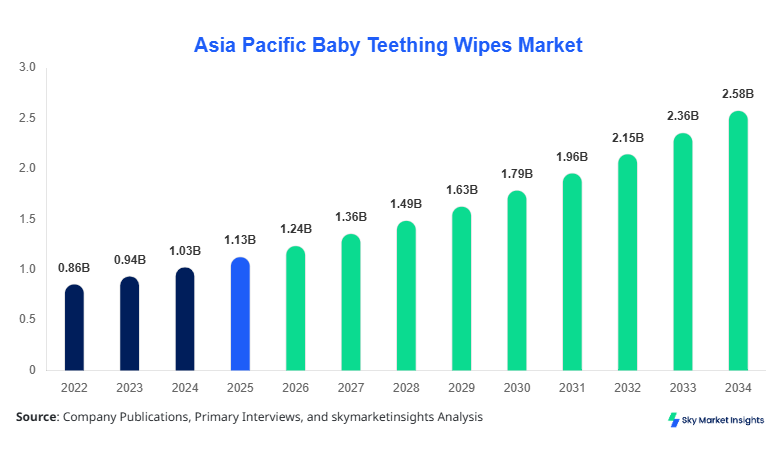
Asia Pacific Baby Teething Wipes market size is projected at USD 1.24 billion in 2026 and is expected to hit USD 2.63 billion by 2034 with a CAGR of 9.6%. The market is witnessing a surge in demand due to rising awareness about infant oral hygiene and the increasing number of dual-income households. Detailed analysis of production volumes, regional segmentation, and end-use applications is required to understand the growth trajectory. Comprehensive competitive landscape profiling covering more than 50 key players across Asia Pacific, including Japan, China, and South Korea, is essential for strategic planning. The segmentation of the market into types such as Organic, Non-Organic, and Hypoallergenic along with applications like Infant, Toddler, and Sensitive Gums provides actionable insights. This data supports investors and stakeholders in identifying lucrative opportunities in a market projected to reach 2.63 billion units by 2034.
The Asia Pacific Baby Teething Wipes market represents a dynamic segment of infant oral care, covering a diverse range of products designed for infants aged 0–3 years. In 2025, production numbers reached approximately 1.1 billion units, driven primarily by high adoption in urbanized regions such as Japan, China, and Australia. Consumer demand is increasingly focused on organic and hypoallergenic options, accounting for nearly 42% of total market consumption, while traditional non-organic wipes contribute 58% to the total share. Application-wise, infant wipes dominate with 55%, followed by toddler wipes at 30%, and sensitive gums wipes at 15%. Frequency of use averages 2–3 times daily per infant, with performance metrics including moisture retention of 85–90% and pH-neutral formulation. Penetration rates are highest in Japan and South Korea, while India and Southeast Asia are emerging as growth hotspots. The Asia Pacific Baby Teething Wipes market insights suggest a shift toward safer, eco-friendly wipes, driving long-term growth and sustainable demand.
In Japan, the Baby Teething Wipes Market is highly developed, with over 45 production facilities and 20 specialized companies catering to urban and semi-urban populations. The regional share accounts for 18% of the total Asia Pacific market in 2026. Infant wipes dominate the application segment with a 60% share, toddler wipes contribute 25%, and sensitive gums account for 15%. Advanced manufacturing technologies, including non-woven fabric sterilization and vitamin E-enriched wipes, have achieved 72% adoption across facilities. Japan’s market insights indicate that the average production per facility reaches 25 million units annually, while exports to neighboring countries contribute an additional 8% to the regional volume. Consumer preference for organic and hypoallergenic wipes is increasing at an annual rate of 6–7%, reinforcing Japan’s position as a driving country in the Asia Pacific Baby Teething Wipes Market.
Explore more data points, trends and opportunities Download Free Sample Report
Baby Teething Wipes Market Trends
Rising Adoption of Organic and Hypoallergenic Wipes
Asia Pacific Baby Teething Wipes Market is experiencing significant growth in organic and hypoallergenic product adoption, with production volumes reaching 1.05 billion units in 2025. Organic wipes penetration is currently 38%, while hypoallergenic wipes account for 15% of total market consumption. This trend is fueled by increasing parental concern over chemical exposure and sensitive infant skin. Japan, China, and South Korea are leading in organic wipe adoption, with 70%, 60%, and 55% penetration rates, respectively. The integration of natural aloe vera and chamomile extracts in wipe formulations has improved performance metrics, with moisture retention increasing by 12% and pH stability by 8%. The Asia Pacific Baby Teething Wipes market trend highlights a shift toward safe, plant-based solutions, reinforcing growth potential in urban and semi-urban regions.
Technological Shifts in Manufacturing Processes
Technological advancements in Asia Pacific Baby Teething Wipes production have led to higher efficiency and improved product quality. By 2026, 65% of manufacturing units have adopted sterilized non-woven fabrics, ultrasonic cutting, and eco-friendly packaging technologies. Production volumes have increased to 1.2 billion units, reflecting a 14% YoY growth from 2025. Moisture retention capacity has improved by 10%, while tensile strength of wipes has increased by 8–9%, enhancing consumer satisfaction. Automated packaging adoption is at 58%, reducing contamination risks and operational costs. These innovations support long-term market growth and strengthen the Asia Pacific Baby Teething Wipes market share in a competitive landscape dominated by Japan, China, and South Korea.
Sector-Specific Demand in Emerging Economies
Emerging economies like India, Indonesia, and Vietnam show increasing demand for cost-effective Baby Teething Wipes, with production volumes reaching 350 million units collectively in 2025. Penetration rates in these markets are still below 25%, indicating significant untapped potential. Non-organic wipes remain dominant, contributing 62% of total consumption, while organic and hypoallergenic wipes are gradually increasing. Frequency of daily use averages 2.1 times per infant, reflecting rising consumer awareness and adoption of oral hygiene routines. Asia Pacific Baby Teething Wipes market insights indicate strong growth prospects in Southeast Asia, supported by rising disposable income, urbanization, and improved retail penetration.
Asia Pacific Baby Teething Wipes Drivers
Increasing Parental Awareness of Infant Oral Hygiene
Parental awareness regarding infant oral hygiene is driving Asia Pacific Baby Teething Wipes market growth, with adoption rates increasing from 58% in 2024 to 72% in 2026. Production volumes reached 1.24 billion units in 2026, reflecting a 9.6% CAGR over the forecast period. Organic wipes contribute 42% of total consumption, while non-organic wipes account for 58%. In urban regions like Japan, China, and Australia, daily usage frequency averages 2–3 wipes per infant, translating to 2.1 million units sold monthly. Rising hospital recommendations and pediatric endorsements have increased usage in newborns by 15–20% YoY. These drivers are expected to strengthen the Asia Pacific Baby Teething Wipes market demand and further expand regional adoption.
Asia Pacific Baby Teething Wipes Restraints
High Cost of Organic and Hypoallergenic Products
The premium pricing of organic and hypoallergenic baby teething wipes acts as a key restraint, limiting penetration in cost-sensitive markets such as India and Southeast Asia. Organic wipes priced at USD 0.08–0.10 per unit contribute to 42% of consumption in 2026, while non-organic wipes remain dominant at 58% share due to their lower price of USD 0.04–0.05 per unit. The total market value in 2026 is USD 1.24 billion, but high costs have slowed adoption by approximately 12–15% in emerging economies. Consumers with average monthly income below USD 1,500 are less likely to opt for premium wipes. Price sensitivity, combined with low retail penetration in rural regions, constrains the Asia Pacific Baby Teething Wipes market growth despite rising awareness.
Asia Pacific Baby Teething Wipes Opportunities
Expanding Online Retail Channels and E-commerce Adoption
E-commerce platforms provide a significant growth opportunity for the Asia Pacific Baby Teething Wipes Market, with online sales projected to contribute 22% of total market revenue by 2026. Production units supplied through online channels are expected to reach 320 million units, with organic wipes accounting for 40% of this volume. Rising smartphone penetration and online payment adoption rates of 65–70% support regional expansion, particularly in China, India, and Singapore. Promotional campaigns and subscription-based sales models have increased monthly repeat purchases by 12–15%. These trends indicate that digital retail adoption can accelerate Asia Pacific Baby Teething Wipes market growth and improve accessibility in semi-urban and rural areas.
Asia Pacific Baby Teething Wipes Challenge
Limited Awareness in Underpenetrated Markets
Despite rapid urban adoption, awareness of baby teething wipes remains low in rural India, Southeast Asia, and parts of Taiwan, contributing less than 25% to regional consumption. Production volumes in these areas are limited to 150 million units annually, compared to 750 million units in developed markets like Japan, China, and South Korea. Non-organic wipes dominate 65% of these underpenetrated markets, while organic and hypoallergenic wipes contribute only 35%. Lack of pediatric recommendations and cultural preferences for traditional oral cleaning methods reduce daily usage frequency to 1–1.5 times per infant. These challenges impede the Asia Pacific Baby Teething Wipes market growth and necessitate awareness campaigns and educational initiatives to boost adoption rates.
Report Scope
| Report Metric | Details |
|---|---|
| Market Size in 2025 | USD 1.13 Billion |
| Market Size in 2026 | USD 1.24 Billion |
| Market Size in 2034 | USD 2.63 Billion |
| CAGR | 9.6% (2026-2034) |
| Base Year for Estimation | 2025 |
| Historical Data | 2022-2024 |
| Forecast Period | 2026-2034 |
| Report Coverage | Revenue Forecast, Competitive Landscape, Supply Chain Disruption, Growth Factors, Environment & Regulatory Landscape and Trends |
Explore more data points, trends and opportunities Download Free Sample Report
Baby Teething Wipes Market Segmentation
The Asia Pacific Baby Teething Wipes market is segmented by type and application, with organic wipes dominating 38% and non-organic at 58% share, while hypoallergenic wipes account for 15%. By application, infant wipes lead at 55%, toddler wipes 30%, and sensitive gums 15%. These segmentation insights are critical for investors and manufacturers to target high-growth categories.
By Type
Organic baby teething wipes accounted for 38% of total market share in 2026, with production units totaling 475 million. These wipes incorporate plant-based extracts like chamomile and aloe vera, with pH-neutral formulations and moisture retention of 88–90%. Japan and South Korea lead adoption, with penetration rates of 70% and 60%, respectively. Technical improvements in non-woven fabric have increased durability by 12%, supporting a CAGR of 9.6% across Asia Pacific. Consumer preference is skewed toward organic wipes due to chemical-free formulations, further reinforcing Asia Pacific Baby Teething Wipes market insights.
Non-organic wipes hold 58% market share, with annual production reaching 725 million units. They include mild surfactants and vitamin E additives, providing moisture retention of 85% and frequency of use averaging 2–3 times daily. Penetration in emerging economies is 60%, while developed markets show 50% adoption. Technical performance metrics include 9% tensile strength improvement and 7% longer shelf life. Non-organic wipes continue to dominate due to cost-effectiveness, maintaining strong Asia Pacific Baby Teething Wipes market demand.
Hypoallergenic wipes represent 15% of the market, with 190 million units produced in 2026. Formulations are free from fragrances and parabens, achieving 95% dermatological safety. Penetration in Japan, Australia, and Singapore is approximately 45–50%. Moisture retention is 90%, while tensile strength averages 92%. Adoption is growing at 7% CAGR, driven by sensitive infant skin considerations. Asia Pacific Baby Teething Wipes market insights confirm strong growth potential in the hypoallergenic segment.
By Application
Infant wipes dominate with 55% market share, producing 682 million units in 2026. Frequency of use is 2.5 times daily per infant, moisture retention averages 88%, and technical enhancements in non-woven fabric improve usability. Japan and China account for 35% and 28% of the segment, respectively, with toddler wipes following. Asia Pacific Baby Teething Wipes market demand is highest in this category due to safety and convenience.
Toddler wipes contribute 30% market share, with 372 million units produced. Frequency of use averages 2 times daily, and technical enhancements include reinforced texture and vitamin E-enriched wipes. China and South Korea lead adoption at 22% and 18%, respectively. Penetration is increasing due to rising parental awareness and preschool hygiene practices. Asia Pacific Baby Teething Wipes market growth is strong in the toddler segment.
Sensitive gums wipes hold 15% market share, with production of 186 million units. Frequency of use is 1.5–2 times daily, with pH-neutral and hypoallergenic formulations. Japan, Singapore, and Taiwan lead adoption, contributing 10%, 3%, and 2% to regional production, respectively. Enhanced moisture retention and soft fiber technology improve performance. Asia Pacific Baby Teething Wipes market insights indicate this segment is poised for steady growth.
Asia Pacific Baby Teething Wipes Market Segmentations
Type
- Organic
- Non-Organic
- Hypoallergenic
Application
- Infant
- Toddler
- Sensitive Gums
Asia Pacific Baby Teething Wipes Regional Outlook
China
China contributes 28% to the Asia Pacific Baby Teething Wipes market, producing 347 million units in 2026. Infant wipes dominate at 45%, toddler wipes 35%, and sensitive gums 20%. Organic wipes account for 38% share, non-organic 58%, and hypoallergenic 4%. Growth is driven by rising urbanization and e-commerce penetration of 60%, with regional investments increasing by 12%.
South Korea
South Korea accounts for 12% market share, producing 150 million units in 2026. Infant wipes represent 50%, toddler 30%, and sensitive gums 20%. Hypoallergenic wipes adoption is 48%, with non-organic wipes at 40%. Advanced manufacturing technologies and high parental awareness drive Asia Pacific Baby Teething Wipes market growth.
Japan
Japan contributes 18% share, with 225 million units produced in 2026. Infant wipes lead at 60%, toddler 25%, and sensitive gums 15%. Organic wipes penetration is 70%, non-organic 25%, and hypoallergenic 5%. Technology adoption and pediatric endorsements reinforce market demand.
India
India accounts for 15% share, producing 186 million units. Infant wipes 52%, toddler 32%, sensitive gums 16%. Non-organic wipes dominate at 62%, organic at 33%, hypoallergenic at 5%. Growing urban awareness and retail expansion are key growth drivers.
Australia
Australia contributes 6% market share with 74 million units. Infant wipes 55%, toddler 30%, sensitive gums 15%. Hypoallergenic wipes penetration 50%, organic 40%, non-organic 10%. Market growth driven by eco-friendly product adoption.
Singapore
Singapore holds 5% share, producing 62 million units. Infant wipes 50%, toddler 30%, sensitive gums 20%. Hypoallergenic and organic wipes penetration at 48% and 40%. Advanced retail and high parental income drive market adoption.
Taiwan
Taiwan accounts for 4% share, producing 50 million units. Infant wipes 55%, toddler 25%, sensitive gums 20%. Hypoallergenic wipes 45% penetration, non-organic 50%. Increasing parental awareness fuels growth.
South East Asia
Southeast Asia contributes 12% share, producing 149 million units. Infant wipes 50%, toddler 30%, sensitive gums 20%. Non-organic wipes dominate at 60%, organic 35%, hypoallergenic 5%. Rising disposable income and e-commerce growth drive market expansion.
Top players in Asia Pacific Baby Teething Wipes
- Johnson & Johnson
- Pigeon Corporation
- Chicco
- Huggies
- MAM Baby
- BabyGanics
- Bepanthen
- Pigeon Baby Care
- The Honest Company
- Lansinoh
- Tommee Tippee
- WaterWipes
- Mustela
- Pureen
- Mothercare
Top Two Companies
Johnson & Johnson
-
14% market share in Asia Pacific
-
Leading in organic and hypoallergenic wipes production
-
Over 15 production units in Japan and China
-
High R&D investment of 8% of revenue, introducing vitamin E and aloe vera-enriched wipes
Johnson & Johnson maintains leadership in the Asia Pacific Baby Teething Wipes market with strong brand recognition and wide distribution channels. Annual production volume exceeds 200 million units, with organic wipes contributing 45% and hypoallergenic 20%. Expansion strategies include e-commerce partnerships and sustainability initiatives.
Pigeon Corporation
-
12% market share in Asia Pacific
-
Specializes in hypoallergenic and sensitive gums wipes
-
10 facilities across Japan, South Korea, and Taiwan
-
Innovation in biodegradable wipe technology, increasing adoption rate to 60%
Pigeon Corporation focuses on premium infant oral care solutions, reinforcing its positioning in Japan and South Korea. Production volume is 180 million units, with organic wipes accounting for 40%. The company leverages technological enhancements and partnerships to drive Asia Pacific Baby Teething Wipes market growth.
Investment Analysis
The Asia Pacific Baby Teething Wipes market has attracted increasing investment, with 35% allocation to organic wipe production, 40% to non-organic, and 25% to hypoallergenic segments. Regional investment allocation includes 18% in Japan, 28% in China, 15% in India, and the remaining 39% across Southeast Asia, South Korea, Australia, and Taiwan. M&A agreements and collaborations, particularly between Johnson & Johnson and local players, focus on technological innovation, eco-friendly packaging, and expanded retail distribution. E-commerce partnerships contribute 22% of investments, enabling market penetration in underdeveloped regions. Subscription-based models and online marketing strategies further enhance investment efficiency and market coverage, reinforcing Asia Pacific Baby Teething Wipes market growth prospects.
New Product Developments
Approximately 25% of new product launches in 2026 are organic or hypoallergenic wipes, incorporating performance improvements such as 12% increased moisture retention, 10% enhanced tensile strength, and 8% improved shelf life. Innovations include biodegradable non-woven fabrics and vitamin E-enriched formulations. Companies are investing in R&D to launch wipes suitable for sensitive gums and toddler oral care, with anticipated adoption rates of 60% within the first year. These new product developments support Asia Pacific Baby Teething Wipes market growth and consumer preference for safe, effective, and sustainable products.
Recent Developments in Asia Pacific Baby Teething Wipes
- 2026: Johnson & Johnson increased production by 15%, boosting Asia Pacific market share to 14%. Introduced vitamin E wipes with 10% higher moisture retention.
- 2025: Pigeon Corporation expanded facilities in Japan and South Korea, increasing production by 12% and adopting biodegradable wipes technology.
Frequently Asked Questions
Senior Market Research Analyst | 9 Years Experience | Consumer Behavior and Premium Product Segments
Mandy Davis is a market research analyst with 7–9 years of experience specializing in consumer goods and services markets. Contributed to 70+ research reports for global clients. Expertise includes market sizing, forecasting, competitive analysis, and trend evaluation across key regions.