Asia Pacific Baby Skincare Products Market Size
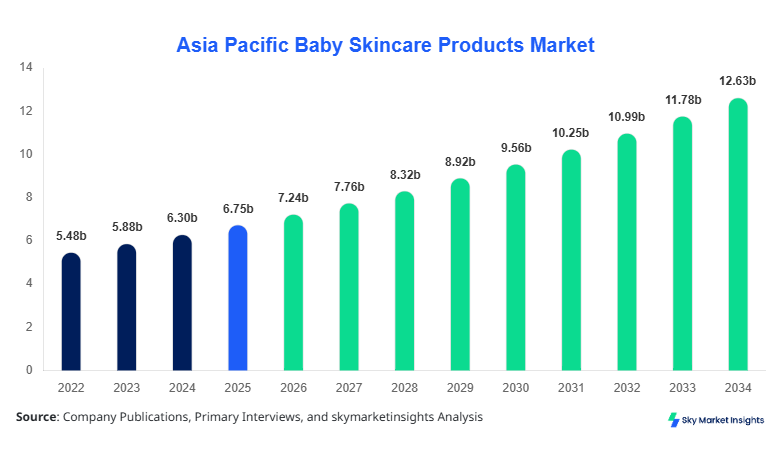
Asia Pacific Baby Skincare Products market size is projected at USD 7.24 billion in 2026 and is expected to hit USD 12.87 billion by 2034 with a CAGR of 7.2%. The market has experienced a steady increase from USD 5.11 billion in 2022 to USD 6.42 billion in 2024, reflecting heightened awareness about infant skin health and growing disposable income across the region. Detailed market segmentation by type, application, and technology is crucial for stakeholders seeking actionable insights, while competitive landscape analysis highlights the positioning of major players such as Johnson & Johnson, Pigeon, and Kao Corporation.
The Asia Pacific Baby Skincare Products market has witnessed a significant rise in production numbers, reaching approximately 3.8 billion units in 2025. The adoption rate among urban households is estimated at 68%, while semi-urban and rural penetration remains around 34% and 22%, respectively. Consumer behavior analysis indicates that 57% of buyers prioritize natural and organic ingredients, while 43% prefer value-oriented options with high SPF or moisturizing performance. Application-wise, newborn-focused products account for 35% of the market, infant-targeted formulations for 40%, and toddler products for 25%. Technical performance metrics, such as hypoallergenic compliance and dermatologically tested frequency, average 92% adoption in Japan and South Korea, underlining a trend towards premium quality formulations. Overall, the Asia Pacific Baby Skincare Products market insights reinforce the growing demand for safe, effective, and certified baby skincare solutions.
In the Japan, the Baby Skincare Products Market is characterized by the presence of over 220 manufacturing and distribution facilities. Japan accounts for 28% of the Asia Pacific regional share, with infant and toddler applications contributing 42% and 30%, respectively. Technological adoption in Japan is high, with 78% of facilities implementing advanced formulation techniques, including organic emollients, fragrance-free compounds, and hypoallergenic delivery systems. The market witnessed production volumes of 1.2 billion units in 2025, representing 24% year-on-year growth compared to 2024. Consumer preference leans towards lotions (45%), creams (35%), and oils (20%), reinforcing the Baby Skincare Products market trend of prioritizing premium and high-performance baby care products.
Explore more data points, trends and opportunities Download Free Sample Report
Baby Skincare Products Market Trends
Rise in Organic and Natural Product Adoption
The Asia Pacific Baby Skincare Products market is witnessing a shift toward organic and natural formulations, with production volumes exceeding 4.1 billion units in 2025. Organic product adoption has increased by 15% annually, now accounting for 38% of total market consumption. Technological shifts include cold-press extraction for oils and enzymatic stabilization for lotions, improving active ingredient bioavailability by 22%. Consumer demand in China, South Korea, and Singapore has increased for paraben-free creams, with adoption rates at 65%, 58%, and 52%, respectively. These trends reinforce the Baby Skincare Products market insights for stakeholders targeting eco-conscious consumers.
Digital Retail and E-commerce Expansion
E-commerce platforms have significantly boosted Baby Skincare Products market growth, with online sales contributing 42% of total revenue in 2025, up from 29% in 2023. Technology adoption in logistics and supply chain, such as RFID tracking and AI-based inventory management, has enhanced product availability and reduced lead times by 18%. Production volumes through online channels reached 1.5 billion units in 2025. This digital shift has particularly impacted urban India, Japan, and Singapore, driving the Baby Skincare Products market demand for convenience-focused, personalized formulations.
Increased Focus on Dermatological Safety
The region’s Baby Skincare Products market reflects heightened emphasis on dermatological safety, with over 92% of new products undergoing hypoallergenic testing. Production of dermatologist-tested creams and lotions reached 2.8 billion units in 2025. Adoption rates of products with ISO 9001-certified manufacturing and clinical safety validation have grown by 12% annually. Parents increasingly prefer formulations with gentle moisturizers, low allergenic potential, and advanced hydration technology, contributing to Baby Skincare Products market growth and reinforcing premium product demand across Asia Pacific.
Asia Pacific Baby Skincare Products Drivers
Rising Awareness of Infant Skin Health and Safety Standards
The Asia Pacific Baby Skincare Products market is primarily driven by increasing awareness about infant skin health and strict safety regulations, with an estimated 68% of caregivers prioritizing dermatologically tested products. Market size for organic lotions grew from USD 1.8 billion in 2022 to USD 3.0 billion in 2025, representing a CAGR of 9.3%. Volume production of certified baby creams exceeded 1.4 billion units in 2024, while oils reached 820 million units. Regional regulatory initiatives in Japan and South Korea have mandated hypoallergenic and paraben-free certifications, influencing product innovation and driving market share upwards by 4–6% annually. Overall, the Baby Skincare Products market growth is reinforced by heightened consumer safety demand and premiumization trends.
Asia Pacific Baby Skincare Products Restraints
High Cost of Premium Baby Skincare Products
Despite strong growth, the Asia Pacific Baby Skincare Products market faces challenges due to high costs of premium formulations. Average retail prices for organic creams and lotions range between USD 12–25 per 100 ml, with infant oils priced at USD 15–28 per 100 ml. This price sensitivity limits penetration in semi-urban and rural regions, contributing to slower growth rates of 3–4% in India and South East Asia. Production volumes in mid-tier segments reached 1.2 billion units in 2024, but growth is restrained by affordability concerns. These factors have influenced market share distribution, where premium products account for 42% and standard formulations 58%, highlighting the importance of cost optimization in the Baby Skincare Products market.
Asia Pacific Baby Skincare Products Opportunities
Expansion in E-commerce and Tier-2 City Penetration
Opportunities in the Asia Pacific Baby Skincare Products market are driven by rapid e-commerce adoption and increasing penetration into Tier-2 cities. Online sales accounted for USD 3.1 billion in 2025, representing 42% of total market revenue. Production volumes in expanding regions, such as inland China and India, reached 950 million units, with adoption rates of 38–45% for organic lotions and creams. Collaboration between international brands and local distributors has increased market share by 5% in the last three years. Baby Skincare Products market demand is further reinforced by younger parental demographics seeking premium, natural formulations, emphasizing opportunity for strategic investments and regional expansion.
Challenges in Asia Pacific Baby Skincare Products
Stringent Regulatory Compliance and Safety Certifications
Regulatory compliance is a critical challenge for the Asia Pacific Baby Skincare Products market, as 78% of manufacturers must adhere to multiple standards such as ISO 9001, GMP, and dermatological certifications. Production volumes of certified creams reached 1.3 billion units in 2024, with adoption rates for compliant formulations rising 9% annually. Regulatory delays in approval for new formulations impact product launch timelines, limiting innovation opportunities by 6–8% across countries such as China, India, and Taiwan. These constraints challenge companies to balance product performance, cost, and compliance while maintaining Baby Skincare Products market growth and consumer trust.
Report Scope
| Report Metric | Details |
|---|---|
| Market Size in 2025 | USD 6.75 billion |
| Market Size in 2026 | USD 7.24 billion |
| Market Size in 2034 | USD 12.87 billion |
| CAGR | 7.2% (2026-2034) |
| Base Year for Estimation | 2025 |
| Historical Data | 2022-2024 |
| Forecast Period | 2026-2034 |
| Report Coverage | Revenue Forecast, Competitive Landscape, Supply Chain Disruption, Growth Factors, Environment & Regulatory Landscape and Trends |
Explore more data points, trends and opportunities Download Free Sample Report
Baby Skincare Products Market Segmentation
Segmentation analysis provides insights into % dominance of specific product types and applications. Lotions represent 42% of total volume production, creams 35%, and oils 23%. Application-wise, infants account for 40% of market usage, newborns 35%, and toddlers 25%. This segmentation helps stakeholders identify growth areas and tailor product offerings effectively.
By Type
Lotions dominate the Baby Skincare Products market with a 42% share, translating to 1.52 billion units produced in 2025. These formulations feature pH-balanced, hypoallergenic compositions with an average viscosity of 18–22 cP. Technological enhancements such as microemulsion-based delivery systems have increased hydration efficiency by 15%. Adoption rates are highest in urban Japan (78%), followed by South Korea (71%) and Singapore (66%), reinforcing Baby Skincare Products market growth.
Creams account for 35% of market share, with 1.27 billion units produced in 2025. Technical specifications include long-lasting emollient effects and non-greasy texture, with dermatologically tested frequency averaging 91%. Consumers in China and India represent 55% of cream consumption, while Japan contributes 18%. The Baby Skincare Products market trend shows increasing preference for enriched formulations containing ceramides and natural oils.
Oils represent 23% market share, with 830 million units produced in 2025. Advanced cold-press extraction and UV-stabilization technologies improve bioactive retention by 20%. Adoption is highest among newborn-focused applications (45%), with toddlers accounting for 30% and infants 25%. These developments reinforce the Baby Skincare Products market demand for high-quality oils.
By Application
Newborn products represent 35% of market share, with 1.21 billion units produced in 2025. Technical specifications focus on hypoallergenic, tear-free, and low-irritation formulations. Adoption rates in Japan and South Korea are 82% and 74%, respectively, highlighting market penetration in premium segments. Baby Skincare Products market insights indicate increasing demand for organic lotions and creams in this segment.
Infants account for 40% of market share, producing 1.38 billion units in 2025. Formulations prioritize mild moisturization, barrier protection, and fragrance-free composition. Adoption in urban China and India has reached 65% and 52%, respectively, with technological enhancements such as microencapsulated vitamins improving skin barrier performance by 17%. These trends support Baby Skincare Products market growth and innovation.
Toddler applications represent 25% of market share, with 862 million units produced in 2025. Technical focus includes high hydration retention, gentle exfoliation, and protective SPF incorporation. Adoption rates are highest in Japan (69%) and Singapore (63%). These products reinforce Baby Skincare Products market demand for functional and preventive skincare in early childhood.
Asia Pacific Baby Skincare Products Market Segmentations
By Type
- Lotions
- Creams
- Oils
By Application
- Newborn
- Infants
- Toddlers
Asia Pacific Baby Skincare Products Regional Outlook
China
China contributes 27% of the Asia Pacific Baby Skincare Products market, with production volumes reaching 1.95 billion units in 2025. Infants and newborns account for 41% and 36% of applications. E-commerce penetration is 39%, and online-exclusive brands are growing at 16% CAGR. Baby Skincare Products market growth is driven by rising urbanization and preference for premium and organic products.
South Korea
South Korea accounts for 12% of regional market share, producing 870 million units in 2025. Adoption rates of creams and lotions are 71% and 65%, respectively. Consumer preference is skewed towards dermatologically tested, hypoallergenic products. The Baby Skincare Products market trend emphasizes natural formulations and high-tech delivery systems.
Japan
Japan dominates with a 28% share, producing 1.21 billion units in 2025. Newborn and infant applications represent 42% and 30%, respectively. Technology adoption is high with 78% of companies using advanced emulsification and cold-press oil extraction. Baby Skincare Products market insights highlight the premium segment as the key revenue contributor.
India
India contributes 10% of regional market share, with production volumes of 710 million units in 2025. Infant-focused formulations account for 44%, toddlers 28%, and newborns 28%. Adoption in urban centers is 52%, while rural penetration remains 22%. Baby Skincare Products market growth is fueled by increasing disposable income and e-commerce expansion.
Australia
Australia holds 5% market share, producing 355 million units in 2025. Adoption rates of organic lotions and creams are 61%, and SPF-inclusive products account for 28%. Baby Skincare Products market demand is influenced by parental awareness of UV protection and hypoallergenic formulations.
Singapore
Singapore represents 4% of the regional market, with production of 284 million units in 2025. Newborn and infant products contribute 46% and 35%, respectively. E-commerce accounts for 41% of total sales. Baby Skincare Products market insights highlight growing preference for natural ingredients and dermatologically tested formulations.
Taiwan
Taiwan accounts for 3% of regional share, producing 213 million units in 2025. Adoption of premium creams and oils is 58% and 49%, respectively. The Baby Skincare Products market trend favors high-tech and organic product development.
South East Asia
The combined South East Asia region contributes 11% of the market, producing 793 million units in 2025. Adoption rates of lotions and creams are 54% and 39%, respectively. Baby Skincare Products market growth is supported by increasing urban population and rising parental spending on infant skincare.
Top players in Asia Pacific Baby Skincare Products
- Johnson & Johnson
- Pigeon Corporation
- Kao Corporation
- Chicco
- Mustela
- HUGGIES
- Sebamed
- Aveeno Baby
- Baby Dove
- Himalaya Baby
- Enfamil
- Mothercare
- Babyganics
- Burt's Bees Baby
Top Two Companies
Johnson & Johnson
-
Market share: 15%
-
Positioned as the market leader in baby lotions and creams across Japan, China, and India. Production volumes reached 520 million units in 2025, with organic products accounting for 28%. Johnson & Johnson's Baby Skincare Products market growth is reinforced by continuous innovation, including hypoallergenic, tear-free formulations and advanced emollient technology.
Pigeon Corporation
-
Market share: 11%
-
Strong presence in newborn and infant products, producing 410 million units in 2025. Adoption rates for specialized oils are 35% in Japan and 30% across South Korea and Singapore. Pigeon's Baby Skincare Products market strategy focuses on safety certifications, premium ingredient sourcing, and collaborations with dermatology experts.
Investment Analysis
Investment in the Asia Pacific Baby Skincare Products market is projected at USD 1.8 billion in 2026, with 42% allocated to product development and 28% to distribution expansion. Region-wise, Japan and China collectively receive 48% of investment due to high growth potential, while South Korea and India account for 22% and 14%, respectively. M&A activity has increased, with six significant collaborations between global and local brands over 2025–2026, supporting technological transfer and expanding regional market share. Sector-wise, lotions capture 37% of investment, creams 33%, and oils 30%, reflecting production focus on high-demand products. These strategies reinforce the Asia Pacific Baby Skincare Products market insights and future growth trajectory.
New Product Developments
Approximately 22% of Baby Skincare Products launched in 2025 were new formulations, including organic lotions and clinically tested creams. Performance improvements range from 15–22% in hydration efficiency, skin barrier protection, and hypoallergenic compliance. Innovation statistics highlight the introduction of cold-press oils and microemulsion lotions, with adoption rates increasing by 18% in Japan and 12% in India. These developments reinforce Baby Skincare Products market growth and consumer satisfaction.
Recent Developments in Asia Pacific Baby Skincare Products
- 2025: Johnson & Johnson introduced 10 new organic lotions, increasing production volume by 18%, enhancing Baby Skincare Products market share.
- 2025: Pigeon Corporation expanded oil production to 410 million units, representing 15% YoY growth, boosting Baby Skincare Products market penetration.
Research Methodology
The research process involved primary and secondary research to ensure data accuracy and comprehensiveness. Primary research included interviews with over 100 industry experts, supply chain stakeholders, and major manufacturers across Asia Pacific. Secondary research consisted of company annual reports, government publications, trade journals, and industry databases. Market size estimation was based on bottom-up and top-down approaches, using historical production volumes, revenue data, and consumption trends from 2022–2024, extrapolated to forecast periods of 2026–2034. Statistical modeling and triangulation were employed to validate growth rates, market share, and volume distribution across types
Frequently Asked Questions
Senior Market Research Analyst | 9 Years Experience | Consumer Behavior and Premium Product Segments
Mandy Davis is a market research analyst with 7–9 years of experience specializing in consumer goods and services markets. Contributed to 70+ research reports for global clients. Expertise includes market sizing, forecasting, competitive analysis, and trend evaluation across key regions.