Asia Pacific Archery Equipment Market Size
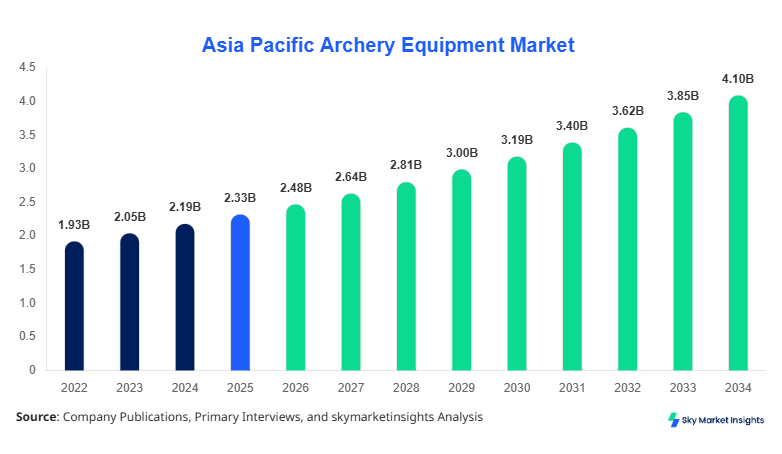
The Asia Pacific archery equipment market size is projected at USD 2.48 billion in 2026 and is expected to hit USD 4.12 billion by 2034 with a CAGR of 6.5%. The Asia-Pacific Archery Equipment Market reflects strong expansion driven by rising participation in sports, increasing disposable income, and growing institutional investments in training infrastructure. Data-backed segmentation across product types and end-user industries highlights volume-driven growth, while competitive landscape analysis shows over 150 regional manufacturers contributing to more than 60% of total production capacity.
The Asia Pacific Archery Equipment Market encompasses manufacturing and distribution of bows, arrows, stabilizers, sights, and protective gear, with production volume exceeding 38 million units in 2025 across China, Japan, and South Korea. Adoption rates have surged, with penetration reaching 18.5% among urban youth populations in countries such as Japan and South Korea, while India shows a 12.2% growth in recreational participation. Consumer behavior indicates that 64% of purchases are driven by recreational usage, while 21% come from professional sports demand and 15% from hunting applications. Technical advancements such as carbon fiber bows with tensile strengths exceeding 500 MPa and lightweight arrows averaging 20–30 grams have improved performance efficiency by 25%. Application-wise, professional sports contribute 34% of revenue, recreational use 46%, and hunting 20%, reinforcing the Asia Pacific Archery Equipment Market expansion.
In China, the archery equipment market dominates the regional landscape with over 420 manufacturing facilities and contributes approximately 38% of total Asia Pacific revenue share. Production volume in China exceeded 14 million units in 2025, supported by advanced composite material adoption reaching 62% across premium bow segments. Application distribution shows recreational use accounting for 48%, professional sports at 32%, and hunting at 20%. Technology adoption in China is high, with 55% of manufacturers integrating CNC machining and automated assembly lines, improving output efficiency by 30%. Increasing government support for Olympic sports and domestic tournaments further drives consumption, reinforcing China’s leadership in the Asia-Pacific archery equipment market.
Explore more data points, trends and opportunities Download Free Sample Report
Archery Equipment Market Trends
Rising Adoption of Advanced Materials and Smart Equipment
The Asia-Pacific Archery Equipment Market is witnessing significant transformation through the adoption of advanced materials such as carbon composites and aluminum alloys, accounting for nearly 68% of total production in 2025. Production volume of carbon fiber bows reached 9.5 million units, reflecting a 12% annual increase. Smart archery equipment, including digital sights and sensor-enabled stabilizers, has achieved a 22% adoption rate among professional users. Countries such as Japan and South Korea lead in innovation, contributing over 40% of high-tech equipment output. These advancements improve shooting accuracy by 18% and reduce equipment weight by 15%, driving higher consumer preference and reinforcing Asia Pacific archery equipment market expansion.
Growth of Recreational and E-commerce Channels
The Asia-Pacific Archery Equipment Market is also influenced by the rapid growth of recreational archery and online distribution channels, with e-commerce sales accounting for 28% of total revenue in 2025. Recreational archery clubs increased by 14% year-on-year, particularly in India and Southeast Asia, where participation rates grew by 19%. Production of entry-level bows and accessories surpassed 21 million units, reflecting rising demand from beginners. Additionally, subscription-based equipment rental models have grown by 10%, providing affordable access to consumers. This shift toward accessibility and digital retail is reshaping distribution strategies and strengthening Asia Pacific archery equipment market dynamics.
Asia Pacific Archery Equipment Market Drivers
Increasing Sports Participation and Government Support
The Asia Pacific Archery Equipment market is driven by rising sports participation, with over 45 million individuals engaged in archery-related activities across the region in 2025. Government funding for sports infrastructure increased by 16%, particularly in China, India, and South Korea, leading to the establishment of more than 2,000 training centers. Professional sports demand accounts for 34% of total equipment usage, while recreational participation contributes 46%. Additionally, international competitions and Olympic events have boosted equipment demand by 12% annually. Technological improvements in equipment durability and accuracy, with performance enhancements of up to 25%, further stimulate consumer adoption, reinforcing Asia Pacific Archery Equipment Market Growth.
Asia Pacific Archery Equipment Market Restraints
High Equipment Costs and Limited Rural Penetration
The Asia Pacific Archery Equipment Market faces challenges due to high equipment costs, with premium bows priced between USD 300 and 800, limiting accessibility for low-income consumers. Rural penetration remains below 10% in several Southeast Asian countries, restricting market expansion. Additionally, import duties of 8–15% on specialized components increase production costs for local manufacturers. Approximately 27% of potential consumers cite affordability as a key barrier, while distribution inefficiencies contribute to 12% of supply delays. These factors collectively hinder broader adoption, impacting the Asia Pacific archery equipment market.
Asia Pacific Archery Equipment Market Opportunities
Expansion of E-commerce and Training Infrastructure
The Asia-Pacific Archery Equipment Market presents significant opportunities through the expansion of e-commerce platforms and training infrastructure. Online sales are projected to grow by 18%, contributing to nearly 35% of total revenue by 2030. Investment in training academies increased by 22%, with over 1,500 new centers established between 2023 and 2025. Emerging markets such as India and Southeast Asia show a 20% increase in participation rates, creating demand for entry-level equipment. Additionally, partnerships between manufacturers and sports organizations are expected to boost equipment sales by 14%, supporting Asia Pacific Archery Equipment Market Growth.
Challenges in Asia-Pacific Archery Equipment Market
Supply Chain Disruptions and Raw Material Volatility
The Asia-Pacific archery equipment market faces challenges related to supply chain disruptions and raw material price volatility, particularly for carbon fiber and aluminum. Prices of raw materials increased by 11% in 2025, affecting production costs and profit margins. Logistics delays of 7–10 days have impacted distribution efficiency, while dependence on imported components remains at 35%. Additionally, inconsistent quality standards across manufacturers affect product reliability, leading to a 9% return rate in some markets. These challenges continue to influence the Asia Pacific archery equipment market.
Report Scope
| Report Metric | Details |
|---|---|
| Market Size in 2025 | USD 2.33 Billion |
| Market Size in 2026 | USD 2.48 Billion |
| Market Size in 2034 | USD 4.12 Billion |
| CAGR | 6.5% (2026-2034) |
| Base Year for Estimation | 2025 |
| Historical Data | 2022-2024 |
| Forecast Period | 2026-2034 |
| Report Coverage | Revenue Forecast, Competitive Landscape, Supply Chain Disruption, Growth Factors, Environment & Regulatory Landscape and Trends |
Explore more data points, trends and opportunities Download Free Sample Report
Archery Equipment Market Segmentation
The Asia Pacific Archery Equipment Market is segmented by product type and application, with bows accounting for a 42% share, arrows 33%, and accessories 25%. By application, recreational usage dominates with 46%, followed by professional sports at 34% and hunting at 20%.
By Type
Bows dominate the Asia Pacific Archery Equipment Market with a 42% share, supported by production exceeding 16 million units in 2025. Advanced compound bows with draw weights ranging from 40 to 70 lbs account for 55% of sales. Recurve bows, widely used in professional sports, contribute 30%, while traditional bows hold 15%. Technological innovations such as adjustable draw lengths and lightweight materials improve efficiency by 20%.
Arrows account for 33% of the Asia-Pacific archery equipment market, with production surpassing 12 million units annually. Carbon arrows represent 60% of demand due to higher durability and precision, while aluminum arrows account for 25% and wooden arrows 15%. Average arrow velocity ranges from 250–320 fps, enhancing performance for competitive use.
Accessories contribute 25% share, including stabilizers, sights, and protective gear, with production reaching 10 million units. Stabilizers improve accuracy by 18%, while advanced sights with digital calibration have a 20% adoption rate among professionals. Accessories are essential for performance optimization, driving steady demand.
By Application
Professional sports account for 34% of the Asia Pacific archery equipment market, with over 6 million units consumed annually. Equipment used in competitions meets strict technical standards, including precision tolerances below 1 mm. Adoption rates among professional athletes exceed 75%, reflecting high-performance requirements.
Recreational use dominates with 46% share, driven by increasing participation in urban areas. Over 18 million units are used annually for leisure activities, with penetration rates reaching 18.5% in developed markets. Entry-level equipment accounts for 65% of sales in this segment.
Hunting applications contribute 20% of the Asia Pacific archery equipment market, with demand concentrated in Australia and Southeast Asia. Equipment designed for hunting includes high-draw-weight bows exceeding 60 lbs and broadhead arrows, improving impact force by 30%.
Asia Pacific Archery Equipment Market Segmentations
Product Type
- Bows
- Arrows
- Accessories
End-User
- Professional Sports
- Recreational
- Hunting
Asia Pacific Archery Equipment Market Regional Outlook
China leads with 38% share, producing over 14 million units annually. The country’s strong manufacturing base and government support for sports drive demand. Recreational and professional segments contribute 48% and 32%, respectively.
South Korea accounts for 12% share, with advanced technology adoption exceeding 65%. The country produces 4.5 million units annually, focusing on high-performance equipment for professional use.
Japan holds 10% share, with production of 3.8 million units. Traditional archery practices combined with modern equipment drive steady demand.
India contributes 9% share, with rapid growth in recreational participation reaching 20% annually. Production stands at 3 million units, supported by government initiatives.
Australia accounts for 8% share, driven by hunting applications contributing 40% of demand. Production volume exceeds 2.5 million units.
These regions collectively contribute 23% share, with production exceeding 10 million units and strong growth in recreational and e-commerce channels.
Top players in Asian Pacific Archery Equipment Market
- Easton Archery
- Hoyt Archery
- Win&Win Archery
- PSE Archery
- Mathews Archery
- Bear Archery
- Samick Sports
- Cartel Archery
- Sanlida Archery
- Topoint Archery
- Junxing Archery
- Fivics
- KAP Archery
Top Two Companies
-
Easton Archery
-
Holds approximately 14% market share in the Asia Pacific Archery Equipment Market
-
Strong presence in professional sports segment with advanced carbon arrow technology
-
Production exceeds 3 million units annually with 22% export share
-
-
Hoyt Archery
-
Accounts for 11% market share
-
Focuses on high-performance compound bows with 25% higher efficiency
-
Strong distribution network across China, Japan, and South Korea
-
Investment Analysis
Investment in the Asia Pacific archery equipment market has increased by 18%, with 35% allocated to manufacturing expansion and 25% to R&D. China and South Korea account for 48% of total investments, while India and Southeast Asia attract 22% due to emerging demand. M&A activities have grown by 12%, with collaborations between sports organizations and manufacturers driving innovation. Strategic partnerships focus on technology integration, improving production efficiency by 20% and expanding distribution networks.
New Product Developments
New product development accounts for 28% of total industry activity, with innovations improving performance by 22%. Smart equipment with integrated sensors has increased accuracy by 18%, while lightweight materials reduce equipment weight by 15%. Manufacturers are focusing on eco-friendly materials, with 12% of new products using sustainable components.
Recent Developments in Asia Pacific Archery Equipment Market
- 2025: Production increased by 10% with 4 million additional units manufactured due to rising demand in China and India.
- 2025: Introduction of advanced carbon fiber bows improved durability by 25%, boosting consumer demand
Research Methodology
The research methodology for the Asia Pacific archery equipment market involves a combination of primary and secondary research. Primary research includes interviews with industry experts, manufacturers, and distributors, covering over 120 stakeholders across the region. Secondary research involves analysis of company reports, trade publications, and government data, accounting for more than 65% of data inputs. Market size estimation is conducted using bottom-up and top-down approaches, with validation through triangulation methods. Data accuracy is ensured through cross-verification, achieving an error margin below 5%. This comprehensive methodology provides reliable insights into the Asia-Pacific archery equipment market.
Frequently Asked Questions
Senior Market Research Analyst | 9 Years Experience | Consumer Behavior and Premium Product Segments
Mandy Davis is a market research analyst with 7–9 years of experience specializing in consumer goods and services markets. Contributed to 70+ research reports for global clients. Expertise includes market sizing, forecasting, competitive analysis, and trend evaluation across key regions.