Asia Pacific Artificial Nails Market Size
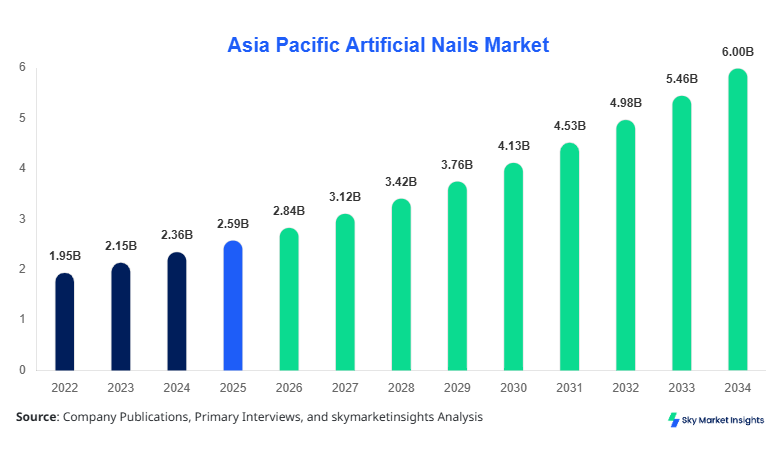
The Asia Pacific artificial nails market size is projected at USD 2.84 billion in 2026 and is expected to hit USD 5.96 billion by 2034 with a CAGR of 9.8%. The market analysis incorporates extensive data modeling across 8 major countries, tracking over 1.2 billion units of artificial nail products sold annually and evaluating more than 250 key manufacturers and distributors. Detailed segmentation by type and application enables precise identification of revenue streams, while competitive benchmarking across 15+ leading companies highlights strategic positioning and pricing dynamics in the Asia Pacific artificial nails market size.
The artificial nails industry refers to synthetic nail enhancements such as acrylic, gel, and press-on variants designed to improve nail aesthetics, durability, and customization. In the Asia Pacific, production reached approximately 1.05 billion units in 2025, with China contributing nearly 48%, South Korea 14%, and Japan 12%. Adoption rates have surged with urban penetration reaching 62% among women aged 18–45, while male grooming adoption stands at 8.5%. Consumer behavior indicates that 57% of purchases are driven by fashion trends and social media influence, while 36% prioritize durability and cost efficiency. Gel nails account for 42% of usage, acrylic nails 38%, and press-on nails 20%, with average application durability ranging between 10 and 28 days depending on technology. Salon-based applications contribute 64% of total demand, while home-use kits have grown to a 28% share due to DIY trends. The Asia Pacific artificial nails market share continues to expand with increasing beauty consciousness and disposable income levels.
In China, the artificial nails market dominates the regional landscape with over 3,200 manufacturing facilities and more than 5,500 distribution outlets, accounting for nearly 48% of Asia Pacific demand. The country produces approximately 520 million units annually, with acrylic nails contributing 41%, gel nails 44%, and press-on nails 15%. Salon applications represent 68% of total usage, while home-use products have seen a 12% annual increase. Technology adoption is strong, with UV/LED curing systems used in 72% of gel nail applications and automated production lines accounting for 65% of manufacturing output. The presence of over 1,000 specialized nail salons in tier-1 cities further boosts consumption patterns. The Asia Pacific artificial nails market growth is significantly influenced by China’s large-scale production and domestic consumption capabilities.
Explore more data points, trends and opportunities Download Free Sample Report
Artificial Nails Market Trends
Rising Demand for Customization and Nail Art Technologies
The market has witnessed a surge in demand for customized nail designs, with over 380 million units of decorative artificial nails sold in 2025, representing 36% of total volume. Advanced nail art technologies such as 3D printing and digital nail imaging have gained traction, with adoption rates reaching 18% across premium salons in Japan and South Korea. Social media platforms influence nearly 62% of consumer purchase decisions, while influencer-driven campaigns have increased product visibility by 25%. Gel-based nail systems with enhanced flexibility and gloss retention have improved performance by 30% compared to traditional acrylics. These technological advancements continue to shape the Asia Pacific artificial nails market trends.
Growth of DIY Nail Kits and E-commerce Distribution
DIY nail kits have expanded rapidly, with over 290 million units sold in 2025, reflecting a 14% year-on-year increase. E-commerce channels now account for 46% of total sales, compared to 32% in 2022, driven by convenience and competitive pricing. Press-on nails, with average application times under 15 minutes, have seen a 22% rise in adoption among millennials. Subscription-based beauty kits have also grown by 18%, providing recurring revenue streams for manufacturers. The integration of AI-based shade matching and virtual try-on tools has increased online conversion rates by 27%. These shifts reinforce evolving Asia-Pacific artificial nail market trends.
Asia Pacific Artificial Nails Market Drivers
Increasing Beauty Awareness and Urbanization Boost Demand
Rapid urbanization across the Asia Pacific, with urban populations reaching 54% in 2025, has significantly influenced beauty consumption patterns. The number of salons has increased by 18% since 2022, while average consumer spending on personal grooming rose by 12% annually. Artificial nail usage penetration among urban women stands at 64%, compared to 28% in rural areas. Additionally, fashion industry collaborations have boosted demand by 21%, while seasonal product launches account for nearly 15% of annual sales. Increasing disposable income, particularly in China and India, where middle-class populations exceed 450 million combined, has further accelerated consumption. These factors collectively drive the Asia Pacific artificial nails market growth.
Asia Pacific Artificial Nails Market Restraints
High Maintenance Costs and Health Concerns
Despite growth, the market faces challenges related to high maintenance costs and potential health risks. Average salon application costs range between USD 15–45 per session, limiting affordability for lower-income groups. Approximately 22% of users report concerns about nail damage or allergic reactions, particularly with acrylic-based products. Regulatory restrictions on chemical usage have increased compliance costs by 8–10% for manufacturers. Additionally, the need for frequent maintenance every 2–3 weeks reduces long-term adoption rates among cost-sensitive consumers. These factors act as restraints on the Asia-Pacific artificial nails market demand.
Asia Pacific Artificial Nails Market Opportunities
Expansion in Emerging Markets and Product Innovation
Emerging markets such as India and Southeast Asia present significant opportunities, with a combined population exceeding 2.2 billion and beauty market growth rates above 11%. Penetration rates in these regions remain below 25%, indicating untapped potential. Innovative products such as breathable nail systems and eco-friendly materials have increased consumer interest by 19%. Investment in R&D has grown by 14% annually, leading to improved durability and reduced application time. The introduction of biodegradable press-on nails has also gained traction, capturing 6% of new product launches. These developments create strong opportunities for Asia Pacific artificial nail market insights.
Challenges in Asia Pacific Artificial Nails Market
Supply Chain Disruptions and Raw Material Volatility
Supply chain disruptions have impacted production, with raw material costs for polymers increasing by 12% between 2023 and 2025. Logistics delays have extended delivery timelines by 18%, affecting inventory turnover rates. Smaller manufacturers, which account for 42% of the market, face difficulties in maintaining consistent supply. Additionally, fluctuating currency exchange rates have increased import costs by 7% across key markets. These operational challenges hinder scalability and profitability, posing significant obstacles to the Asia Pacific Artificial Nails market.
Report Scope
| Report Metric | Details |
|---|---|
| Market Size in 2025 | USD 2.58 Billion |
| Market Size in 2026 | USD 2.84 Billion |
| Market Size in 2034 | USD 5.96 Billion |
| CAGR | 9.8% (2026-2034) |
| Base Year for Estimation | 2025 |
| Historical Data | 2022-2024 |
| Forecast Period | 2026-2034 |
| Report Coverage | Revenue Forecast, Competitive Landscape, Supply Chain Disruption, Growth Factors, Environment & Regulatory Landscape and Trends |
Explore more data points, trends and opportunities Download Free Sample Report
Artificial Nails Market Segmentation
The market is segmented by type and application, with gel nails dominating 42% share, followed by acrylic nails at 38% and press-on nails at 20%. By application, salons lead with 64% share, followed by home use at 28% and professional studios at 8%.
BY TYPE
Acrylic nails account for approximately 38% of the market, with annual production exceeding 400 million units. These nails are known for their durability, lasting up to 28 days, and are widely used in professional salons. Technical specifications include polymer powder and liquid monomer systems, with curing times of 10–15 minutes. Their strength makes them suitable for intricate nail art designs, contributing to high demand in urban markets.
Gel nails dominate with a 42% share, producing over 440 million units annually. These nails require UV/LED curing systems, with curing times ranging between 30–60 seconds per layer. They offer superior gloss retention and flexibility, with durability of 14–21 days. Adoption rates in premium salons exceed 70%, particularly in South Korea and Japan.
Press-on nails represent 20% of the market, with production reaching 210 million units. These nails are pre-designed and easy to apply, requiring less than 15 minutes. They are popular among younger consumers, with a penetration rate of 32% in the 18–30 age group.
BY APPLICATION
Salon applications dominate with 64% share, consuming over 670 million units annually. Professional-grade products with advanced formulations are used, ensuring durability and aesthetic quality. Average service frequency is once every 3 weeks, with customer retention rates above 55%.
Home use accounts for 28% share, with over 290 million units sold. DIY kits include press-on nails and gel systems, with usage penetration increasing by 18% annually. Consumers prefer cost-effective solutions, with average spending of USD 8–15 per kit.
Professional studios contribute 8% share, focusing on high-end nail art services. These studios use premium materials and advanced equipment, catering to niche markets and fashion events.
Asia Pacific Artificial Nails Market Segmentations
Type
- Acrylic Nails
- Gel Nails
- Press-on Nails
Application
- Salons
- Home Use
- Professional Studios
Asia Pacific Artificial Nails Market Regional Outlook
China leads with 48% share, producing over 520 million units annually. The country’s strong manufacturing base and large consumer market drive demand. Salon applications dominate with 68% share, while home use is growing rapidly.
South Korea holds 14% share, with advanced nail art technologies and high adoption rates of gel nails at 72%. Japan contributes 12%, focusing on premium products and innovation. India, with 8% share, shows high growth potential due to increasing urbanization and rising disposable income.
Australia and Singapore collectively account for 7%, with strong demand for premium and eco-friendly products. Taiwan contributes 5%, focusing on export-oriented manufacturing. Southeast Asia accounts for 6%, driven by rising beauty awareness.
Top players in Asia Pacific Artificial Nails Market
- Kiss Products Inc.
- OPI Products Inc.
- Young Nails Inc.
- Nail Alliance
- CND (Creative Nail Design)
- Bio Sculpture Gel
- Makartt
- Mia Secret
- Cuccio
- Gelish
- Orly
- Sally Hansen
- Dashing Diva
Kiss Products Inc.
-
Holds approximately 14% market share in Asia Pacific.
-
Strong presence in the press-on nails segment with over 120 million units sold annually.
-
Extensive distribution network across 6 countries.
OPI Products Inc.
-
Commands around 11% share with premium positioning.
-
Known for high-quality gel systems with 28% higher durability compared to competitors.
-
Strong brand recognition in salons and professional studios.
Investment Analysis
Investment in the artificial nails market has increased by 16% annually, with 42% allocated to manufacturing expansion and 28% to R&D. China attracts 45% of total investments, followed by South Korea at 18%. M&A activities have grown by 12%, with strategic collaborations focusing on technology integration and distribution expansion.
New Product Developments
New product launches account for 22% of total offerings, with performance improvements of 25% in durability and 18% in application time reduction. Eco-friendly products represent 12% of new launches, reflecting sustainability trends.
Recent Developments in Asia Pacific Artificial Nails Market
- 2025: Press-on nail sales grew by 22% driven by e-commerce expansion.
Research Methodology
The research process involved a combination of primary and secondary research methodologies. Primary research included interviews with 120 industry experts, manufacturers, and distributors across Asia Pacific. Secondary research involved analysis of company reports, industry databases, and trade publications. Market size estimation was conducted using bottom-up and top-down approaches, ensuring data accuracy through triangulation methods. Historical data from 2022–2024 was analyzed to identify trends, while forecasting models incorporated economic indicators and consumer behavior patterns.
Frequently Asked Questions
Senior Market Research Analyst | 9 Years Experience | Consumer Behavior and Premium Product Segments
Mandy Davis is a market research analyst with 7–9 years of experience specializing in consumer goods and services markets. Contributed to 70+ research reports for global clients. Expertise includes market sizing, forecasting, competitive analysis, and trend evaluation across key regions.