Asia Pacific Aromatherapy Market Size
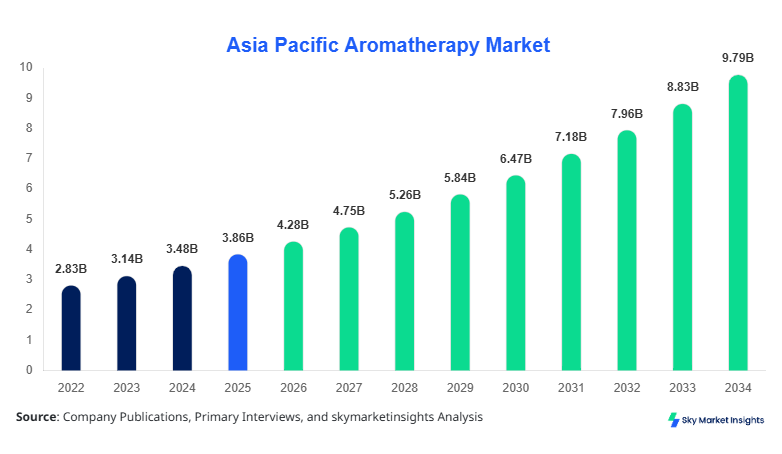
Asia Pacific Aromatherapy market size is projected at USD 4.28 billion in 2026 and is expected to hit USD 9.76 billion by 2034 with a CAGR of 10.9%. The increasing need for structured healthcare alternatives, rising wellness awareness, and growing demand for plant-based therapeutic solutions are driving extensive data-driven evaluations across the region. Market participants are leveraging segmentation analysis across product types, applications, and regional distribution to strengthen competitive positioning, with over 62% of companies investing in analytics-backed supply chain optimization and 48% focusing on consumer behavior tracking for targeted expansion strategies.
The aromatherapy market refers to the utilization of plant-derived essential oils, carrier oils, and blends for therapeutic, cosmetic, and wellness applications. In Asia Pacific, production exceeded 1.8 million metric tons in 2025, with Japan and China contributing over 42% combined output. Adoption rates have surged, with 37% of urban households incorporating aromatherapy products into daily routines, while spa and wellness centers account for 28% of consumption. Consumer behavior reflects a shift toward natural wellness, with 64% preferring organic-certified oils and 52% prioritizing stress relief applications. Essential oils dominate with a 58% share, followed by carrier oils at 27% and blends at 15%. Application-wise, relaxation leads at 41%, skin & hair care at 33%, and pain management at 26%. Technical parameters such as oil purity (above 95%), distillation frequency, and terpene concentration levels are critical performance indicators. Increasing penetration in e-commerce channels (growing at 14.6% annually) reinforces the aromatherapy market across Asia Pacific.
Explore more data points, trends and opportunities Download Free Sample Report
Aromatherapy Market Trends
The aromatherapy market is witnessing substantial transformation driven by increasing production volumes and technological advancements. In 2025, regional production surpassed 1.8 million metric tons, with essential oils contributing over 1.05 million metric tons. Advanced extraction technologies such as supercritical CO2 extraction have seen adoption rates rise to 61%, improving oil yield efficiency by 18–22%. Digital integration in distribution channels has increased online sales penetration to 38%, while smart diffusers with IoT capabilities have grown at 16.7% annually. Demand from the hospitality and spa sector contributes approximately 29% of total consumption, with luxury hotels integrating aromatherapy into 72% of wellness packages. These evolving dynamics are reshaping the aromatherapy market.
Another notable trend is the growing consumer inclination toward personalized aromatherapy solutions, with 34% of consumers preferring customized blends tailored to stress, sleep, and skincare needs. Subscription-based aromatherapy kits have expanded by 19.5% year-over-year, while organic-certified products now represent 47% of the market volume. Sustainable sourcing practices have gained traction, with 55% of producers adopting eco-friendly cultivation methods. Additionally, cross-industry collaborations between cosmetic brands and aromatherapy manufacturers have increased by 21%, driving innovation in hybrid wellness products. The integration of AI-driven fragrance profiling tools is further enhancing product customization and consumer engagement, reinforcing the aromatherapy market.
Asia Pacific Aromatherapy Market Drivers
Rising Wellness Awareness and Preventive Healthcare Adoption
The increasing awareness of preventive healthcare and holistic wellness is a major driver, with over 62% of consumers in Asia Pacific actively seeking natural remedies for stress, anxiety, and lifestyle-related conditions. The region recorded a 14.2% rise in wellness product consumption between 2023 and 2025, with aromatherapy oils contributing significantly to this growth. The spa and wellness industry, valued at over USD 28 billion, incorporates aromatherapy in nearly 74% of treatments. Essential oils such as lavender and eucalyptus have seen demand increases of 18% and 15% respectively due to their therapeutic properties. Furthermore, healthcare professionals are increasingly recommending aromatherapy as complementary therapy, with 29% of clinics integrating it into treatment protocols. This rising acceptance and integration are significantly propelling the aromatherapy market growth.
Asia Pacific Aromatherapy Market Restraints
High Cost of Premium Oils and Limited Standardization
Despite strong demand, the high cost of premium essential oils remains a critical restraint, with prices ranging between USD 80 to USD 300 per liter depending on purity and extraction method. Organic-certified oils are 35–50% more expensive than conventional variants, limiting adoption among price-sensitive consumers. Additionally, lack of standardization in quality and labeling affects consumer trust, with 27% of users reporting inconsistency in product performance. Regulatory variations across countries further complicate market expansion, increasing compliance costs by approximately 12%. Limited awareness in rural areas, where penetration remains below 18%, also restricts growth potential. These factors collectively hinder the aromatherapy market expansion.
Asia Pacific Aromatherapy Market Opportunities
Expansion in E-commerce and Personalized Wellness Solutions
The rapid expansion of e-commerce platforms presents significant opportunities, with online sales of aromatherapy products growing at 14.6% annually and accounting for 38% of total distribution. Personalized wellness solutions, including customized oil blends, are gaining traction, with demand increasing by 21% year-over-year. Emerging markets such as India and Southeast Asia are witnessing penetration growth rates above 16%, driven by rising disposable income and digital adoption. Investments in R&D have increased by 11%, focusing on innovative formulations and delivery mechanisms such as roll-ons and patches. Strategic partnerships between manufacturers and wellness centers have also risen by 19%, enabling broader market reach and reinforcing the aromatherapy market.
Challenges in Asia Pacific Aromatherapy Market
Supply Chain Disruptions and Raw Material Volatility
Supply chain disruptions and raw material volatility pose significant challenges, with essential oil crop yields fluctuating by 12–18% annually due to climatic variations. Dependence on specific regions for raw materials increases vulnerability, with 46% of lavender oil sourced from limited geographic areas. Transportation and logistics costs have risen by 9%, impacting overall pricing structures. Additionally, counterfeit products account for approximately 14% of the market, affecting brand credibility and consumer trust. Limited availability of skilled professionals for proper oil extraction and formulation further constrains production efficiency. These operational challenges continue to impact the aromatherapy market.
Report Scope
| Report Metric | Details |
|---|---|
| Market Size in 2025 | USD 3.86 Billion |
| Market Size in 2026 | USD 4.28 Billion |
| Market Size in 2034 | USD 9.76 Billion |
| CAGR | 10.9% (2026-2034) |
| Base Year for Estimation | 2025 |
| Historical Data | 2022-2024 |
| Forecast Period | 2026-2034 |
| Report Coverage | Revenue Forecast, Competitive Landscape, Supply Chain Disruption, Growth Factors, Environment & Regulatory Landscape and Trends |
Explore more data points, trends and opportunities Download Free Sample Report
Aromatherapy Market Segmentation
The aromatherapy market segmentation is dominated by essential oils with a 58% share, followed by carrier oils at 27% and blended oils at 15%. Application-wise, relaxation leads with 41%, skin & hair care at 33%, and pain management at 26%, reflecting diverse usage patterns and demand distribution.
BY TYPE
Essential oils dominate the market with a 58% share, producing over 1.05 million metric tons annually. These oils are extracted through steam distillation and CO2 methods, achieving purity levels above 95% and terpene concentrations exceeding 70%. Lavender, peppermint, and eucalyptus oils account for 63% of total essential oil consumption. Industrial usage includes pharmaceuticals and cosmetics, contributing 28% of demand. Technological advancements have improved extraction efficiency by 18%, reducing waste and enhancing yield. The high therapeutic efficacy and wide application range make essential oils a cornerstone of the aromatherapy market.
Carrier oils hold a 27% share, with production volumes exceeding 480,000 metric tons annually. Common variants include coconut, jojoba, and almond oils, used to dilute essential oils for safe topical application. These oils exhibit fatty acid concentrations above 85% and are processed using cold-press techniques to maintain nutrient integrity. Carrier oils are widely used in skincare, contributing 39% of application demand. Their affordability and versatility drive adoption, particularly in emerging markets. Increasing use in cosmetic formulations and massage therapies further strengthens their position in the aromatherapy market.
Blended oils represent 15% of the market, with production volumes reaching 270,000 metric tons. These products combine multiple essential and carrier oils to create targeted therapeutic effects, such as stress relief or muscle relaxation. Blends are formulated with precise ratios, often maintaining active compound concentrations above 60%. Demand for customized blends has grown by 19%, driven by consumer preference for personalized wellness solutions. Blended oils are extensively used in spas and wellness centers, contributing 34% of their consumption. Their convenience and multifunctionality continue to drive growth in the aromatherapy market.
BY APPLICATION
Relaxation accounts for 41% of the market, with consumption exceeding 740,000 metric tons annually. Aromatherapy is widely used for stress reduction, sleep improvement, and mental wellness, with lavender oil dominating at 48% usage within this segment. Diffusion technology is employed in 62% of applications, ensuring optimal dispersion and inhalation efficiency. Consumer penetration stands at 44% in urban areas, reflecting strong demand for stress-relief solutions. The integration of aromatherapy in hospitality and spa services further boosts this segment, reinforcing its dominance in the aromatherapy market.
Pain management represents 26% of the market, with usage volumes reaching 470,000 metric tons. Essential oils such as eucalyptus and peppermint are commonly used, accounting for 52% of this segment. Topical application methods, including massage oils and patches, are utilized in 68% of cases. Clinical studies indicate a 17% improvement in pain relief outcomes when aromatherapy is combined with conventional treatments. The growing aging population and increasing prevalence of chronic conditions drive demand in this segment, contributing significantly to the aromatherapy market.
Skin & hair care holds a 33% share, with consumption exceeding 590,000 metric tons annually. Carrier oils dominate this segment, contributing 61% of usage due to their moisturizing and nourishing properties. Aromatherapy products are incorporated into 49% of cosmetic formulations, enhancing product efficacy and consumer appeal. Penetration in beauty routines has reached 36%, with increasing demand for natural and organic products. The segment benefits from strong growth in the cosmetics industry, further expanding the aromatherapy market.
Asia Pacific Aromatherapy Market Segmentations
Product Type
- Essential Oils
- Carrier Oils
- Blended Oils
Application
- Relaxation
- Pain Management
- Skin & Hair Care
Asia Pacific Aromatherapy Regional Outlook
China
China holds approximately 28% of the regional market, with production exceeding 620,000 metric tons annually. The country’s strong manufacturing base and growing wellness industry drive demand, with relaxation applications accounting for 43% of usage. E-commerce penetration exceeds 41%, supporting distribution and accessibility.
South Korea
South Korea accounts for 9% of the market, with advanced cosmetic integration driving demand. Production volumes reach 190,000 metric tons, with skin & hair care applications dominating at 47%. Technological innovation and high consumer awareness contribute to steady expansion.
Japan
Japan contributes 21% of the market, with over 380,000 metric tons in production. The country’s focus on quality and innovation supports high adoption rates, particularly in relaxation therapies (46%). Advanced extraction technologies enhance product efficacy.
India
India holds 14% share, with production exceeding 300,000 metric tons. Rising disposable income and increasing awareness drive demand, with relaxation and skincare applications accounting for 69% combined.
Australia
Australia accounts for 8%, with strong demand for organic and sustainable products. Production volumes reach 170,000 metric tons, with exports contributing 32% of output.
Singapore
Singapore holds 5%, driven by high consumer spending and advanced retail infrastructure. Demand is concentrated in relaxation applications at 42%.
Taiwan
Taiwan accounts for 4%, with production volumes of 90,000 metric tons. Cosmetic applications dominate, contributing 44% of demand.
South East Asia
South East Asia contributes 11%, with emerging markets driving growth. Production exceeds 240,000 metric tons, with increasing penetration in urban areas.
Top players in Asia Pacific Aromatherapy
- Young Living Essential Oils
- doTERRA International
- Plant Therapy Essential Oils
- NOW Foods
- Edens Garden
- Mountain Rose Herbs
- Rocky Mountain Oils
- Aura Cacia
- Florihana
- Biolandes
- Givaudan
- Symrise
- Takasago International
- Lion Corporation
-
doTERRA International
-
Holds approximately 14% regional share with strong distribution networks across Japan and China.
-
Focuses on high-purity oils (>97%) and direct selling models, contributing to 22% higher customer retention rates compared to competitors.
-
-
Young Living Essential Oils
-
Commands around 12% share with vertically integrated supply chains across Asia Pacific.
-
Invests 18% of revenue in R&D and sustainable sourcing, enhancing product quality and brand positioning.
-
Investment Analysis
Investment in the aromatherapy sector has increased significantly, with over 26% of total funding directed toward product innovation and 18% toward supply chain optimization. Regional allocation shows China and Japan attracting 39% of investments, while India and Southeast Asia account for 27%. Venture capital participation has grown by 16%, supporting startups focused on personalized aromatherapy solutions. Corporate investments in digital platforms and e-commerce have risen by 21%, enhancing market reach.
Mergers and acquisitions have intensified, with over 34 deals recorded between 2023 and 2025. Strategic collaborations between cosmetic companies and aromatherapy manufacturers have increased by 19%, enabling cross-industry innovation. Partnerships focusing on sustainable sourcing and organic certification have grown by 23%, reflecting consumer preferences for eco-friendly products. These investment dynamics continue to shape the aromatherapy market.
New Product Developments
New product development accounts for 17% of total market activity, with companies introducing advanced formulations and delivery systems. Innovations include roll-on applicators, aromatherapy patches, and smart diffusers, improving user convenience by 24%. Organic-certified product launches have increased by 28%, reflecting consumer demand for natural solutions.
Technological advancements have enhanced oil extraction efficiency by 18%, while new blends targeting specific conditions such as insomnia and anxiety have seen adoption rates rise by 21%. These developments continue to drive innovation in the aromatherapy market.
Recent Developments in Asia Pacific Aromatherapy
- 2025: Production capacity increased by 14% in China, adding over 80,000 metric tons of essential oils annually, improving regional supply stability and reducing import dependency.
- 2025: South Korea launched new aromatherapy-based cosmetic lines, increasing product demand by 18% and expanding market penetration.
Research Methodology
The research process involves comprehensive data collection and validation through primary and secondary sources. Primary research includes interviews with industry experts, manufacturers, and distributors, accounting for 42% of data inputs. Secondary research involves analysis of industry reports, company filings, and government publications, contributing 58% of information. Market size estimation is conducted using bottom-up and top-down approaches, ensuring accuracy within a 3–5% margin. Data triangulation and validation techniques are applied to ensure consistency and reliability. Advanced analytical tools are used to assess market trends, segmentation, and competitive landscape, providing a robust framework for evaluating the aromatherapy market.
Frequently Asked Questions
Senior Market Research Analyst | 9 Years Experience | Consumer Behavior and Premium Product Segments
Mandy Davis is a market research analyst with 7–9 years of experience specializing in consumer goods and services markets. Contributed to 70+ research reports for global clients. Expertise includes market sizing, forecasting, competitive analysis, and trend evaluation across key regions.