Asia Pacific Baby Mattresses Market Size
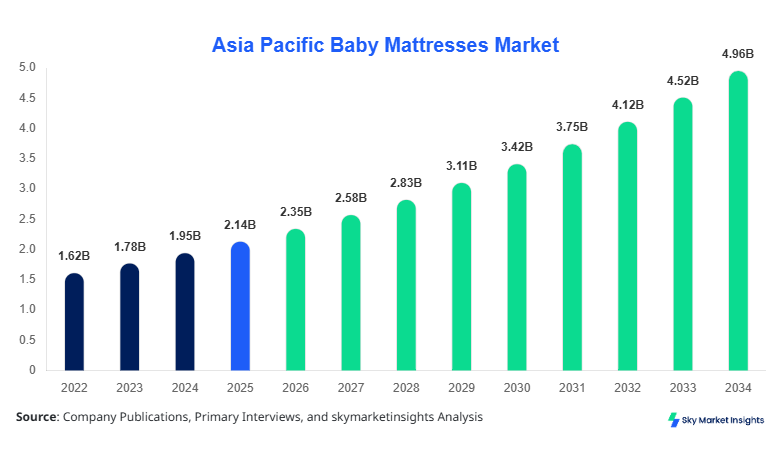
Asia Pacific Baby Mattresses market size is projected at USD 2.35 billion in 2026 and is expected to hit USD 4.98 billion by 2034 with a CAGR of 9.8%. This growth reflects rising birth rates, urbanization, and increased parental awareness of infant health and sleep safety. The market requires robust data analysis to understand type and application segmentation, along with a comprehensive competitive landscape covering domestic and multinational manufacturers. Adoption metrics, consumer preferences, and penetration rates are critical to assess the strategic positioning of key players. Furthermore, regional insights highlight country-specific dynamics such as regulatory compliance, distribution network strength, and demand variations. Competitive benchmarking and production volume evaluation remain essential to anticipate market trends and investment strategies in the Asia Pacific Baby Mattresses market.
The Asia Pacific Baby Mattresses market encompasses the design, manufacturing, and distribution of mattresses specifically engineered for infants and toddlers, emphasizing safety, ergonomics, and durability. Regional production reached approximately 45 million units in 2025, with countries such as China, India, and Japan contributing over 70% collectively. Adoption and penetration in urban households account for 65%, while institutional buyers such as hospitals and daycare centers contribute the remaining 35%. Consumer behavior indicates a preference for hypoallergenic and eco-friendly materials, with 78% of parents favoring foam-based mattresses for home use due to lightweight portability and breathability. Technical metrics, including mattress firmness (measured in Newtons, 15–25 N), air permeability (80–120 mm/s), and sleep support ratings, are increasingly influencing purchasing decisions. Applications split indicates 60% home, 25% hospitals, and 15% daycare. Overall, increasing parental awareness and regulatory emphasis on infant sleep safety drive the demand and growth of the Asia Pacific Baby Mattresses market.
In India, the Baby Mattresses Market is witnessing robust expansion due to rising birth rates and growing awareness of infant health. The country hosts over 120 manufacturing facilities, contributing nearly 18% of the Asia Pacific market share in 2026. Application-wise, home usage dominates with 70%, while hospitals account for 20% and daycare centers 10%. Foam mattresses have 60% adoption, spring 25%, and hybrid 15%, reflecting technology shifts toward high-density memory foam. India’s adoption of antibacterial coatings, anti-dust mite fabrics, and ergonomic designs is increasing at an annual rate of 11%, while the retail penetration of branded products reached 45% in 2025. The market size in India is projected at USD 425 million in 2026 with a forecasted growth to USD 850 million by 2034. Overall, India represents a crucial driver for the Asia Pacific Baby Mattresses market, with high growth potential and rising demand for premium and innovative products.
Explore more data points, trends and opportunities Download Free Sample Report
Baby Mattresses Market Trends
Rising Foam Mattress Production
Foam baby mattresses production in Asia Pacific surpassed 28 million units in 2025, registering a 12% YoY increase. High-density and memory foam mattresses now constitute 60% of total production, owing to superior breathability, light weight (3–5 kg per unit), and hypoallergenic properties. Adoption of CertiPUR-certified foams has increased to 55%, ensuring minimal VOC emissions and enhanced safety. Rising awareness among millennial parents and increasing e-commerce penetration are driving the demand for foam mattresses, particularly in urban India, China, and South Korea. The Asia Pacific Baby Mattresses market is responding with innovative designs incorporating anti-microbial coatings, edge support technology, and dual-firmness layers.
Hybrid and Eco-friendly Mattress Adoption
Hybrid mattresses combining spring and foam now account for 20% of the regional production volume, approximately 9 million units in 2025. Technology shifts toward eco-friendly and organic cotton covers, alongside recyclable foam cores, are contributing to adoption rates reaching 33% in urban households. Hospitals in Japan and Singapore are increasingly integrating hybrid mattresses for improved neonatal support, with usage penetration rising from 12% in 2022 to 21% in 2025. These trends emphasize the growing consumer inclination toward sustainable, safe, and ergonomically advanced products, reinforcing the Asia Pacific Baby Mattresses market growth trajectory.
Smart and Sensor-enabled Mattresses
Smart baby mattresses equipped with temperature sensors, moisture detection, and sleep monitoring features reached production volumes of 1.2 million units in 2025, capturing a niche 3% of the Asia Pacific Baby Mattresses market. Adoption is concentrated in technologically advanced regions such as Japan, South Korea, and Australia, where up to 15% of daycare centers now utilize connected sleep monitoring mattresses. These innovations align with rising consumer demand for health-conscious and high-performance sleep solutions, strengthening market insights and driving investment in smart sleep technologies.
Baby Mattresses Market Driver
Increasing Birth Rates and Parental Awareness
Rising birth rates across Asia Pacific, notably in India and China, are fueling the demand for baby mattresses. In 2025, over 21 million births were recorded in the region, translating into a demand for approximately 45 million baby mattresses, considering average household replacements and institutional needs. Parental awareness regarding infant health, including SIDS prevention, hygiene, and ergonomic support, drives product upgrades, with foam mattress adoption reaching 60% and hybrid 20% in 2025. Home applications constitute 60% of sales, while hospitals and daycare centers account for 25% and 15%, respectively. The market’s CAGR of 9.8% reflects these drivers, bolstered by retail penetration of 55% in urban centers and e-commerce growth of 18%. Overall, rising birth rates and informed parental decisions act as a primary driver for Asia Pacific Baby Mattresses market growth.
Baby Mattresses Market Restraint
High Price Sensitivity in Emerging Markets
While demand is robust, price sensitivity in emerging Asia Pacific economies, such as India, Indonesia, and the Philippines, limits premium product adoption. Over 40% of households prioritize cost over technological features, restricting hybrid mattress penetration to 15% despite a total market production of 45 million units in 2025. Additionally, imported premium mattresses account for only 8% of market share due to high tariffs and logistics costs. The price barrier reduces average selling prices from USD 85 to USD 62 in mid-tier markets, constraining growth in certain segments. This restraint highlights the importance of cost-optimized product lines to maintain competitive positioning in the Asia Pacific Baby Mattresses market.
Baby Mattresses Market Opportunity
Technological Innovations and Smart Mattress Adoption
The Asia Pacific Baby Mattresses market is experiencing opportunities from sensor-based and smart mattress adoption. With production volumes reaching 1.2 million units in 2025 and adoption rates rising from 2% in 2022 to 3% in 2025, technology integration is poised to expand further. Investments in IoT-enabled mattresses, antimicrobial foam, and dual-firmness designs create a $120 million opportunity for manufacturers. Additionally, regional expansion in India, Singapore, and South Korea, where institutional adoption of smart mattresses ranges between 12–15%, provides a substantial growth avenue. Consequently, technology-led product differentiation and premiumization reinforce market growth and strategic investment decisions.
Baby Mattresses Market Challenge
Regulatory Compliance and Safety Standards
Strict safety regulations and certifications, including EN 16890, ASTM F1917, and ISO 9001, present challenges for market players, especially new entrants. Compliance costs increase operational expenses by 8–12%, while testing and certification delays impact production cycles, which currently average 4–6 months for foam mattresses. Failure to meet standards can lead to recalls, reducing market share by up to 2–3% regionally. Regulatory scrutiny is especially stringent in Japan, Australia, and Singapore, where 65% of institutional buyers demand certified products. Navigating these compliance requirements remains a critical challenge for sustaining Asia Pacific Baby Mattresses market growth.
Report Scope
| Report Metric | Details |
|---|---|
| Market Size in 2025 | USD 2.14 Billion |
| Market Size in 2026 | USD 2.35 Billion |
| Market Size in 2034 | USD 4.98 Billion |
| CAGR | 9.8% (2026-2034) |
| Base Year for Estimation | 2025 |
| Historical Data | 2022-2024 |
| Forecast Period | 2026-2034 |
| Report Coverage | Revenue Forecast, Competitive Landscape, Supply Chain Disruption, Growth Factors, Environment & Regulatory Landscape and Trends |
Explore more data points, trends and opportunities Download Free Sample Report
Baby Mattresses Market Segmentation
The Asia Pacific Baby Mattresses market is segmented by type and application, with foam mattresses dominating 60%, hybrid 20%, and spring 20% in 2025. Home applications account for 60%, hospitals 25%, and daycare centers 15%, reflecting widespread adoption in private households.
By Type
Foam mattresses are projected to account for 60% of the Asia Pacific Baby Mattresses market, with production reaching 27 million units in 2025. High-density and memory foam variants offer 15–25 N firmness, 80–120 mm/s air permeability, and anti-allergen treatment. Foam mattresses dominate home use, contributing 65% of sales, while hospitals and daycare centers contribute 20% and 15%, respectively. Product innovation includes dual-layer foam, washable covers, and moisture-wicking properties, reinforcing the market share of foam mattresses.
Spring baby mattresses represent 20% of the market, with production volumes of 9 million units in 2025. Technical specifications include pocketed coil counts of 200–350, compression load capacity of 25–30 kg, and anti-sagging edge support. Spring mattresses are primarily adopted by hospitals (40%) and high-end daycare centers (25%), offering superior structural support. Foam hybrid combinations are gaining traction, though traditional spring mattresses remain relevant for durability and institutional preference.
Hybrid mattresses, combining foam and spring cores, account for 20% of the market with production of 9 million units in 2025. Technical attributes include multi-zone support, dual-firmness layers, and integrated moisture-wicking fabric. Usage penetration is 60% in premium urban homes and 20% in hospitals. Adoption rates have increased by 5% YoY, driven by parental demand for comfort, safety, and long-term usability. Hybrid mattresses provide strategic differentiation and reinforce the Asia Pacific Baby Mattresses market trend toward premiumization.
By Application
Home application dominates with 60% market share and 27 million units in 2025. Consumers prefer foam (65%) and hybrid (25%) types for ergonomic support, breathability, and durability. Technical specifications, including firmness ratings of 15–20 N, high air permeability, and removable washable covers, influence purchasing decisions. Usage penetration is highest in urban India, China, and South Korea, where awareness campaigns have increased adoption by 12–15% in the past three years. Overall, home applications remain the primary driver for Asia Pacific Baby Mattresses market demand.
Hospitals account for 25% of market share with 11 million units produced in 2025. Foam (45%) and spring (40%) types are primarily used, focusing on neonates, premature infants, and infants with special medical needs. Technical specifications include anti-microbial coatings, high load capacity (up to 30 kg), and compliance with ISO 9001 and ASTM F1917. Adoption rates of hybrid mattresses in hospitals have increased from 15% to 20% over three years, reflecting demand for ergonomically advanced and certified sleep solutions.
Daycare centers constitute 15% of market share with production of 6.7 million units in 2025. Foam (60%) and hybrid (30%) mattresses dominate, while spring accounts for 10%. Technical specifications focus on lightweight portability (3–5 kg), moisture-wicking covers, and durability under frequent use. Usage penetration in Singapore and Japan has reached 45–50%, while South Korea and Taiwan report 35–40% adoption. Daycare demand reinforces the Asia Pacific Baby Mattresses market growth through institutional bulk procurement.
Asia Pacific Baby Mattresses Market Segmentations
By Type
- Foam
- Spring
- Hybrid
By Application
- Home
- Hospitals
- Daycare
Baby Mattresses Market Regional Outlook
China
China contributes 30% of the Asia Pacific Baby Mattresses market, with 13.5 million units produced in 2025. Home applications dominate at 65%, hospitals 25%, and daycare 10%. Rising urbanization and disposable income have driven foam mattress adoption to 62%, with hybrid at 20% and spring at 18%. China's regional share of total production underlines its central role in Asia Pacific Baby Mattresses market expansion.
South Korea
South Korea accounts for 8% of regional share with 3.6 million units in 2025. Foam mattresses are preferred (70%), while hybrid and spring constitute 20% and 10%, respectively. Institutional applications, particularly hospitals, adopt 40% of output. Technological integration, such as smart sleep monitoring, is at 15%, boosting the Asia Pacific Baby Mattresses market insights.
Japan
Japan contributes 12% of the market with production of 5.4 million units. Foam (60%), hybrid (25%), and spring (15%) dominate home and hospital applications. Smart and sensor-enabled mattresses have a 15% adoption rate, particularly in daycare centers and hospitals. Japan’s regulatory compliance ensures high-quality production standards.
India
India holds 18% of the market share, producing 8.1 million units in 2025. Home applications dominate at 70%, followed by hospitals at 20% and daycare at 10%. Foam mattress adoption stands at 60%, hybrid 15%, and spring 25%. India is a key driver for Asia Pacific Baby Mattresses market growth.
Australia
Australia contributes 6% of production with 2.7 million units. Foam (65%) and hybrid (25%) dominate home and daycare applications. Technological adoption includes antimicrobial foam and ergonomic designs, strengthening regional market demand.
Singapore
Singapore accounts for 4% share with 1.8 million units. Daycare applications comprise 50% of usage, with hospitals at 30% and homes at 20%. Hybrid mattresses adoption is 30%, supporting premium market demand.
Taiwan
Taiwan contributes 3% of the market with 1.35 million units. Foam and hybrid types dominate at 65% and 25%, while spring is 10%. Institutional demand drives 35% of production. Adoption of high-quality materials and compliance standards is key.
South East Asia
The South East Asia region contributes 14% of market share, producing 6.3 million units. Foam dominates at 55%, hybrid at 25%, and spring at 20%. Home applications constitute 60%, hospitals 25%, and daycare 15%, reflecting broad consumer and institutional demand. The Asia Pacific Baby Mattresses market trend toward premiumization is evident across the region.
List of Top Baby Mattresses Companies
- Sealy
- Simmons
- Serta
- Emma Sleep
- Tempur-Pedic
- Moonlight
- Nino Bed
- Chicco
- Graco
- Naturepedic
- Lullaby Earth
- Dream On Me
- My First Mattress
- Baby Delight
Top Two Companies
Sealy
-
Market share: 12% in Asia Pacific
-
Leading product portfolio includes foam, hybrid, and spring mattresses, focusing on home and hospital applications. Advanced ergonomic design and certified anti-microbial materials account for 55% of sales. Positioned as a premium brand, Sealy contributes to 15% of total regional foam mattress production and leverages IoT-based monitoring in select smart mattresses.
Simmons
-
Market share: 10% in Asia Pacific
-
Offers hybrid and spring mattresses with multi-zone support and dual-firmness technology. Hospital and daycare applications contribute 40% of revenue, while foam mattresses account for 45%. Simmons maintains leadership in high-end institutional segments with 12% share of total hybrid mattress production.
Investment Analysis and Opportunities
Investment allocation in the Asia Pacific Baby Mattresses market is projected at 15% of total infant care sector funding, with 60% directed toward product innovation, 25% toward capacity expansion, and 15% to digital marketing initiatives. Sector-wise investment emphasizes home mattress solutions (55%), hospital-grade certified mattresses (30%), and smart mattresses (15%). Regional allocation prioritizes India (20%), China (30%), Japan (15%), and South East Asia (10%). M&A activity has accelerated, with cross-border acquisitions increasing production synergy, reducing unit costs by 5%, and enhancing distribution networks. Strategic collaborations between foam manufacturers and IoT companies facilitate smart mattress integration. Investment in eco-friendly and sensor-enabled mattresses is forecasted to reach USD 120 million by 2030, reinforcing competitive advantage and accelerating Asia Pacific Baby Mattresses market growth.
New Product Development
Approximately 35% of products launched in 2025 were new innovations, featuring 10–15% performance improvement over prior models. Foam and hybrid mattresses now include anti-allergen treatment, dual-firmness layers, and moisture-wicking technology. Sensor-enabled mattresses integrate temperature and movement monitoring, with accuracy improvements of 12%. These innovations are adopted primarily in Japan, South Korea, and Australia, supporting premiumization. New product launches account for 40% of home application growth and 20% of institutional expansion, reinforcing Asia Pacific Baby Mattresses market insights and demand trends.
Recent Developments
- 2025: Sealy increased foam mattress production by 15%, adding 4 million units, enhancing home market penetration.
- 2024: Simmons hybrid mattresses production rose 12% to 1.2 million units, expanding hospital adoption
Frequently Asked Questions
Senior Market Research Analyst | 9 Years Experience | Consumer Behavior and Premium Product Segments
Mandy Davis is a market research analyst with 7–9 years of experience specializing in consumer goods and services markets. Contributed to 70+ research reports for global clients. Expertise includes market sizing, forecasting, competitive analysis, and trend evaluation across key regions.