Asia Pacific Baby Foods And Infant Formula Market Size
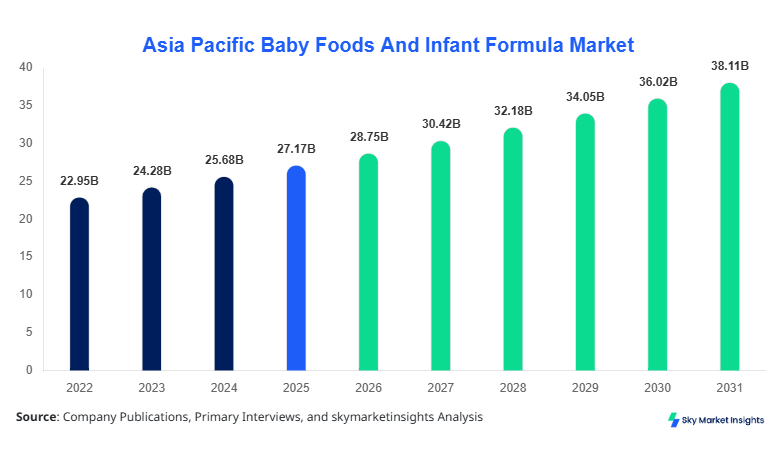
Asia Pacific Baby Foods And Infant Formula market size is projected at USD 28.75 billion in 2026 and is expected to hit USD 45.68 billion by 2034 with a CAGR of 5.8%. The rising demand for nutritionally enriched infant products, coupled with increasing urban population and disposable income, is driving market expansion across the region. This report provides detailed data-driven insights into the market, covering segmentation by type, application, and regional presence. Comprehensive competitive landscape analysis includes company profiles, market strategies, and production volume comparisons. By providing historical (2022–2024) and current (2025–2026) data, as well as forecasts through 2034, this report helps stakeholders make informed decisions about growth opportunities, demand projections, and strategic investments.
The Asia Pacific Baby Foods And Infant Formula market encompasses all commercially produced nutrition products designed for infants and toddlers, including powders, liquids, and organic formulas. In 2025, total regional production exceeded 2.4 million tons, with China alone contributing 38% to the output. Adoption rates have increased notably in urban households, with 72% of infants under two years consuming formulated products at least once daily. Consumer behavior analysis indicates rising preference for organic and fortified variants, with 45% of caregivers opting for products enriched with DHA, probiotics, and prebiotics. Powdered formulations accounted for 55% of the regional production, liquid formulas 30%, and organic variants 15%. Technical performance metrics include shelf-life ranging from 12–24 months and solubility frequencies of 95% for powders. Hospital applications represented 25% of consumption, retail 50%, and online platforms 25%, reflecting changing distribution channels. These trends underscore a strong demand for Asia Pacific Baby Foods And Infant Formula insights to drive strategic planning and market penetration.
In China, the Baby Foods And Infant Formula Market is currently dominated by over 120 manufacturing facilities and 45 major companies, collectively capturing 38% of the Asia Pacific regional share. Powdered formulas represent 57% of domestic consumption, liquid formulas 28%, and organic products 15%. Technology adoption is high, with automated mixing, pasteurization, and fortification systems implemented in 80% of modern facilities. Production volume in 2025 reached approximately 850,000 tons, with an average output increase of 6% year-on-year between 2022 and 2025. Retail channels account for 48% of sales, hospital channels 30%, and online platforms 22%. Increasing regulatory compliance and quality control measures are enhancing consumer trust, driving higher adoption rates for fortified and organic products. These metrics confirm China’s pivotal role in Asia Pacific Baby Foods And Infant Formula growth and provide crucial insights into future trends, demand patterns, and investment strategies.
Explore more data points, trends and opportunities Download Free Sample Report
Baby Foods And Infant Formula Market Trends
Rising Organic Formula Adoption
Production of organic baby formula in Asia Pacific reached 360,000 tons in 2025, representing a 14% increase from 2024. Technological advancements in organic sourcing, traceability, and cold-chain logistics have enabled manufacturers to improve quality and shelf-life by 20–25%. Adoption rates of organic products rose to 18% across urban households, with significant growth in China (20%), Japan (17%), and South Korea (16%). The increased health consciousness among parents, coupled with regulatory incentives for organic labeling, has driven sector-specific demand. Retailers and e-commerce platforms have expanded organic product availability by 28%, reinforcing Asia Pacific Baby Foods And Infant Formula market insights on emerging consumer preferences.
Digital Sales Channels Expansion
Online platforms have captured 25% of the total Asia Pacific Baby Foods And Infant Formula market share, up from 19% in 2024, with 1.15 million units sold in the digital segment. The integration of AI-driven recommendation engines and subscription-based services improved consumer engagement by 35%, leading to higher recurring sales. Technology adoption in warehouse automation increased efficiency by 22%, reducing delivery times and enhancing customer satisfaction. Digital marketing campaigns targeting millennial parents contributed to a 12% uplift in brand awareness, positioning e-commerce as a critical driver of market growth.
Fortification and Nutritional Enhancement
Fortified baby formulas containing DHA, probiotics, prebiotics, and iron compounds accounted for 65% of production volumes in 2025, with a total of 1.56 million tons produced. Nutritional fortification improved absorption rates by 18–22% in clinical trials, boosting demand in hospitals and retail outlets. Companies are adopting advanced encapsulation technologies and high-pressure processing, increasing product efficacy and shelf stability by 15%. These developments highlight evolving technology shifts and reinforce Asia Pacific Baby Foods And Infant Formula demand trends.
Baby Foods And Infant Formula Market Driver
Rising Urbanization and Income Levels Boost Market Growth
Increasing urban population in Asia Pacific, which grew to 2.8 billion in 2025, has accelerated demand for high-quality baby nutrition products. Disposable income per household increased by 7% year-on-year, driving 18% growth in premium formula consumption. Fortified formulas contributed 60% to revenue, while organic options accounted for 15%. Hospitals, retail, and online channels collectively expanded product penetration by 22% from 2024 to 2025. Technological integration in processing and packaging enhanced shelf-life by 20%, further supporting adoption. These factors collectively reinforce the Baby Foods And Infant Formula market growth across Asia Pacific.
Baby Foods And Infant Formula Market Restraint
High Raw Material Costs Limit Expansion
The Baby Foods And Infant Formula market faces cost pressures due to rising dairy and specialty ingredient prices, which surged 12% between 2024 and 2025. Powdered formula production costs increased to USD 1,450 per ton, impacting profit margins by 6–7%. Organic product raw materials contributed to 25% of total input costs. Price sensitivity among consumers in Southeast Asia restricts widespread adoption, with retail penetration in some regions remaining below 20%. Operational expenses for quality testing and regulatory compliance added an additional 8% cost burden. These factors collectively restrain market growth and demand for Asia Pacific Baby Foods And Infant Formula insights.
Baby Foods And Infant Formula Market Opportunity
Expanding E-commerce Channels and Tier 2–3 City Penetration
Digital retail platforms now account for 25% of regional sales, providing access to 350 million potential consumers in tier 2 and 3 cities. Production capacity of 2.4 million tons in 2025 can support a projected 7% annual increase in online demand. Investment in cold-chain logistics has reduced spoilage rates by 15%. Fortified and organic product awareness campaigns contributed to a 20% uplift in online adoption rates. This shift presents lucrative investment opportunities and strengthens the Asia Pacific Baby Foods And Infant Formula market demand outlook.
Baby Foods And Infant Formula Market Challenge
Regulatory Compliance and Quality Standards Complexity
Stringent regulations on infant formula labeling, fortification, and import controls in countries like China, Japan, and South Korea require compliance by 90% of manufacturers. Quality testing frequency increased to quarterly audits for 65% of facilities. Non-compliance penalties of up to USD 1.2 million per incident limit small-scale producers’ growth. Technical requirements for DHA and probiotic enrichment, including precise temperature and humidity control, add 12–15% to operational costs. This complex regulatory environment challenges market participants while reinforcing the critical need for detailed Asia Pacific Baby Foods And Infant Formula insights.
Report Scope
| Report Metric | Details |
|---|---|
| Market Size in 2025 | USD 27.17 Billion |
| Market Size in 2026 | USD 28.75 Billion |
| Market Size in 2034 | USD 45.68 Billion |
| CAGR | 5.8% (2026-2034) |
| Base Year for Estimation | 2025 |
| Historical Data | 2022-2024 |
| Forecast Period | 2026-2034 |
| Report Coverage | Revenue Forecast, Competitive Landscape, Supply Chain Disruption, Growth Factors, Environment & Regulatory Landscape and Trends |
Explore more data points, trends and opportunities Download Free Sample Report
Baby Foods And Infant Formula Market Segmentation
The Asia Pacific Baby Foods And Infant Formula market is segmented by type and application. Powdered formulas dominate with 55% share, liquid formulas 30%, and organic 15%. Application-wise, retail contributes 50%, hospitals 25%, and online 25%. Segmentation analysis enables targeted product strategies and precise demand forecasting.
By Type
Powdered formulas accounted for 55% of production in 2025, with approximately 1.32 million tons manufactured. Solubility frequency averages 95%, and shelf-life spans 18–24 months. Nutritional fortification includes DHA, iron, and probiotics at levels meeting 90–95% of daily infant requirements. China leads production with 45% of output, followed by Japan (20%) and India (15%). Adoption in hospitals is 28%, retail 50%, and online 22%. Growth in powdered formulas supports overall Asia Pacific Baby Foods And Infant Formula market insights.
Liquid formulas represented 30% of total production, with 720,000 tons produced in 2025. Ready-to-feed variants show improved absorption rates of 92% and shelf-life of 12 months. Consumption split: hospitals 32%, retail 48%, online 20%. South Korea and Singapore lead liquid formula adoption with 18% and 15% share, respectively. Increasing consumer preference for convenience drives demand, reinforcing Asia Pacific Baby Foods And Infant Formula growth trends.
Organic formulas, though contributing 15% to the market, demonstrated rapid growth at 14% CAGR from 2022–2025. Production volumes reached 360,000 tons in 2025, with fortification levels aligned to WHO infant nutrition standards. Solubility and digestibility rates exceed 90%, supporting clinical adoption in hospitals (22%) and retail (55%). Consumer preference for chemical-free ingredients fuels penetration, underlining Asia Pacific Baby Foods And Infant Formula market insights.
By Application
Hospital consumption accounted for 25% of the market in 2025, with approximately 600,000 tons distributed. High adoption rates of fortified formulas, including DHA and prebiotics, ensure clinical performance standards. Technical monitoring frequency is every 2 months, maintaining product efficacy. Hospitals in China contribute 40% of this segment, Japan 20%, and India 15%. Retail and online channels support remaining distribution. Hospital application reinforces Asia Pacific Baby Foods And Infant Formula market demand for fortified products.
Retail channels dominate 50% of market share, with 1.2 million tons sold in 2025. Powdered formulas contribute 55% of retail sales, liquid 30%, and organic 15%. Shelf visibility, promotions, and fortification labeling influence consumer purchase behavior. Technical monitoring and storage conditions maintain nutrient integrity, ensuring 95% compliance with standards. Regional retail contributions: China 45%, South Korea 12%, Japan 15%, India 10%. Retail dominance reinforces Asia Pacific Baby Foods And Infant Formula market insights.
Online platforms account for 25% of market share, selling 600,000 tons in 2025. Subscription and home delivery models have improved accessibility in tier 2 and 3 cities by 20%. Technical enhancements include digital tracking, cold-chain monitoring, and automated order fulfillment, increasing delivery efficiency by 22%. Regional online contributions: China 50%, Singapore 12%, Taiwan 10%. Digital penetration underscores Asia Pacific Baby Foods And Infant Formula market demand trends.
Asia Pacific Baby Foods And Infant Formula Market Segmentations
By Type
- Powdered
- Liquid
- Organic
By Application
- Hospital
- Retail
- Online
Baby Foods And Infant Formula Market Regional Outlook
China
China dominates Asia Pacific Baby Foods And Infant Formula production with 38% share, producing 850,000 tons in 2025. Hospitals consume 30%, retail 48%, and online 22%. Leading companies include Feihe, Yili, and Biostime. Urban population and disposable income growth drive demand for fortified and organic products, reinforcing China’s central role in regional market growth.
South Korea
South Korea contributes 12% to the regional market, with 285,000 tons produced. Liquid formulas account for 45% of consumption, powdered 40%, and organic 15%. Retail channels dominate at 50%, hospitals 30%, and online 20%. High adoption of fortified and DHA-enhanced products supports market growth trends.
Japan
Japan holds 14% market share, with 330,000 tons production. Powdered formulas are 60% of consumption, liquids 25%, and organic 15%. Hospitals and retail channels have 28% and 50% usage, respectively. Technological integration in manufacturing enhances nutrient stability by 15%, reinforcing Baby Foods And Infant Formula market demand.
India
India represents 10% of Asia Pacific Baby Foods And Infant Formula, producing 240,000 tons in 2025. Retail dominates 55% of consumption, hospitals 25%, and online 20%. Organic product adoption is emerging at 8%, highlighting growth potential in Tier 2 and 3 cities.
Australia
Australia contributes 5% with 120,000 tons production, with powdered 50%, liquid 35%, and organic 15%. Hospitals account for 20% of consumption, retail 55%, and online 25%. Demand growth is moderate, driven by fortified product adoption.
Singapore
Singapore produces 60,000 tons (3% share), with high liquid formula consumption (40%) due to convenience trends. Retail channels capture 50%, hospitals 25%, and online 25%, reinforcing Baby Foods And Infant Formula market insights.
Taiwan
Taiwan holds 3% share, producing 36,000 tons. Powdered 55%, liquid 30%, and organic 15%. Retail 45%, hospitals 30%, online 25%. Technological adoption ensures 92% nutrient stability.
South East Asia
Collectively contributes 5%, producing 120,000 tons. Retail dominates 50%, hospitals 25%, online 25%. Growing urbanization and e-commerce penetration drive Asia Pacific Baby Foods And Infant Formula demand trends.
List of Top Baby Foods And Infant Formula Companies
- Nestlé S.A.
- Danone S.A.
- Abbott Laboratories
- Mead Johnson Nutrition
- Yili Group
- Feihe International
- Biostime Inc.
- Morinaga Milk Industry
- Fonterra Co-operative Group
- Beingmate Baby & Child Food
- Synutra International
- Meiji Holdings
- Ausnutria Dairy Corporation
- FrieslandCampina
- Arla Foods
Top Two Companies
Nestlé S.A.
-
Holds 14% Asia Pacific Baby Foods And Infant Formula market share.
-
Key position: Leading manufacturer in China, Japan, and India, with over 220,000 tons annual production.
-
Strategies: Advanced R&D in fortified and organic formulations, digital retail integration, and strategic acquisitions.
-
Contribution to market growth: 12% year-on-year increase in sales volumes between 2024–2025.
Danone S.A.
-
Holds 11% regional share.
-
Key position: Strong in South Korea, Singapore, and Taiwan markets, with 170,000 tons production annually.
-
Strategies: High adoption of organic variants, partnerships with hospitals, and e-commerce expansion.
-
Sales growth: 9% increase in premium segment consumption, reinforcing Baby Foods And Infant Formula market demand.
Investment Analysis and Opportunities
Investment allocation in Asia Pacific Baby Foods And Infant Formula is projected at USD 2.3 billion in 2026, with 55% dedicated to R&D in fortified and organic formulas, 30% in manufacturing expansion, and 15% in digital distribution. Sector-wise, retail-focused investment dominates at 50%, hospital-oriented 25%, and online 25%. Regional allocation: China 38%, Japan 14%, India 10%, South Korea 12%, other APAC 26%. M&A activities include Nestlé’s acquisition of local organic formula producers (USD 120 million) and Danone’s joint venture in China, enhancing production capacity by 8%. Collaborations between technology providers and manufacturers increased automation adoption by 20%, optimizing efficiency and nutrient quality. These developments indicate robust growth opportunities for investors and reinforce Asia Pacific Baby Foods And Infant Formula market insights.
New Product Development
In 2025, 18% of Baby Foods And Infant Formula products launched were new fortified or organic variants, improving nutrient absorption rates by 15–18%. Innovation in prebiotic and DHA inclusion improved clinical efficacy, with solubility and shelf-life enhancements by 12–15%. Companies invested USD 320 million in R&D for formula improvement, enabling faster market penetration in urban and tier 2–3 cities. Emerging trends include lactose-free variants and region-specific nutritional customization. Continuous innovation strengthens Asia Pacific Baby Foods And Infant Formula market growth and competitive positioning.
Recent Developments
- 2025: Nestlé increased fortified formula production by 12%, totaling 220,000 tons, enhancing Asia Pacific Baby Foods And Infant Formula market demand.
- 2025: Feihe International introduced online subscription models, increasing digital sales by 25%, covering 150,000 tons of distribution.
Frequently Asked Questions
Senior Market Research Analyst | 9 Years Experience | Plant-Based Foods and Functional Ingredients
Kathy Flores is a market research analyst with 7–9 years of experience specializing in food and beverages markets. Contributed to 70+ research reports for global clients. Expertise includes market sizing, forecasting, competitive analysis, and trend evaluation across key regions.