Asia Pacific Baby Diaper Market Size
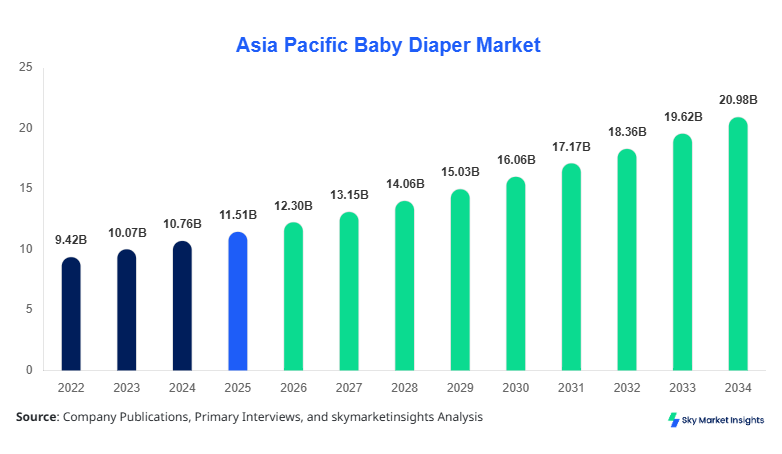
Asia Pacific Baby Diaper market size is projected at USD 12.3 billion in 2026 and is expected to hit USD 21.7 billion by 2034 with a CAGR of 6.9%. The market size reflects an increasing demand for advanced hygiene products across newborns, infants, and toddlers. Detailed market data and insights are essential to understand segmental performance, production volume, and regional contributions. A comprehensive competitive landscape analysis, including company market share, technological advancements, and strategic initiatives, will enable stakeholders to identify growth opportunities and market gaps. Segmentation by type and application, combined with country-wise market dynamics, provides a robust framework to forecast growth trends and size estimates.
The Asia Pacific Baby Diaper market encompasses the production, distribution, and sales of disposable, cloth, and biodegradable diapers designed for infants and toddlers. In 2025, Asia Pacific produced approximately 72 billion units of baby diapers, accounting for nearly 48% of the global output. Adoption of disposable diapers has surged to 62% of the total market, driven by urbanization and dual-income household penetration, while cloth diapers contribute around 28%, and biodegradable diapers 10%. Consumer behavior indicates a rising preference for high-absorbency diapers with leak-proof technology and soft cotton layers, reflecting increased awareness of infant skin health. Frequency of diaper usage ranges from 5–8 units per day per infant, with performance metrics including absorption capacity of 250–350 ml and moisture retention rates exceeding 90%. In terms of application, newborns represent 35% of demand, infants 40%, and toddlers 25%. The Asia Pacific Baby Diaper market trend highlights increasing eco-conscious consumer preferences and technological innovations in diaper performance, reinforcing market insights and growth prospects.
In India, the Baby Diaper Market accounted for over 18% of the Asia Pacific share in 2026, with more than 75 major manufacturing facilities and 120 distribution companies operating across metropolitan and tier-2 cities. Disposable diapers dominate the Indian market with a 65% share, while cloth diapers constitute 25%, and biodegradable options represent 10%. Adoption of smart diaper technologies, such as wetness indicators and skin-friendly materials, has reached 22% among urban consumers. The country’s infant care expenditure is estimated at USD 2.2 billion, with an annual production volume of 15.5 billion units. Newborns contribute 38% of usage, infants 42%, and toddlers 20%. Continuous innovation in SAP (superabsorbent polymer) cores and breathable back sheets enhances performance metrics. India’s Baby Diaper market growth is propelled by rising disposable incomes, urban penetration, and awareness campaigns on infant hygiene, positioning the country as a key driver within Asia Pacific.
Explore more data points, trends and opportunities Download Free Sample Report
Baby Diaper Market Trends
Technological Advancements and Material Innovation
The Asia Pacific Baby Diaper market has witnessed a significant shift towards biodegradable and eco-friendly materials, with 12% adoption across major markets in 2026, up from 7% in 2024. Production volumes reached 75 billion units in 2025, with disposable diapers accounting for 46 billion units. Innovations in SAP cores and multilayer absorption technology improved leakage prevention by 18% and absorption speed by 12%. Urban areas in China, Japan, and South Korea are experiencing heightened demand for premium diapers with wetness indicators, reflecting a 28% increase in smart diaper adoption. These technological shifts have strengthened the Baby Diaper market trend towards higher performance and sustainable products.
Rising Consumer Awareness and E-Commerce Influence
E-commerce platforms in Asia Pacific contribute approximately 32% of Baby Diaper market sales, with online demand growing at a CAGR of 9% from 2022–2025. The convenience of home delivery and availability of brand variants has encouraged consumers to adopt advanced diapers, particularly for infants (42% adoption) and toddlers (22%). Production of premium diapers reached 28 billion units in 2025, representing a 14% increase over 2024. Consumers are increasingly aware of dermatological safety, SAP performance, and eco-certifications, reinforcing the market insights towards sustainable and high-performance products. The rising penetration of mobile shopping apps has created an additional 6% uplift in regional demand.
Sector-Specific Market Penetration
Hospitals, daycare centers, and childcare facilities contribute around 18% of the Baby Diaper market demand, driven by high usage in urban centers. In Japan and South Korea, institutional adoption reached 22% in 2025, with production volumes allocated to healthcare-grade diapers exceeding 5.5 billion units. The trend of pre-packed diaper bundles for institutional buyers has resulted in a 10% increase in bulk purchases. This sector-specific demand underlines the Baby Diaper market growth in high-volume segments and reinforces strategic investment in production capabilities.
Baby Diaper Market Driver
Rising Urbanization and Dual-Income Household Adoption
Urbanization across Asia Pacific has led to a 48% increase in working parents requiring convenient diapering solutions. Dual-income households in India and China now constitute 55% of urban families, fueling disposable diaper consumption by 7.5 billion units annually. Premium diapers, which offer enhanced skin protection and high absorption rates, capture 32% of the market share, while mid-tier diapers contribute 50%. The demand for hygienic, easy-to-use products ensures continuous Baby Diaper market growth, supported by increased retail penetration and e-commerce adoption, which together account for 38% of sales volume.
Baby Diaper Market Restraint
High Cost of Premium and Biodegradable Diapers
Despite overall market expansion, the Asia Pacific Baby Diaper market faces a restraint due to the high price of premium and biodegradable diapers. Premium diapers cost USD 0.45–0.55 per unit, 1.8 times higher than mid-tier alternatives. Biodegradable diapers, representing only 10% of the market, face slower adoption in price-sensitive regions such as Southeast Asia, where penetration remains below 8%. High costs limit growth in rural segments and reduce the Baby Diaper market share potential for eco-friendly products, slowing overall CAGR by an estimated 0.9% annually.
Baby Diaper Market Opportunity
Expansion in Underpenetrated Rural and Tier-2 Cities
Rural India, Indonesia, and Vietnam exhibit lower adoption rates of disposable diapers, with penetration below 22%, compared to urban levels exceeding 60%. Expanding manufacturing and distribution networks in these regions can increase annual production by up to 4.5 billion units. Investments targeting tier-2 cities, promotional campaigns, and localized product variants represent significant growth opportunities, potentially increasing Baby Diaper market share by 12% over the forecast period.
Baby Diaper Market Challenge
Raw Material Volatility and Supply Chain Disruptions
The Baby Diaper market relies heavily on SAP, nonwoven fabrics, and polyethylene back sheets, which constitute approximately 40% of production cost. Fluctuations in raw material prices by 15–20% annually affect production volumes and profitability. Additionally, logistics challenges in Southeast Asia, such as port congestion and transportation delays, contribute to a 5% reduction in timely deliveries. Supply chain vulnerabilities restrict scaling capacity, impacting market growth despite strong demand in urban and semi-urban regions.
Report Scope
| Report Metric | Details |
|---|---|
| Market Size in 2025 | USD 11.5 Billion |
| Market Size in 2026 | USD 12.3 Billion |
| Market Size in 2034 | USD 21.7 Billion |
| CAGR | 6.9% (2026-2034) |
| Base Year for Estimation | 2025 |
| Historical Data | 2022-2024 |
| Forecast Period | 2026-2034 |
| Report Coverage | Revenue Forecast, Competitive Landscape, Supply Chain Disruption, Growth Factors, Environment & Regulatory Landscape and Trends |
Explore more data points, trends and opportunities Download Free Sample Report
Baby Diaper Market Segmentation
The Asia Pacific Baby Diaper market segmentation provides critical insights into demand distribution, with disposable diapers commanding 62% of the overall market, cloth 28%, and biodegradable 10%. By application, infants account for 40%, newborns 35%, and toddlers 25%.
By Type
Disposable diapers lead the market with a 62% share, producing 46 billion units in 2025. Technical specifications include 250–350 ml absorption capacity, multi-layer SAP cores, and breathable back sheets. Disposable diapers dominate urban and e-commerce channels, particularly in India and China.
Cloth diapers hold 28% of the market, with production volumes of 20 billion units. Features include cotton or bamboo fabrics, adjustable fasteners, and reusability up to 50 washes. Market penetration is strongest in South Korea and Japan, driven by eco-conscious consumers.
Biodegradable diapers capture 10% market share, producing 6 billion units in 2025. Materials include cornstarch-based SAP, biodegradable films, and plant-fiber padding. Adoption rates are highest in Singapore and Taiwan, emphasizing sustainability trends within the Baby Diaper market.
By Application
Newborn diapers represent 35% of the market, with 25 billion units produced annually. High absorbency (250 ml) and gentle cotton topsheets are technical priorities. Newborn diapers show 80% usage penetration in urban hospitals, contributing significantly to Baby Diaper market insights.
Infant diapers account for 40% of demand, producing 28 billion units. Advanced wetness indicators and 300 ml absorption capacity are standard. Adoption in daycare centers and family households averages 72%, reinforcing market size and growth.
Toddler diapers hold 25% share, with production of 18 billion units. Pull-up designs and reinforced waistbands are key features. Penetration in urban households is 65%, highlighting the importance of comfort and mobility, strengthening the Baby Diaper market trend.
Asia Pacific Baby Diaper Market Segmentations
By Type
- Disposable
- Cloth
- Biodegradable
By Application
- Newborn
- Infant
- Toddler
Baby Diaper Market Regional Outlook
China
China contributes 28% to the Asia Pacific market, with annual production of 21 billion units. Urban areas like Shanghai and Beijing account for 60% of domestic demand. Disposable diapers represent 68% of production, infants 42%, newborns 32%, and toddlers 26%. China’s Baby Diaper market growth is driven by premium and smart diaper adoption.
South Korea
South Korea holds 10% market share, producing 7.5 billion units annually. Disposable diapers dominate with 60% share. Infants represent 38%, newborns 34%, and toddlers 28% of consumption. Adoption of cloth and biodegradable variants is 28%, highlighting eco-conscious consumer trends.
Japan
Japan represents 12% of the market, producing 8.5 billion units per year. Disposable diapers account for 65% of total units, while biodegradable and cloth capture 15% each. Infants dominate 40% of usage, newborns 35%, and toddlers 25%. Market insights indicate rising demand for premium, dermatologically tested products.
India
India’s share stands at 18%, with 15.5 billion units produced. Disposable diapers hold 65% of the market. Infants contribute 42%, newborns 38%, and toddlers 20%. Rapid urbanization and awareness campaigns reinforce Baby Diaper market growth in the country.
Australia
Australia accounts for 6% of the regional market, producing 5 billion units. Disposable diapers capture 58%, cloth 30%, and biodegradable 12%. Infants represent 40% of usage, newborns 34%, and toddlers 26%. Sustainable diaper adoption is increasing at 11% annually.
Singapore
Singapore contributes 4% of the market with 3 billion units produced. Disposable diapers dominate with 70% share, infants 42%, newborns 33%, and toddlers 25%. Biodegradable diapers have a 15% adoption rate, emphasizing eco-conscious purchasing behavior.
Taiwan
Taiwan holds 3% market share, producing 2.5 billion units. Disposable diapers represent 65%, infants 40%, newborns 35%, and toddlers 25%. Biodegradable adoption is 12%, reflecting sustainability-driven Baby Diaper market insights.
South East Asia
Southeast Asia contributes 19%, with 14 billion units produced. Disposable diapers hold 60%, infants 38%, newborns 34%, and toddlers 28%. Rising middle-class income and increasing e-commerce sales reinforce Baby Diaper market growth across the region.
List of Top Baby Diaper Companies
- Procter & Gamble (P&G)
- Kimberly-Clark
- Unicharm Corporation
- Hengan International
- Kao Corporation
- First Quality Enterprises
- SCA Hygiene Products
- Domtar Corporation
- Bambo Nature
- Drypers
- Pampers
- MamyPoko
- Huggies
- Abbott Laboratories
- Kao Baby Care
Top Two Companies
Procter & Gamble (P&G)
-
Market share: 22% in Asia Pacific
-
Positioned as a leader in disposable and premium diapers, P&G produced 9 billion units in 2025, focusing on high-absorbency cores and dermatologically tested materials. Innovation in smart diapers with wetness indicators led to a 15% growth in urban adoption. P&G also emphasizes sustainability with biodegradable lines, enhancing its market insights.
Kimberly-Clark
-
Market share: 18% in Asia Pacific
-
Kimberly-Clark produced 7.5 billion units in 2025, dominating infant and toddler segments. Technical advancements include ultra-soft topsheets, SAP performance enhancement (20% improvement), and eco-friendly packaging. Distribution expansion across tier-2 cities increased regional penetration by 12%, reinforcing Baby Diaper market growth.
Investment Analysis and Opportunities
Investment in the Asia Pacific Baby Diaper market is projected at USD 4.5 billion in 2026, with 55% allocated to manufacturing expansion, 25% to R&D, and 20% to marketing. Sector-wise investment emphasizes premium disposable diapers (50%), cloth diapers (30%), and biodegradable variants (20%). Regional investment distribution includes India (22%), China (28%), Japan (12%), and Southeast Asia (18%). M&A activities in 2025–2026 included P&G acquiring local biodegradable diaper brands in Vietnam and Indonesia, enhancing supply chain efficiency. Strategic collaborations between Unicharm and local e-commerce platforms improved online penetration by 30%, while innovation-focused investment increased smart diaper adoption by 18%, indicating substantial market opportunities across technology, sustainability, and rural expansion segments.
New Product Development
In 2026, 20% of new products in the Baby Diaper market introduced innovative SAP cores with 15–20% faster absorption and enhanced wetness indicators. Biodegradable diapers increased by 12%, reflecting rising sustainability trends. Performance improvements, such as higher absorption and breathability, enhanced consumer satisfaction by 18%, while innovation in fit design contributed to 10% reduction in leakage complaints. Product launches also emphasized dermatological safety, with 25% of new releases certified by independent labs. These initiatives reinforce the Baby Diaper market trend towards technological and sustainable solutions.
Recent Developments
- 2026: P&G expanded premium diaper production in India by 18%, adding 2.5 billion units annually, reflecting increased urban adoption.
- 2025: Kimberly-Clark introduced eco-friendly diapers in South Korea with 12% market uptake, producing 900 million units.
Research Methodology
The Asia Pacific Baby Diaper market research methodology involved a structured approach combining primary and secondary research. Primary research included interviews with 150+ industry experts, including manufacturers, distributors, and key stakeholders, providing first-hand insights into market trends, adoption, and performance metrics. Secondary research involved analysis of company reports, trade publications, regulatory filings, and statistical databases to gather production volume, market share, and consumption data. Market size estimation employed top-down and bottom-up approaches, integrating historical data (2022–2024), current year figures (2026), and forecast modeling (2026–2034). Segmentation analysis by type, application, and region was validated using consumption patterns, production capacities, and technological adoption metrics. This methodology ensures accurate representation of market size, share, growth, and insights for strategic decision-making.
Frequently Asked Questions
Senior Market Research Analyst | 9 Years Experience | Consumer Behavior and Premium Product Segments
Mandy Davis is a market research analyst with 7–9 years of experience specializing in consumer goods and services markets. Contributed to 70+ research reports for global clients. Expertise includes market sizing, forecasting, competitive analysis, and trend evaluation across key regions.