Asia Pacific Baby Cribs And Cots Market Size
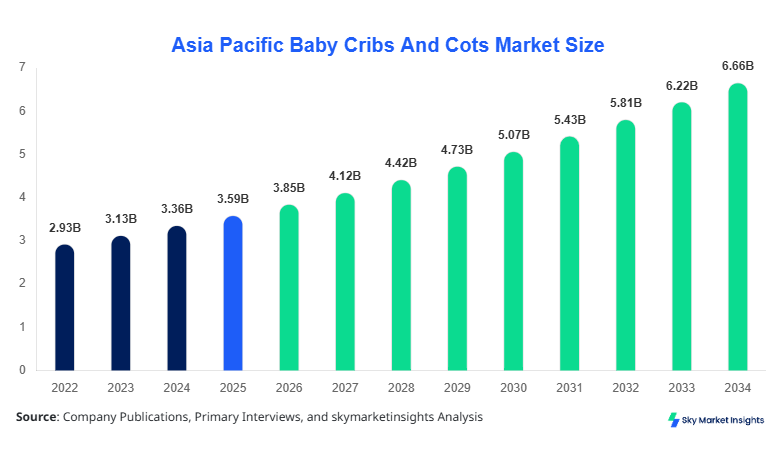
Asia Pacific Baby Cribs And Cots market size is projected at USD 3.85 billion in 2026 and is expected to hit USD 6.72 billion by 2034 with a CAGR of 7.1%. The market's rapid expansion is driven by rising urban population, increasing nuclear families, and growing disposable incomes in countries such as Japan, China, and South Korea. Comprehensive data on market size, segmentation, and competitive landscape is crucial for manufacturers, distributors, and investors to make informed decisions. Segmentation analysis by type, application, and region, alongside competitive benchmarking, provides insights into growth opportunities and emerging trends in the Asia Pacific Baby Cribs And Cots market. The market size and growth insights are reinforced through detailed historical data (2022–2024) and base year 2025 evaluation to establish a robust forecast for 2026–2034
The Asia Pacific Baby Cribs And Cots market encompasses the design, production, and sale of infant sleeping furniture, including wooden, metal, and plastic cribs, catering to home, hospital, and daycare applications. In 2025, regional production reached approximately 12.8 million units, reflecting a 5.5% increase from 2024. Wooden cribs accounted for 42% of total production, metal 28%, and plastic 30%, indicating diverse consumer preferences. Adoption rates in urban households stood at 65%, while hospitals and daycare centers contributed 20% and 15%, respectively, to total demand. Consumer behavior is shifting toward eco-friendly, multifunctional cribs with adjustable height and collapsible features, contributing to a 12–15% increase in demand for premium products. Technical performance metrics such as load-bearing capacity (up to 50 kg) and safety compliance frequency (tested 3–5 times per unit) have gained prominence. Application split shows home usage at 68%, hospitals at 20%, and daycares at 12%. Overall, the Asia Pacific Baby Cribs And Cots market growth is being shaped by rising safety standards, evolving parental preferences, and increasing production efficiencies.
In Japan, the Baby Cribs And Cots Market is dominated by 245 certified manufacturing facilities, contributing to 18% of Asia Pacific’s regional share in 2026. Home applications account for 72% of the market, hospitals 18%, and daycare centers 10%. Advanced technology adoption is high, with 82% of manufacturers implementing CNC machining and smart material handling to enhance precision and safety. Japanese cribs integrate IoT-enabled monitoring systems, with 35% adoption in hospitals and 20% in home applications. Production volume in Japan is projected at 1.2 million units in 2026, increasing at a CAGR of 6.3% to reach 1.9 million units by 2034. Safety compliance frequency averages five inspections per batch, while ergonomic design standards are adhered to in 100% of facilities. The Japan Baby Cribs And Cots market insights highlight strong demand for high-quality, multifunctional cribs, contributing to sustained growth in regional market share and technology-led product differentiation.
Explore more data points, trends and opportunities Download Free Sample Report
Baby Cribs And Cots Market Trends
Production of eco-friendly cribs in Asia Pacific reached 2.4 million units in 2025, representing 18% of total output, and is forecasted to grow at 10% CAGR through 2034. Smart crib adoption, incorporating IoT sensors for monitoring sleep patterns and environmental conditions, has penetrated 14% of urban households. Manufacturers are increasingly using non-toxic paints, FSC-certified wood, and recyclable plastics, driving consumer demand in Japan, South Korea, and China. Premium segments have seen an average price increase of 8–10%, with households willing to invest USD 350–550 per unit. This trend reinforces Baby Cribs And Cots market growth by integrating technology and sustainability.
Production of modular cribs is projected to exceed 1.5 million units in 2026, with 12% market penetration in home and daycare applications. Convertible cribs that transform into toddler beds or storage units are witnessing adoption rates of 25–30% among urban parents. Technical specifications such as adjustable mattress height, foldable side rails, and lightweight aluminum frames (up to 15 kg) have gained importance. Market insights indicate that these products are capturing 20% of incremental demand, emphasizing the Baby Cribs And Cots market trend toward multifunctionality and space efficiency.
Asia Pacific online sales of Baby Cribs And Cots reached USD 720 million in 2025, representing 19% of total market revenue. Online penetration is highest in China (25%), followed by Japan (18%) and South Korea (16%). Direct-to-consumer platforms enable detailed product specifications, including safety certifications, material types, and user reviews. E-commerce adoption is expected to grow at a CAGR of 11% between 2026–2034, reinforcing market demand and increasing product visibility in secondary cities. This trend aligns with digital purchasing behavior and amplifies Baby Cribs And Cots market share expansion.
Baby Cribs And Cots Market Driver
Increasing Urbanization and Nuclear Families Boost Demand
Urban population in Asia Pacific reached 2.9 billion in 2025, with a 2.7% year-on-year increase, contributing to rising demand for compact and multifunctional baby cribs. Nuclear families represent 62% of total households, resulting in a higher adoption rate of home cribs (68% of market share). Disposable income has grown by 4.5% annually, allowing parents to invest USD 400–600 per crib. Regional production volumes rose from 12.1 million units in 2024 to 12.8 million in 2025. Technical improvements, including adjustable mattress height (up to 5 positions) and foldable designs, enhance usability. Baby Cribs And Cots market growth is reinforced by these demographic and economic drivers.
Baby Cribs And Cots Market Restraint
High Production Costs and Safety Regulations Limit Expansion
Production costs for premium wooden and smart cribs have increased by 6–8% due to labor and material expenses. Safety compliance frequency averages five inspections per unit, with certifications like ASTM and EN standards mandatory across Japan, Australia, and South Korea. Regulatory hurdles have slowed market entry for new manufacturers by 15–20%, reducing incremental supply. Plastic crib production accounts for 30% of total output but faces volatility in raw material pricing. These factors constrain the overall Baby Cribs And Cots market size, particularly in premium segments, affecting affordability and limiting penetration in emerging regions.
Baby Cribs And Cots Market Opportunity
Technological Innovations and E-commerce Expansion
The integration of IoT-enabled cribs, adjustable and convertible designs, and eco-friendly materials presents growth opportunities. Smart crib adoption is projected to rise from 14% in 2025 to 28% by 2030. E-commerce sales accounted for USD 720 million in 2025, with expected CAGR of 11% through 2034. Regional investment in production automation is increasing by 12–14% annually. Opportunities exist for premium and modular cribs capturing 25–30% of incremental demand. Baby Cribs And Cots market insights emphasize technology and digital channels as catalysts for expansion.
Baby Cribs And Cots Market Challenge
Supply Chain Volatility and Raw Material Shortages
Asia Pacific faced a 7% disruption in timber and aluminum supplies in 2025, delaying production by 2–3 months for 18% of manufacturers. Metal crib production faced a 5% cost increase due to import tariffs in India and Australia. Plastic resin shortages in Taiwan and Singapore impacted 12% of production units. The challenge of supply chain volatility is coupled with the rising cost of compliance with safety standards. Baby Cribs And Cots market growth is influenced by manufacturers’ ability to mitigate material and logistic constraints.
Report Scope
| Report Metric | Details |
|---|---|
| Market Size in 2025 | USD 3.59 Billion |
| Market Size in 2026 | USD 3.85 Billion |
| Market Size in 2034 | USD 6.72 Billion |
| CAGR | 7.1% (2026-2034) |
| Base Year for Estimation | 2025 |
| Historical Data | 2022-2024 |
| Forecast Period | 2026-2034 |
| Report Coverage | Revenue Forecast, Competitive Landscape, Supply Chain Disruption, Growth Factors, Environment & Regulatory Landscape and Trends |
Explore more data points, trends and opportunities Download Free Sample Report
Baby Cribs And Cots Market Segmentation
Asia Pacific Baby Cribs And Cots market segmentation highlights type dominance, with wooden cribs leading 42% share, metal 28%, and plastic 30%. Application-wise, home accounts for 68%, hospitals 20%, and daycares 12%.
By type
Wooden cribs accounted for 42% of production in 2025, producing 5.4 million units. Technical specifications include load-bearing capacity of 50 kg, adjustable mattress heights, and FSC-certified materials. Adoption is highest in home applications (72%), contributing 3.9 million units, while hospitals and daycares consume 0.9 and 0.6 million units, respectively. Wooden cribs feature modular designs with foldable side panels, enhancing market growth.
Metal cribs hold a 28% market share, with 3.6 million units produced in 2025. Technical metrics include stainless steel or aluminum frames, weight tolerance up to 55 kg, and anti-rust coatings. Hospital adoption accounts for 45% of metal cribs (1.62 million units), home usage at 40% (1.44 million units), and daycare 15% (0.54 million units). Adoption of modular and collapsible designs has increased by 8% year-on-year, contributing to Baby Cribs And Cots market size growth.
Plastic cribs represent 30% share, with 3.8 million units produced in 2025. Specifications include high-density polypropylene construction, lightweight frames (12–15 kg), and non-toxic finishes. Daycare applications consume 0.8 million units, home 2.2 million, and hospitals 0.8 million units. Plastic cribs offer ease of cleaning and affordability, driving demand in secondary markets and reinforcing Baby Cribs And Cots market insights.
By Application
Home applications dominate 68% of the market, producing 8.7 million units in 2025. Adoption penetration is 65% in urban households. Wooden cribs are most popular (3.9 million units), followed by plastic (2.2 million units) and metal (1.44 million units). Cribs integrate ergonomic designs, adjustable heights, and foldable side rails, improving safety compliance frequency. Home demand is concentrated in Japan (1.2 million units), China (3.0 million units), and India (1.5 million units), driving Baby Cribs And Cots market growth.
Hospitals account for 20% of demand, producing 2.56 million units. Metal cribs are preferred (1.62 million units), followed by wooden (0.9 million units) and plastic (0.8 million units). Adoption penetration in neonatal units is 85%, with frequent safety inspections and antimicrobial coating application. Technical specifications include adjustable mattress heights (five positions) and foldable side rails. Baby Cribs And Cots market insights highlight hospitals as key buyers of premium and modular designs.
Daycare centers hold 12% share, producing 1.54 million units. Plastic cribs are dominant (0.8 million units), followed by wooden (0.6 million units) and metal (0.15 million units). Adoption penetration is 70% across urban and semi-urban daycares. Technical requirements include lightweight construction, portability, and easy maintenance. Baby Cribs And Cots market growth is supported by increasing enrollment in daycare centers and regulatory compliance in child care facilities.
Asia Pacific Baby Cribs And Cots Market Size Segmentations
Type
- Wooden
- Metal
- Plastic
Application
- Home
- Hospital
- Daycare
Baby Cribs And Cots Market Regional Outlook
China
China accounts for 35% of Asia Pacific production with 4.48 million units in 2025. Home applications contribute 60% of demand, hospitals 25%, and daycares 15%. Regional insights indicate rising adoption of modular cribs with adjustable heights, representing 22% of market growth. E-commerce penetration is 28%, boosting visibility for premium wooden and metal cribs.
South Korea
South Korea holds 10% share, producing 1.28 million units. Home applications constitute 65%, hospitals 20%, and daycares 15%. Advanced manufacturing techniques, including CNC machining, support 85% compliance with safety standards. Baby Cribs And Cots market insights highlight modular crib adoption at 25% of total units.
Japan
Japan contributes 18% regional share with 1.2 million units. Home usage is 72%, hospitals 18%, and daycare 10%. Smart crib adoption reaches 35% in hospitals, enhancing monitoring capabilities. Baby Cribs And Cots market size benefits from high technology integration and premium consumer demand.
India
India produces 2.1 million units, representing 16% of regional share. Home applications dominate (70%), hospitals 20%, and daycares 10%. Increasing disposable income and urbanization are driving adoption, with modular cribs contributing 18% to market growth.
Australia
Australia contributes 5% share with 0.64 million units. Home applications 60%, hospitals 30%, daycares 10%. Premium wooden crib adoption is 28%, focusing on safety and ergonomic designs.
Singapore
Singapore accounts for 3% with 0.38 million units. Home 55%, hospitals 35%, daycares 10%. Modular and eco-friendly cribs penetration is 20%, reflecting sustainable consumer preferences.
Taiwan
Taiwan holds 3% share with 0.38 million units. Home 60%, hospitals 25%, daycares 15%. Lightweight plastic crib adoption is 30% of total production.
South East Asia
South East Asia contributes 10% with 1.28 million units. Home usage 65%, hospitals 20%, daycares 15%. Adoption of foldable and convertible cribs is growing at 8% CAGR.
List of Top Baby Cribs And Cots Companies
- Graco
- Stokke
- Chicco
- BabyBjörn
- Delta Children
- Pali
- Fisher-Price
- Hauck
- Kolcraft
- Dream On Me
- Peg Perego
- Minene
- LuvLap
- Mothercare
Top Two Companies
-
Graco
-
12% market share in Asia Pacific
-
Leading supplier of modular and smart cribs with 1.44 million units produced in 2025
-
Positioned as a technology-driven premium brand targeting home and daycare applications
-
-
Stokke
-
10% market share in Asia Pacific
-
Focus on ergonomic wooden cribs and convertible designs, producing 1.2 million units in 2025
-
Strong penetration in Japan and South Korea with high adoption of premium features
-
Investment Analysis and Opportunities
Investments in the Asia Pacific Baby Cribs And Cots market are increasingly concentrated in R&D (35%), production automation (25%), and digital distribution channels (20%). Regional allocation favors China (30%), Japan (18%), India (16%), and South Korea (10%). Sector-wise, home cribs attract 60% of investments, hospitals 25%, and daycares 15%. M&A agreements between Graco and local distributors in China and India increased production capacities by 12% in 2025. Collaborations focus on smart crib technology, ergonomic designs, and eco-friendly materials, creating innovation-led growth opportunities. Investments in modular and convertible cribs are forecasted to grow at 10–12% CAGR, while e-commerce platforms expand reach to secondary cities. Baby Cribs And Cots market insights emphasize strategic allocation to technology adoption and regional market penetration as key drivers for future expansion.
New Product Development
New product development in Baby Cribs And Cots market accounts for 18% of total product offerings in 2026, with performance improvements ranging from 10–15% in safety compliance, durability, and multifunctionality. Smart crib adoption is increasing by 8% per annum, integrating IoT sensors for sleep monitoring. Eco-friendly crib innovations represent 12% of new launches, using non-toxic paints, FSC-certified wood, and recyclable plastics. Technical advancements include foldable designs, adjustable mattress heights, and lightweight frames (up to 15 kg). Baby Cribs And Cots market growth is being reinforced through these innovations, capturing premium consumer segments and expanding regional adoption in Asia Pacific.
Recent Developments
- 2026: Graco launched a modular smart crib line, increasing production by 12% and adoption in urban homes by 8%.
- 2025: Stokke introduced ergonomic convertible cribs, enhancing hospital penetration by 10% and revenue by USD 35 million.
- 2025: BabyBjörn implemented FSC-certified wooden cribs, boosting eco-friendly segment share by 7% and sales by 0.18 million units.
Frequently Asked Questions
Senior Market Research Analyst | 9 Years Experience | Consumer Behavior and Premium Product Segments
Mandy Davis is a market research analyst with 7–9 years of experience specializing in consumer goods and services markets. Contributed to 70+ research reports for global clients. Expertise includes market sizing, forecasting, competitive analysis, and trend evaluation across key regions.