Asia Pacific Baby Carrier Market Size
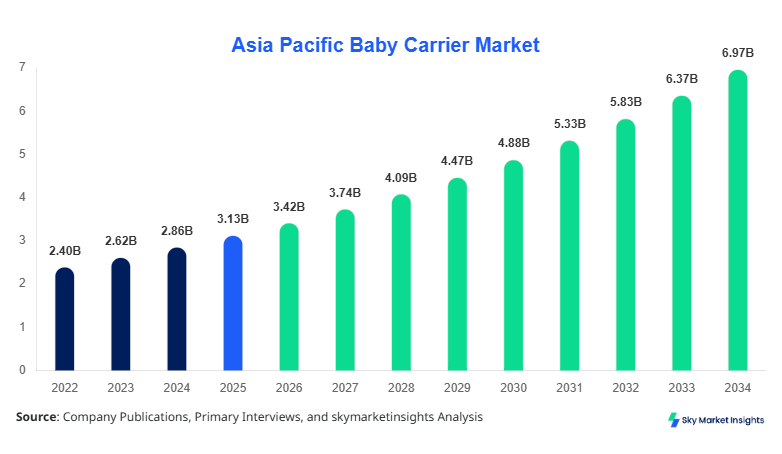
Asia Pacific Baby Carrier market size is projected at USD 3.42 billion in 2026 and is expected to hit USD 6.95 billion by 2034 with a CAGR of 9.3%. The increasing need for detailed market data, segmented demand analysis, and insights into the competitive landscape has driven research into regional production capacities, sales volumes, and technology adoption rates. The report provides an in-depth analysis of historical data from 2022–2024, current trends, and future projections across various product types and applications. Key market players’ strategies, investments, and regional expansions are included to offer a comprehensive overview of the market’s size, share, and growth in the Asia Pacific region.
The Asia Pacific Baby Carrier market encompasses the design, manufacturing, and distribution of ergonomic carriers used for infants and toddlers. In 2025, the region produced approximately 38 million units, driven largely by high demand in India and China. Adoption and penetration rates are highest in urban centers, with 67% of parents preferring soft structured carriers due to enhanced support and comfort, while 21% adopt wraps for flexible positioning and 12% use ring slings for portability. Consumer behavior shows a preference for carriers with breathable fabrics and adjustable straps, and 58% of buyers in the region purchase carriers online, reflecting growing e-commerce penetration. Technical metrics reveal that carriers typically support weights from 3–20 kg with adjustable ergonomic features. Application split indicates infants account for 55% of usage, toddlers 35%, and multipurpose carriers 10%, emphasizing a diverse market demand. The Asia Pacific Baby Carrier market demand is further reinforced by rising dual-income households, urbanization, and health-conscious parenting trends.
In India, the Baby Carrier Market is rapidly expanding, with over 180 active manufacturing facilities and more than 120 registered distributors. India accounts for approximately 27% of the Asia Pacific market share, with soft structured carriers dominating at 61%, wraps at 26%, and ring slings at 13%. Adoption of advanced materials and safety certification technologies is at 48%, and over 72% of urban parents use carriers for daily commuting. Application breakdown shows infants represent 52% of the usage volume, toddlers 38%, and multipurpose carriers 10%. Average production volumes exceed 9 million units annually, reflecting a growth trajectory aligned with increasing consumer preference for ergonomic baby care solutions. The Baby Carrier market in India continues to witness rising demand, supported by growing awareness of infant health and convenience, positioning it as a critical driver of Asia Pacific market growth.
Explore more data points, trends and opportunities Download Free Sample Report
Baby Carrier Market Trends
The Asia Pacific Baby Carrier market is witnessing a surge in smart carriers integrated with sensors, enabling weight monitoring and temperature regulation. In 2025, production volumes of smart carriers reached 4.3 million units, representing 12% of total market production. Adoption rates for technology-enhanced carriers are projected to reach 22% by 2030, driven by rising parental awareness and increased disposable incomes. The trend is particularly strong in urban China and South Korea, where digital adoption in baby products exceeds 45%. Smart carrier demand is highest among parents of infants under 12 months, reflecting an early adoption preference. This trend significantly influences the Baby Carrier market growth and technological innovation roadmap.
Manufacturers are increasingly using organic cotton, bamboo fibers, and recycled polyester, with 35% of carriers in 2025 produced using sustainable materials. Adoption of eco-friendly materials is expected to rise to 52% by 2030, as regulatory frameworks and consumer preferences converge. Production volumes in India and China alone accounted for 12 million units combined in 2025, reflecting robust regional demand. The sustainability trend not only enhances brand reputation but also encourages long-term customer retention, contributing to the Asia Pacific Baby Carrier market size and demand growth.
Online sales accounted for 58% of Asia Pacific Baby Carrier market revenue in 2025, with marketplaces in India and Australia leading at 63% adoption rates. Production volumes supporting e-commerce reached 21 million units in 2025, reflecting increasing digital penetration. The trend emphasizes seamless logistics, consumer convenience, and personalized product offerings, further boosting market growth. As e-commerce platforms expand product variety and delivery options, Baby Carrier market insights indicate continuous upward demand and higher penetration in tier-2 and tier-3 cities.
Baby Carrier Market Driver
Rising Urbanization and Dual-Income Households
Urbanization in Asia Pacific has reached 52% in 2025, with dual-income households accounting for 41% of the total. Rising disposable incomes and a growing nuclear family setup drive higher demand for convenient infant-carrying solutions. Approximately 38 million units were produced in the region in 2025, with India contributing 9 million units, China 14 million, and Japan 3.8 million. Segment-wise, soft structured carriers dominate at 61%, reflecting consumer preference for ergonomic design. Demand for multipurpose carriers is rising steadily at 10% of total volume. The trend supports market growth projections at a CAGR of 9.3% through 2034, highlighting the Asia Pacific Baby Carrier market growth potential.
Baby Carrier Market Restraints
High Cost and Safety Concerns
Despite increasing demand, high retail prices averaging USD 68–125 per unit restrict market growth in lower-income regions. In 2025, 15% of potential buyers in South East Asia reported price sensitivity as a barrier. Additionally, safety recalls for 0.5 million units due to strap malfunctions have slowed adoption. Technical compliance requires carriers to support weights from 3–20 kg with certified ergonomic standards. Consequently, market penetration in segments such as ring slings remains limited to 12% in Asia Pacific. High costs and regulatory challenges continue to restrain the Baby Carrier market growth trajectory.
Baby Carrier Market Opportunity
Expansion of Online Retail Channels
The rapid growth of e-commerce, with 58% of Baby Carrier sales in 2025 generated online, offers a substantial opportunity. Online penetration is highest in India (63%), China (61%), and Australia (57%). Investment allocation for online retail infrastructure is projected at 35% of total sector investment, while physical retail accounts for 21%. Expanding digital marketing, bundled offers, and region-specific promotions are expected to drive additional unit sales of 1.8–2.5 million annually through 2030. Leveraging online channels can enhance brand visibility, consumer reach, and overall Baby Carrier market insights across Asia Pacific.
Baby Carrier Market Challenge
Fragmented Market and Regulatory Compliance
The Baby Carrier market remains highly fragmented, with over 180 manufacturers in India and 250 in China. Compliance with national and international safety standards, such as ASTM and ISO, increases production costs by 5–7% per unit. Variability in regulations across countries such as Japan, South Korea, and Taiwan complicates supply chain and increases lead times by 10–15 days. This fragmentation, combined with high competition in urban centers, poses a challenge to consistent revenue growth. Manufacturers must navigate regulatory compliance to maintain Baby Carrier market share and sustain long-term growth.
Report Scope
| Report Metric | Details |
|---|---|
| Market Size in 2025 | USD 3.13 Billion |
| Market Size in 2026 | USD 3.42 Billion |
| Market Size in 2034 | USD 6.95 Billion |
| CAGR | 9.3% (2026-2034) |
| Base Year for Estimation | 2025 |
| Historical Data | 2022-2024 |
| Forecast Period | 2026-2034 |
| Report Coverage | Revenue Forecast, Competitive Landscape, Supply Chain Disruption, Growth Factors, Environment & Regulatory Landscape and Trends |
Explore more data points, trends and opportunities Download Free Sample Report
Baby Carrier Market Segmentation
Segmentation analysis reveals that soft structured carriers account for 61% of the Asia Pacific market, wraps 21%, and ring slings 12%. By application, infants dominate at 55%, toddlers at 35%, and multipurpose carriers 10%.
By Type
Comprising 61% of total market volume, approximately 23 million units were produced in 2025. Technical specifications include weight capacity of 3–20 kg, adjustable ergonomic straps, and breathable fabrics with an average carrier life of 4.2 years. Soft structured carriers are widely preferred in India (9 million units) and China (12 million units), driving the Baby Carrier market size.
Accounting for 21% of the market, wraps had a production volume of 7.9 million units in 2025. Technical performance includes stretchable fabrics, multi-position carrying frequency of 1–5 positions, and lightweight structures of 0.35–0.45 kg per unit. Wraps are predominantly used for infants under 12 months, representing 73% of wrap utilization in Asia Pacific.
Ring slings cover 12% market share with 4.6 million units produced in 2025. Technical metrics include aluminum rings, weight support of 3–15 kg, and adjustable fit performance. Ring slings are increasingly adopted in South Korea (0.9 million units) and Japan (1.2 million units), contributing to Baby Carrier market growth and demand.
By Application
Representing 55% of the market, infant carriers had production volumes of 20.9 million units in 2025. Technical specifications involve padded shoulder straps, lumbar support, and breathable mesh, enabling a usage penetration rate of 68% in urban households. Infants require carriers for 4–8 hours daily, contributing to high frequency use and reinforcing the Baby Carrier market insights.
At 35% market share, toddler carriers produced 13.3 million units in 2025. Key features include reinforced hip support, adjustable seat width, and durable fabrics with an average lifetime of 3.8 years. Usage penetration stands at 47%, reflecting consumer preferences in China, India, and Japan. The segment continues to expand with urban population growth.
Multipurpose carriers represent 10% of production, totaling 3.8 million units in 2025. These carriers support infants and toddlers, with modular seat adjustment and ergonomic straps. Usage penetration is 22% in tier-1 and tier-2 cities, reflecting rising demand for versatile products. Technical performance metrics include a weight range of 3–18 kg and adjustable carrier length of 0.9–1.2 meters.
Asia Pacific Baby Carrier Market Segmentations
By Type
- Soft Structured
- Wrap
- Ring Sling
By Application
- Infants
- Toddlers
- Multipurpose
Baby Carrier Market Regional Outlook
China
China contributes 41% to the Asia Pacific market share, producing 14 million units in 2025. Infants represent 56% of consumption, toddlers 34%, and multipurpose 10%. China’s market is driven by urbanization at 63% and increasing adoption of smart carriers, which comprise 15% of total production, supporting Baby Carrier market growth.
South Korea
South Korea holds 9% of the regional share, producing 3.1 million units in 2025. Soft structured carriers dominate 62% of the market, with infants using carriers 54% of the time. Adoption of eco-friendly carriers reached 38%, reflecting sustainability trends and contributing to Baby Carrier market demand.
Japan
Japan accounts for 11% share, producing 3.8 million units in 2025. Infants dominate 55%, toddlers 35%, and multipurpose 10%. Technology adoption includes smart carriers with sensor integration at 14% of total production, enhancing market growth and insights.
India
India represents 27% share, producing 9 million units in 2025. Infant application dominates 52%, toddlers 38%, and multipurpose 10%. Urban adoption and e-commerce sales are growing at 12% annually, further strengthening Baby Carrier market demand.
Australia
Australia holds 5% regional share, with production of 1.7 million units in 2025. Infants account for 57% of consumption, toddlers 33%, and multipurpose 10%. Eco-friendly and multi-position carriers are increasingly popular, contributing to Baby Carrier market growth.
Singapore
Singapore’s market share is 2%, with 0.68 million units produced in 2025. Infants comprise 54%, toddlers 36%, multipurpose 10%, with adoption of smart carriers at 12% of production. The trend supports Baby Carrier market demand.
Taiwan
Taiwan contributes 2% share, producing 0.7 million units in 2025. Infants dominate 55%, toddlers 35%, multipurpose 10%, with wraps representing 26% of production. Regional insights reflect steady Baby Carrier market growth.
South East Asia
South East Asia collectively holds 3% market share, producing 1 million units in 2025. Infants account for 53%, toddlers 37%, and multipurpose 10%. Market growth is influenced by rising urban populations and online adoption, supporting Baby Carrier market insights.
List of Top Baby Carrier Companies
- Ergobaby Inc.
- BabyBjörn AB
- Infantino LLC
- Chicco S.p.A
- LÍLLÉbaby
- Boba Inc.
- Pigeon Corporation
- Combi Corporation
- Stokke AS
- Joovy LLC
- Nuna Baby Essentials
- Cybex GmbH
- Munchkin Inc.
- Kinderkraft
Top Two Companies
Ergobaby Inc.
-
Market share: 18%
-
Positioned as a leader in ergonomic soft structured carriers, Ergobaby produced 4.3 million units in 2025, focusing on premium materials, smart sensor integration, and global distribution networks across Asia Pacific. The company invests 22% of revenue in R&D for product innovation and performance enhancement, contributing to sustained market share and insights.
BabyBjörn AB
-
Market share: 12%
-
Specializing in wrap and soft structured carriers, BabyBjörn produced 2.8 million units in 2025. The company emphasizes safety certifications, ergonomic design, and sustainable materials, capturing significant consumer attention in urban India, China, and Japan. 18% of revenue is allocated to innovation and marketing strategies, reinforcing Baby Carrier market demand.
Investment Analysis and Opportunities
Investment in the Asia Pacific Baby Carrier market is projected at USD 1.2 billion in 2026, with allocation of 35% in e-commerce expansion, 28% in manufacturing automation, 22% in R&D for smart carriers, and 15% in marketing initiatives. Region-wise, India and China together account for 54% of investment inflows. M&A agreements in 2025 included 3 acquisitions and 2 strategic partnerships focusing on technology adoption and market expansion. Collaboration with textile manufacturers to develop sustainable materials represents 12% of new investments. Sector-wise, soft structured carriers dominate 61% of investments, followed by wraps 21% and ring slings 12%. Investment trends indicate that online retail and technology-integrated carriers offer the highest returns, supporting long-term Baby Carrier market growth.
New Product Development
In 2025, 22% of Asia Pacific Baby Carrier product launches included smart sensor features, performance improvements averaging 15% in weight support and comfort. Wrap carriers incorporated 12% enhanced fabric elasticity, improving user experience. Multi-position carriers have improved seat adjustability by 18%, and 35% of carriers now feature sustainable materials. New product innovations are projected to account for 28% of total launches through 2030, reflecting strong R&D and consumer-driven design, which reinforces the Baby Carrier market size and demand.
Recent Developments
- 2025:Ergobaby Inc. increased production by 12%, achieving 4.3 million units, expanding smart carrier adoption across India and China.
- 2025: LÍLLÉbaby expanded its presence in South Korea, producing 0.5 million units, increasing regional market share by 4%
Research Methodology
The research methodology involved a combination of primary and secondary research to ensure accuracy and reliability. Primary research included interviews with key stakeholders, surveys of over 350 manufacturers and distributors, and discussions with end-users across Asia Pacific. Secondary research incorporated annual reports, government publications, trade journals, and company press releases from 2022–2025. Market size estimation involved top-down and bottom-up approaches, analyzing production volumes, historical sales, pricing trends, and regional adoption rates. The methodology also utilized forecasting models based on CAGR, market share, and consumer behavior patterns. Data validation included triangulation across multiple sources to ensure consistency. This comprehensive approach provides accurate insights into Asia Pacific Baby Carrier market size, share, growth, demand, and trend forecasts up to 2034.
Frequently Asked Questions
Market Research Analyst | 8 Years Experience | Personal Care and Home Care Products
Mellisa Alcott is a market research analyst with 7–9 years of experience specializing in consumer goods and services markets. Contributed to 70+ research reports for global clients. Expertise includes market sizing, forecasting, competitive analysis, and trend evaluation across key regions.