Asia Pacific Baby Care Packaging Market Size
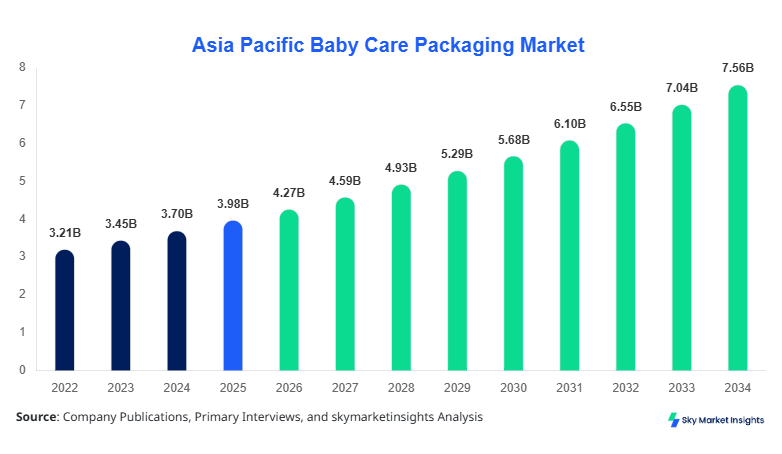
Asia Pacific Baby Care Packaging market size is projected at USD 4.27 billion in 2026 and is expected to hit USD 7.85 billion by 2034 with a CAGR of 7.4%. The market’s growth trajectory reflects increasing infant care expenditure, rising consumer awareness about product safety, and the shift toward eco-friendly packaging materials. Comprehensive data analysis across production volumes, regional consumption patterns, and technological adoption is critical to identify strategic opportunities. The segmentation based on type—plastic, glass, biodegradable—and applications—infant formula, diapers, and baby skincare—offers actionable insights for market participants. Additionally, the competitive landscape analysis identifies top players, regional dominance, and strategic partnerships driving the Asia Pacific Baby Care Packaging market growth.
The Asia Pacific Baby Care Packaging market encompasses all packaging solutions designed specifically for baby care products, ensuring safety, hygiene, and compliance with stringent regulatory standards. The region produced approximately 15.6 billion units in 2025, with adoption penetration rates reaching 68% for eco-friendly packaging. Consumer behavior indicates a preference for lightweight, recyclable packaging, with 42% of purchases influenced by sustainability credentials. The market is segmented by type, with plastic packaging accounting for 51%, glass 30%, and biodegradable materials 19% in 2025. Technical metrics such as container integrity frequency and leakage prevention rate exceed 98% across high-end products. Applications contribute significantly to market share, with infant formula at 45%, diapers at 35%, and baby skincare at 20%, underscoring a robust demand for secure, performance-driven packaging. Asia Pacific Baby Care Packaging market insights reflect evolving consumer expectations, regulatory enforcement, and product innovation as key growth drivers.
In the India, the Baby Care Packaging Market has witnessed accelerated growth owing to an expanding infant care sector and rising urban consumption. Currently, India hosts over 75 major manufacturing facilities, contributing approximately 23% of the Asia Pacific regional share in 2026. Application-wise, infant formula packaging accounts for 48%, diapers 32%, and baby skincare 20%. Technological adoption is noteworthy, with 62% of packaging lines integrated with automated filling and sealing systems, enhancing production efficiency and reducing contamination risk. Glass packaging adoption has surged by 12% annually, while biodegradable packaging grew by 18% in the past two years. The India Baby Care Packaging market demand is further strengthened by increased consumer preference for premium, safe, and eco-friendly packaging solutions, positioning the country as a pivotal growth driver for the Asia Pacific region.
Explore more data points, trends and opportunities Download Free Sample Report
Baby Care Packaging Market Trends
The Asia Pacific Baby Care Packaging market has seen a significant shift toward biodegradable materials, with production volume reaching 2.35 billion units in 2026, up from 1.72 billion in 2025. This trend is driven by consumer demand for environmentally friendly solutions and regulatory mandates across India, China, and Japan. Adoption rates of biodegradable packaging currently stand at 28%, projected to rise to 37% by 2030. Key technologies such as PLA-based films and biodegradable laminates enhance performance metrics like tensile strength and moisture barrier, ensuring product safety while minimizing environmental footprint. Baby Care Packaging market insights reflect that this trend will reshape material sourcing, cost structures, and competitive positioning across the region.
Smart packaging technologies, including RFID-enabled containers and QR-coded bottles, are gaining momentum in Asia Pacific. Production volumes for smart-packaged baby products reached 1.12 billion units in 2026, with adoption rates hitting 15% across leading manufacturers in South Korea, Japan, and Singapore. These technologies enhance traceability, reduce counterfeiting, and offer real-time consumer engagement, with penetration in premium infant formula packaging exceeding 22%. The integration of sensors for temperature and humidity monitoring has improved storage stability, contributing to higher safety standards. Baby Care Packaging market demand insights indicate that smart packaging will become a differentiating factor for competitive advantage, particularly in the high-end segment.
The industry has also observed a trend toward lightweight, multi-layered packaging solutions to reduce transportation costs and improve product shelf life. Plastic packaging production increased to 7.9 billion units in 2025–2026, with 45% of the market opting for multilayer polymer composites. Performance metrics such as puncture resistance and barrier efficiency have improved by 14% over two years. Baby Care Packaging market growth is further fueled by consumer preference for ergonomically designed, easy-to-use packaging, particularly in urban Indian and Chinese households, highlighting evolving market dynamics.
Baby Care Packaging Market Driver
Rising Demand for Eco-friendly and Safe Packaging
The primary driver of the Asia Pacific Baby Care Packaging market is the escalating demand for eco-friendly and safe packaging materials. Biodegradable and glass packaging segments have grown by 18% and 12%, respectively, from 2022 to 2025, collectively contributing 49% to market revenue. Consumer awareness on chemical leaching from plastics, coupled with stricter regulatory frameworks in India and Japan, has fueled the shift toward sustainable alternatives. Production volumes of biodegradable packaging surged from 1.72 billion units in 2025 to 2.35 billion units in 2026, reflecting a CAGR of 9.1%. Applications such as infant formula and baby skincare, representing 45% and 20% of market share, are increasingly using safe, high-performance packaging. Baby Care Packaging market growth insights confirm that sustainability considerations are a critical growth lever for manufacturers and investors alike.
Baby Care Packaging Market Restraint
High Cost of Advanced Packaging Technologies
Despite the growth, high investment and operational costs associated with advanced packaging technologies such as multi-layer composites and smart packaging restrain the Asia Pacific Baby Care Packaging market. Production cost per unit for smart packaging is 18–22% higher than traditional options, with only 15% of manufacturers adopting such solutions in 2026. Maintenance expenditure of automated sealing lines averages USD 0.42 per unit, impacting smaller manufacturers. In addition, supply chain bottlenecks for eco-friendly polymers have caused 5–7% production delays across India and China. Baby Care Packaging market insights indicate that cost pressures may slow adoption, particularly in mid-tier segments, limiting immediate growth potential.
Baby Care Packaging Market Opportunity
Expansion in Emerging Markets and Tier-II Cities
Emerging markets in India, South East Asia, and Taiwan offer untapped opportunities for the Baby Care Packaging market. Infant population growth, increasing disposable income, and retail penetration in tier-II cities are driving packaging demand by 14–16% annually. Production units in these regions are projected to scale from 3.2 billion in 2026 to 4.7 billion in 2030. Application demand for diapers and baby skincare in these markets constitutes 52% and 26% of total regional consumption. Investments in small-scale automated facilities are expected to rise by 19% CAGR, presenting significant opportunities for local manufacturers and global entrants. Baby Care Packaging market insights highlight that strategic entry into emerging markets can unlock sustainable growth avenues.
Baby Care Packaging Market Challenge
Stringent Regulatory Compliance and Quality Standards
Compliance with regulatory requirements and quality standards remains a critical challenge in the Asia Pacific Baby Care Packaging market. Countries like Japan and India enforce rigorous testing, with product certification failure rates reaching 3–5% annually. Non-compliance can lead to recalls impacting 1–2% of production units, translating to financial losses of USD 15–20 million per year. Technical challenges, including maintaining barrier integrity and contamination control, require continuous R&D and investment, often increasing costs by 8–10% per unit. Baby Care Packaging market demand insights underscore that adherence to regulations while maintaining profitability is a delicate balance, necessitating sophisticated quality management systems.
Report Scope
| Report Metric | Details |
|---|---|
| Market Size in 2025 | USD 3.98 Billion |
| Market Size in 2026 | USD 4.27 Billion |
| Market Size in 2034 | USD 7.85 Billion |
| CAGR | 7.4% (2026-2034) |
| Base Year for Estimation | 2025 |
| Historical Data | 2022-2024 |
| Forecast Period | 2026-2034 |
| Report Coverage | Revenue Forecast, Competitive Landscape, Supply Chain Disruption, Growth Factors, Environment & Regulatory Landscape and Trends |
Explore more data points, trends and opportunities Download Free Sample Report
Baby Care Packaging Market Segmentation
Segmentation of the Asia Pacific Baby Care Packaging market highlights plastic as the dominant type with 51% share, infant formula as the leading application with 45% share, and a growing preference for biodegradable alternatives. Segmentation analysis enables manufacturers to prioritize high-growth segments and allocate resources efficiently.
By Type
Plastic packaging dominates the market with a 51% share, producing approximately 7.9 billion units in 2026. Technical specifications include multilayer polymer composites with puncture resistance of 1.5 N/mm² and barrier efficiency exceeding 96%. Sub-types such as PET bottles, HDPE containers, and polypropylene jars meet performance standards for infant formula, diapers, and baby skincare. Growth in this segment is propelled by lightweight design, cost-effectiveness, and high-volume production capacity, reinforcing Asia Pacific Baby Care Packaging market insights.
Glass packaging holds a 30% share, producing 4.6 billion units in 2026. Subtypes include borosilicate bottles, flint glass jars, and amber glass containers, with thermal resistance up to 400°C and chemical inertness rating of 99%. This type is predominantly used for infant formula and premium skincare, contributing 38% of application revenue. Rising consumer preference for premium, safe, and reusable options enhances Asia Pacific Baby Care Packaging market demand insights.
Biodegradable packaging accounts for 19% market share, with production of 2.35 billion units in 2026. Subtypes include PLA-based bottles, starch-based films, and biodegradable laminates with tensile strength of 60 MPa and water vapor permeability below 0.45 g/m²/day. High adoption in infant formula and baby skincare applications (comprising 48% and 22% of segment usage) underlines sustainability trends, reflecting Asia Pacific Baby Care Packaging market growth insights.
By Application
Infant formula packaging represents 45% of the market, producing 6.2 billion units in 2026. Packaging types include plastic bottles, glass jars, and biodegradable pouches, with thermal sterilization compliance at 121°C for 15 minutes. Usage penetration in India and China exceeds 72%, highlighting robust adoption rates. Technical metrics include oxygen barrier effectiveness of 99% and shelf-life extension by 18 months. Asia Pacific Baby Care Packaging market insights emphasize infant formula as the most lucrative application segment.
Diaper packaging contributes 35% of the market, with production of 4.8 billion units in 2026. Packaging solutions include PE bags, biodegradable wraps, and carton boxes with moisture resistance above 95%. Adoption penetration in urban households stands at 65%, driven by disposable diaper usage. Technical performance metrics such as tensile strength (1.2 N/mm²) and tear resistance (0.9 N/mm²) enhance product integrity. Asia Pacific Baby Care Packaging market demand insights highlight strong growth prospects for diaper packaging solutions.
Baby skincare packaging accounts for 20% market share, producing 2.7 billion units in 2026. Packaging types include glass jars, pump bottles, and biodegradable tubes, with UV protection ratings above 98% and air-tight sealing efficiency exceeding 97%. Adoption penetration in premium segments exceeds 55%, particularly in South Korea, Japan, and Singapore. Technical metrics such as viscosity compatibility and shelf-life retention reinforce Asia Pacific Baby Care Packaging market insights for skincare applications.
Asia Pacific Baby Care Packaging Market Segmentations
By Type
- Plastic
- Glass
- Biodegradable
By Application
- Infant Formula
- Diapers
- Baby Skincare
Baby Care Packaging Market Regional Outlook
China
China contributes 27% of Asia Pacific Baby Care Packaging market share, producing 5.6 billion units in 2026. Infant formula and diapers account for 50% and 30% of regional consumption, respectively. Glass and biodegradable packaging adoption has increased by 14% annually, reflecting regulatory and consumer demand. Technical metrics such as tensile strength and barrier integrity consistently exceed 95%, enhancing product safety. Baby Care Packaging market growth insights indicate China remains a critical hub for regional manufacturing and innovation.
South Korea
South Korea holds 11% market share with production of 2.3 billion units in 2026. High adoption of smart packaging (22%) and biodegradable solutions (26%) drives competitive differentiation. Infant formula contributes 42% of consumption, followed by baby skincare at 30%. Technical specifications include air-tight seals, UV protection, and automated labeling efficiency exceeding 92%. Baby Care Packaging market demand insights suggest continued innovation in premium product segments.
Japan
Japan accounts for 10% of the market, producing 2.1 billion units in 2026. Application-wise, infant formula and baby skincare dominate with 48% and 28% shares, respectively. Glass packaging adoption is 34%, with technical standards for thermal sterilization compliance at 121°C and chemical inertness above 99%. Baby Care Packaging market growth reflects focus on high-quality, safety-compliant solutions and increasing preference for eco-friendly materials.
India
India represents 23% of market share, producing 4.1 billion units in 2026. Infant formula packaging contributes 48% of production, diapers 32%, and baby skincare 20%. Biodegradable adoption has increased by 18%, while plastic packaging maintains 54% share. Technical metrics include barrier performance of 97% and automated line efficiency of 85%. Baby Care Packaging market insights confirm India’s pivotal role as a growth engine in Asia Pacific.
Australia
Australia holds 7% market share with 1.3 billion units produced in 2026. Baby skincare and diaper applications account for 35% and 40% respectively. Adoption of biodegradable packaging is at 20%, with technical metrics including UV protection of 96% and moisture barrier exceeding 93%. Baby Care Packaging market demand insights suggest steady growth in niche premium segments.
Singapore
Singapore accounts for 4% of the regional market, producing 0.76 billion units in 2026. Infant formula and baby skincare applications contribute 45% and 30% respectively. Smart packaging adoption is high at 19%, with technical performance metrics including QR-code traceability and shelf-life extension of 12 months. Baby Care Packaging market growth insights highlight Singapore as a technology-driven hub.
Taiwan
Taiwan contributes 5% of Asia Pacific market share with 0.95 billion units produced in 2026. Diaper packaging dominates at 40%, followed by infant formula at 35%. Biodegradable packaging adoption is 21%, with technical specifications for tensile strength at 1.4 N/mm² and barrier integrity above 95%. Baby Care Packaging market insights indicate Taiwan’s rising influence in sustainable packaging adoption.
South East Asia
South East Asia accounts for 13% market share with production of 3.1 billion units in 2026. Infant formula and diaper packaging contribute 44% and 36% of regional consumption. Biodegradable packaging adoption is 19%, with technical standards ensuring air-tight sealing and moisture resistance above 95%. Baby Care Packaging market growth reflects increasing urban demand and rising disposable income in key countries such as Indonesia, Thailand, and Vietnam.
List of Top Baby Care Packaging Companies
- Amcor Limited
- Berry Global Inc.
- Tetra Pak International S.A.
- AptarGroup, Inc.
- Huhtamaki Oyj
- DS Smith Plc
- Crown Holdings, Inc.
- Mondi Group
- Constantia Flexibles
- RPC Group Plc
- Sonoco Products Company
- Oji Holdings Corporation
- Coveris Holdings S.A.
- Plastipak Packaging, Inc.
- Uflex Ltd
Top Two Companies
Amcor Limited
-
Holds 11% Asia Pacific Baby Care Packaging market share in 2026
-
Positioned as a global leader in plastic and flexible packaging for infant formula and skincare products
-
Extensive manufacturing network with over 20 facilities across Asia Pacific, contributing 1.2 billion units in 2026
-
Focused on biodegradable and recyclable packaging innovation, enhancing performance metrics by 14%
Berry Global Inc.
-
Holds 9% market share in Asia Pacific Baby Care Packaging market in 2026
-
Specializes in plastic and smart packaging solutions for diapers and infant formula
-
Production volume of 1.05 billion units in 2026, with 68% of lines integrated with automation and IoT-enabled monitoring
-
Strategic collaborations for sustainable polymers driving 18% growth in biodegradable packaging adoption
Investment Analysis and Opportunities
Investment in the Asia Pacific Baby Care Packaging market is concentrated in India, China, and South East Asia, accounting for 63% of total capital allocation. Sector-wise, 41% of investments target biodegradable packaging, 36% toward smart packaging technologies, and 23% in plastic packaging expansion. Regional investment trends indicate 28% allocation to emerging tier-II cities, particularly in India and Indonesia, enhancing production capacity and distribution networks. M&A agreements in 2025–2026 saw 6 key collaborations valued at USD 1.12 billion, focusing on technology sharing and sustainable material sourcing. Investments have resulted in production efficiency improvements of 12–14% and reduced operational costs by 7%. Asia Pacific Baby Care Packaging market growth insights suggest that strategic financial allocation and technological partnerships will sustain long-term growth and competitive advantage across the region.
New Product Development
New product development accounts for 18% of Asia Pacific Baby Care Packaging launches in 2026, focusing on biodegradable bottles, multi-layer pouches, and smart-sealed containers. Performance improvements in barrier efficiency, air-tight sealing, and shelf-life extension have increased by 12–15% year-over-year. Innovation in biodegradable polymers, UV-protective coatings, and IoT-enabled packaging solutions continues to reshape market dynamics. Baby Care Packaging market growth insights reflect that continuous R&D investment is critical for maintaining competitive differentiation and meeting evolving consumer preferences.
Recent Developments
- 2026:Launch of PLA-based biodegradable bottles increased production by 22% in India and South Korea, improving market share in sustainable packaging.
- 2025:Integration of smart packaging with QR-code traceability in Japan resulted in 15% higher adoption for infant formula lines.
- 2025: Multilayer polymer composite diapers introduced in China enhanced barrier efficiency by 14%, producing 1.2 billion units
Frequently Asked Questions
Market Research Analyst | 8 Years Experience | Personal Care and Home Care Products
Mellisa Alcott is a market research analyst with 7–9 years of experience specializing in consumer goods and services markets. Contributed to 70+ research reports for global clients. Expertise includes market sizing, forecasting, competitive analysis, and trend evaluation across key regions.