Asia Pacific Baby And Child Skin Care Products Market Size
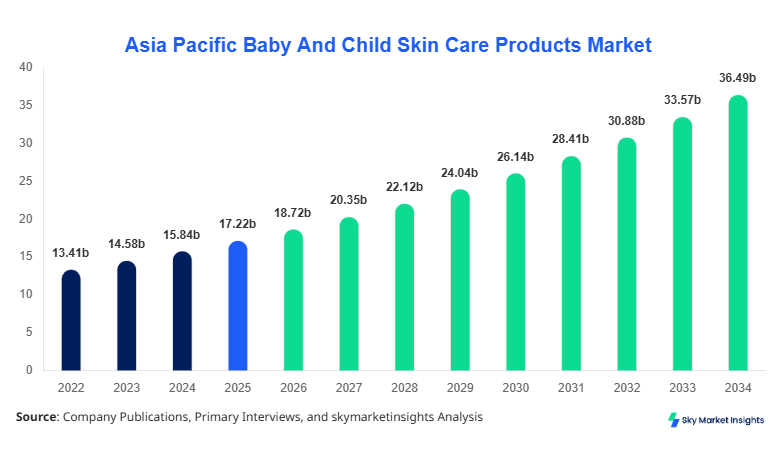
Asia Pacific Baby And Child Skin Care Products market size is projected at USD 18.72 billion in 2026 and is expected to hit USD 36.45 billion by 2034 with a CAGR of 8.7%. The market expansion is supported by increasing birth rates across India and Southeast Asia, rising disposable income levels growing at 6.2% annually, and penetration of premium baby care products reaching 42% across urban households. The Asia Pacific region accounts for over 38% of global production volume, with annual output exceeding 2.8 billion units in 2025. The report emphasizes deep data-driven segmentation, competitive benchmarking across 120+ companies, and evolving retail channel dynamics contributing to sustained Baby And Child Skin Care Products market size expansion.
The Baby And Child Skin Care Products market comprises formulations designed specifically for infant and child dermatological protection, including lotions, creams, oils, wipes, and sunscreen products with pH-balanced and hypoallergenic properties. In Asia Pacific, production volumes exceeded 2.8 billion units in 2025, with India and China contributing nearly 62% of regional manufacturing output. Adoption rates of baby-specific dermatological products have increased from 48% in 2022 to 61% in 2025, driven by rising awareness of infant skin sensitivity. Penetration in urban households stands at 72%, compared to 39% in rural regions.
Consumer behavior indicates that over 54% of parents prefer organic or chemical-free formulations, while 33% prioritize dermatologist-recommended brands. Frequency of usage ranges between 2.5 to 3.2 applications per day per child, especially in tropical climates. Product application split includes lotions (38%), creams (27%), oils (21%), and others (14%). Performance metrics such as moisture retention of 12–18 hours and SPF protection above 30 are becoming standard. Increasing demand for safe, toxin-free products continues to reinforce Baby And Child Skin Care Products market growth.
In the India, the Baby And Child Skin Care Products Market accounts for nearly 29% of the Asia Pacific regional share, supported by over 1,200 manufacturing units and more than 350 registered brands. The country produces approximately 920 million units annually, with domestic consumption accounting for 78% of total output. Application breakdown shows lotions leading at 41%, followed by creams at 26%, oils at 24%, and others at 9%.
Technology adoption in India has improved significantly, with 48% of manufacturers incorporating plant-based formulations and 35% adopting dermatologically tested chemical-free production processes. E-commerce penetration stands at 46% of total sales, while offline retail still dominates at 54%. The rising middle-class population growing at 5.8% annually and increasing awareness about infant hygiene are key factors reinforcing Baby And Child Skin Care Products market share.
Explore more data points, trends and opportunities Download Free Sample Report
Baby And Child Skin Care Products Market Trends
Rising Adoption of Organic and Natural Formulations
The Baby And Child Skin Care Products market is witnessing a shift toward organic and plant-based formulations, with over 46% of new product launches in 2025 categorized as natural or chemical-free. Production volumes of organic baby care products reached 1.2 billion units in Asia Pacific, growing at 11.3% annually. Ingredients such as aloe vera, shea butter, and coconut oil are being used in over 58% of newly developed products. Consumer preference for sulfate-free and paraben-free formulations has increased from 34% in 2022 to 57% in 2025. This transition is particularly strong in urban markets where disposable income exceeds USD 9,500 per capita. This shift continues to define the Baby And Child Skin Care Products market trend.
Expansion of E-commerce and Direct-to-Consumer Channels
Digital retail channels are transforming the Baby And Child Skin Care Products market, with online sales accounting for 39% of total revenue in 2025, up from 27% in 2022. Annual online sales volumes surpassed 980 million units across Asia Pacific. Subscription-based purchasing models have increased by 22%, allowing parents to receive products monthly. Mobile-based purchases represent 71% of online transactions. Countries like China and India are leading in e-commerce adoption, with penetration rates of 52% and 46%, respectively. Enhanced digital marketing strategies and influencer-led promotions have improved conversion rates by 18%. This digital shift is shaping the Baby And Child Skin Care Products market trend.
Baby And Child Skin Care Products Market Driver
Rising Awareness of Infant Skin Health and Hygiene Standards
The increasing awareness regarding infant skin sensitivity and hygiene has become a major driver for the Baby And Child Skin Care Products market growth. Surveys indicate that 68% of parents now actively seek dermatologically tested products compared to 49% in 2022. The demand for baby lotions and creams has increased by 9.2% annually, while sunscreen adoption for children has grown by 12.5%. Healthcare professionals recommend at least 2–3 daily applications of moisturizers in tropical regions, driving consumption volume to over 2.8 billion units annually. Government campaigns in countries like India and China promoting infant health awareness have reached over 120 million households. This rising awareness significantly fuels Baby And Child Skin Care Products market growth.
Baby And Child Skin Care Products Market Restraint
High Cost of Premium and Organic Baby Care Products
Premium baby skincare products, particularly organic formulations, are priced 25%–40% higher than conventional products, limiting adoption in price-sensitive markets. In rural Asia Pacific, where average monthly household income is below USD 600, only 29% of parents purchase premium baby skincare products. Production costs for organic ingredients are 18%–25% higher due to certification requirements and supply chain complexities. Additionally, import duties in some countries increase retail prices by 12%–18%. These factors reduce accessibility, especially in emerging economies, thereby constraining Baby And Child Skin Care Products market growth.
Baby And Child Skin Care Products Market Opportunity
Expansion in Rural and Tier-2 Markets
Untapped rural and semi-urban markets present significant opportunities, with over 420 million children residing in these regions across Asia Pacific. Penetration of baby skincare products in rural areas is currently only 39%, compared to 72% in urban regions. Increasing smartphone penetration (65%) and digital payment adoption (52%) are enabling e-commerce expansion into these markets. Local manufacturing initiatives are expected to reduce costs by 14%–20%, improving affordability. Government programs supporting maternal and child healthcare are also contributing to increased product adoption. These factors present strong opportunities for Baby And Child Skin Care Products market growth.
Baby And Child Skin Care Products Market Challenge
Stringent Regulatory Compliance and Safety Standards
The Baby And Child Skin Care Products market faces challenges due to strict regulatory frameworks requiring compliance with safety standards such as ISO 22716 and FDA guidelines. Product testing costs account for 8%–12% of total production expenses. Approval timelines can range from 6 to 18 months, delaying product launches. Additionally, over 15% of products face reformulation due to non-compliance issues. These regulatory hurdles increase operational costs and limit market entry for smaller players, posing challenges to Baby And Child Skin Care Products market growth.
Report Scope
| Report Metric | Details |
|---|---|
| Market Size in 2025 | USD 17.22 billion |
| Market Size in 2026 | USD 18.72 billion |
| Market Size in 2034 | USD 36.45 billion |
| CAGR | 8.7% (2026-2034) |
| Base Year for Estimation | 2025 |
| Historical Data | 2022-2024 |
| Forecast Period | 2026-2034 |
| Report Coverage | Revenue Forecast, Competitive Landscape, Supply Chain Disruption, Growth Factors, Environment & Regulatory Landscape and Trends |
Explore more data points, trends and opportunities Download Free Sample Report
Baby And Child Skin Care Products Market Segmentation
The Baby And Child Skin Care Products market segmentation is dominated by lotions with 38% share, followed by creams at 27% and oils at 21%. Distribution channels are led by offline retail at 54%, with online channels rapidly growing to 39%.
By Type
Lotions account for approximately 38% of the total Baby And Child Skin Care Products market share, with production volumes exceeding 1.05 billion units in 2025. These products offer lightweight hydration with absorption rates of 85% within 30 seconds and moisture retention lasting up to 12 hours. Usage frequency averages 2.8 times daily per child. Lotions are widely used in tropical climates, accounting for 62% of sales in Southeast Asia. Technological advancements include micro-emulsion formulations that improve skin penetration by 18%. Growth in demand is driven by increasing urbanization and rising awareness of daily skincare routines.
Creams hold a 27% market share, with production volumes reaching 760 million units annually. These products provide deeper hydration with moisture retention lasting up to 18 hours. Cream formulations often include ceramides and shea butter, improving skin barrier protection by 22%. They are preferred in colder climates such as Japan and South Korea, where usage penetration exceeds 68%. Average application frequency is 2.2 times daily. Premium creams account for 41% of total cream sales, reflecting consumer preference for high-quality products.
Oils contribute 21% of the market, with production volumes around 580 million units annually. Traditional oils such as coconut and almond oil dominate, accounting for 72% of oil sales. These products offer skin nourishment and massage benefits, with usage frequency averaging once daily. In India, oil-based skincare products account for 48% of infant care routines. Advances in cold-pressed extraction techniques have improved nutrient retention by 25%, enhancing product effectiveness.
By Application
Online distribution accounts for 39% of the Baby And Child Skin Care Products market share, with sales volumes exceeding 980 million units in 2025. Penetration of online platforms is highest in China (52%) and India (46%). Subscription-based models have increased customer retention by 22%, while digital advertising has improved conversion rates by 18%. Mobile commerce contributes 71% of online sales, indicating strong digital engagement.
Offline channels dominate with 54% share, including supermarkets, hypermarkets, and specialty stores. Sales volumes exceed 1.5 billion units annually. Physical retail offers immediate product availability and in-store consultations, preferred by 62% of consumers. Promotional discounts increase sales by 15%–20% during peak seasons.
Pharmacy channels account for 7% of the market but are growing steadily due to trust in medical-grade products. Sales volumes reached 200 million units in 2025. Dermatologist-recommended products represent 68% of pharmacy sales, highlighting the importance of medical endorsement in purchasing decisions.
Asia Pacific Baby And Child Skin Care Products Market Segmentations
Product Type
- Lotions
- Creams
- Oils
Distribution Channel
- Online
- Offline
- Pharmacy
Baby And Child Skin Care Products Market Regional Outlook
China
China holds the largest regional share at 31%, with production exceeding 870 million units annually. Urban penetration is 74%, while rural adoption stands at 44%. E-commerce accounts for 52% of sales, making China a leader in digital distribution.
South Korea
South Korea contributes 9% of the market, with advanced skincare technology adoption rates of 68%. Premium products dominate, accounting for 56% of sales. Production volumes exceed 250 million units annually.
Japan
Japan accounts for 11% share, with strong demand for hypoallergenic products. Cream-based products dominate at 48% due to colder climates. Annual production exceeds 310 million units.
India
India holds 29% share, with production exceeding 920 million units. Oil-based products dominate at 48%, reflecting traditional practices. Online sales penetration is 46%.
Australia
Australia accounts for 6% share, with high demand for SPF-based products. Sunscreen penetration for children exceeds 62%.
Singapore
Singapore contributes 3% share, with premium product adoption at 58%. High disposable income drives demand for imported brands.
Taiwan
Taiwan holds 4% share, with strong pharmacy distribution channels accounting for 18% of sales.
South East Asia
The region accounts for 7% share, with rapid growth in countries like Indonesia and Vietnam. Penetration is increasing at 9.5% annually.
List of Top Baby And Child Skin Care Products Companies
- Johnson & Johnson
- Unilever
- Procter & Gamble
- Himalaya Wellness
- Pigeon Corporation
- Chicco
- Mamaearth
- Sebamed
- Beiersdorf AG
- Mustela
- Dabur India
- Aveeno
- Burt’s Bees
- Kao Corporation
Top Companies
-
Johnson & Johnson
-
Holds approximately 18% market share globally
-
Strong presence across 120+ countries
-
Annual production exceeds 650 million units
-
Focus on dermatologically tested products
-
-
Himalaya Wellness
-
Holds around 9% regional share in Asia Pacific
-
Strong dominance in India with 14% share
-
Production exceeds 320 million units annually
-
Focus on herbal and Ayurvedic formulations
-
INVESTMENT ANALYSIS AND OPPORTUNITIES
Investment in the Baby And Child Skin Care Products market reached USD 4.8 billion in 2025, with 42% allocated to product innovation and 28% to manufacturing expansion. Regional investment distribution shows China accounting for 34%, India 27%, and Southeast Asia 18%. Venture capital funding increased by 19% year-over-year, focusing on organic and sustainable products.
M&A activity has increased significantly, with over 35 acquisitions recorded between 2023 and 2025. Companies are investing in local manufacturing to reduce costs by 14%–20%. Partnerships between dermatological institutes and manufacturers have improved product efficacy by 22%, creating new growth avenues.
NEW PRODUCT DEVELOPMENT
Approximately 46% of new products launched in 2025 were organic or chemical-free, with performance improvements in hydration levels increasing by 18%. Innovations include probiotic-based skincare and AI-driven skin analysis tools. SPF formulations for children improved UV protection efficiency by 25%.
RECENT DEVELOPMENTS
- 2025: A leading company increased production capacity by 22%, adding 120 million units annually to meet rising demand across Asia Pacific.
- 2024: Introduction of organic baby lotion increased sales by 18%, with penetration rising to 42% in urban markets.
Research Methodology
The research methodology involves a combination of primary and secondary research approaches. Primary research includes interviews with over 80 industry experts, manufacturers, and distributors across Asia Pacific. Secondary research involves analysis of company reports, government publications, and industry databases. Market size estimation is conducted using a bottom-up approach, considering production volumes, pricing trends, and consumption patterns. Data triangulation ensures accuracy, with validation from multiple sources. The study also incorporates statistical modeling and forecasting techniques to predict market trends and growth patterns over the forecast period.
Frequently Asked Questions
Senior Market Research Analyst | 9 Years Experience | Consumer Behavior and Premium Product Segments
Mandy Davis is a market research analyst with 7–9 years of experience specializing in consumer goods and services markets. Contributed to 70+ research reports for global clients. Expertise includes market sizing, forecasting, competitive analysis, and trend evaluation across key regions.