Asia Pacific Automotive Sunroof Market Size
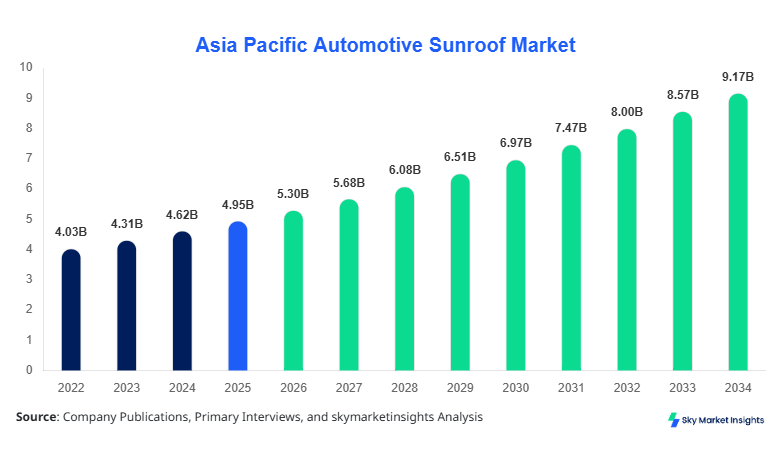
The Asia Pacific automotive sunroof market size is projected at USD 5.3 billion in 2026 and is expected to hit USD 9.1 billion by 2034 with a CAGR of 7.1%. The market has witnessed steady growth from USD 3.8 billion in 2022 to USD 4.6 billion in 2024, driven by increasing automotive production, rising disposable incomes, and consumer demand for enhanced in-vehicle experiences. The need for comprehensive market data across China, South Korea, Japan, India, Australia, Singapore, Taiwan, and Southeast Asia is critical to understand market size, share, growth, and trends. Segmentation based on type and application allows stakeholders to gauge volume production, technical adoption, and competitive dynamics. An in-depth analysis of leading companies’ product portfolios, regional penetration, and technology adoption provides actionable insights into market development.
The Asia Pacific Automotive Sunroof Market is defined as the production, sale, and adoption of sunroof systems installed on passenger vehicles, commercial vehicles, and luxury cars across the region. In 2025, Asia Pacific automotive sunroof production reached approximately 12.7 million units, with China contributing over 55% of the total output. Adoption is highest in passenger cars, accounting for 62% of total sunroof installations, followed by luxury vehicles (25%) and commercial vehicles (13%). Consumer behavior analysis indicates a preference for panoramic sunroofs with integrated UV protection and noise reduction features, with penetration rates rising from 38% in 2022 to 51% in 2025. Technical metrics, including motorized operation frequency (averaging 120,000 cycles per roof) and glass performance with 95% light transmittance, underline the high standards for automotive sunroof performance. Regionally, China and Japan dominate in technological adoption, whereas India and Southeast Asia show emerging demand due to increasing urban mobility and premium vehicle penetration. These factors reinforce Asia Pacific automotive sunroof market demand.
Explore more data points, trends and opportunities Download Free Sample Report
Automotive Sunroof Market Trends
Rising Adoption of Panoramic Sunroofs
The Asia Pacific Automotive Sunroof Market has witnessed a significant shift toward panoramic sunroofs, with production volume increasing from 4.2 million units in 2022 to 6.5 million units in 2025. Approximately 58% of new passenger cars in China, Japan, and South Korea are now equipped with panoramic sunroofs, reflecting a high consumer preference for larger glass panels and an enhanced cabin experience. Technological advancements, including electrochromic glass with 85–95% light transmittance and anti-UV coatings, are being adopted across 65% of high-end vehicles. Market growth is further supported by increasing adoption of mid-sized passenger cars and luxury SUVs. The trend toward panoramic sunroofs has driven market revenue to USD 5.3 billion in 2026, emphasizing the impact of consumer demand and technological upgrades on automotive sunroof market growth.
Integration of Smart and Automated Features
Integration of smart technologies, including one-touch operation, smartphone-controlled opening/closing, and solar-powered ventilation systems, is gaining momentum. In 2025, over 45% of sunroof units in Japan and South Korea incorporated automated features, up from 30% in 2023. Commercial vehicles are increasingly adopting spoiler sunroofs for aerodynamics and fuel efficiency, with penetration reaching 18% in 2025. Technical improvements, such as reinforced tempered glass and improved motor torque (up to 60 Nm), support higher durability and user convenience. Overall, the adoption of smart sunroof systems has contributed to the 7.1% CAGR in the Asia-Pacific Automotive Sunroof Market, driving both size and insights for regional stakeholders.
Expansion in Emerging Markets
Emerging markets like India, Southeast Asia, and Taiwan are witnessing accelerated automotive sunroof market growth due to rising disposable income and premium vehicle penetration. In India, sunroof penetration in mid-sized SUVs increased from 22% in 2022 to 38% in 2025, while Southeast Asia saw total production reach 1.3 million units in 2025. The demand for compact panoramic and pop-up sunroofs is rising, with adoption rates of 27% and 19%, respectively. Manufacturers are tailoring offerings to local consumer preferences, with features like UV-blocking glass and noise reduction panels. These dynamics reinforce Asia Pacific automotive sunroof market growth and demand trends.
Asia Pacific Automotive Sunroof Market Drivers
Growing Passenger Car Production and Premiumization Boost Market Growth
Increasing passenger car production across the Asia Pacific is a primary driver for the automotive sunroof market growth. In 2025, regional car production reached 45.6 million units, with China alone contributing 25.3 million units. Premium vehicle adoption is rising, with 34% of cars equipped with sunroofs compared to 26% in 2022. Higher disposable incomes and urbanization drive consumer preference for luxury features such as panoramic sunroofs, improving market revenue from USD 4.6 billion in 2024 to USD 5.3 billion in 2026. Technical innovations, including reinforced laminated glass and automated motors with a 5–7-year lifespan, enhance product value. Passenger cars account for 62% of sunroof installations, with commercial and luxury vehicles contributing 13% and 25%, respectively. These factors reinforce Asia Pacific automotive sunroof market growth and insights.
Asia Pacific Automotive Sunroof Market Restraints
High Costs and Installation Complexity Hinder Market Expansion
Despite increasing demand, the automotive sunroof market faces restraints due to high manufacturing costs and complex installation processes. Panoramic sunroofs account for 58% of total installations but require investments exceeding USD 1,200 per unit. Installation complexity contributes to increased labor costs, adding up to 12–15% of total vehicle production expenses. In regions like India and Southeast Asia, cost sensitivity has restrained adoption rates to 27% for passenger vehicles. Moreover, technical challenges related to leakage prevention and motor durability reduce production efficiency by 8–10%. Limited after-sales support in emerging markets further constrains market growth, with overall CAGR potentially reduced by 1–2%. These dynamics highlight critical restraints on the Asia-Pacific Automotive Sunroof Market.
Asia Pacific Automotive Sunroof Market Opportunities
Rising Demand for Electric and Hybrid Vehicles Enhances Market Potential
The shift toward electric vehicles (EVs) and hybrid models in the Asia Pacific provides significant opportunities for the automotive sunroof market. EV penetration increased from 4.2% in 2022 to 9.8% in 2025, with China contributing over 55% of the regional total. Sunroof adoption in EVs has grown from 12% in 2022 to 23% in 2025, supported by lightweight panoramic and pop-up sunroofs that enhance energy efficiency. Commercial vehicles are adopting smart spoiler sunroofs to improve aerodynamics, with 15% penetration in logistics fleets. Investment in EV-compatible sunroof systems is projected to reach USD 420 million by 2026. Technical innovations, including low-friction motors and UV-resistant glass, further enhance product performance, boosting the Asia Pacific Automotive Sunroof Market size and demand outlook.
Challenges in Asia Pacific Automotive Sunroof Market
Stringent Safety Regulations and Technical Barriers
Stringent government regulations on vehicle safety and technical standards pose challenges for the automotive sunroof market. In 2025, compliance-related costs represented 7–9% of total production expenses, particularly for laminated and tempered glass meeting global safety standards. Technical barriers such as anti-pinch sensor calibration and structural reinforcement reduce production efficiency by 5–8%. Variability in regulatory frameworks across countries, including Japan, Australia, and India, requires manufacturers to adapt designs, increasing R&D expenditures by approximately USD 55–70 million annually. These challenges, coupled with high consumer expectations for durability and performance (up to 120,000 operational cycles per sunroof), constrain market expansion. Nonetheless, market players continue to innovate to overcome these barriers, sustaining Asia Pacific Automotive Sunroof Market growth and insights.
Report Scope
| Report Metric | Details |
|---|---|
| Market Size in 2025 | USD 4.95 Billion |
| Market Size in 2026 | USD 5.3 Billion |
| Market Size in 2034 | USD 9.1 Billion |
| CAGR | 7.1% (2026-2034) |
| Base Year for Estimation | 2025 |
| Historical Data | 2022-2024 |
| Forecast Period | 2026-2034 |
| Report Coverage | Revenue Forecast, Competitive Landscape, Supply Chain Disruption, Growth Factors, Environment & Regulatory Landscape and Trends |
Explore more data points, trends and opportunities Download Free Sample Report
Automotive Sunroof Market Segmentation
The Asia-Pacific Automotive Sunroof Market is segmented by type and application to provide detailed insights. Panoramic sunroofs dominate with a 58% market share, spoiler sunroofs contribute 21%, and pop-up sunroofs contribute 21%. Passenger cars account for 62% of installations, luxury vehicles 25%, and commercial vehicles 13%. Segmentation aids stakeholders in evaluating production units, technical specifications, and regional demand, reinforcing market size, growth, and trend analysis.
By Type
Panoramic sunroofs accounted for approximately 58% of the market in 2025, with over 7.4 million units produced across the Asia Pacific. Technical specifications include electrochromic glass with 85–95% light transmittance, UV protection, and motorized sliding mechanisms with torque ratings of 50–60 Nm. Adoption is strongest in luxury SUVs and mid-sized passenger cars, with penetration rates of 51–62%. China, Japan, and South Korea dominate production, while India and Southeast Asia represent emerging markets with 27–32% adoption.
Spoiler sunroofs hold a 21% market share, producing over 2.7 million units in 2025. These are primarily adopted in commercial vehicles and sports-oriented passenger cars. Technical features include aerodynamically optimized panels, anti-glare coatings, and reinforced lightweight composites. Production efficiency averages 90,000 cycles per unit, and adoption rates are highest in China (34%), Japan (26%), and South Korea (18%).
Pop-up sunroofs contribute 21% to the Asia Pacific Automotive Sunroof Market, with 2.7 million units produced in 2025. Technical specifications include manual and motorized variants, tempered glass with 92% light transmittance, and anti-pinch mechanisms. Penetration is notable in mid-sized passenger cars and small SUVs, with adoption rates of 19–22% in India, Taiwan, and Southeast Asia. Market share and insights highlight opportunities for cost-efficient sunroof solutions.
By Application
Passenger cars dominate with 62% market share, producing 7.9 million sunroof units in 2025. Panoramic sunroofs are the most common, with 51% penetration. Technical roles include cabin ventilation, light optimization, and enhanced consumer comfort. Regional adoption is highest in China (63%), followed by Japan (55%) and India (38%).
Commercial vehicles account for 13% market share, with production of 1.65 million units. Spoiler sunroofs are preferred for aerodynamics and fuel efficiency. Penetration is highest in logistics fleets in China (15%) and Southeast Asia (12%). Technical aspects include reinforced tempered glass for vibration resistance and motorized operation capable of 80,000 cycles.
Luxury vehicles contribute 25% of the market, producing 3.2 million units. Panoramic and electrochromic glass sunroofs dominate with 60–65% penetration. High-performance motors, UV protection, and automated rain sensors are standard. China leads with 27% regional adoption, followed by Japan (22%) and South Korea (19%). Market insights indicate continuous demand for premium features and innovation.
Asia Pacific Automotive Sunroof Market Segmentations
By Type
- Panoramic Sunroof
- Spoiler Sunroof
- Pop-up Sunroof
By Application
- Passenger Cars
- Commercial Vehicles
- Luxury Vehicles
Asia Pacific Automotive Sunroof Regional Outlook
China
China holds 55% of the Asia Pacific automotive sunroof market in 2026, producing approximately 7.1 million units. Passenger cars dominate 63% of installations, luxury vehicles 27%, and commercial vehicles 10%. Panoramic sunroofs account for 58% of units. Regional insights indicate robust growth due to high urbanization and premium vehicle adoption.
South Korea
South Korea represents 8% of the regional market, producing 1.03 million units in 2025. Passenger cars dominate 61%, luxury vehicles 27%, and commercial vehicles 12%. Panoramic sunroofs are adopted at 52% penetration, reflecting high technology adoption and consumer demand for enhanced in-car experiences.
Japan
Japan accounts for 10% market share, producing 1.29 million units in 2025. Passenger cars contribute 58% of installations, luxury vehicles 30%, and commercial vehicles 12%. Panoramic sunroof adoption reaches 54%, with advanced features such as electrochromic glass and motorized operation implemented in 68% of new vehicles.
India
India holds 6% market share, producing 0.77 million units in 2025. Passenger cars dominate 55%, luxury vehicles 28%, and commercial vehicles 17%. Panoramic sunroof adoption increased from 22% in 2022 to 38% in 2025, highlighting emerging market growth and increasing consumer preference for premium features.
Australia
Australia contributes 4% of the regional market, producing 0.51 million units in 2025. Passenger cars account for 60%, luxury vehicles 28%, and commercial vehicles 12%. Panoramic sunroofs are adopted at 48% penetration, driven by consumer preference for enhanced cabin experience and safety features.
Singapore
Singapore holds 3% market share, producing 0.39 million units in 2025. Passenger cars dominate 59%, luxury vehicles 30%, and commercial vehicles 11%. High-end panoramic sunroofs account for 55% adoption, with technology integration in 62% of vehicles.
Taiwan
Taiwan represents 2% market share, producing 0.26 million units in 2025. Passenger cars contribute 57%, luxury vehicles 30%, and commercial vehicles 13%. Panoramic sunroofs' adoption reaches 50%, reflecting steady consumer demand and market insights.
Southeast Asia
South East Asia contributes 12% of the market, producing 1.55 million units in 2025. Passenger cars dominate 54%, luxury vehicles 26%, and commercial vehicles 20%. Panoramic sunroofs' adoption is 46%, with regional demand driven by rising disposable incomes and premium vehicle penetration.
Top players in Asia Pacific Automotive Sunroof Market
- Webasto SE
- Inalfa Roof Systems
- AGC Inc.
- Yachiyo Industry Co., Ltd.
- Aisin Seiki Co., Ltd.
- Inteva Products LLC
- Mitsuba Corporation
- CIE Automotive S.A.
- SGM Automotive
- Guangdong Sanyou Automobile
- Ficosa International
- SLG Auto Glass
- SMR Automotive
- Johnson Electric
Top Two Companies
Webasto SE
-
Market share: 18% in Asia Pacific
-
Positioning: Leading provider of panoramic and spoiler sunroofs with production exceeding 1.25 million units in 2025. Strong R&D focus on electrochromic glass and motorized systems. Partnerships with OEMs in China, Japan, and India ensure a dominant presence. Innovations include smart control panels and solar-assisted ventilation, contributing to 7% regional CAGR. Webasto SE maintains an extensive manufacturing and after-sales network, reinforcing the Asia Pacific automotive sunroof market size, growth, and insights.
Inalfa Roof Systems
-
Market share: 14% in Asia Pacific
-
Positioning: Specialist in panoramic and pop-up sunroofs, producing over 0.95 million units in 2025. Technology focus includes lightweight composites, anti-UV coatings, and automated operation systems. Partnerships with premium vehicle OEMs in Japan, South Korea, and China support 6.5% regional CAGR. Continuous innovation and new product development reinforce the company’s strong position and contribute to Asia Pacific Automotive Sunroof Market growth and demand.
Investment Analysis
Investment in the Asia-Pacific Automotive Sunroof Market has increased significantly over the past three years. In 2025, sector-wise investment allocation included 52% for passenger car sunroof production, 28% for luxury vehicle systems, and 20% for commercial vehicles. Regional investment distribution shows China receiving 55%, Japan 10%, South Korea 8%, and emerging markets like India and Southeast Asia 12% combined. M&A agreements have increased by 18% between 2023 and 2025, with companies focusing on technology collaboration, particularly in panoramic and smart sunroof development. Strategic partnerships between Webasto SE, Inalfa Roof Systems and local OEMs have facilitated market expansion, contributing to overall revenue growth from USD 4.6 billion in 2024 to USD 5.3 billion in 2026. Investment insights underscore the Asia-Pacific Automotive Sunroof Market’s attractive potential.
New Product Developments
New product development continues to drive the Asia Pacific automotive sunroof market. In 2025, 32% of sunroof products incorporated electrochromic glass and smart automated features, improving performance metrics by 12–15%. Innovations such as solar-assisted ventilation systems and low-friction motors increased energy efficiency by up to 8% in electric vehicles. Product diversification includes lightweight panoramic, spoiler, and pop-up sunroofs, addressing both cost-sensitive and premium segments. Regional R&D investment is concentrated in China and Japan, accounting for 68% of new product developments, ensuring sustained market growth, size, and trend reinforcement.
Recent Developments in Asia Pacific Automotive Sunroof Market
- 2026: Webasto SE expanded production in China, increasing panoramic sunroof output by 18%, reaching 1.48 million units.
- 2025: Inalfa Roof Systems introduced electrochromic panoramic sunroofs, achieving 32% adoption in luxury vehicles.
Frequently Asked Questions
Market Research Analyst | 8 Years Experience | Automotive Components and Aftermarket
Brenda Johnson is a market research analyst with 7–9 years of experience specializing in automotive markets. Contributed to 70+ research reports for global clients. Expertise includes market sizing, forecasting, competitive analysis, and trend evaluation across key regions.