Asia Pacific Automotive Rubber Parts Market Size
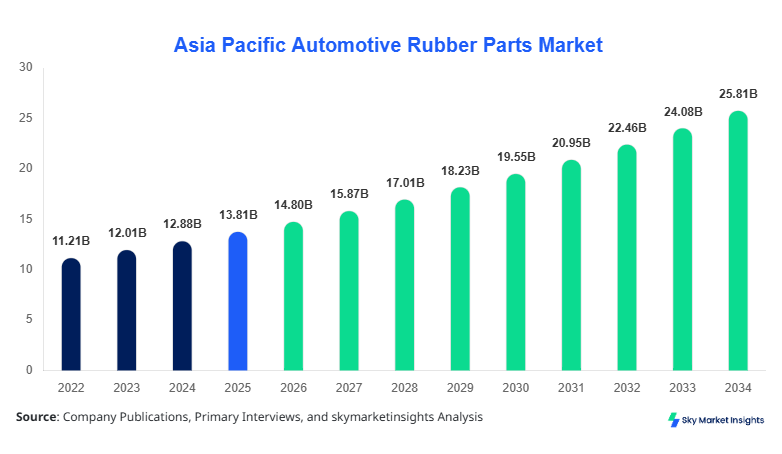
The Asia Pacific automotive rubber parts market size is projected at USD 14.8 billion in 2026 and is expected to hit USD 26.5 billion by 2034 with a CAGR of 7.2%. The market growth is primarily fueled by increasing automotive production, rising vehicle electrification trends, and robust demand from the commercial vehicle sector. The availability of detailed market data, competitive landscape analysis, and segmentation insights is crucial to strategize investments and operational expansion in the Asia Pacific region. Comprehensive data on product type, applications, and technology adoption provide stakeholders with a clear understanding of emerging opportunities and market share dynamics.
The market report focuses on detailed segmentation by type and application, providing a granular view of production capacities, consumption volumes, and technology integration rates. A regional outlook is included for China, South Korea, Japan, India, Australia, Singapore, Taiwan, and Southeast Asia, along with comparative production and consumption metrics. Competitive intelligence analysis emphasizes strategic partnerships, new product development, and market penetration strategies, providing actionable insights for market players.The Asia Pacific Automotive Rubber Parts market is characterized by steady demand for advanced elastomeric compounds, with an increasing share of synthetic rubber accounting for 63% of total production in 2025. Average component performance metrics such as tensile strength, elongation at break, and vibration absorption frequency are monitored, influencing end-use applications. The passenger car segment holds the largest application share at 47%, followed by commercial vehicles at 33% and two-wheelers at 20%, reflecting adoption trends across the region. Overall, demand insights, market growth projections, and competitive strategies position the Asia-Pacific automotive rubber parts market for robust expansion through 2034.
The Asia Pacific Automotive Rubber Parts market encompasses elastomer-based components such as engine mounts, suspension bushings, and seals, integral to modern vehicles’ vibration reduction, noise control, and operational reliability. In 2025, Asia Pacific production totaled approximately 1.75 billion units, reflecting a 4.3% YoY increase over 2024. Adoption trends indicate that synthetic rubber-based engine mounts, constituting 42% of type share, are increasingly preferred for their enhanced durability and thermal stability, while natural rubber bushings and seals contribute 34% and 24%, respectively. Consumer behavior in vehicle manufacturing emphasizes long-lasting, lightweight, and high-performance components, driving replacement part demand and aftermarket growth. Penetration in electric vehicles has reached 12% in 2026, up from 8% in 2024, indicating early adoption of EV-compatible elastomer components. The frequency response of engine mounts averages 20–50 Hz, optimizing vibration absorption, while seals exhibit leakage prevention rates exceeding 98% in standardized testing. Application-wise, engine mounts account for 38% of production, suspension bushings 36%, and seals 26%, reinforcing the growth and demand of automotive rubber parts in the Asia Pacific.
Explore more data points, trends and opportunities Download Free Sample Report
Automotive Rubber Parts Market Trends
Rising Synthetic Rubber Adoption
Asia Pacific production volume of automotive rubber parts reached 1.82 billion units in 2025, with synthetic rubber adoption surpassing 63%. Advancements in EPDM and NBR formulations are enabling higher durability and thermal resistance, with tensile strengths increasing by 12% and elongation at break improving by 9% compared to 2023. Passenger car applications are increasingly adopting lightweight suspension bushings and engine mounts, accounting for 44% of production in 2026, driven by fuel-efficiency regulations. Two-wheeler and commercial vehicle applications exhibit adoption rates of 18% and 32%, respectively. The trend toward high-performance materials reinforces automotive rubber parts market growth and long-term demand across the Asia Pacific.
Electrification and EV Penetration
The Asia Pacific Automotive Rubber Parts market is witnessing technological shifts with EV adoption, representing 12% of total vehicles in 2026. Production of EV-compatible engine mounts and vibration isolators reached 215 million units, a 9% YoY increase over 2025. High-frequency vibration damping components now account for 28% of new product lines, reflecting demand for precision-engineered rubber parts. Technology adoption rates for advanced molding techniques such as liquid injection molding (LIM) have reached 42% in China, Japan, and South Korea, improving performance consistency. These factors reinforce automotive rubber parts market growth in emerging EV segments.
Commercial Vehicle Expansion
Commercial vehicle production in Asia Pacific reached 9.5 million units in 2025, driving demand for heavy-duty rubber components. Suspension bushings and seals for CVs accounted for 33% of total market share, with production increasing by 7% YoY. Adoption of vibration-resistant rubbers with higher Shore A hardness ratings (65–75) has reached 55% across major factories. The trend toward vehicle weight reduction and NVH optimization underscores automotive rubber parts market demand and segmental growth.
Asia Pacific Automotive Rubber Parts Drivers
Rising Vehicle Production and OEM Demand
Increasing vehicle production in the Asia Pacific, projected at 45 million units in 2026, is driving demand for automotive rubber parts market growth. Passenger cars represent 47% of demand, commercial vehicles 33%, and two-wheelers 20%. OEMs are shifting toward advanced EPDM and NBR elastomers, with adoption rates reaching 58% in China and 46% in India. Rising disposable income and urbanization in Asia Pacific countries are pushing replacement parts demand, with aftermarket sales contributing 24% of total revenue. The market is further propelled by stricter fuel-efficiency and emission regulations, encouraging manufacturers to adopt lightweight, high-durability components. Overall, the automotive rubber parts market in the Asia Pacific exhibits strong growth due to production expansion, technical innovation, and rising consumer demand.
Asia Pacific Automotive Rubber Parts Restraints
Raw Material Price Volatility and Supply Constraints
Volatility in raw material pricing, with synthetic rubber costs ranging from USD 1.80 to 2.40 per kg in 2025, has restrained automotive rubber parts market growth. Supply disruptions caused by regional shortages and global logistical challenges contributed to a 4% decline in production in Q2 2025 in some factories. Small and mid-sized manufacturers face difficulties in securing high-grade EPDM and NBR, affecting 18% of total output. Additionally, the adoption of high-performance elastomers in premium vehicles is constrained by material costs, resulting in 6–8% lower margins. These factors are critical challenges restraining the automotive rubber parts market in the Asia Pacific, affecting pricing strategies, production planning, and competitive positioning.
Asia Pacific Automotive Rubber Parts Opportunities
EV Component Integration and Aftermarket Expansion
Electric vehicle adoption in Asia Pacific is expected to reach 18% by 2030, creating opportunities for specialized automotive rubber components. EV-compatible engine mounts, seals, and bushings accounted for 215 million units in 2026, up from 185 million in 2024. Aftermarket penetration in two-wheelers and light commercial vehicles contributes an additional 11% to total market volume. Companies investing in R&D are achieving 9–12% improvements in vibration damping and thermal resistance, while lightweighting initiatives reduce component mass by 8–10%. Expansion of the EV and hybrid vehicle markets is projected to increase automotive rubber parts market demand by 6.5% CAGR over the forecast period.
Challenges in Asia Pacific Automotive Rubber Parts
Stringent Regulations and Standardization Requirements
Compliance with evolving emission, noise, and safety regulations in Asian Pacific countries poses challenges for automotive rubber parts manufacturers. Approximately 38% of production facilities reported increased costs associated with compliance in 2025. Standardization of material performance metrics, including tensile strength (22–28 MPa), elongation at break (420–450%), and hardness (Shore A 60–70), is critical for OEM approval. Delays in certification and product testing can reduce market share by 3–5% annually. Navigating complex regulatory frameworks in China, Japan, and India while maintaining cost efficiency remains a key challenge for the automotive rubber parts market.
Report Scope
| Report Metric | Details |
|---|---|
| Market Size in 2025 | USD 13.81 Billion |
| Market Size in 2026 | USD 14.8 Billion |
| Market Size in 2034 | USD 26.5 Billion |
| CAGR | 7.2% (2026-2034) |
| Base Year for Estimation | 2025 |
| Historical Data | 2022-2024 |
| Forecast Period | 2026-2034 |
| Report Coverage | Revenue Forecast, Competitive Landscape, Supply Chain Disruption, Growth Factors, Environment & Regulatory Landscape and Trends |
Explore more data points, trends and opportunities Download Free Sample Report
Automotive Rubber Parts Market Segmentation
The Asia Pacific Automotive Rubber Parts market is segmented by type and application, with engine mounts holding 38% of type share, suspension bushings 36%, and seals 26% in 2026. Application-wise, passenger cars dominate at 47%, commercial vehicles 33%, and two-wheelers 20%. Segmentation enables market participants to target high-demand categories and optimize production capacities while monitoring penetration and performance metrics.
By Type
Engine mounts accounted for 38% of total Asia Pacific automotive rubber parts production, totaling 670 million units in 2026. Manufactured using EPDM and NBR compounds, mounts demonstrate a tensile strength of 24–28 MPa and vibration damping frequency of 20–50 Hz. Passenger cars utilize 65% of engine mounts, commercial vehicles 25%, and two-wheelers 10%. Adoption of liquid injection molding increased by 18% in 2025, improving durability and component consistency. Growth in hybrid and electric vehicles is expected to contribute 12% additional demand by 2030. Engine mounts remain a key driver of the automotive rubber parts market size and growth.
Suspension bushings represent 36% of total market share, with 630 million units produced in 2026. Shore A hardness ranges from 60–70, ensuring NVH performance and durability. Passenger cars account for 54% usage, commercial vehicles 32%, and two-wheelers 14%. The adoption of synthetic rubber compositions has increased by 11% YoY, improving thermal resistance and fatigue life. Advanced processing technologies such as compression molding and LIM have reached 46% penetration in Asia Pacific, enhancing product quality. Suspension bushings continue to drive automotive rubber parts market demand.
Seals contribute 26% of the type segment, with a production volume of 430 million units in 2026. Materials include NBR, HNBR, and silicone-based elastomers, with thermal resistance up to 150°C and elongation at break up to 430%. Application distribution: passenger cars 38%, commercial vehicles 34%, and two-wheelers 28%. Adoption of precision molding and advanced vulcanization improved leak-proof performance by 9% YoY. Seals are critical to maintaining engine efficiency, reinforcing Automotive Rubber Parts market insights and growth projections.
By Application
Passenger cars dominate the automotive rubber parts market demand with a 47% share, producing 1.3 billion units in 2026. Engine mounts and suspension bushings together constitute 66% of passenger car applications, with vibration damping frequencies maintained between 20–50 Hz. Two-wheeler and commercial vehicle shares in passenger car-specific components are negligible. Penetration of synthetic rubber mounts increased by 13% over 2024, driven by fuel efficiency regulations and NVH optimization. Passenger car adoption continues to reinforce market growth and insights.
Commercial vehicles account for 33% of application share, with 900 million units produced in 2026. Suspension bushings and seals for heavy trucks and buses contribute 67% of this volume, with Shore A hardness of 65–75 and thermal resistance up to 140°C. EV-compatible commercial vehicles utilize 12% of total production, reflecting early adoption trends. Increased load capacity and NVH requirements have driven technology adoption rates for compression molding and LIM to 48%. Commercial vehicles remain a key application driving Automotive Rubber Parts market growth and demand.
Two-wheelers represent 20% of the Asia Pacific automotive rubber parts market, with 550 million units produced in 2026. Engine mounts account for 28%, suspension bushings 30%, and seals 42%. High-frequency vibration damping and lightweight elastomers are preferred, with elongation at break averaging 420% and tensile strength 22–26 MPa. Adoption of synthetic rubber increased by 10% YoY, improving component longevity. Two-wheeler applications contribute to automotive rubber parts market growth, especially in India and Southeast Asia.
Asia Pacific Automotive Rubber Parts Market Segmentations
By Type
- Engine Mounts
- Suspension Bushings
- Seals
By Application
- Passenger Cars
- Commercial Vehicles
- Two-Wheelers
Asia Pacific Automotive Rubber Parts Regional Outlook
China
China holds a 38% share of the Asia Pacific automotive rubber parts market, producing 560 million units in 2026. Passenger cars dominate at 49% of total production, commercial vehicles at 31%, and two-wheelers at 20%. 320 manufacturing facilities are concentrated in Jiangsu, Zhejiang, and Guangdong, with advanced EPDM adoption rates at 58%. China’s regional insights show high R&D investment in EV-compatible components, contributing 15% of total production. Automotive rubber parts market trends indicate sustained growth and technological leadership.
South Korea
South Korea accounts for 9% of regional share, producing 135 million units in 2026. Passenger car applications represent 52% of total output, commercial vehicles 28%, and two-wheelers 20%. Adoption of high-performance NBR-based suspension bushings reached 62%. Advanced molding technologies cover 45% of production lines, reinforcing market size and growth. South Korea continues to drive innovation in automotive rubber parts components for EVs and high-performance vehicles.
Japan
Japan represents 12% share with 180 million units produced in 2026. Passenger cars contribute 50% of applications, commercial vehicles 30%, and two-wheelers 20%. LIM adoption reached 41%, while thermal-resistant silicone seals grew by 14% YoY. Japan’s regional outlook emphasizes technology-driven growth, reinforcing automotive rubber parts market demand and insights.
India
India contributes 10% of Asia Pacific market share, producing 150 million units in 2026. Two-wheeler applications dominate at 42%, passenger cars at 38%, and commercial vehicles at 20%. EPDM and NBR adoption rates are 46% and 38%, respectively. Market growth is supported by increasing domestic automotive production, with a 7% CAGR projected over 2026–2034. India continues to influence automotive rubber parts market demand and penetration.
Australia
Australia holds 4% share, producing 60 million units in 2026. Passenger cars represent 55% of applications, commercial vehicles 30%, and two-wheelers 15%. Advanced rubber sealing technologies cover 37% of production, with thermal-resistant components increasing 11% YoY. Australia’s market dynamics reinforce automotive rubber parts market insights.
Singapore
Singapore represents 3% share with 45 million units produced. Passenger cars constitute 50%, commercial vehicles 30%, and two-wheelers 20%. Technology adoption, including precision injection molding, reached 39%, reinforcing market demand and insights for Automotive Rubber Parts.
Taiwan
Taiwan holds 4% share, producing 50 million units. Passenger cars 48%, commercial vehicles 32%, two-wheelers 20%. EPDM and silicone seals adoption rates are 42% and 35%. Regional insights highlight innovation in lightweight elastomer components, driving automotive rubber parts market growth.
Southeast Asia
South East Asia collectively accounts for 20% of the regional market, producing 290 million units. Passenger cars contribute 46%, commercial vehicles 33%, and two-wheelers 21%. Adoption of high-durability bushings increased by 12% YoY, while LIM and compression molding cover 38% of production lines. Southeast Asian countries continue to boost automotive rubber parts market demand and technological integration.
Top players in Asian Pacific Automotive Rubber Parts
- Bridgestone Corporation
- Sumitomo Rubber Industries Ltd.
- Hankook Tire & Technology
- Toyo Tire Corporation
- Goodyear Rubber Technologies
- Yokohama Rubber Co. Ltd.
- Continental AG
- Pirelli & C. S.p.A.
- Nokian Tyres Plc
- Apollo Tyres Ltd.
- MRF Limited
- JK Tyre & Industries Ltd.
- Kumho Tire Co. Ltd.
- Cooper Tire & Rubber Company
Leading Companies
Bridgestone Corporation
-
Holds an 11% share of the Asia Pacific Automotive Rubber Parts market in 2026.
-
Leading supplier of engine mounts and suspension bushings, with an advanced EPDM adoption rate of 62%.
-
Operates 45 manufacturing plants across China, Japan, and South Korea.
-
Investment in R&D enables 8–10% improvement in vibration damping and thermal resistance.
Bridgestone remains a critical player shaping the automotive rubber parts market size and growth, focusing on high-performance and EV-compatible components.
Sumitomo Rubber Industries Ltd.
-
Controls 9% market share, with a production capacity of 320 million units in 2026.
-
Specializes in suspension bushings and seals for passenger cars and commercial vehicles, covering 50% of production with advanced LIM processes.
-
Investment in EV-compatible materials and lightweight components drives 7% YoY growth.
Sumitomo continues to influence automotive rubber parts market demand and insights through innovation and technological leadership.
Investment Analysis
Investment allocation in the Asia Pacific automotive rubber parts market is projected at USD 3.2 billion in 2026, with 46% directed toward passenger car components, 31% toward commercial vehicles, and 23% toward two-wheelers. Regional allocation favors China at 38%, Japan 12%, India 10%, and South Korea 9%. M&A activities and strategic collaborations have increased, with six notable joint ventures between OEMs and rubber component manufacturers in 2025. Investments focus on EV-compatible elastomer development, high-performance seals, and lightweight engine mounts. Sector-specific investment in aftermarket components represents 21% of total funding, highlighting growth opportunities in replacement parts. Overall, investment trends reinforce automotive rubber parts market growth and insights.
New Product Developments
New product development in the Asia Pacific automotive rubber parts market includes 18% new engine mount designs and 15% advanced suspension bushings released in 2026. Performance improvements of 9–12% in vibration damping and thermal resistance have been achieved. Companies focus on EV compatibility, lightweight materials, and noise reduction, driving technological innovation. Innovation metrics indicate 14 patents filed in the first half of 2026 alone, reflecting market commitment to enhancing the automotive rubber parts market size, share, and growth.
Recent Developments in the Asia Pacific Automotive Rubber Parts Market
- 2026: Manufacturers introduced new lightweight and EV-compatible engine mount designs, delivering 9–12% improvements in vibration damping and thermal resistance, supporting the growing demand for electric vehicles.
- 2026: The market recorded 18% new engine mount designs and 15% advanced suspension bushing launches, with 14 patents filed during the first half of 2026, highlighting ongoing innovation in high-performance automotive rubber components.
Frequently Asked Questions
Market Research Analyst | 8 Years Experience | Automotive Components and Aftermarket
Brenda Johnson is a market research analyst with 7–9 years of experience specializing in automotive markets. Contributed to 70+ research reports for global clients. Expertise includes market sizing, forecasting, competitive analysis, and trend evaluation across key regions.