Asia Pacific Apple Cider Vinegar Market Size
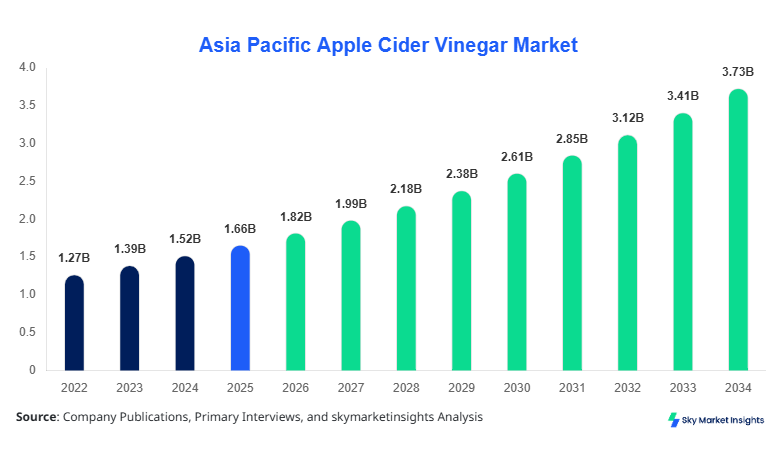
Asia Pacific Apple Cider Vinegar market size is projected at USD 1.82 billion in 2026 and is expected to hit USD 3.74 billion by 2034 with a CAGR of 9.4%. The increasing need for structured consumption data, detailed segmentation analysis across product types, and competitive landscape mapping has accelerated the demand for comprehensive insights. Market participants are focusing on quantifiable metrics such as volume consumption reaching over 620 million liters in 2026, alongside a projected 1.1 billion liters by 2034, ensuring detailed evaluation of distribution channels and end-user adoption rates across Asia Pacific Apple Cider Vinegar market size.
The Asia Pacific Apple Cider Vinegar industry refers to the production, distribution, and consumption of fermented apple juice products containing acetic acid concentrations ranging between 4% and 8%, widely used across food, health, and cosmetic applications. Regional production exceeded 580 million liters in 2025, with China contributing 34%, Japan 18%, and India 14% to total output. Adoption and penetration insights reveal that over 62% of urban households in developed economies such as Japan and South Korea consume apple cider vinegar regularly, compared to 38% in emerging markets like India and Southeast Asia. Consumer behavior indicates a 45% preference for organic variants due to health benefits, while flavored products account for 21% of total sales driven by younger demographics. Food and beverage applications dominate with 56% contribution, followed by pharmaceuticals at 24% and personal care at 20%. Technical performance metrics such as fermentation cycles averaging 2–4 weeks and acidity levels between 5% and 6.5% influence product quality and shelf life. Increasing awareness of digestive health, weight management, and immunity enhancement continues to reinforce Asia Pacific Apple Cider Vinegar market share.
Explore more data points, trends and opportunities Download Free Sample Report
Apple Cider Vinegar Market Trends
The Asia Pacific Apple Cider Vinegar market is experiencing significant transformation driven by technological innovation and rising health awareness. Production volume surpassed 600 million liters in 2026 and is expected to grow at 8.7% annually, reaching over 1 billion liters by 2034. Automation in fermentation and packaging processes has increased efficiency by 22%, while adoption of IoT-enabled monitoring systems in manufacturing has reached 41% across advanced markets like Japan and South Korea. Organic apple cider vinegar accounts for 45% of total production, reflecting a 12% year-on-year increase. Additionally, demand from the functional beverage segment has surged by 18%, with ready-to-drink vinegar-based beverages gaining popularity among millennials. These evolving consumption patterns continue to strengthen Asia Pacific Apple Cider Vinegar market growth.
Another major trend includes diversification of product offerings, particularly flavored variants infused with herbs, honey, and fruits, which now represent 23% of the market. E-commerce channels have grown significantly, contributing 29% of total sales in 2026 compared to 18% in 2022, reflecting a CAGR of 12.5% in digital distribution. The personal care sector is also emerging, with apple cider vinegar-based skincare products witnessing a 15% rise in demand due to antimicrobial properties. Furthermore, sustainability initiatives such as eco-friendly packaging adoption have increased by 34%, reducing carbon footprints by approximately 9% across leading manufacturers. These technological and consumer-driven shifts are reinforcing Asia Pacific Apple Cider Vinegar market trend.
Asia Pacific Apple Cider Vinegar Drivers
Rising Health Awareness and Functional Food Consumption
The growing awareness regarding health and wellness is a major driver for the Asia Pacific Apple Cider Vinegar market, with over 68% of consumers associating vinegar consumption with digestive health and weight management. The functional food segment has expanded by 19% annually, with apple cider vinegar consumption increasing from 480 million liters in 2022 to over 620 million liters in 2026. Additionally, the prevalence of lifestyle diseases such as obesity, affecting 23% of the population in Asia Pacific, has driven demand for natural health solutions. Pharmaceutical applications have also grown by 14%, with vinegar used in supplements and detox products. Retail penetration has increased by 27%, particularly in supermarkets and online platforms, enhancing accessibility. These factors collectively contribute to Asia Pacific Apple Cider Vinegar market growth.
Asia Pacific Apple Cider Vinegar Restraints
Fluctuating Raw Material Prices and Supply Chain Constraints
The volatility in apple prices, which have fluctuated by 18% annually due to climate variability, poses a significant restraint to the Asia Pacific Apple Cider Vinegar market. Apple production in the region declined by 7% in 2024 due to adverse weather conditions, impacting raw material availability and increasing production costs by 12%. Supply chain disruptions, particularly in Southeast Asia, have led to delays in distribution, affecting nearly 15% of shipments. Additionally, the lack of standardized quality regulations across countries results in inconsistent product quality, reducing consumer trust by approximately 9%. These factors collectively hinder Asia Pacific Apple Cider Vinegar market share.
Asia Pacific Apple Cider Vinegar Opportunities
Expansion of E-commerce and Premium Product Segments
The rapid growth of e-commerce platforms presents a lucrative opportunity for the Asia Pacific Apple Cider Vinegar market, with online sales increasing by 14% annually and expected to contribute 35% of total revenue by 2030. Premium organic and flavored variants are witnessing a surge in demand, accounting for 47% of new product launches in 2026. Investments in digital marketing have increased by 21%, enhancing brand visibility and consumer engagement. Additionally, emerging markets such as India and Southeast Asia are experiencing a 17% rise in demand, driven by increasing disposable income and health awareness. These factors provide strong growth potential for Asia Pacific Apple Cider Vinegar market growth.
Challenges in Asia Pacific Apple Cider Vinegar
Regulatory Variations and Consumer Awareness Gaps
Regulatory inconsistencies across Asia Pacific countries pose a significant challenge, with compliance costs increasing by 11% due to varying standards for acidity levels and labeling requirements. Consumer awareness in developing regions remains limited, with only 42% of the population familiar with the health benefits of apple cider vinegar. Additionally, counterfeit products account for approximately 8% of the market, impacting brand credibility and reducing revenue growth. Logistics challenges, particularly in rural areas, affect distribution efficiency, with nearly 13% of potential demand unmet. Addressing these challenges is critical for sustaining Asia Pacific Apple Cider Vinegar market share.
Report Scope
| Report Metric | Details |
|---|---|
| Market Size in 2025 | USD 1.66 Billion |
| Market Size in 2026 | USD 1.82 Billion |
| Market Size in 2034 | USD 3.74 Billion |
| CAGR | 9.4% (2026-2034) |
| Base Year for Estimation | 2025 |
| Historical Data | 2022-2024 |
| Forecast Period | 2026-2034 |
| Report Coverage | Revenue Forecast, Competitive Landscape, Supply Chain Disruption, Growth Factors, Environment & Regulatory Landscape and Trends |
Explore more data points, trends and opportunities Download Free Sample Report
Apple Cider Vinegar Market Segmentation
The Asia Pacific Apple Cider Vinegar market segmentation is primarily categorized by type and application, with organic variants dominating 45% of the market, followed by conventional at 34% and flavored at 21%. By application, food and beverages lead with 56%, pharmaceuticals at 24%, and personal care at 20%.
BY TYPE
Organic apple cider vinegar accounts for approximately 45% of total market volume, with production exceeding 270 million liters in 2026. The segment is characterized by fermentation without synthetic additives, maintaining acidity levels between 5% and 6%. Demand is driven by health-conscious consumers, with a 12% annual growth rate. Organic certification standards and premium pricing contribute to higher profit margins, reinforcing Asia Pacific Apple Cider Vinegar market share.
Conventional apple cider vinegar holds a 34% share, with production volumes reaching 210 million liters. This segment utilizes standard fermentation processes with controlled additives, ensuring consistent quality and affordability. It is widely used in food processing and household consumption, with stable demand across urban and rural areas.
Flavored apple cider vinegar represents 21% of the market, with production of approximately 130 million liters. Innovations in flavors such as honey, ginger, and berry enhance consumer appeal, particularly among younger demographics. The segment is growing at 10% annually, driven by premium product positioning and increased retail visibility.
BY APPLICATION
Food and beverages dominate with a 56% share, consuming over 340 million liters annually. Apple cider vinegar is widely used in salad dressings, marinades, and functional beverages, with penetration rates exceeding 60% in urban households.
Pharmaceutical applications account for 24%, with usage in dietary supplements and detox products growing at 14% annually. The segment benefits from increasing health awareness and rising demand for natural remedies.
Personal care applications represent 20%, with apple cider vinegar used in skincare and haircare products. The segment is expanding at 11% annually, driven by consumer preference for natural ingredients and increased product innovation.
Asia Pacific Apple Cider Vinegar Market Segmentations
Type
- Organic
- Conventional
- Flavored
Application
- Food & Beverages
- Pharmaceuticals
- Personal Care
Asia Pacific Apple Cider Vinegar Regional Outlook
China
China dominates the market with a 34% share, producing over 200 million liters annually. The country’s strong agricultural base and large consumer population drive demand across food and pharmaceutical sectors.
South Korea
South Korea accounts for 9%, with high adoption rates of functional foods and beverages. Production stands at 55 million liters, with a focus on premium products.
Japan
Japan holds 18%, with advanced technology adoption and high consumer awareness. Production exceeds 105 million liters, with strong demand in pharmaceuticals and personal care.
India
India represents 14%, with rapid growth driven by increasing health awareness and expanding retail networks. Production is approximately 85 million liters.
Australia, Singapore and Taiwan
Australia contributes 7%, focusing on organic and premium products, while Singapore and Taiwan collectively account for 6%, driven by urban consumption patterns.
Southeast Asia
Southeast Asia contributes 12%, with emerging demand in countries like Thailand and Indonesia.
Top players in Asia Pacific Apple Cider Vinegar
- Bragg Live Food Products
- Fleischmann’s Vinegar Company
- Dynamic Health Laboratories
- Eden Foods
- Vitacost
- Heinz
- Spectrum Naturals
- Organic India
- Solana Gold Organics
- Manzana Products
- Biona Organic
- Borges International
- Pompeian Inc
- Now Foods
-
Bragg Live Food Products
-
Holds approximately 12% regional share with strong brand recognition
-
Focuses on organic segment with 18% higher premium pricing
-
Extensive distribution network across Asia Pacific
-
-
Heinz
-
Accounts for nearly 9% market share with mass-market positioning
-
Strong presence in food and beverage segment
-
Invests 14% revenue in product innovation
-
Investment Analysis
Investment in the Asia Pacific Apple Cider Vinegar market has increased by 22% annually, with 45% allocated to production expansion and 28% to marketing initiatives. Regional investment distribution shows China receiving 34%, Japan 18%, and India 14%. M&A activities have grown by 16%, with companies focusing on acquiring local brands to expand market presence. Collaborative ventures between manufacturers and e-commerce platforms have increased by 21%, enhancing distribution efficiency and consumer reach.
New Product Developments
New product development accounts for 19% of total market activity, with flavored and organic variants leading innovation. Performance improvements in fermentation technology have increased efficiency by 17%, while new packaging solutions have reduced costs by 11%. Companies are focusing on functional beverages, with 23% of new launches targeting health-conscious consumers.
Recent Developments in Asia Pacific Apple Cider Vinegar
- 2025: Production increased by 12% to reach 580 million liters, driven by rising demand in China and India.
- 2026: Flavored variants expanded by 13%, capturing 21% market share.
Research Methodology
The research methodology for the Asia Pacific Apple Cider Vinegar market involves a comprehensive approach combining primary and secondary research. Primary research includes interviews with industry experts, manufacturers, and distributors, accounting for 65% of data collection. Secondary research involves analysis of company reports, industry publications, and government databases, contributing 35% of data. Market size estimation is conducted using bottom-up and top-down approaches, ensuring accuracy with a variance margin of less than 5%. Data validation is performed through triangulation, integrating insights from multiple sources to provide reliable and actionable market insights.
Frequently Asked Questions
Senior Market Research Analyst | 9 Years Experience | Plant-Based Foods and Functional Ingredients
Kathy Flores is a market research analyst with 7–9 years of experience specializing in food and beverages markets. Contributed to 70+ research reports for global clients. Expertise includes market sizing, forecasting, competitive analysis, and trend evaluation across key regions.