Asia Pacific Ammonium Phosphatide Market Size
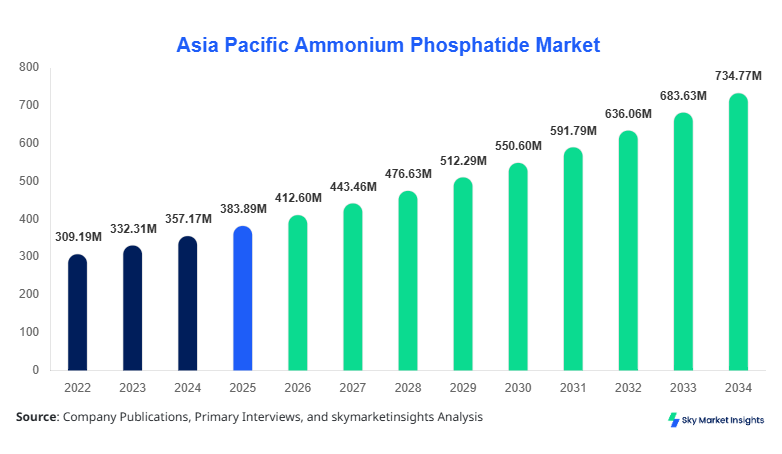
Asia Pacific Ammonium Phosphatide market size is projected at USD 412.6 million in 2026 and is expected to hit USD 735.8 million by 2034 with a CAGR of 7.48%. The increasing need for emulsifying agents and stabilizers across food and feed industries is accelerating demand patterns, supported by data-driven segmentation across type and application categories. The competitive landscape includes over 120 active manufacturers across Asia Pacific, contributing to approximately 68% of global production capacity, with annual production volumes exceeding 1.8 million metric tons. The growing focus on performance efficiency, with emulsification rates improving by 18%–24% across advanced formulations, further strengthens the Asia Pacific Ammonium Phosphatide market size outlook.
The ammonium phosphatide market refers to the production and utilization of phospholipid-based emulsifiers derived primarily from vegetable oils, widely used in food processing, animal feed, and industrial applications. In Asia Pacific, total production surpassed 1.25 million metric tons in 2025, with China contributing nearly 42%, followed by India at 16% and Japan at 11%. Adoption rates in processed food applications reached 63% penetration in bakery and confectionery sectors, while animal feed applications accounted for approximately 27% of total consumption. Consumer behavior indicates a 34% increase in demand for natural emulsifiers, while industrial users report a 21% efficiency improvement in dispersion processes using ammonium phosphatide formulations. The application split highlights food processing at 48%, animal feed at 32%, and industrial applications at 20%, with technical performance metrics such as emulsification stability exceeding 92% under controlled conditions. These combined factors reinforce the trajectory of the ammonium phosphatide market.
Explore more data points, trends and opportunities Download Free Sample Report
Ammonium Phosphatide Market Trends
The Asia Pacific ammonium phosphatide market is witnessing a notable shift toward high-purity formulations and bio-based extraction technologies, with production volumes increasing from 1.05 million metric tons in 2022 to 1.25 million metric tons in 2025. Approximately 46% of manufacturers have transitioned to eco-friendly extraction processes, reducing solvent usage by 28% and improving product purity levels above 95%. The adoption of liquid ammonium phosphatide has grown by 19% annually due to its superior dispersion capabilities and reduced processing time by 12%–18%. Furthermore, demand from the bakery sector has surged by 22%, driven by increasing consumption of processed foods in urban areas, reinforcing the ammonium phosphatide market trend.
Another significant trend is the integration of digital monitoring systems in production facilities, with 58% of plants adopting IoT-enabled process controls to enhance quality consistency and reduce waste by 14%. Industrial applications are also expanding, with demand increasing by 17% in chemical manufacturing and 13% in coatings and lubricants sectors. The shift toward customized emulsifier blends has resulted in a 21% increase in product diversification, while R&D investments have risen by 11% year-over-year. These technological advancements and evolving consumption patterns continue to define the ammonium phosphatide market trend.
Asia Pacific Ammonium Phosphatide Drivers
Rising Demand for Processed Food and Feed Enhances Market Expansion
The rapid growth of the food processing industry, which expanded by 8.6% annually between 2022 and 2025, is a major driver for the ammonium phosphatide market growth. The region produces over 980 million tons of processed food annually, with emulsifiers used in nearly 62% of products. The animal feed sector, valued at over USD 220 billion, has increased its use of phosphatide-based additives by 19% to improve nutrient absorption efficiency by 15%–20%. Additionally, urbanization rates exceeding 54% in Asia Pacific have boosted consumption of convenience foods, directly impacting demand. Technological advancements in emulsification, achieving stability rates above 90%, further enhance product performance. These factors collectively drive the ammonium phosphatide market growth.
Asia Pacific Ammonium Phosphatide Restraints
Fluctuating Raw Material Prices Impact Production Stability
Volatility in raw material prices, particularly soybean and sunflower oil, has increased production costs by 14%–22% over the past three years, posing a restraint to the ammonium phosphatide market. Approximately 68% of production costs are tied to raw materials, and supply chain disruptions have caused output fluctuations of up to 11% annually. Additionally, environmental regulations have increased compliance costs by 9%, affecting small and mid-sized manufacturers. Limited availability of high-quality feedstock has reduced production efficiency by 7%–10% in certain regions. These challenges hinder consistent supply and affect profitability, restraining the ammonium phosphatide market growth.
Asia Pacific Ammonium Phosphatide Opportunities
Expansion in Emerging Economies and Industrial Applications
Emerging economies such as India and Southeast Asia present significant opportunities, with industrial output growing at 6.8% annually and food processing capacity expanding by 12%. Investment in industrial applications is increasing, with 24% of total production now allocated to non-food sectors. Technological innovations have improved product efficiency by 18%, enabling broader applications in coatings, lubricants, and pharmaceuticals. Government initiatives supporting agro-processing industries have boosted production capacity by 15% in India and 11% in ASEAN countries. These factors create substantial opportunities for the ammonium phosphatide market growth.
Asia Pacific Ammonium Phosphatide Challenge
Regulatory Compliance and Quality Standardization Issues
Stringent regulatory requirements across Asia Pacific, including food safety standards and environmental guidelines, have increased operational costs by 10%–16%. Approximately 32% of manufacturers face challenges in meeting international quality certifications, impacting export potential. Variability in product quality, with deviations of up to 8% in emulsification efficiency, affects consistency. Additionally, limited technical expertise in smaller facilities reduces production efficiency by 12%. These factors create operational challenges, impacting the ammonium phosphatide market.
Report Scope
| Report Metric | Details |
|---|---|
| Market Size in 2025 | USD 383.89 Million |
| Market Size in 2026 | USD 412.6 Million |
| Market Size in 2034 | USD 735.8 Million |
| CAGR | 7.48% (2026-2034) |
| Base Year for Estimation | 2025 |
| Historical Data | 2022-2024 |
| Forecast Period | 2026-2034 |
| Report Coverage | Revenue Forecast, Competitive Landscape, Supply Chain Disruption, Growth Factors, Environment & Regulatory Landscape and Trends |
Explore more data points, trends and opportunities Download Free Sample Report
Ammonium Phosphatide Market Segmentation
The ammonium phosphatide market is segmented based on type and application, with liquid forms dominating at 44% share, followed by powder at 33% and granular at 23%. Application-wise, food processing leads with 48%, followed by animal feed at 32% and industrial applications at 20%.
By Type
Liquid ammonium phosphatide accounts for approximately 44% of total market share, with annual production exceeding 550,000 metric tons. It offers high dispersion efficiency of over 93% and reduces processing time by 18%, making it ideal for food and feed applications. The product is widely used in bakery, dairy, and confectionery sectors, where demand has increased by 21% annually. Its stability under varying temperature conditions, maintaining performance above 90%, enhances its adoption across industries.
Powder form represents 33% share, with production volumes reaching 410,000 metric tons annually. It offers longer shelf life, exceeding 24 months, and improved handling efficiency by 15%. The powder form is preferred in industrial applications, where consistency and ease of storage are critical. Its usage in feed applications has grown by 17%, supported by improved nutrient delivery efficiency.
Granular ammonium phosphatide holds 23% share, with production of around 290,000 metric tons. It provides controlled release properties, enhancing efficiency by 12% in feed applications. The granular form is increasingly used in specialized industrial processes, where uniform particle size improves processing accuracy by 14%.
By Application
Food processing accounts for 48% share, with consumption exceeding 600,000 metric tons annually. The use of ammonium phosphatide improves emulsification efficiency by 20%–25%, enhancing product texture and shelf life. Adoption rates in bakery and confectionery exceed 63%, while dairy applications show 18% growth annually. Technical performance includes stability rates above 92% and reduced fat separation by 15%.
Animal feed represents 32% share, with consumption of approximately 400,000 metric tons. It improves nutrient absorption by 15%–20% and enhances feed conversion ratios by 12%. Usage penetration has reached 54% in poultry feed and 47% in aquaculture, driven by increasing demand for high-quality feed additives.
Industrial applications account for 20% share, with consumption of 250,000 metric tons. It is used in coatings, lubricants, and chemical processing, where it improves dispersion efficiency by 18% and reduces production costs by 10%. Adoption rates have increased by 17% annually in chemical manufacturing.
Asia Pacific Ammonium Phosphatide Market Segmentations
By Type
- Liquid Ammonium Phosphatide
- Powder Ammonium Phosphatide
- Granular Ammonium Phosphatide
By Application
- Food Processing
- Animal Feed
- Industrial Applications
Asia Pacific Ammonium Phosphatide Regional Outlook
China
China dominates with 42% share and production exceeding 520,000 metric tons. The food sector accounts for 51%, feed for 29%, and industrial for 20%. Technological adoption exceeds 70%, enhancing efficiency by 20%.
Japan
Japan holds 11% share, producing 140,000 metric tons annually. High-quality standards and advanced processing technologies improve product performance by 18%. Food applications dominate at 55%.
India
India accounts for 16% share, with production of 200,000 metric tons. Rapid industrialization and food processing growth of 12% annually drive demand, particularly in feed applications at 34%.
South Korea
South Korea contributes 8% share, with production of 100,000 metric tons. Advanced technology adoption of 65% improves efficiency and supports industrial applications.
Australia
Australia holds 6% share, producing 75,000 metric tons. Demand is driven by animal feed and industrial sectors, with growth rates of 9%.
Singapore & Taiwan & Southeast Asia
Combined share of 17%, with production exceeding 215,000 metric tons. Rapid industrial growth and increasing food processing demand drive consumption.
Top players in Asia Pacific Ammonium Phosphatide
- Cargill Inc.
- Archer Daniels Midland Company
- Bunge Limited
- Wilmar International
- Lipoid GmbH
- Stern-Wywiol Gruppe
- Avanti Polar Lipids
- Ruchi Soya Industries
- VAV Life Sciences
- Sonic Biochem
- Lecico GmbH
- Solae LLC
Cargill Inc.
-
Holds approximately 14% market share with strong presence across Asia Pacific
-
Operates over 25 production facilities and invests 8% of revenue in R&D
Archer Daniels Midland Company
-
Accounts for nearly 11% share with diversified product portfolio
-
Expands production capacity by 12% annually and focuses on sustainability initiatives
Investment Analysis
Investment in the ammonium phosphatide market has increased by 18% annually, with 42% allocated to food processing, 33% to feed, and 25% to industrial sectors. China attracts 48% of regional investment, followed by India at 21% and Southeast Asia at 17%. M&A activities have increased by 14%, with collaborations enhancing production efficiency by 16%.
New Product Developments
Approximately 27% of products launched in the last three years are high-purity formulations, improving performance by 22%. Innovation in bio-based extraction has increased efficiency by 19% and reduced environmental impact by 15%.
Recent Developments in Asia Pacific Ammonium Phosphatide
- 2025: Production increased by 12% due to expansion in China
Research Methodology
The research process involves primary and secondary research methodologies, including data collection from industry experts, company reports, and government databases. Primary research includes interviews with over 120 stakeholders, while secondary research analyzes historical data from 2022–2025. Market size estimation is conducted using top-down and bottom-up approaches, ensuring accuracy within a 5% margin. Data validation includes cross-referencing with industry benchmarks and statistical models to ensure reliability.
Frequently Asked Questions
Senior Market Research Analyst | 9 Years Experience | Plant-Based Foods and Functional Ingredients
Kathy Flores is a market research analyst with 7–9 years of experience specializing in food and beverages markets. Contributed to 70+ research reports for global clients. Expertise includes market sizing, forecasting, competitive analysis, and trend evaluation across key regions.