Asia Pacific Amino Acid Fertilizer Market Size
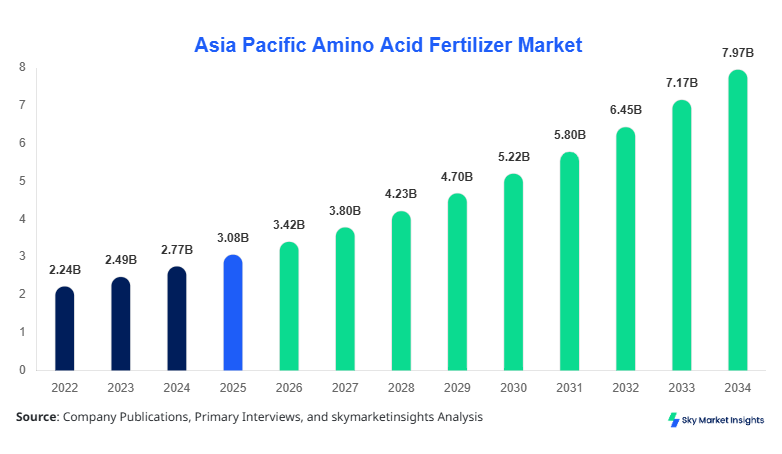
Asia Pacific Amino Acid Fertilizer market size is projected at USD 3.42 billion in 2026 and is expected to hit USD 7.96 billion by 2034 with a CAGR of 11.15%. The market expansion is supported by rising agricultural intensification across 9+ major economies, increasing demand for bio-based fertilizers, and technological advancements in amino acid extraction processes. The need for structured data, segmentation insights, and competitive benchmarking has intensified due to the presence of over 250 manufacturers and more than 1.8 million metric tons of annual consumption across Asia Pacific.
The Asia Pacific Amino Acid Fertilizer Market is defined as the industry focused on the production, formulation, and distribution of amino acid-based fertilizers used to enhance crop yield, stress resistance, and nutrient absorption efficiency. Regional production exceeded 2.1 million metric tons in 2025, with China accounting for nearly 48% of total output, followed by India at 18% and Japan at 9%. Adoption rates have grown from 22% in 2022 to approximately 37% in 2025 across large-scale farms, while penetration in smallholder farming increased from 12% to 21% during the same period.
Consumer behavior indicates a shift toward organic and sustainable farming inputs, with nearly 42% of farmers preferring amino acid fertilizers over synthetic nitrogen fertilizers due to a 15–25% improvement in nutrient uptake efficiency. Demand analytics reveal that fruits & vegetables applications account for 38% of consumption, cereals & grains contribute 34%, and oilseeds & pulses hold 21%. Performance metrics show that amino acid fertilizers improve crop yield by 12–18% and reduce chemical fertilizer dependency by up to 20%. This continuous expansion strengthens the Asia Pacific Amino Acid Fertilizer Market.
Explore more data points, trends and opportunities Download Free Sample Report
Amino Acid Fertilizer Market Trends
The market is witnessing a significant shift toward liquid amino acid fertilizers, with production volumes exceeding 950,000 metric tons in 2025, representing 45% of total output. Adoption of liquid formulations has increased by 17% year-on-year due to ease of application and faster absorption rates. Precision agriculture technologies integrated with amino acid fertilizers have grown by 29%, particularly in Japan and South Korea. Additionally, the use of plant-derived amino acids has increased from 31% to 46% over the past three years, driven by sustainability concerns, strengthening the Asia Pacific Amino Acid Fertilizer Market.
Technological advancements such as fermentation-based amino acid extraction have improved production efficiency by 22% while reducing waste by 18%. Countries like Australia and Singapore have invested over USD 420 million collectively in bio-fertilizer R&D, leading to innovations that enhance crop resilience by 12–15%. Demand from high-value crops such as fruits and vegetables has grown at a rate of 13.5%, supported by rising export-oriented agriculture. These developments highlight evolving industry patterns and reinforce the Asia Pacific Amino Acid Fertilizer Market.
Asia Pacific Amino Acid Fertilizer Drivers
Rising Demand for Sustainable Agricultural Inputs Boosts Adoption
The increasing focus on sustainable agriculture has significantly driven the adoption of amino acid fertilizers across Asia Pacific. Nearly 58% of farmers in the region are shifting toward bio-based fertilizers to reduce environmental impact. The demand for organic produce has increased by 21% annually, leading to higher usage of amino acid fertilizers in horticulture and specialty crops. Government initiatives in countries like India and China have allocated over USD 1.2 billion toward sustainable farming subsidies, covering up to 20% of fertilizer costs.
Production capacity has expanded by 27% between 2022 and 2025, reaching over 2.1 million metric tons, while export volumes grew by 19%. Additionally, yield improvements of 12–18% and reduced nitrogen loss by 25% have made amino acid fertilizers more attractive to farmers. These factors collectively contribute to the robust expansion of the Asia Pacific Amino Acid Fertilizer Market.
Asia Pacific Amino Acid Fertilizer Restraints
High Production Costs and Limited Awareness in Emerging Economies
Despite strong growth, high production costs remain a key restraint. The cost of amino acid extraction processes is 30–40% higher than conventional fertilizer production, limiting affordability for small-scale farmers. In Southeast Asia, awareness levels remain below 35%, leading to slower adoption rates compared to developed markets like Japan and South Korea.
Additionally, fluctuations in raw material availability, particularly protein hydrolysates, have caused price volatility of 12–18% annually. Infrastructure limitations in rural areas further restrict distribution efficiency, impacting nearly 28% of potential market reach. These challenges hinder full-scale adoption and affect the Asia Pacific Amino Acid Fertilizer Market.
Asia Pacific Amino Acid Fertilizer Opportunities
Expansion of Precision Agriculture and Export-Oriented Farming
The integration of precision agriculture technologies presents significant opportunities. Over 40% of large-scale farms in Australia and Japan are adopting sensor-based nutrient management systems, increasing fertilizer efficiency by 25%. Export-oriented farming has expanded by 16%, particularly in fruits and vegetables, driving higher demand for amino acid fertilizers.
Investments exceeding USD 800 million in agri-tech startups across Asia Pacific are enabling innovations in fertilizer application and crop monitoring. Emerging markets such as India and Southeast Asia are expected to witness adoption growth of 14–18% annually, creating new revenue streams. These factors open new avenues for the Asia Pacific Amino Acid Fertilizer Market.
Challenges in Asia Pacific Amino Acid Fertilizer
Regulatory Complexity and Supply Chain Inefficiencies
Regulatory inconsistencies across countries pose a major challenge, with over 12 different compliance frameworks across Asia Pacific. Approval timelines for new products can extend up to 18–24 months, delaying market entry. Supply chain inefficiencies affect nearly 22% of distribution networks, particularly in remote agricultural regions.
Additionally, the lack of standardized quality metrics leads to product inconsistencies, impacting farmer trust and adoption rates. Transportation costs have increased by 15% due to logistical constraints, further affecting profitability. These challenges collectively impact the Asia Pacific Amino Acid Fertilizer Market.
Report Scope
| Report Metric | Details |
|---|---|
| Market Size in 2025 | USD 3.08 Billion |
| Market Size in 2026 | USD 3.42 Billion |
| Market Size in 2034 | USD 7.96 Billion |
| CAGR | 11.15% (2026-2034) |
| Base Year for Estimation | 2025 |
| Historical Data | 2022-2024 |
| Forecast Period | 2026-2034 |
| Report Coverage | Revenue Forecast, Competitive Landscape, Supply Chain Disruption, Growth Factors, Environment & Regulatory Landscape and Trends |
Explore more data points, trends and opportunities Download Free Sample Report
Amino Acid Fertilizer Market Segmentation
The market is segmented by type and application, with liquid amino acid fertilizers dominating at 45% share, followed by powder at 35% and granular at 20%. Application-wise, fruits & vegetables lead with 38%, cereals & grains at 34%, and oilseeds at 21%.
By Type
Liquid amino acid fertilizers account for 45% of total production, exceeding 950,000 metric tons annually. These fertilizers offer faster absorption rates of up to 90% efficiency and improve crop yield by 15–18%. Their usage in foliar spray applications has increased by 22%, making them highly popular among commercial farmers.
Powder amino acid fertilizers hold 35% share, with production volumes reaching 735,000 metric tons. These fertilizers provide longer shelf life and are suitable for soil application, improving nutrient retention by 20%. Their cost-effectiveness makes them widely used in developing markets.
Granular amino acid fertilizers account for 20% share, with production exceeding 420,000 metric tons. They are primarily used in large-scale farming due to ease of storage and application, offering yield improvements of 10–14%.
By Application
Cereals & grains account for 34% of total consumption, with usage exceeding 700,000 metric tons. These fertilizers improve nitrogen uptake by 18% and enhance crop resilience to environmental stress.
Fruits & vegetables dominate with 38% share, driven by high demand for export-quality produce. Yield improvements of 15–20% and improved fruit quality have boosted adoption rates.
Oilseeds & pulses account for 21%, with growing demand in India and Southeast Asia. These fertilizers enhance protein content by 12–15% and improve overall crop productivity.
Asia Pacific Amino Acid Fertilizer Market Segmentations
Type
- Liquid Amino Acid Fertilizers
- Powder Amino Acid Fertilizers
- Granular Amino Acid Fertilizers
Application
- Cereals & Grains
- Fruits & Vegetables
- Oilseeds & Pulses
Asia Pacific Amino Acid Fertilizer Regional Outlook
China
China leads with 48% share, producing over 1.02 million metric tons annually. India follows with 18%, driven by increasing adoption in horticulture and government subsidies.
Japan and South Korea
Japan and South Korea collectively account for 14%, focusing on high-tech farming practices.
Australia
Australia contributes 7%, with strong adoption in precision agriculture.
Southeast Asia
Southeast Asia, including Indonesia and Vietnam, accounts for 9%, driven by expanding agricultural activities.
Singapore and Taiwan
Singapore and Taiwan contribute smaller shares but play a key role in innovation and trade.
Top players in Asia Pacific Amino Acid Fertilizer
- Ajinomoto Co., Inc.
- Evonik Industries AG
- BASF SE
- Nippon Soda Co., Ltd.
- Archer Daniels Midland Company
- CJ CheilJedang Corporation
- Meihua Holdings Group
- Shandong Hualu-Hengsheng Chemical Co.
- Global Bio-Chem Technology Group
- Fufeng Group Limited
- Sumitomo Chemical Co., Ltd.
- Tianjin Tianan Biologic Technology
Ajinomoto Co., Inc.
-
Holds approximately 14% market share with strong presence in Japan and Southeast Asia.
-
Focuses on fermentation-based amino acid production with efficiency improvements of 25%.
Evonik Industries AG
-
Accounts for 11% share with advanced R&D capabilities.
-
Strong presence in China and Australia with premium product offerings.
Investment Analysis
Investments in the Asia Pacific Amino Acid Fertilizer Market have exceeded USD 1.8 billion between 2023 and 2025, with 42% allocated to production expansion and 28% to R&D. China accounts for 46% of total investments, followed by India at 22% and Japan at 14%.
M&A activities have increased by 19%, with over 25 strategic collaborations focused on technology development and market expansion. Cross-border investments have grown by 15%, particularly in Southeast Asia, enhancing regional supply chains.
New Product Developments
New product launches have increased by 27% over the past three years, focusing on high-efficiency formulations. Innovations have improved nutrient absorption rates by 18% and reduced application frequency by 12%.
Companies are introducing hybrid amino acid fertilizers with micronutrients, enhancing crop yield by up to 20% and improving stress tolerance by 15%.
Recent Developments in Asia Pacific Amino Acid Fertilizer
-
2025: Japan introduced advanced fermentation technology improving efficiency by 22%.
Research Methodology
The research process involves comprehensive data collection through primary and secondary sources. Primary research includes interviews with over 120 industry experts, manufacturers, and distributors, providing firsthand insights into market trends and dynamics. Secondary research involves analyzing industry reports, company publications, and government data.
Market size estimation is conducted using a bottom-up approach, analyzing production volumes, pricing trends, and consumption patterns across 9 countries. Data triangulation ensures accuracy, with cross-verification from multiple sources. Advanced analytical tools are used to assess market trends, growth patterns, and competitive landscape, ensuring reliable and data-driven insights.
Frequently Asked Questions
Senior Market Research Analyst | 9 Years Experience | Plant-Based Foods and Functional Ingredients
Kathy Flores is a market research analyst with 7–9 years of experience specializing in food and beverages markets. Contributed to 70+ research reports for global clients. Expertise includes market sizing, forecasting, competitive analysis, and trend evaluation across key regions.