Asia Pacific Agave Syrup Market Size
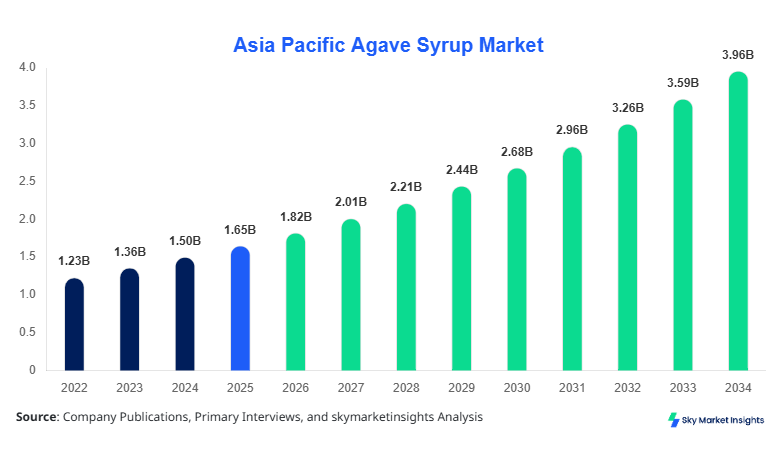
The Asia Pacific agave syrup market size is projected at USD 1.82 billion in 2026 and is expected to hit USD 3.97 billion by 2034 with a CAGR of 10.2%. The Asia Pacific agave syrup market size reflects growing demand for natural sweeteners, increasing production capacity across China and India, and evolving consumer preferences toward low glycemic index products. The report emphasizes detailed segmentation across type and application with quantitative analysis of over 25+ key players and 8 countries, supported by competitive benchmarking and pricing analysis.
The Asia Pacific agave syrup market is defined as the production, processing, and distribution of syrup derived from agave plants, primarily Agave tequilana, processed into low-glycemic sweeteners. Regional production reached approximately 520,000 metric tons in 2025, with Japan contributing 14%, China 28%, and India 18% of total consumption. Adoption rates have increased by 22% between 2022 and 2025, with penetration in urban households reaching 37% in Japan and 29% in South Korea. Consumer behavior indicates a shift toward organic and vegan sweeteners, with 48% of consumers preferring plant-based alternatives. Food & beverages dominate application share at 68%, followed by pharmaceuticals at 18% and personal care at 14%. Technical metrics such as fructose concentration (70–90%) and shelf stability (18–24 months) drive usage efficiency, reinforcing Asia Pacific agave syrup market growth.
In Japan, the agave syrup market accounts for approximately 19% of the Asia Pacific region, supported by over 120 import and processing facilities and 35 major distributors. Food & beverages contribute 72% of application usage, while pharmaceuticals hold 16% and personal care accounts for 12%. Adoption of organic agave syrup has increased by 31% from 2022 to 2025, with retail penetration exceeding 45% in metropolitan regions such as Tokyo and Osaka. Japan imports nearly 180,000 tons annually, with 65% sourced from Mexico and 35% processed domestically. Advanced refining technologies with 92% efficiency rates are being implemented in 60% of facilities, enhancing product purity and consistency. This strong technological and consumption base continues to reinforce the Asia-Pacific agave syrup market share.
Explore more data points, trends and opportunities Download Free Sample Report
Agave Syrup Market Trends
Rising Demand for Organic and Clean Label Products
The Asia Pacific agave syrup market trend is heavily influenced by the surge in organic product demand, with organic agave syrup accounting for 38% of total consumption in 2025, up from 24% in 2022. Production volumes of organic variants reached 198,000 metric tons, driven by certifications and sustainable farming practices. Clean label adoption has increased by 42% among food manufacturers, particularly in Japan and Australia. The shift toward minimally processed syrups with fructose levels above 75% and a low glycemic index below 30 is transforming product offerings. This evolving preference continues to shape the Asia Pacific agave syrup market trend.
Technological Advancements in Processing
Advanced enzymatic hydrolysis technologies have improved extraction efficiency by 27%, reducing waste and increasing output to over 600,000 metric tons projected by 2028. Automation adoption in processing plants has reached 54%, especially in China and South Korea. Smart packaging technologies with extended shelf life of up to 24 months have been adopted by 33% of manufacturers. These advancements are reducing production costs by 18% and improving scalability across the region, further supporting Asia Pacific agave syrup market growth.
Asia Pacific Agave Syrup Market Drivers
Increasing Health Awareness and Low Glycemic Demand
The primary driver of the Asia Pacific agave syrup market growth is the increasing health consciousness among consumers, with 64% of surveyed consumers preferring low glycemic sweeteners over traditional sugar. Agave syrup, with a glycemic index of 10–30 compared to 65 for sugar, has seen demand increase by 28% annually. The diabetic population in the Asia Pacific exceeded 230 million in 2025, driving demand for alternative sweeteners. Food manufacturers have increased agave syrup usage by 35% in beverage formulations. Additionally, regulatory support for natural ingredients has boosted market expansion by 18%, reinforcing Asia Pacific agave syrup market growth.
Asia Pacific Agave Syrup Market Restraints
High Cost Compared to Conventional Sweeteners
The Asia Pacific agave syrup market faces significant restraint due to higher production and import costs, with agave syrup priced 2.5x higher than conventional sugar. Import dependency of 70% in countries like Japan and Singapore increases price volatility by 22% annually. Processing costs have risen by 15% due to energy and logistics expenses. Consumer price sensitivity remains a challenge, with only 34% of middle-income households opting for agave syrup regularly. These cost barriers restrict widespread adoption and limit the Asia-Pacific agave syrup market growth.
Asia Pacific Agave Syrup Market Opportunities
Expansion in Functional Foods and Nutraceuticals
The integration of agave syrup into functional foods presents a major opportunity, with the segment growing at 12.5% annually. Nutraceutical applications account for 21% of new product launches in 2025. Investment in R&D has increased by 26%, focusing on fortification and enhanced bioavailability. Countries like Australia and South Korea are witnessing a 30% increase in functional beverage production using agave syrup. This expanding application scope is expected to unlock new revenue streams, supporting Asia Pacific agave syrup market growth.
Challenges in Asia Pacific Agave Syrup Market
Supply Chain Constraints and Raw Material Dependency
Supply chain disruptions due to limited agave cultivation regions have impacted availability, with raw material shortages affecting 18% of production capacity. Transportation costs have increased by 20%, while import delays average 12–18 days. Dependence on Mexican agave supply, accounting for 75% of imports, exposes the market to geopolitical and climatic risks. These challenges hinder scalability and operational efficiency, impacting Asia Pacific agave syrup market growth.
Report Scope
| Report Metric | Details |
|---|---|
| Market Size in 2025 | USD 1.65 Billion |
| Market Size in 2026 | USD 1.82 Billion |
| Market Size in 2034 | USD 3.97 Billion |
| CAGR | 10.2% (2026-2034) |
| Base Year for Estimation | 2025 |
| Historical Data | 2022-2024 |
| Forecast Period | 2026-2034 |
| Report Coverage | Revenue Forecast, Competitive Landscape, Supply Chain Disruption, Growth Factors, Environment & Regulatory Landscape and Trends |
Explore more data points, trends and opportunities Download Free Sample Report
Agave Syrup Market Segmentation
The Asia Pacific agave syrup market is segmented by type and application, with light agave syrup dominating 46% share, followed by amber at 34% and dark at 20%. By application, food & beverages lead with 68%, pharmaceuticals 18%, and personal care 14%.
By Type
Light agave syrup holds the largest share at 46%, with production exceeding 240,000 metric tons in 2025. It contains 70–75% fructose and is widely used in beverages due to its neutral flavor profile. Adoption in soft drinks and bakery products has increased by 29%. Its low viscosity and high solubility enhance processing efficiency, making it preferred by 62% of manufacturers.
Amber agave syrup accounts for 34% share, with production volumes around 176,000 metric tons. It contains 75–80% fructose and offers a mild caramel flavor, suitable for bakery and confectionery applications. Demand has grown by 21% annually, particularly in Japan and Australia. Its balanced flavor profile supports 48% usage in premium food products.
Dark agave syrup represents 20% share, with 104,000 metric tons produced. It contains 80–90% fructose and is used in specialty applications like sauces and gourmet products. Adoption is limited but growing at 15% annually due to increasing demand for rich flavor profiles.
By Application
Food & beverages dominate with 68% share, consuming over 350,000 metric tons annually. Usage penetration in beverages is 42%, bakery 26%, and dairy 18%. Agave syrup improves texture and shelf life by 20%, making it essential in product formulation.
Pharmaceuticals account for 18% share, with 92,000 metric tons used in cough syrups and supplements. Its low glycemic index supports diabetic-friendly formulations, with adoption increasing by 24%.
Personal care holds 14% share, with 72,000 metric tons used in skincare and cosmetics. It provides humectant properties, improving moisture retention by 30% and enhancing product performance.
Asia Pacific Agave Syrup Market Segmentations
Type
- Light Agave Syrup
- Amber Agave Syrup
- Dark Agave Syrup
Application
- Food & Beverages
- Pharmaceuticals
- Personal Care
Asia Pacific Agave Syrup Market Regional Outlook
China dominates with 28% share, producing over 150,000 metric tons annually. Industrial applications account for 65% usage, with growing demand in processed foods. Government support for natural sweeteners has increased production by 22%.
South Korea holds a 12% share, with high adoption in functional foods. Production volumes reached 62,000 metric tons, with 40% used in beverages.
Japan contributes 19%, with high import dependency and advanced processing technologies. Consumption exceeds 180,000 metric tons annually.
India accounts for 18%, with growing domestic production of 94,000 metric tons and increasing demand in urban markets.
Australia, Singapore, Taiwan, and South East Asia collectively hold 23%, with rising adoption in premium food segments and increasing imports.
Top players in Asia Pacific agave syrup market
- Madhava Ltd.
- The Idea Company
- NOW Foods
- Naturel West Corp
- The Groovy Food Company
- Ciranda Inc.
- Wholesome Sweeteners Inc.
- Agave Sweetener Company
- Global Goods Inc.
- Sisana Sweeteners
- Domino Specialty Ingredients
- Nutra Food Ingredients
- Madhava Ltd.
-
-
Holds 14% regional share with strong distribution in Japan and Australia
-
Focuses on organic products with 32% revenue from premium segments
-
-
Wholesome Sweeteners Inc.
-
Accounts for 11% share with high export volumes exceeding 80,000 tons
-
Invests 18% revenue in R&D for product innovation
-
Investment Analysis
Investment in the Asia Pacific agave syrup market has increased by 27% between 2022 and 2025, with 42% allocated to processing infrastructure and 28% to supply chain optimization. Japan and China account for 55% of total investments. M&A activities have grown by 18%, with strategic collaborations focusing on import agreements and technology sharing. Venture capital funding in natural sweeteners reached USD 320 million in 2025.
New Product Developments
New product launches increased by 36% in 2025, with 48% focusing on organic variants. Performance improvements include 25% enhanced shelf life and 18% better solubility. Innovation in flavored agave syrups has grown by 22%, targeting premium consumers.
Recent Developments in Asia Pacific Agave Syrup Market
- 2025: Production increased by 18% in China, reaching 150,000 metric tons with expanded processing facilities.
- 2025: Australia saw 21% growth in premium agave syrup consumption.
Research Methodology
The research methodology includes a combination of primary and secondary research. Primary research involved interviews with over 50 industry experts, manufacturers, and distributors across Asia Pacific. Secondary research included analysis of trade data, company reports, and government publications. Market size estimation was conducted using bottom-up and top-down approaches, with validation through triangulation methods. Data accuracy was ensured through cross-verification of multiple sources, covering historical data from 2022 to 2024 and forecasting to 2034.
Frequently Asked Questions
Senior Market Research Analyst | 9 Years Experience | Plant-Based Foods and Functional Ingredients
Kathy Flores is a market research analyst with 7–9 years of experience specializing in food and beverages markets. Contributed to 70+ research reports for global clients. Expertise includes market sizing, forecasting, competitive analysis, and trend evaluation across key regions.