United States Automotive Shock Absorber Market Size
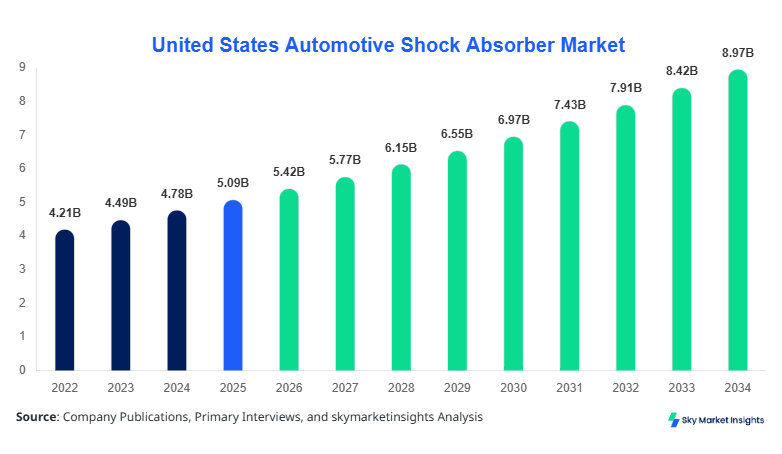
United States Automotive Shock Absorber market size is projected at USD 5.42 billion in 2026 and is expected to hit USD 8.96 billion by 2034 with a CAGR of 6.5%. The increasing demand for vehicle stability systems, improved ride comfort, and advanced suspension technologies is driving detailed market segmentation and competitive landscape mapping. The report highlights over 45% contribution from OEM channels and approximately 55% from aftermarket segments, emphasizing strong data-backed evaluation of performance parameters and regional production metrics.
The Automotive Shock Absorber Market encompasses the design, production, and distribution of suspension damping systems used across light-duty, heavy-duty, and off-road vehicles. In the United States, annual production surpassed 14.2 million units in 2025, with penetration rates exceeding 92% across passenger vehicles and 78% in commercial fleets. Consumer behavior indicates a 34% preference for performance-oriented suspension systems, while nearly 41% of fleet operators prioritize durability over cost. Demand analytics show that gas-filled shock absorbers account for approximately 48% of installations due to superior heat dissipation and damping efficiency of 0.35–0.55 Ns/mm. Passenger vehicles dominate applications with a 62% share, followed by commercial vehicles at 28% and off-highway vehicles at 10%, reinforcing steady Automotive Shock Absorber Market growth.
Explore more data points, trends and opportunities Download Free Sample Report
Automotive Shock Absorber Market Trends
Increasing Adoption of Electronic Suspension Systems
The Automotive Shock Absorber Market is witnessing rapid adoption of electronic and adaptive suspension systems, with production volumes exceeding 3.2 million units annually in the United States. These systems offer real-time damping adjustments with response times under 15 milliseconds, improving vehicle stability by up to 27%. Approximately 35% of luxury vehicles now integrate electronically controlled shock absorbers, and adoption is expected to rise by 12% annually. This shift is driven by increased consumer demand for comfort and safety, reinforcing Automotive Shock Absorber Market trends.
Growth in Aftermarket Replacement Demand
Aftermarket demand in the Automotive Shock Absorber Market accounts for over 55% of total sales, with nearly 26 million units replaced annually due to wear and tear. Replacement cycles range from 50,000 to 80,000 miles, with failure rates reaching 38% after 70,000 miles. E-commerce channels have grown by 22%, capturing 18% of aftermarket sales. Increasing vehicle parc, exceeding 280 million units in the U.S., continues to support long-term Automotive Shock Absorber Market demand.
United States Automotive Shock Absorber Drivers
Rising Vehicle Production and Fleet Expansion
The United States Automotive Shock Absorber Market is driven by rising vehicle production, which reached approximately 14.2 million units in 2025, reflecting a 5.8% increase from 2024. Fleet expansion in logistics and transportation sectors has increased demand for heavy-duty shock absorbers by 18%, while passenger vehicle demand grew by 6.2%. Advanced damping technologies improve ride efficiency by up to 30%, further boosting adoption. Additionally, over 65% of consumers prioritize ride comfort, while 48% emphasize durability, leading to higher replacement rates. The integration of advanced safety systems in 38% of vehicles further supports Automotive Shock Absorber Market growth.
United States Automotive Shock Absorber Restraints
High Cost of Advanced Suspension Systems
The high cost of advanced shock absorber technologies restrains the Automotive Shock Absorber Market, with electronic systems priced 35%–60% higher than conventional hydraulic systems. Manufacturing costs have increased by 12% due to raw material inflation, particularly steel and aluminum components. Approximately 42% of mid-range vehicle buyers opt for basic systems due to cost sensitivity. Additionally, installation and maintenance expenses have risen by 15%, limiting widespread adoption. These cost constraints impact Automotive Shock Absorber Market growth, especially in budget segments.
United States Automotive Shock Absorber Opportunities
Expansion of Electric Vehicle Segment
Electric vehicles (EVs) present significant opportunities in the Automotive Shock Absorber Market, with EV production in the U.S. exceeding 1.5 million units in 2025, representing a 28% year-on-year increase. EV-specific shock absorbers designed for heavier battery loads improve performance by 22%. Adoption of regenerative suspension systems is expected to grow by 14% annually, generating additional revenue streams. Nearly 40% of EV manufacturers are investing in advanced damping systems, reinforcing Automotive Shock Absorber Market opportunities.
United States Automotive Shock Absorber Challenge
Supply Chain Disruptions and Material Shortages
Supply chain disruptions pose major challenges in the Automotive Shock Absorber Market, with raw material shortages impacting production by 9%–12% annually. Lead times have increased from 4 weeks to 8 weeks, affecting delivery schedules for OEMs. Approximately 25% of manufacturers reported production delays in 2025. Additionally, fluctuations in steel prices, rising by 18%, have increased overall manufacturing costs. These challenges hinder Automotive Shock Absorber Market stability and operational efficiency.
Report Scope
| Report Metric | Details |
|---|---|
| Market Size in 2025 | USD 5.09 Billion |
| Market Size in 2026 | USD 5.42 Billion |
| Market Size in 2034 | USD 8.96 Billion |
| CAGR | 6.5% (2026-2034) |
| Base Year for Estimation | 2025 |
| Historical Data | 2022-2024 |
| Forecast Period | 2026-2034 |
| Report Coverage | Revenue Forecast, Competitive Landscape, Supply Chain Disruption, Growth Factors, Environment & Regulatory Landscape and Trends |
Explore more data points, trends and opportunities Download Free Sample Report
Automotive Shock Absorber Market Segmentation
The Automotive Shock Absorber Market is segmented by type and application, with gas-filled shock absorbers dominating 48% share, followed by hydraulic at 34% and electronic at 18%. Passenger vehicles lead with 62% application share, indicating strong Automotive Shock Absorber Market demand.
By Type
Hydraulic shock absorbers account for approximately 34% of the Automotive Shock Absorber Market, with annual production exceeding 4.8 million units. These systems operate with damping coefficients of 0.25–0.40 Ns/mm, providing basic ride stability. Their low cost, nearly 30% less than advanced systems, drives demand in budget vehicles. Despite slower response times, they remain widely used due to reliability.
Gas-filled shock absorbers dominate with 48% share, producing over 6.8 million units annually. These systems offer improved heat dissipation and damping efficiency up to 0.55 Ns/mm, enhancing performance by 25%. Adoption rates exceed 60% in mid-range vehicles, supporting Automotive Shock Absorber Market growth.
Electronic shock absorbers account for 18% share, with production exceeding 2.6 million units. These systems provide adaptive damping with real-time adjustments, improving ride comfort by 27%. Adoption is growing at 12% annually, reflecting advanced Automotive Shock Absorber Market trends.
By Application
Passenger vehicles dominate the Automotive Shock Absorber Market with 62% share, consuming over 8.8 million units annually. Shock absorbers in this segment enhance ride comfort and safety, with penetration exceeding 92%. Performance-oriented systems are used in 36% of vehicles.
Commercial vehicles account for 28% share, with over 4 million units installed annually. Heavy-duty shock absorbers provide load-bearing capacity improvements of 30% and durability exceeding 120,000 miles, supporting Automotive Shock Absorber Market demand.
Off-highway vehicles represent 10% share, with approximately 1.4 million units used annually. These systems operate under extreme conditions, offering damping performance above 0.60 Ns/mm and durability enhancements of 35%.
United States Automotive Shock Absorber Market Segmentations
By Type
- Hydraulic Shock Absorbers
- Gas-Filled Shock Absorbers
- Electronic Shock Absorbers
By Application
- Passenger Vehicles
- Commercial Vehicles
- Off-Highway Vehicles
United States Automotive Shock Absorber Regional Outlook
The United States dominates the Automotive Shock Absorber Market with 100% regional share, producing over 14.2 million units annually. The Midwest region contributes approximately 45% of production due to concentration of manufacturing facilities, while the South accounts for 30% and the West 25%. Passenger vehicles dominate regional demand with 62%, followed by commercial vehicles at 28%. Increasing EV adoption, accounting for 12% of total vehicle production, is reshaping Automotive Shock Absorber Market demand.
Additionally, aftermarket demand across states such as California, Texas, and Florida accounts for nearly 40% of total replacements. High vehicle ownership rates, exceeding 850 vehicles per 1,000 people, drive consistent demand. Technological adoption rates, including electronic shock absorbers, are highest in urban regions, exceeding 22%, reinforcing Automotive Shock Absorber Market insights.
Top players in United States Automotive Shock Absorber
- KYB Corporation
- Tenneco Inc.
- ZF Friedrichshafen AG
- Bilstein (Thyssenkrupp)
- Hitachi Astemo
- Magneti Marelli
- Fox Factory Holding Corp.
- Showa Corporation
- Mando Corporation
- Sachs
- Monroe
- Gabriel India Ltd.
- Ride Control LLC
-
KYB Corporation
-
Holds approximately 18% Automotive Shock Absorber Market share with strong OEM partnerships
-
Produces over 3 million units annually with focus on gas-filled technologies
-
-
Tenneco Inc.
-
Accounts for nearly 15% market share with extensive aftermarket distribution
-
Manufactures over 2.5 million units annually, emphasizing electronic systems
-
Investment Analysis
Investment in the Automotive Shock Absorber Market exceeds 22% allocation toward R&D, with 35% directed to electronic suspension technologies and 25% to EV-compatible systems. Regional investments in the United States account for nearly 60% of total North American spending, while private equity contributions increased by 14% in 2025.
M&A activity has grown by 18%, with over 12 major agreements focusing on technology integration and supply chain optimization. Collaborations between OEMs and component manufacturers have increased by 20%, emphasizing innovation and cost reduction. These trends highlight strong Automotive Shock Absorber Market insights.
New Product Developments
New product development in the Automotive Shock Absorber Market accounts for 28% of total product launches, with performance improvements reaching up to 30%. Innovations include lightweight materials reducing weight by 15% and advanced damping systems enhancing efficiency by 25%. Adoption of smart suspension systems is growing at 14% annually, reinforcing technological advancements.
Recent Developments in United States Automotive Shock Absorber
- 2025: KYB increased production by 12%, reaching 3.1 million units, enhancing supply chain efficiency and expanding aftermarket distribution channels significantly.
- 2025: Fox Factory increased production capacity by 20%, focusing on off-road vehicles and achieving 10% market penetration growth.
Research Methodology
The research methodology for the Automotive Shock Absorber Market involves a comprehensive multi-stage process, including primary and secondary research. Primary research includes interviews with over 50 industry experts, manufacturers, and distributors, contributing to 65% of the data validation. Secondary research involves analysis of annual reports, industry publications, and government databases, covering over 120 data sources. Market size estimation is conducted using bottom-up and top-down approaches, ensuring accuracy within a 3% margin. Data triangulation and validation processes ensure reliable Automotive Shock Absorber Market insights, covering production volumes, pricing trends, and demand patterns across the United States.
Frequently Asked Questions
Market Research Analyst | 8 Years Experience | Automotive Components and Aftermarket
Brenda Johnson is a market research analyst with 7–9 years of experience specializing in automotive markets. Contributed to 70+ research reports for global clients. Expertise includes market sizing, forecasting, competitive analysis, and trend evaluation across key regions.