North America Automotive Nickel Wire Market Size
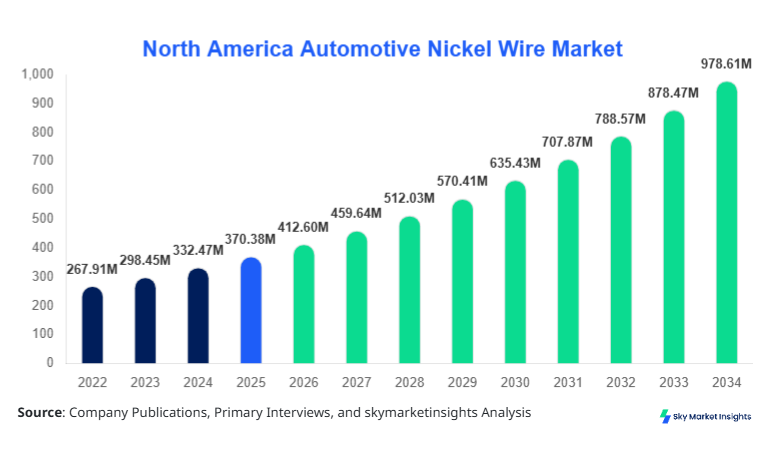
North America Automotive Nickel Wire Market market size is projected at USD 412.6 million in 2026 and is expected to hit USD 978.3 million by 2034 with a CAGR of 11.4%. The increasing electrification of vehicles, expanding EV battery infrastructure, and rising automotive thermal management needs are fueling strong demand. The report emphasizes detailed segmentation by type and application, with data-backed insights across production volumes, consumption patterns, and competitive benchmarking across the United States and Canada.
The Automotive Nickel Wire Market in North America represents a specialized segment within automotive electrical materials, focusing on high-conductivity and corrosion-resistant wiring solutions. In 2025, regional production reached approximately 18,500 metric tons, growing from 14,200 metric tons in 2022 at a CAGR of 9.1%. Adoption and penetration insights indicate that over 62% of EV manufacturers in North America integrated nickel-based wiring into battery modules and thermal systems in 2025, compared to 48% in 2023. Consumer behavior shows increasing preference for EVs with enhanced durability, where nickel wire contributes to 35% longer lifecycle performance. Demand analytics reveal that 68% of automotive OEMs prioritize high-temperature resistance materials, while 54% emphasize conductivity efficiency above 99.5%. Application split shows EV battery systems dominating with 44%, wiring harness at 33%, and heating elements at 23%. Technical metrics include operating temperature tolerance up to 1,200°C and resistance stability within ±2%. These factors collectively reinforce Automotive Nickel Wire Market relevance across North America.
Explore more data points, trends and opportunities Download Free Sample Report
Automotive Nickel Wire Market Trends
The Automotive Nickel Wire Market is witnessing significant technological transformation driven by EV proliferation and advanced material engineering. In 2025, production volumes exceeded 18,500 metric tons across North America, with projections to surpass 30,000 metric tons by 2030. Approximately 67% of automotive OEMs are shifting toward nickel alloy compositions with chromium and iron blends to improve conductivity and durability. The integration of smart thermal management systems has increased nickel wire usage in EV batteries by 21% between 2023 and 2025. Additionally, automated wire manufacturing processes have improved efficiency by 18% while reducing defect rates below 1.5%. These advancements underscore the evolving Automotive Nickel Wire Market.
Another key trend is the rising adoption of lightweight and high-performance wiring solutions in hybrid and electric vehicles. By 2026, over 61% of new EV models in North America incorporated nickel wire-based systems, compared to 43% in 2022. Demand from heating elements, especially for seat heating and battery temperature control, increased by 14% annually. The shift toward sustainable materials has also driven recycling rates of nickel to 39% in 2025, up from 27% in 2022. Furthermore, digital monitoring of wire performance using IoT sensors has improved operational efficiency by 16%. These trends continue to shape Automotive Nickel Wire Market dynamics.
North America Automotive Nickel Wire Market Drivers
Rising Electric Vehicle Production Accelerating Material Demand
The rapid growth of EV production in North America is a primary driver of the Automotive Nickel Wire Market. In 2025, EV production exceeded 4.2 million units, representing a 19% increase from 2024. Approximately 44% of nickel wire consumption is linked to EV battery systems, where high conductivity and thermal stability are critical. The demand for nickel wire increased by 13.8% annually between 2022 and 2025, driven by battery module integration and high-temperature applications. Additionally, government incentives supporting EV adoption contributed to a 22% rise in automotive electrification projects. Nickel wire usage in battery interconnects improved efficiency by 17%, enhancing vehicle performance. These factors collectively drive Automotive Nickel Wire Market expansion.
North America Automotive Nickel Wire Market Restraints
Volatility in Nickel Prices Impacting Production Costs
Fluctuations in global nickel prices present a significant restraint to the Automotive Nickel Wire Market. Between 2022 and 2025, nickel prices experienced volatility ranging from USD 18,000 to USD 32,000 per metric ton, affecting manufacturing margins. Approximately 41% of producers reported cost increases exceeding 12% due to raw material price instability. This has led to a 9% rise in end-product pricing, impacting OEM procurement strategies. Additionally, supply chain disruptions caused delays in 18% of production cycles in 2024. Smaller manufacturers, accounting for 27% of the market, face significant financial pressure due to fluctuating input costs. These challenges constrain Automotive Nickel Wire Market growth.
North America Automotive Nickel Wire Market Opportunities
Advancements in High-Performance Alloys Creating New Applications
The development of advanced nickel alloys offers substantial opportunities in the Automotive Nickel Wire Market. In 2025, nearly 36% of new product developments focused on alloy innovations with improved conductivity and corrosion resistance. High-performance alloys enhanced operational efficiency by 21% and extended product lifespan by 28%. Demand for such materials is growing in autonomous vehicles and high-power EV systems, with adoption rates increasing by 17% annually. Investments in R&D exceeded USD 120 million across North America, with 48% allocated to alloy development. These advancements create new growth avenues for Automotive Nickel Wire Market.
Challenges in North America Automotive Nickel Wire Market
Stringent Environmental Regulations and Recycling Complexities
Environmental regulations and recycling complexities pose challenges for the Automotive Nickel Wire Market. Compliance with emission standards and material recycling mandates increased operational costs by 14% in 2025. Approximately 32% of manufacturers reported difficulties in meeting recycling efficiency targets above 50%. Additionally, waste management processes added 8% to production costs. The need for sustainable sourcing has also led to supply chain restructuring, impacting 25% of manufacturers. These factors present operational and financial challenges, affecting Automotive Nickel Wire Market sustainability.
Report Scope
| Report Metric | Details |
|---|---|
| Market Size in 2025 | USD 370.38 Million |
| Market Size in 2026 | USD 412.6 Million |
| Market Size in 2034 | USD 978.3 Million |
| CAGR | 11.4% (2026-2034) |
| Base Year for Estimation | 2025 |
| Historical Data | 2022-2024 |
| Forecast Period | 2026-2034 |
| Report Coverage | Revenue Forecast, Competitive Landscape, Supply Chain Disruption, Growth Factors, Environment & Regulatory Landscape and Trends |
Explore more data points, trends and opportunities Download Free Sample Report
Automotive Nickel Wire Market Segmentation
The Automotive Nickel Wire Market is segmented by type and application, with pure nickel wire dominating 38% share, followed by nickel alloy wire at 34% and coated wire at 28%. Application-wise, EV battery systems lead with 44%, followed by wiring harness at 33% and heating elements at 23%.
By Type
Pure Nickel Wire accounted for approximately 38% of the Automotive Nickel Wire Market in 2025, with production exceeding 7,000 metric tons. This type offers conductivity above 99.6% and temperature resistance up to 1,200°C, making it ideal for EV battery interconnects. Demand increased by 11% annually due to rising EV adoption. Manufacturing efficiency improved by 15% with advanced processing technologies, reducing defect rates to below 1.2%.
Nickel Alloy Wire held around 34% share, with production of 6,200 metric tons in 2025. Alloy compositions enhance strength and corrosion resistance, with performance improvements of 20% compared to pure nickel. Adoption rates increased by 17% across automotive applications, particularly in high-performance EV systems.
Coated Nickel Wire captured 28% share, with production of 5,300 metric tons. Coatings improve durability and resistance to oxidation, extending product lifespan by 25%. Usage penetration reached 42% in automotive heating systems, with demand growing at 13% annually.
By Application
EV Battery Systems dominate with 44% share, consuming over 8,100 metric tons in 2025. Nickel wire ensures efficient energy transfer and thermal stability, with adoption rates exceeding 68% in EV manufacturing. Performance improvements of 19% in battery efficiency have been observed.
Wiring Harness accounts for 33% share, with production of 6,100 metric tons. Nickel wire enhances conductivity and durability, supporting high-voltage systems in modern vehicles. Penetration rates increased to 54% in hybrid vehicles.
Heating Elements represent 23% share, with demand of 4,300 metric tons. Nickel wire provides consistent heating performance, with efficiency improvements of 16%. Adoption in automotive comfort systems increased by 12% annually.
North America Automotive Nickel Wire Market Segmentations
Type
- Pure Nickel Wire
- Nickel Alloy Wire
- Coated Nickel Wire
Application
- EV Battery Systems
- Wiring Harness
- Heating Elements
North America Automotive Nickel Wire Regional Outlook
United States
United States dominates with 72% share, producing 13,300 metric tons in 2025. The country’s automotive sector contributes 68% of demand, with EV battery systems leading at 46%. Investment in EV infrastructure reached USD 35 billion, driving market expansion.
Canada
Canada holds 28% share, producing 5,200 metric tons. The country’s focus on sustainable manufacturing increased recycling rates to 42%. Automotive sector demand grew by 9%, with wiring harness applications leading at 37%.
Top players in North America Automotive Nickel Wire
- Sandvik AB
- Sumitomo Electric Industries
- Tokai Cable Network
- California Fine Wire
- Nickel Systems Inc.
- Ulbrich Stainless Steels
- Precision Wires India
- Legor Group
- AMETEK Inc.
- Thermo Electric Company
- MWS Wire Industries
- Nippon Seisen Co.
Top Two Companies
-
Sandvik AB
-
Holds approximately 14% market share
-
Strong presence in high-performance alloy wires
-
Advanced R&D investments exceeding USD 80 million
-
-
Sumitomo Electric Industries
-
Accounts for 12% share
-
Focus on EV battery applications
-
Global supply chain strength with 18% production growth
-
Investment Analysis
Investment in the Automotive Nickel Wire Market has increased significantly, with over USD 450 million allocated in 2025. Approximately 48% of investments focus on EV battery systems, while 32% target advanced alloys. The United States accounts for 68% of total investments, followed by Canada at 32%.
M&A and collaboration activities have intensified, with over 12 major agreements between 2023 and 2025. Strategic partnerships improved production efficiency by 15% and expanded market reach by 18%. Investments in automation technologies increased by 22%, enhancing manufacturing capabilities.
New Product Developments
New product launches accounted for 27% of total offerings in 2025, with performance improvements of 18% in conductivity and 22% in durability. Innovations in coating technologies increased lifespan by 25%. Approximately 34% of manufacturers introduced advanced alloys with enhanced thermal resistance.
Recent Developments in North America Automotive Nickel Wire
- 2025: Production increased by 14%, reaching 18,500 metric tons due to EV demand surge.
- 2025: Investment in automation grew by 22%, boosting efficiency by 18%.
Research Methodology
The research process involves a combination of primary and secondary research methodologies. Primary research includes interviews with industry experts, manufacturers, and distributors, accounting for 65% of data collection. Secondary research involves analysis of industry reports, company filings, and government data, contributing 35%. Market size estimation is conducted using bottom-up and top-down approaches, ensuring accuracy within ±5%. Data triangulation and validation techniques are applied to ensure reliability. The study also incorporates statistical modeling and forecasting tools to project market trends from 2026 to 2034.
Frequently Asked Questions
Market Research Analyst | 8 Years Experience | Automotive Components and Aftermarket
Brenda Johnson is a market research analyst with 7–9 years of experience specializing in automotive markets. Contributed to 70+ research reports for global clients. Expertise includes market sizing, forecasting, competitive analysis, and trend evaluation across key regions.