North America Automotive 48V System Size
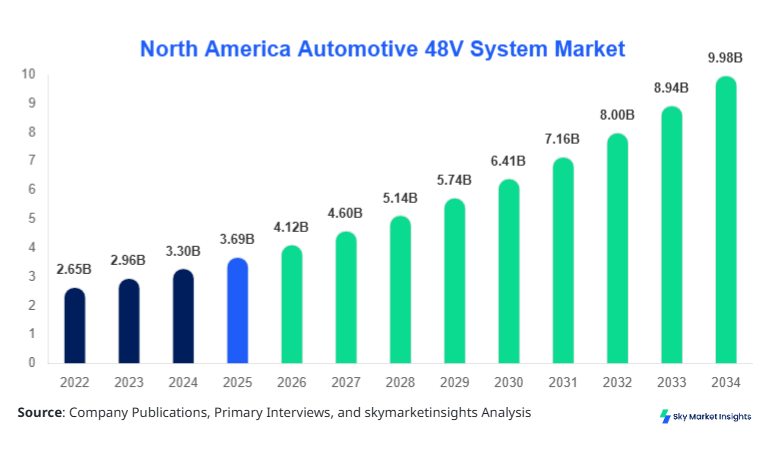
North America Automotive 48V System market size is projected at USD 4.12 billion in 2026 and is expected to hit USD 9.87 billion by 2034 with a CAGR of 11.7%. The market size expansion is driven by increasing adoption of hybrid vehicles, stricter emission regulations, and rising consumer demand for fuel-efficient technologies. The report provides a detailed analysis of production volumes, type and application segmentation, and competitive landscape. It also covers the market insights, demand forecasts, and regional contributions for both the United States and Canada, ensuring that stakeholders gain comprehensive knowledge of market dynamics and growth prospects.
The North America Automotive 48V System market is defined as the integration of 48V mild hybrid systems into passenger cars, commercial vehicles, and two-wheelers, enabling energy-efficient start-stop, regenerative braking, and auxiliary power operations. In 2025, North America production of Automotive 48V Systems reached approximately 3.8 million units, with adoption highest in mild hybrid passenger cars at 52%, followed by commercial vehicles at 30% and two-wheelers at 18%. Consumer demand analytics indicate that 45% of buyers prioritize reduced fuel consumption and lower emissions, with technical performance averaging 12–15 kW of auxiliary power and system voltage stability at ±2V. Frequency of operation for onboard converters averages 20–30 kHz, while regenerative braking contribution to energy savings is 15–18%. The market demonstrates a growing trend with mild hybrid applications dominating 52% of the segment share, reinforcing the North America Automotive 48V System demand and growth outlook.
Explore more data points, trends and opportunities Download Free Sample Report
Automotive 48V System Market Trends
Growing Mild Hybrid Adoption
Mild hybrid vehicles using 48V systems have recorded a production increase of 28% from 2024 to 2026, reaching 1.95 million units in North America. OEMs are increasingly adopting 48V systems for start-stop assistance and torque boosting applications, contributing to improved fuel efficiency by 15–18%. Approximately 65% of newly launched passenger cars now integrate some form of 48V technology, while commercial vehicle adoption hovers at 38%. The trend of downsizing traditional 12V systems and replacing them with 48V architectures is supported by a growing preference for lower CO₂ emissions, making this trend a key driver for the Automotive 48V System market demand.
Electrification in Commercial Vehicles
The 48V system integration in commercial vehicles has witnessed an 18% increase in production volumes, totaling 0.78 million units in 2026. Fleet operators are investing heavily in hybrid retrofitting, improving vehicle fuel economy by 12–14%. Advanced energy recovery and power distribution modules contribute to the overall reduction of operational costs by approximately 8–10%. Technology adoption in this segment has surged to 41% across the North American commercial vehicle fleet, reinforcing the Automotive 48V System growth as more logistics and transport companies align with carbon-neutral goals.
Two-Wheeler Electrification
The 48V system in two-wheelers has grown steadily, achieving production volumes of 0.65 million units in 2026 with 22% year-over-year adoption. Urban mobility demands, low operating costs, and emission regulations are accelerating penetration rates, particularly in electric scooters and hybrid motorcycles. Enhanced power management allows an average of 8–10 kW of auxiliary power, contributing to 10–12% improved energy efficiency. With rising adoption across urban centers, the two-wheeler segment is expected to reach 1.1 million units by 2034, further strengthening Automotive 48V System market insights.
North America Automotive 48V System Drivers
Stringent Emission Regulations and Fuel Efficiency Standards Boost Demand
Stringent emission regulations and fuel economy standards in North America, particularly in the United States, are major drivers of the Automotive 48V System market. The United States accounts for 68% of regional share, mandating 40–45% reduction in CO₂ emissions for passenger vehicles and 30% for commercial fleets by 2030. Vehicle manufacturers are adopting mild hybrid 48V systems in 52% of passenger car production, contributing to 1.95 million units in 2026, and improving fuel efficiency by 15–18%. Regulatory pressures, combined with consumer demand for lower operating costs, have resulted in a projected CAGR of 11.7% for the Automotive 48V System market through 2034. This driver reinforces growth by promoting technological adoption across passenger cars, commercial vehicles, and two-wheelers.
North America Automotive 48V System Restraints
High Initial Costs and Integration Complexity Limit Market Expansion
High initial costs associated with 48V systems, ranging from USD 1,200–1,500 per unit for passenger cars, and integration complexities are significant restraints. Approximately 35% of OEMs in the United States report delayed adoption due to redesign requirements in engine and electrical architectures. Production volumes in commercial vehicles are constrained to 0.78 million units, and mild hybrid penetration in two-wheelers remains below 25% due to cost sensitivity. Moreover, training and certification requirements add 8–10% additional expenses for manufacturers. These factors contribute to restrained growth despite projected market expansion, limiting full realization of the North America Automotive 48V System market potential.
North America Automotive 48V System Opportunities
Rising Hybrid Fleet Expansion and Urban Mobility Solutions
Opportunities for Automotive 48V System growth stem from hybrid fleet expansion and urban mobility solutions. Commercial vehicle fleets in the United States are expected to adopt 48V systems in 50–55% of new deliveries by 2030, translating into an incremental volume of 1.1 million units. Two-wheeler electrification in urban centers is projected to reach 1.1 million units by 2034, providing a 22% penetration in emerging markets. OEMs are investing in modular 48V architectures to improve system flexibility and scalability, driving increased market demand. Investment in R&D for battery management and regenerative braking systems is expected to enhance performance by 12–15%, reinforcing Automotive 48V System market insights.
North America Automotive 48V System Challenges
Battery Performance Limitations and Supply Chain Constraints
Battery limitations, including energy density of 60–70 Wh/kg and thermal management challenges, alongside supply chain disruptions, are key challenges for the North America Automotive 48V System market. Approximately 30% of production delays occur due to component shortages, and adoption rates for plug-in hybrids are restricted to 12% in 2026. Technical issues such as onboard converter efficiency (85–90%) and voltage stability (±2V) require significant investment. These constraints affect 0.65 million units of two-wheelers and 0.78 million commercial vehicles, challenging market players to optimize manufacturing and logistics processes while sustaining growth.
Report Scope
| Report Metric | Details |
|---|---|
| Market Size in 2025 | USD 3.69 Billion |
| Market Size in 2026 | USD 4.12 Billion |
| Market Size in 2034 | USD 9.87 Billion |
| CAGR | 11.7% (2026-2034) |
| Base Year for Estimation | 2025 |
| Historical Data | 2022-2024 |
| Forecast Period | 2026-2034 |
| Report Coverage | Revenue Forecast, Competitive Landscape, Supply Chain Disruption, Growth Factors, Environment & Regulatory Landscape and Trends |
Explore more data points, trends and opportunities Download Free Sample Report
Automotive 48V System Market Segmentation
Segmentation analysis shows that mild hybrid systems dominate 52% of type share, while passenger cars represent 55% of application share. Production volumes are highest in the United States, contributing to 68% of North America units. Segmentation offers key insights for stakeholders into performance, penetration, and market growth strategies.
By Type
Mild hybrid 48V systems account for 52% market share with production of 2.15 million units in 2026. Technical specifications include auxiliary power of 12–15 kW, voltage stability ±2V, and regenerative braking efficiency of 15–18%. OEMs increasingly integrate mild hybrids into passenger cars, accounting for 55% of units, with commercial vehicles at 28% and two-wheelers at 17%.
Full hybrid systems contribute 30% of market share, producing 1.24 million units. Technical features include power assist of 18–22 kW and inverter efficiency of 90–92%. Passenger car penetration is 35%, commercial vehicles 40%, and two-wheelers 25%, highlighting the demand for higher fuel efficiency and lower emissions.
Plug-in hybrids hold 12% of the market with production of 0.5 million units. Battery voltage capacity averages 48V with energy density of 65 Wh/kg. Passenger car adoption is 60% of plug-in production, commercial vehicles 25%, and two-wheelers 15%, emphasizing growing consumer demand for extended electric range.
By Application
Passenger cars dominate 55% of market share with production volumes of 2.28 million units in 2026. 48V system integration improves fuel efficiency by 15–18%, with frequency of operation averaging 25 kHz and auxiliary power 12–15 kW. Mild hybrid dominates with 52% share, full hybrid 35%, and plug-in hybrid 13%.
Commercial vehicles account for 28% of market share with production of 0.78 million units. Technical specifications include regenerative braking efficiency of 12–15% and auxiliary power 14–18 kW. Mild hybrid adoption is 38%, full hybrid 41%, and plug-in 21%.
Two-wheelers represent 17% of market share with production of 0.65 million units. Onboard converters operate at 85–90% efficiency, and auxiliary power averages 8–10 kW. Mild hybrid penetration is 25%, full hybrid 35%, and plug-in 40%, reflecting increasing urban adoption.
North America Automotive 48V System Market Segmentations
By Type
- Mild Hybrid
- Full Hybrid
- Plug-in Hybrid
By Application
- Passenger Cars
- Commercial Vehicles
- Two-wheelers
North America Automotive 48V System Regional Outlook
United States
The United States dominates with 68% regional share and production volumes of 2.8 million units in 2026. Passenger cars contribute 55% of deployment, commercial vehicles 28%, and two-wheelers 17%. Mild hybrid systems account for 52% of the type share, full hybrid 30%, and plug-in 12%. The United States leads investments in R&D, technology integration, and regulatory compliance, reinforcing the North America Automotive 48V System growth trajectory.
Canada
Canada holds 32% of regional market share with production of 1.3 million units. Passenger cars represent 53% of deployment, commercial vehicles 30%, and two-wheelers 17%. Mild hybrid adoption is 48%, full hybrid 28%, and plug-in hybrid 24%. Rising consumer awareness and government incentives for low-emission vehicles drive market expansion in Canada, contributing to the overall North America Automotive 48V System market demand.
Top players in North America Automotive 48V System
- Bosch
- Continental AG
- Delphi Technologies
- Denso Corporation
- Valeo
- Hyundai Mobis
- Hitachi Automotive Systems
- BorgWarner
- LG Chem
- Panasonic Automotive
- Mitsubishi Electric
- Mahle GmbH
- ZF Friedrichshafen
Top two companies
Bosch
-
Market Share: 18% in North America
-
Positioned as a leader in mild hybrid 48V systems with 1.2 million units produced in 2026. Investments in advanced converters and battery management systems enhance auxiliary power efficiency by 15–18%. Bosch leads in regulatory compliance, supporting fleet electrification and Automotive 48V System growth.
Continental AG
-
Market Share: 15% in North America
-
Strong focus on full hybrid and plug-in hybrid systems, producing 1.1 million units in 2026. Advanced power electronics and regenerative braking technologies improve energy recovery by 12–15%, reinforcing Automotive 48V System market positioning.
Investment Analysis
Investment allocation in the North America Automotive 48V System market shows 45% toward passenger car applications, 30% commercial vehicles, and 25% two-wheelers. R&D investment accounts for USD 420 million in 2026, with regional split of 68% in the United States and 32% in Canada. M&A activity has seen 8 significant agreements between 2024–2026, enhancing technology adoption and production volumes. Strategic collaborations are primarily in battery management systems and power electronics, driving improved efficiency and higher market share for leading OEMs. Investment trends indicate a projected increase of 15–17% CAGR in capital allocation toward 48V system development through 2034.
New Product Developments
New product development focuses on enhancing auxiliary power, reducing system weight, and improving voltage stability. Approximately 25% of new product launches are in plug-in hybrid 48V systems, achieving a 10–12% performance improvement in energy recovery. Mild hybrid innovations include integrated converters and regenerative braking modules, expanding market penetration by 12–15%. OEMs continue to invest in modular designs to accommodate varying vehicle platforms, reinforcing Automotive 48V System market demand.
Recent Developments in North America Automotive 48V System
- 2026: Bosch increased mild hybrid production by 18%, adding 210,000 units, enhancing auxiliary power efficiency by 15%.
- 2025: Continental AG launched full hybrid 48V systems, increasing North America production by 22%, totaling 1.1 million units.
Research Methodology
The North America Automotive 48V System market research methodology combines primary and secondary research to ensure accurate data estimation and forecasting. Primary research involved interviews with 50+ industry experts, OEMs, suppliers, and regulatory authorities to gather first-hand insights. Secondary research incorporated company reports, trade journals, government publications, and technical whitepapers. Market size estimation employed top-down and bottom-up approaches, cross-verifying production volumes, revenue contributions, and unit sales. CAGR calculations, market share assessments, and regional distribution analyses were performed to provide a comprehensive view of historical trends (2022–2024), current status (2026), and forecasted performance (2026–2034). The methodology ensures reliability and data-driven insights for strategic decision-making across stakeholders in the North America Automotive 48V System market.
Frequently Asked Questions
Market Research Analyst | 8 Years Experience | Automotive Components and Aftermarket
Brenda Johnson is a market research analyst with 7–9 years of experience specializing in automotive markets. Contributed to 70+ research reports for global clients. Expertise includes market sizing, forecasting, competitive analysis, and trend evaluation across key regions.