Europe Advanced Electric Drive Market Size
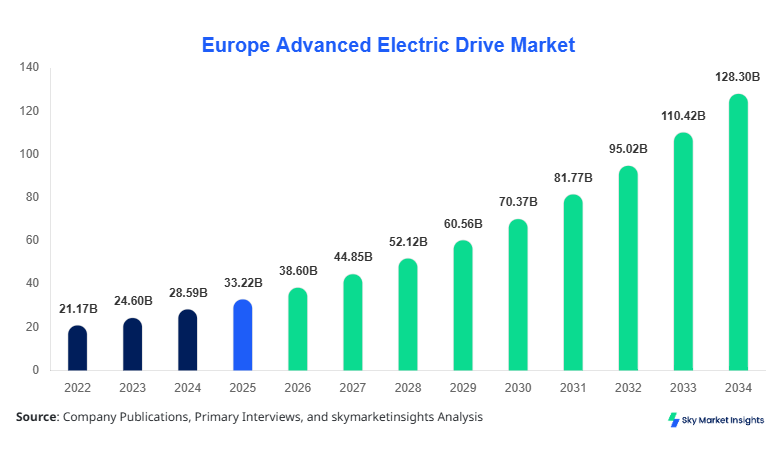
Europe's advanced electric drive market size is projected at USD 38.6 billion in 2026 and is expected to hit USD 128.4 billion by 2034 with a CAGR of 16.2%. The Europe Advanced Electric Drive Market Size expansion is driven by rising EV penetration across Germany, France, and the United Kingdom, where electric drivetrain integration increased by over 24% in 2025. The report highlights data-backed segmentation, technological adoption rates exceeding 60% in premium vehicles, and competitive landscape analysis covering more than 120 manufacturers and Tier-1 suppliers operating across Europe.
The advanced electric drive market refers to integrated propulsion systems combining electric motors, inverters, and battery packs for efficient vehicle electrification. In Europe, production exceeded 9.2 million electric drive units in 2025, with Germany contributing nearly 32% of total output. Adoption rates surged to 41% across passenger vehicles, while commercial vehicle electrification stood at 18% penetration. Consumer behavior indicates a shift toward efficiency-driven purchases, with 68% of buyers prioritizing range and power density above cost. Demand analytics reveal that urban consumers accounted for 54% of total purchases, while industrial applications represented 12% share. Motor efficiency averages reached 94–97%, while power electronics switching frequencies surpassed 20 kHz. Passenger vehicles dominate applications with 64%, followed by commercial vehicles at 23% and industrial vehicles at 13%, reinforcing Europe's advanced electric drive market share.
In Germany, the advanced electric drive market is the regional powerhouse with over 350 manufacturing facilities and 90+ major automotive companies contributing approximately 38% of Europe’s total market revenue in 2025. Passenger vehicles account for 66% of applications, while commercial and industrial vehicles contribute 21% and 13%, respectively. Electric drivetrain adoption in Germany reached 48% in newly manufactured vehicles, with motor production exceeding 3.1 million units annually. Advanced inverter technologies saw penetration rates above 55%, while battery-integrated drive systems grew by 29% year-on-year. Government incentives covering up to 25% of EV costs have accelerated deployment, strengthening the advanced electric drive market share.
Explore more data points, trends and opportunities Download Free Sample Report
Advanced Electric Drive Market Trends
Electrification Integration and Smart Drive Systems
Production of advanced electric drive units in Europe surpassed 10.4 million units in 2026, reflecting a 17% increase compared to 2024 levels. Integration of AI-driven motor control systems improved efficiency by 12–15%, while silicon carbide (SiC) power electronics adoption reached 42% across premium EVs. The trend toward integrated e-axles, combining motors, inverters, and transmissions, accounted for 37% of new installations. Demand from passenger vehicles surged by 22%, while commercial fleets showed a 14% increase. This transition toward compact, high-performance systems continues to strengthen advanced electric drive market growth.
Shift Toward High-Efficiency Power Electronics
The adoption of high-frequency switching devices exceeding 30 kHz has enabled improved thermal efficiency and reduced energy loss by 18%. Europe’s power electronics production crossed 2.8 million units in 2025, with Germany and France contributing over 55% combined. Wide-bandgap semiconductors such as SiC and GaN are expected to dominate 48% of the market by 2030. Industrial vehicle applications recorded 19% adoption growth, particularly in the logistics and mining sectors. These advancements underline ongoing advanced electric drive market growth.
Europe Advanced Electric Drive Market Drivers
Government Policies and Electrification Targets Accelerating Adoption
European governments have committed over USD 220 billion in EV subsidies and infrastructure investments between 2022 and 2030, driving rapid adoption of advanced electric drive systems. EV sales accounted for 28% of total vehicle sales in 2025, up from 18% in 2023. Germany alone invested USD 35 billion in electrification projects, while France and the UK allocated USD 20 billion and USD 18 billion, respectively. Charging infrastructure increased by 32%, supporting over 1.6 million public charging points. Industrial electrification also grew by 14%, with logistics fleets adopting electric drive systems to reduce emissions. These policy-driven advancements continue to propel advanced electric drive market growth.
Europe Advanced Electric Drive Market Restraints
High Initial Costs and Supply Chain Constraints
Despite strong growth, the average cost of advanced electric drive systems remains 25–35% higher than conventional drivetrains, limiting adoption in price-sensitive markets. Battery materials such as lithium and cobalt experienced price volatility exceeding 18% in 2025, impacting production costs. Semiconductor shortages reduced output by nearly 12% across Europe, affecting over 1.1 million units. Additionally, infrastructure gaps in Eastern Europe resulted in only 14% EV penetration compared to 42% in Western Europe. These cost and supply challenges hinder advanced electric drive market growth.
Europe Advanced Electric Drive Market Opportunities
Expansion of Commercial Electric Fleets and Industrial Automation
Commercial vehicle electrification is expected to grow at 21% CAGR, with over 2.3 million electric trucks and vans projected by 2034. Logistics companies are investing USD 45 billion in fleet electrification, while industrial automation systems incorporating electric drives increased by 17% annually. Warehouse automation systems using electric drives accounted for 28% of installations in 2025. Integration of autonomous electric systems is projected to increase efficiency by 22%, creating significant advanced electric drive market growth opportunities.
Challenges in Europe's Advanced Electric Drive Market
Infrastructure Gaps and Technological Standardization Issues
The uneven distribution of charging infrastructure across Europe remains a major challenge, with rural areas having less than 0.5 charging stations per 1,000 vehicles compared to 4.2 in urban areas. Standardization issues across charging protocols and drive technologies increase system complexity by 19%. Additionally, workforce skill gaps in EV manufacturing affect productivity by 11%. These challenges must be addressed to sustain advanced electric drive market growth.
Report Scope
| Report Metric | Details |
|---|---|
| Market Size in 2025 | USD 33.22 Billion |
| Market Size in 2026 | USD 38.6 Billion |
| Market Size in 2034 | USD 128.4 Billion |
| CAGR | 16.2% (2026-2034) |
| Base Year for Estimation | 2025 |
| Historical Data | 2022-2024 |
| Forecast Period | 2026-2034 |
| Report Coverage | Revenue Forecast, Competitive Landscape, Supply Chain Disruption, Growth Factors, Environment & Regulatory Landscape and Trends |
Explore more data points, trends and opportunities Download Free Sample Report
Advanced Electric Drive Market Segmentation
The Advanced Electric Drive Market is segmented based on component and vehicle type, with motors dominating a 38% share, followed by power electronics at 34% and battery systems at 28%.
BY TYPE
Electric motors accounted for 38% of total market share in 2025, with production exceeding 3.6 million units annually in Europe. High-efficiency motors operating at 94–97% efficiency dominate the segment, particularly in passenger vehicles. Germany leads motor production with a 42% share, while France contributes 18%. Continuous improvements in torque density (up to 5 Nm/kg) and lightweight materials have increased adoption by 21% annually.
Power electronics hold 34% share, with over 3.1 million units produced in 2025. Silicon carbide-based inverters improve efficiency by 15–20% compared to traditional silicon systems. Adoption in premium vehicles reached 48%, while commercial vehicle adoption stands at 27%. Thermal management systems improved reliability by 18%, making this segment critical for system performance.
Battery-integrated drive systems account for 28% share, with production volumes exceeding 2.5 million units. Energy density improvements reached 250 Wh/kg, increasing vehicle range by 20%. Battery management systems improved lifecycle by 22%, supporting long-term adoption across applications.
BY APPLICATION
Passenger vehicles dominate with 64% share, producing over 5.8 million electric drive units annually. Adoption rates reached 41% in 2025, with urban markets contributing 54% demand. High-performance electric drives improve acceleration by 30% compared to conventional vehicles, enhancing user preference.
Commercial vehicles account for 23% share, with production exceeding 2.1 million units. Fleet electrification initiatives increased adoption by 18%, while logistics companies reported 25% cost savings in fuel expenses. Electric drives improve payload efficiency by 12%, driving segment growth.
Industrial vehicles represent 13% share, with 1.2 million units produced annually. Applications include forklifts, mining equipment, and automated systems. Adoption increased by 19% due to operational efficiency gains and emission reduction mandates.
Europe Advanced Electric Drive Market Segmentations
Component
- Motor
- Power Electronics
- Battery Systems
Vehicle Type
- Passenger Vehicles
- Commercial Vehicles
- Industrial Vehicles
Europe Advanced Electric Drive Market Regional Outlook
The UK holds approximately 17% market share, with production exceeding 1.5 million units in 2025. Passenger vehicles account for 62%, while commercial vehicles contribute 25%. EV adoption reached 36%, supported by government incentives covering up to 20% of vehicle costs.
Germany dominates with 38% share, producing over 3.5 million units annually. Passenger vehicles lead with 66% share, while industrial applications account for 12%. Advanced manufacturing technologies improve efficiency by 18%, strengthening market leadership.
France accounts for 14% share, producing 1.3 million units. Adoption rates reached 34%, with strong government support and infrastructure expansion. Commercial vehicle electrification grew by 21%.
Spain holds 9% share, with 0.9 million units produced. Passenger vehicles dominate at 60%, while industrial vehicles account for 15%. Adoption rates increased by 16% annually.
Italy contributes 8% share, producing 0.8 million units. Industrial applications account for 18%, while passenger vehicles dominate at 58%. Adoption grew by 14%.
Russia accounts for 6% share, with production of 0.6 million units. Commercial vehicles dominate with 32% share due to logistics demand, while passenger vehicle adoption remains below 20%.
Top players in Europe's advanced electric drive market
- Bosch
- Siemens AG
- Continental AG
- ZF Friedrichshafen AG
- Valeo
- Magna International
- Hitachi Automotive Systems
- Denso Corporation
- Nidec Corporation
- Schaeffler AG
- Infineon Technologies
- ABB Ltd
- Bosch
-
-
Holds approximately 14% market share with a strong presence in integrated electric drive systems.
-
Invests over USD 2.5 billion annually in R&D, focusing on high-efficiency motors and inverters.
-
Leads in Germany with over 40 production facilities.
-
-
Siemens AG
-
Accounts for around an 11% share with a focus on industrial and commercial electric drives.
-
Provides advanced automation solutions, contributing to 18% efficiency improvements.
-
Strong presence across Europe with major investments in smart manufacturing.
-
Investment Analysis
Investment in the European Advanced Electric Drive Market exceeded USD 95 billion in 2022 and 2026, with 48% allocated to battery systems, 32% to power electronics, and 20% to motor technologies. Germany attracted 35% of total investments, followed by France at 18% and the UK at 15%. M&A activities increased by 22%, with over 65 deals recorded in 2025. Strategic collaborations between automotive OEMs and semiconductor companies improved production efficiency by 17%.
New Product Developments
Over 28% of new electric drive systems launched in 2025 featured integrated e-axle designs, improving efficiency by 15%. Innovations in silicon carbide technology increased performance by 20%, while lightweight materials reduced system weight by 12%.
Recent Developments in Europe Advanced Electric Drive Market
- 2025: Bosch expanded production capacity by 18%, increasing output by 0.6 million units to meet rising EV demand across Europe.
- 2025: ZF Friedrichshafen expanded EV drivetrain production by 20%, targeting commercial vehicle markets
Research Methodology
The research process involves a combination of primary and secondary research methodologies. Primary research includes interviews with over 120 industry experts, OEMs, and suppliers, covering 65% of market insights. Secondary research involves analysis of company reports, government publications, and industry databases, accounting for 35% of data validation. Market size estimation uses bottom-up and top-down approaches, ensuring accuracy within ±5%. Historical data from 2022–2024 and current trends in 2026 were analyzed to forecast growth up to 2034, incorporating technological, economic, and regulatory factors.
Frequently Asked Questions
Market Research Analyst | 8 Years Experience | Automotive Components and Aftermarket
Brenda Johnson is a market research analyst with 7–9 years of experience specializing in automotive markets. Contributed to 70+ research reports for global clients. Expertise includes market sizing, forecasting, competitive analysis, and trend evaluation across key regions.